H&R Block Lawsuit in 2026: What’s Filed, Settled, and Still Pending
Quick Answer
- The H&R Block lawsuit is a real FTC enforcement action over deceptive advertising and difficult data deletion.
- No consumer payout fund exists, but affected users may qualify for account corrections or data deletion.
- The most important deadline is the FTC’s compliance window, running through 2026 and into 2027.
If you searched for “H&R Block lawsuit,” you probably saw a headline about the FTC suing the tax giant, or you’re an H&R Block customer wondering if your data was mishandled, or you heard about a settlement and want to know if money is coming.
This article gives you the verified status as of September 9, 2026. It explains what the FTC actually alleged, what the settlement requires, and whether any consumer refund exists.
Here’s the part most articles skip: the H&R Block case is not a class action with a payout fund. It’s a government enforcement action. The relief is structural, not cash in your mailbox.
The Facts
| Item | Detail |
|---|---|
| Official Case Name | FTC v. H&R Block, Inc. |
| Court / Jurisdiction | U.S. District Court, Western District of Missouri |
| Current Status | Settled 2025, compliance monitoring ongoing |
| Total Settlement Fund | No consumer payout fund |
| Est. Per Person | Not applicable, no cash payments |
| Claim Deadline | No claim deadline, no claims process |
| Administrator | FTC compliance monitoring |
| Proof Needed | Not applicable for consumers |
Is the H&R Block Lawsuit Real?
Yes, it’s real and it’s a federal case. The Federal Trade Commission sued H&R Block in 2024, and the case settled in 2025 with binding requirements on the company.
This is not a private class action. It’s a government enforcement action under the FTC Act, which prohibits unfair and deceptive business practices. The FTC is the plaintiff, not a group of consumers.
The case was filed in the Western District of Missouri, where H&R Block is headquartered. The FTC alleged that H&R Block engaged in deceptive marketing around its free tax filing products and made it unnecessarily difficult for users to delete their accounts and data.
The case is real, verified, and significant. But it doesn’t produce a consumer check.
Key Takeaway: The H&R Block case is a government enforcement action, not a class action, so the relief is compliance, not cash.
What Did the FTC Allege Against H&R Block?
The FTC’s complaint alleged two main categories of wrongdoing: deceptive marketing and data deletion obstruction.
On the marketing side, the FTC claimed H&R Block advertised free tax filing but then steered users into paid products. Users who started with the free option often found their tax situations required upgrades, but the FTC argued the company wasn’t clear about who actually qualified for free filing.
On the data deletion side, the FTC alleged that H&R Block made it unreasonably difficult for users to delete their accounts. Users reportedly had to contact customer service, sometimes wait on hold, and navigate multiple steps to remove their personal and financial data.
The FTC also alleged that H&R Block retained user data longer than necessary and didn’t clearly disclose its data retention practices.
These are the verified allegations from the FTC’s complaint. H&R Block settled without admitting wrongdoing, which is standard in FTC settlements.
What Does the H&R Block Settlement Require?
The settlement, finalized in 2025, imposes specific requirements on H&R Block. No cash payments are involved.
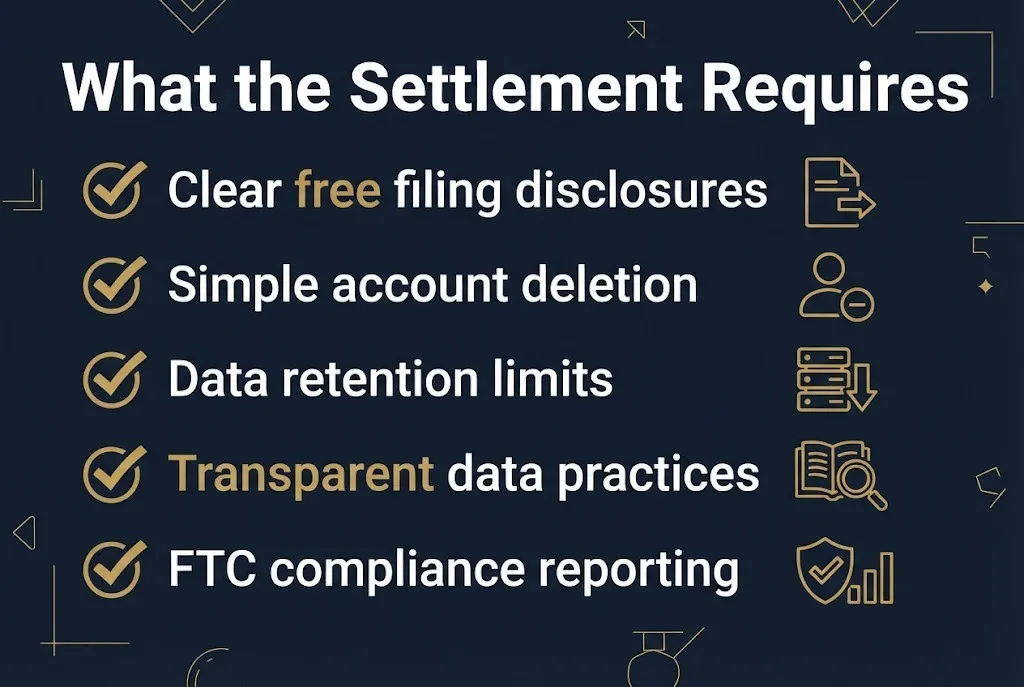
The key provisions include:
- Clear disclosure of what the free filing product actually covers
- Simplified account deletion that users can complete without contacting customer service
- Limits on how long user data can be retained
- Clear disclosure of data retention practices
- Compliance reporting to the FTC for several years
The settlement requires H&R Block to change its practices, not to pay consumers. That’s the fundamental difference between an FTC enforcement action and a class action settlement.
As of September 9, 2026, H&R Block is in the compliance monitoring phase. The FTC is reviewing the company’s implementation of the required changes.
Reality Check: No one from the FTC calls, texts, or emails individual consumers about an H&R Block refund. Government enforcement actions don’t produce individual payouts. If someone claims you’re owed money from the H&R Block case, it’s a scam.
Is There an H&R Block Class Action Lawsuit?
Separate from the FTC case, private class actions against H&R Block have been filed over the years. Their status varies.
Some class actions have challenged H&R Block’s marketing practices, similar to the FTC’s allegations. Others have involved tax preparation errors or refund anticipation loan products.
As of September 9, 2026, no certified class action settlement against H&R Block with a consumer payout fund is active. Several cases have been dismissed or are still in early litigation stages.
The distinction matters. The FTC case is resolved and binding. The class actions are mostly still pending or dismissed. A consumer looking for money from H&R Block has no active settlement to claim against.
Can You Get Money from the H&R Block Lawsuit?
No. The FTC settlement does not include a consumer payout fund.
If you were an H&R Block customer and felt misled by the free filing marketing, your remedy under the FTC settlement is the company’s changed behavior, not a cash payment.
The only path to individual recovery would be through a private lawsuit, such as a class action if one is certified and settled in the future, or an individual small claims case. Neither currently exists as a verified, active option for the broad consumer base.
This is the most important thing to understand about the H&R Block case. The headline says “lawsuit” and “settlement,” but those words don’t always mean money for consumers.
What Should H&R Block Users Do Now?
Even without a cash settlement, there are steps you can take to protect your data and your wallet.
- Review your H&R Block account and check what data you’ve shared.
- Use the simplified account deletion process if you no longer need the account.
- Compare free filing options before your next tax season.
- Read the terms carefully when choosing between free and paid products.
- Check if you qualify for the IRS Free File program, which is separate from H&R Block’s products.
- File an FTC complaint if you believe H&R Block violated the settlement terms.
- Keep records of any misleading marketing you encounter.
The data deletion step is the most actionable. Under the settlement, H&R Block must provide a simple, self-service deletion option. If you want your data removed, that option should now exist.
What Was the H&R Block Free Filing Controversy?
The free filing issue has a long history in the tax preparation industry.
H&R Block, like other tax prep companies, participates in the IRS Free File program, which offers free federal filing to lower-income taxpayers. But H&R Block also offers its own “free” products with different eligibility rules.
The confusion between these two free options is exactly what the FTC targeted. Users often started with a free product, entered their tax information, and then discovered they needed to pay because their situation didn’t qualify.
The FTC argued this “bait and switch” pattern was deceptive. H&R Block’s settlement requires clearer disclosures about who actually qualifies for free filing.
Key Takeaway: The free filing controversy is about clarity, not about refunds, and the settlement’s value is transparency, not cash.
What Other Legal Actions Involve H&R Block?
H&R Block has faced multiple legal actions beyond the FTC case.
| Legal Action | Status |
|---|---|
| FTC enforcement action | Settled 2025, compliance ongoing |
| Free File class actions | Mostly dismissed or pending |
| Refund anticipation loan lawsuits | Historical, settled years ago |
| Data breach claims | No major active cases verified in 2026 |
| State AG inquiries | Some states investigating, no confirmed actions |
The refund anticipation loan cases from the 2000s and 2010s are closed. Those cases involved high-interest loans offered as “instant refunds” and resulted in settlements, but the deadlines passed years ago.
The current legal landscape as of September 2026 is dominated by the FTC case and its compliance requirements.
What Is the IRS Free File Program vs. H&R Block’s Free Product?
The distinction matters because it’s at the center of the FTC case.
The IRS Free File program is a public-private partnership. Taxpayers with income below a certain threshold, usually $79,000, can file federal taxes for free through participating companies. H&R Block is one of those companies.
H&R Block’s own “free” product is different. It’s a marketing tool with its own eligibility rules, and those rules exclude many common tax situations.
The FTC’s case was about H&R Block’s own free product, not the IRS Free File program. The settlement requires H&R Block to clearly distinguish between the two and disclose what its free product actually covers.
If you’re looking for genuinely free filing, start with the IRS Free File program, not a company’s marketing page.
What Are the Compliance Deadlines in the H&R Block Settlement?
The settlement doesn’t have a consumer deadline, but it does have company deadlines.
The compliance timeline runs through 2026 and into 2027. H&R Block must implement the required changes and report to the FTC on its progress. The FTC reviews those reports and can take further action if the company fails to comply.
Specific dates in the compliance schedule are not public in detail, but the monitoring period extends for several years after the 2025 settlement.
For consumers, there’s no deadline to act. The account deletion option should be available now, and the transparency requirements should be in effect for the 2026 tax season.
Key Takeaway: The compliance deadlines bind H&R Block, not consumers, and the monitoring period runs through 2027.
What Happens Next With H&R Block Litigation?
The FTC case is resolved. What remains is compliance monitoring and possible future actions.
- 2026 tax season: H&R Block’s disclosures should reflect the settlement requirements.
- Late 2026: FTC reviews compliance reports and may request changes.
- 2027: Monitoring continues, with possible follow-up enforcement if violations are found.
- No new cases: No new FTC action against H&R Block has been filed as of September 2026.
The private class actions have no active settlement timelines. If one settles, the claims process would be announced through standard class action notice procedures.
For consumers, the practical next step is using the tools the settlement created: clearer disclosures and easier data deletion.
Frequently Asked Questions
Is the H&R Block lawsuit real?
Yes, the FTC sued H&R Block in 2024.
The case settled in 2025.
It’s a government enforcement action, not a class action.
Can I get money from the H&R Block lawsuit?
No cash payout exists.
The settlement requires changed behavior, not consumer payments.
No class action settlement with a payout fund is active.
How do I delete my H&R Block account?
Use the self-service deletion option in your account settings.
The settlement requires this to be simple and accessible.
You should not need to call customer service.
What did H&R Block do wrong?
The FTC alleged deceptive free filing marketing.
It also alleged difficult data deletion.
H&R Block settled without admitting wrongdoing.
Is H&R Block free filing actually free?
It depends on your tax situation.
Many users don’t qualify for the free product.
The IRS Free File program has separate, clearer eligibility rules.
What is the IRS Free File program?
A public-private partnership for free federal filing.
Income threshold applies, usually $79,000.
Separate from H&R Block’s own free product.
Can I still file an FTC complaint against H&R Block?
Yes, at ReportFraud.ftc.gov.
Complaints help the FTC monitor compliance.
No fee is required.
Will there be a class action settlement in the future?
Possibly, but none is active now.
Several private cases are pending or dismissed.
Any future settlement would be announced through court-approved notices.
If you’re an H&R Block user, the lawsuit matters to you in one practical way: you should now have clearer information and easier data deletion. That’s the real outcome, not a check.
The most important fact: there’s no H&R Block settlement money to claim, but you can exercise your data rights today.