Native Shampoo Lawsuit 2026: What the Court Record Actually Shows
Quick Answer
- The native shampoo lawsuit is not an active court case. Attorneys closed the PFAS investigation in May 2025 without filing suit.
- There is no settlement fund, no payout, and no claim form. Not yet determined because no case exists to fund one.
- The related Native deodorant lawsuit, case 1:24-cv-04846, was dismissed by a federal judge on April 9, 2025.
If you searched “native shampoo lawsuit” hoping to find a claim form, here’s the direct answer. No such form exists right now. The lawsuit most people mean when they say this is actually an attorney-led PFAS investigation, and it closed over a year ago without a single court filing.
That matters if you bought Native shampoo, conditioner, or body wash and reported hair loss or scalp irritation. The one number that counts here isn’t a payout. It’s the date May 14, 2025, when ClassAction.org marked the investigation “Investigation Closed.”
This article covers both Native cases people confuse with each other: the shampoo PFAS probe and the separate deodorant lawsuit against Zenlen Inc. One surprising detail: the deodorant case died partly because the plaintiffs’ own legal argument contradicted itself in court filings.
The Facts
| Case | Hernandez et al. v. Zenlen, Inc. (dba Native Cos.), plus a closed PFAS attorney investigation into Native shampoo |
| Status | Deodorant case dismissed April 9, 2025. Shampoo PFAS investigation closed May 14, 2025, no suit filed |
| Fund Size | None. No settlement exists |
| Est. Per Person | Not applicable, there is no fund |
| Claim Deadline | None. There is no claims process to file with |
| Administrator | Not appointed, no settlement was reached |
| Proof Needed | Not applicable right now. If a new case is filed, this section will update |
Is the Native shampoo lawsuit real in 2026?
The shampoo lawsuit isn’t a real, filed court case. It’s a closed attorney investigation.
Attorneys working with ClassAction.org opened the probe around 2022 and reviewed complaints through early 2025. They examined whether Native’s Cucumber & Mint Shampoo and similar hair care lines contained undisclosed PFAS, often called forever chemicals, despite marketing built on words like “naturally derived” and “clean.”
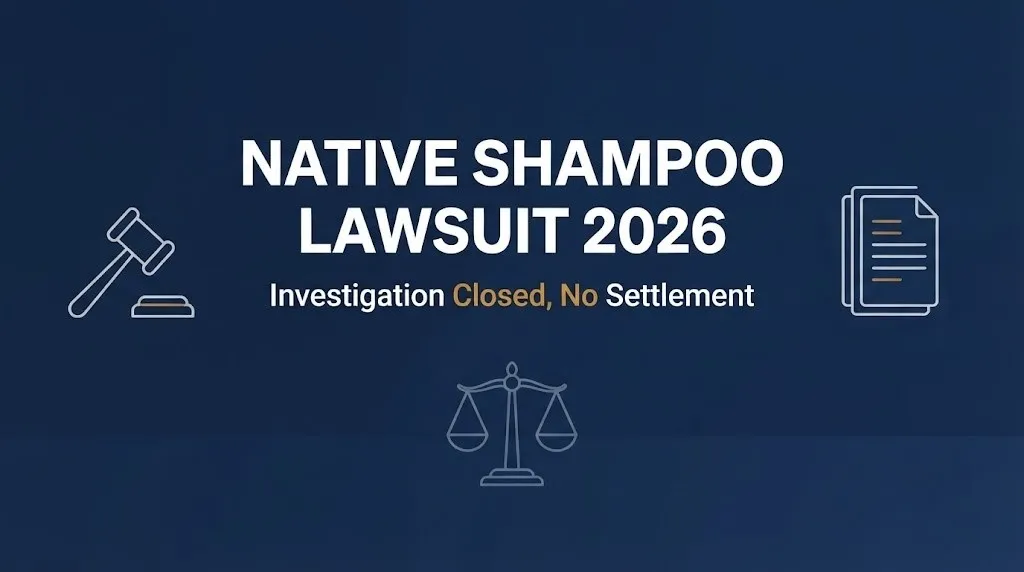
On May 14, 2025, the case page changed to “Investigation Closed.” No complaint was ever filed in federal or state court. That’s the single most misreported fact online right now.
Several competitor articles describe “settlement negotiations underway” or a “certified class.” Court dockets and the ClassAction.org record don’t back that up. Treat those claims as unconfirmed until a real filing surfaces.
Is Native being sued for hair loss?
Not currently. No hair loss lawsuit against Native has been filed in any court as of this writing.
Consumers reported hair shedding and scalp irritation on TikTok and Reddit starting in early 2025. One widely shared post came from a user known as Hailey (@hmsmilezzz), who said she saw visible thinning after switching to Native’s curly hair shampoo.
Attorneys reviewed these reports as part of the same PFAS investigation. They closed it without filing, citing a lack of medical documentation and no lab confirmation tying specific ingredients to hair loss.
That doesn’t mean the complaints aren’t real to the people who experienced them. It means the legal bar for turning social media reports into a court case wasn’t cleared. Think of it like a warranty claim without a receipt: the experience is real, but there’s no paperwork to process it yet.
Key Takeaway: No formal hair loss lawsuit exists against Native as of 2026, even though thousands of consumers reported symptoms online.
How much is the Native shampoo lawsuit settlement worth?
Not yet determined, because no settlement exists. There is no fund, no tier structure, and no per-person estimate to report.
Any number you see attached to this case anywhere else is not sourced to a court record. Settlement math only exists after a case survives filing, certification, and either a verdict or a negotiated agreement.
Here’s what a payout structure would need before any number could be trusted:
| Stage | Required Before a Payout Figure Is Real |
|---|---|
| Filing | A complaint must be filed in a specific court |
| Certification | A judge must certify the class |
| Settlement or verdict | Both sides agree, or a court rules |
| Fund creation | An administrator sets aside actual dollars |
None of these four stages has happened for Native shampoo. Skip past any page that quotes a specific payout figure right now.
Is there a Native shampoo and conditioner lawsuit payout?
No payout exists for shampoo or conditioner purchases at this time. This is the same fund status as the broader PFAS case: zero, because the case never reached settlement.
If you bought Native shampoo, conditioner, or body wash and want to be ready in case a new suit is filed, save your receipts now. Also photograph any packaging showing “naturally derived” or “clean” marketing language.
Reality Check: Nobody will text or email you first about a Native settlement payout, because no settlement exists to pay out from. Filing a real class claim is always free. Any site or message asking for a fee to “process” your Native shampoo claim right now is not connected to a real case.
How do I file a Native shampoo lawsuit claim?
You cannot file a claim right now because there is no open case or claim form. What you can do is prepare documentation in case a new lawsuit is filed.
- Save every Native shampoo, conditioner, or body wash receipt you have.
- Photograph product labels showing “clean,” “naturally derived,” or similar wording.
- Document any hair loss or scalp irritation with dated photos.
- See a dermatologist if symptoms persist and keep those records.
- Check the official ClassAction.org Native page for status changes.
- Watch for a new complaint filing in federal court databases like PACER.
- Avoid paying any third party claiming to file a claim on your behalf.
What proof do you need for a Native products lawsuit?
Proof requirements aren’t set yet because no active case exists to require them. Based on how the closed investigation was evaluated, several proof types were treated as essential.
- Purchase receipts or order history showing you bought a specific Native product.
- Dated photos of hair shedding, scalp irritation, or product packaging.
- Medical records from a dermatologist linking symptoms to product use.
- Independent lab testing showing PFAS presence in the specific product batch.
That last point was the investigation’s biggest gap. Attorneys said no lab testing confirmed high PFAS levels in the products reviewed.
Key Takeaway: Attorneys closed the shampoo investigation mainly because no lab data or medical causation evidence existed, not because complaints stopped coming in.
Native lawsuit update: what happened to the PFAS investigation?
The PFAS investigation into Native shampoo, body wash, and related products closed in May 2025 without a lawsuit. Attorneys reviewed complaints for close to three years before ending the probe.
The investigation covered specific products, including the Cucumber & Mint Shampoo, Coconut & Vanilla Shampoo, Powder & Cotton Body Wash, and Citrus & Herbal Musk Deodorant. Attorneys looked at both PFAS content and the “naturally derived” marketing claim tied to it.
Four gaps closed the case, according to the investigation record:
- No lab testing confirmed high PFAS levels in the products reviewed.
- No named plaintiffs showed documented, medically confirmed harm.
- No evidence proved causation between product use and hair loss.
- Consumer complaints leaned on social media reports, not medical records.
Separately, California’s ban on intentionally added PFAS in cosmetics took effect January 1, 2025. That state law shapes future scrutiny of any personal care brand, Native included, even without an active suit today.
Native deodorant lawsuit status in 2026
The Native deodorant lawsuit is closed. A federal judge dismissed it on April 9, 2025, and it has not been refiled or appealed successfully since.
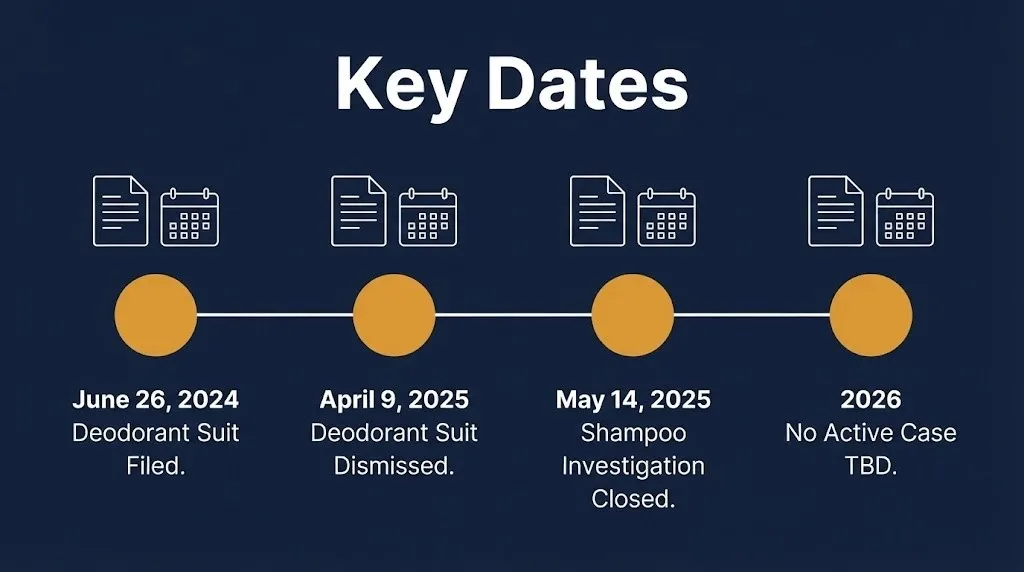
This case, Hernandez et al. v. Zenlen, Inc., ran in the U.S. District Court for the Southern District of New York under case number 1:24-cv-04846. Plaintiffs Ashton Hernandez and Andrew Smyrak filed it on June 26, 2024.
They alleged Native’s Whole Body Deodorant falsely claimed “clinically proven 72-hour odor protection.” Their attorneys, including Denlea & Carton LLP and Kravit Smith LLP, argued the product needed reapplication well before three days passed.
U.S. District Judge Denise L. Cote granted Zenlen’s motion to dismiss. She found no reasonable consumer would read “72-hour odor protection” as a guarantee of three full stink-free days without reapplying. The plaintiffs also ran into a contradiction: they claimed no clinical testing ever occurred, but Zenlen had already produced documentation showing testing had, in fact, taken place.
Native products lawsuit update: what’s next?
Nothing is scheduled right now, because both known Native cases are closed. Any future update would start with a brand-new filing, not a continuation of either past case.
Watch for these possible triggers of a new filing:
| Possible Trigger | Why It Matters |
|---|---|
| New independent lab test results | Could revive PFAS allegations with real data |
| A named plaintiff with medical records | Fixes the causation gap that closed the last probe |
| A state attorney general action | AG offices can act without private plaintiffs |
| New FDA guidance on PFAS in cosmetics | Could raise regulatory pressure on P&G brands |
Until one of those happens, “Native products lawsuit update” searches will keep returning the same closed status you’re reading here.
Key Takeaway: Both known Native legal actions, the deodorant suit and the shampoo PFAS probe, are closed as of mid-2026 with no active claims process.
What is the Native soap lawsuit about?
There isn’t a separate “Native soap lawsuit.” Native’s soap and body wash products were folded into the same closed PFAS investigation as its shampoo line.
The investigation specifically named Powder & Cotton Body Wash among the products reviewed. Body wash and bar soap complaints followed the same pattern as shampoo complaints: skin irritation and questions about “clean” labeling.
Since the whole investigation closed in May 2025 without filing, soap and body wash purchases carry the same status as shampoo purchases. No claim exists to file for any of these product lines right now.
What is the Native hair care lawsuit alleging?
The Native hair care lawsuit, more accurately called an investigation, alleged the brand’s marketing didn’t match its actual formulas. Specifically, it questioned undisclosed PFAS chemicals in products marketed as chemical-free.
Native built its identity on simplicity: coconut oil, shea butter, and a short ingredient list. Consumers paid a premium expecting a genuinely clean formula.
The gap between that promise and what independent reviewers could verify is the core of every Native-related complaint, whether it’s about shampoo, soap, or deodorant. So far, that gap hasn’t produced a filed case with legal teeth behind it.
Who is Zenlen Inc and how is it connected to P&G?
Zenlen, Inc. is the operating company behind the Native brand, doing business as Native Cos. Procter & Gamble acquired Native in 2017, reportedly for around $100 million.
That acquisition ended Native’s run as an independent startup. Production and legal responsibility now sit under a much larger corporate structure, with P&G named alongside Zenlen in some complaints.
Court filings in the deodorant case list Zenlen, Inc. as the defendant. That’s the legal name you’ll see on any future Native filing too, even though most consumers just know the brand as “Native.”
Native brand lawsuit: full case history
Two separate legal actions make up everything verified about Native as of 2026. Confusing them is the single biggest source of bad information online.
| Case | Filed | Outcome |
|---|---|---|
| Hernandez et al. v. Zenlen, Inc. (deodorant, 72-hour claim) | June 26, 2024 | Dismissed April 9, 2025 |
| PFAS/hair loss investigation (shampoo, body wash) | Opened around 2022 | Closed May 14, 2025, no suit filed |
| National Advertising Division review (SC Johnson vs. Native ad claims) | June 2024 | Ad industry self-regulation, not a lawsuit |
A separate, smaller item worth knowing: SC Johnson, maker of Method products, challenged some of Native’s advertising through the National Advertising Division in June 2024. That’s a self-regulatory ad review, similar to an industry referee, not a court case and not connected to any consumer payout.
What are PFAS and why do they matter in the Native lawsuit?
PFAS are a class of synthetic chemicals nicknamed “forever chemicals” because they resist breaking down in the environment and the body. They’ve been used in consumer products since the 1950s.
Regulators and researchers have linked long-term PFAS exposure to a range of health concerns, which is why their presence in personal care products draws scrutiny. In the Native investigation, the question was whether PFAS showed up in products marketed as “naturally derived.”
Attorneys said no testing confirmed high PFAS levels in the specific Native products reviewed. That finding, more than anything else, is why the investigation closed without a filed complaint.
What Happens Next
- Closed, April 9, 2025: Native deodorant lawsuit dismissed by Judge Denise Cote in the Southern District of New York.
- Closed, May 14, 2025: PFAS/hair loss investigation into Native shampoo and body wash ended without a filed suit.
- Ongoing: Consumer complaints continue on social media, without a legal case attached.
- Expected, ongoing 2026: Any new lab testing, named plaintiff, or state AG action could restart the process from scratch.
- Not scheduled: No claims process, deadline, or payout, because no active case exists.
Frequently Asked Questions
Is the Native shampoo lawsuit a scam?
The lawsuit itself isn’t a scam, it’s a closed attorney investigation that never became a court case.
Be cautious of any site or message claiming you can file a claim or get paid right now.
No legitimate settlement currently exists for Native shampoo.
Can I still sue Native for hair loss?
You can generally still pursue an individual claim if you have documented harm and medical records.
A closed class investigation doesn’t block you from consulting your own attorney about an individual case.
This article reports news, it isn’t legal advice.
Did Native lose the deodorant lawsuit?
No, Native (Zenlen, Inc.) won. The case was dismissed in its favor on April 9, 2025.
The judge found the “72-hour odor protection” claim wasn’t misleading to a reasonable consumer.
Plaintiffs did not successfully appeal the dismissal.
Is there a Native settlement check being mailed in 2026?
No. There is no settlement, so there are no checks being mailed to anyone.
Any message claiming otherwise about Native shampoo, soap, or deodorant is not connected to a verified case.
Treat unsolicited settlement texts or emails about Native as unverified.
What products were part of the PFAS investigation?
The investigation named Cucumber & Mint Shampoo, Coconut & Vanilla Shampoo, Powder & Cotton Body Wash, and Citrus & Herbal Musk Deodorant.
It closed in May 2025 without confirming high PFAS levels in these items.
Other Native product lines were not specifically named in the closed probe.
Why did the Native shampoo investigation close without a lawsuit?
Attorneys said no lab testing confirmed high PFAS levels and no plaintiff had documented, medically linked harm.
Social media reports of hair loss weren’t enough on their own to support a filed complaint.
That gap in evidence is the main reason the case never reached court.
Does California’s PFAS cosmetics ban affect Native right now?
California’s ban on intentionally added PFAS in cosmetics took effect January 1, 2025, and applies going forward.
It doesn’t create a retroactive claim for past Native purchases by itself.
It does raise the bar for future PFAS scrutiny across the entire beauty industry.
Should I stop using Native shampoo because of this?
That’s a personal and medical decision, and this article isn’t offering medical advice.
If you’re experiencing irritation or hair loss, a dermatologist can help you evaluate the cause.
No confirmed lawsuit finding currently requires anyone to stop using the product.
Nothing about the Native shampoo lawsuit requires action from you right now, because no claim process exists. Keep receipts and photos if you experienced symptoms, in case a new case is filed later.
The date to remember is May 14, 2025, when the last known Native shampoo investigation officially closed.