Nintendo Lawsuit in 2026: Active Cases, Settlements, and What Gamers Should Know
Quick Answer
- Nintendo has faced several lawsuits, including patent disputes and consumer class actions.
- No major Nintendo settlement is open for consumer claims in 2026.
- Most Nintendo lawsuits are company-to-company disputes, not consumer payout cases.
Nintendo is one of the most litigious companies in gaming. It sues and gets sued regularly. If you searched for a Nintendo lawsuit, you may have seen headlines about Joy-Con drift, eShop closures, or patent fights. The key question: is there money for you?
The answer in 2026 is no. No Nintendo class action settlement is currently paying consumers. Some older cases closed. Others are still in court. None are at the claim stage.
This guide breaks down the major Nintendo lawsuits, what they mean for gamers, and how to spot a fake settlement notice. One surprising fact: Nintendo wins most of its patent cases, but it has paid out in consumer cases before.
The Facts
| Item | Detail |
|---|---|
| Case | Multiple active and closed lawsuits |
| Status | Varies, no open consumer settlement |
| Fund Size | Case-specific, none currently open |
| Est. Per Person | Not applicable for most cases |
| Claim Deadline | None currently active |
| Administrator | None currently appointed |
| Proof Needed | Varies by case, none needed now |
Is There a Nintendo Class Action Lawsuit?
Yes, Nintendo has faced class action lawsuits. The most famous recent one involved Joy-Con drift. That case alleged that the controllers were defective because the joysticks drifted without user input.
The Joy-Con drift class action was filed in federal court. Parents and gamers claimed Nintendo sold a defective product and failed to fix it. Nintendo denied the defect and pointed to its free repair program.
No nationwide Joy-Con settlement has produced a consumer payout in 2026. The case has faced procedural hurdles. Courts have sometimes ruled that arbitration clauses in Nintendo’s user agreements block class actions.
Other Nintendo class actions have involved the eShop, digital purchases, and subscription auto-renewal. None are currently accepting claims.
Key Takeaway: Nintendo has faced class actions, but no consumer settlement is open for claims right now.
What Is the Nintendo Joy-Con Drift Lawsuit?
The Nintendo Joy-Con drift lawsuit is a consumer class action over defective controllers. The joystick registers movement even when the player is not touching it. That is the drift.
The lawsuit claims the defect is widespread and that Nintendo knew about it. The plaintiffs allege violations of consumer protection laws and warranty laws. They seek refunds, repairs, and damages.
Nintendo has offered free Joy-Con repairs in North America and other regions. That program does not require proof of purchase in some cases. The company says the repair program fixes the problem.
The legal question is whether the repair program is enough. The plaintiffs say it is not, because the repairs often fail and the defect returns. The court has not issued a final ruling that leads to a payout.
How Much Could I Get from a Nintendo Lawsuit?
You cannot get any money from a Nintendo lawsuit in 2026 because no consumer settlement is open. If a future settlement happens, payouts would depend on the case.
For a Joy-Con drift settlement, a typical outcome might be a free repair or a partial refund. A class action over a $70 controller might pay $10 to $40 per claim. A digital purchase case might pay a small voucher.
Here is a hypothetical payout table if a Joy-Con settlement is approved:
| Claim Type | Possible Payout |
|---|---|
| Repair already paid | Full repair cost refund |
| Controller replaced | $20 to $40 |
| No repair, still owning controller | Free repair or $20 |
| Multiple affected controllers | $30 to $80 |
These numbers are not confirmed. They are estimates based on similar consumer electronics cases. Nothing is payable until a court approves a settlement.
Can I Join a Nintendo Class Action Lawsuit?
No, you cannot join a Nintendo class action lawsuit right now because no case is accepting consumer claims. You cannot sign up for a future settlement. You can only wait for official notice.
If a Nintendo class action settles, potential class members will receive notice by email or postcard. The notice will include a claim deadline and a website. Filing a claim is free.
In the meantime, keep any receipts for Nintendo products you bought. If you paid for a Joy-Con repair, save that receipt too. Proof of purchase strengthens your claim later.
Here is what you can do now:
- Save receipts for Nintendo consoles and controllers.
- Save repair invoices if you paid for a fix.
- Check the official court docket for case updates.
- Do not pay anyone to register you for a lawsuit.
- Wait for official notice from a claims administrator.
Key Takeaway: No Nintendo consumer settlement is open. Save your receipts and wait.
What Patent Lawsuits Is Nintendo Involved In?
Nintendo is involved in patent disputes with other companies. These are company-to-company cases. They do not involve consumer payouts.
Nintendo has sued companies for patent infringement related to game mechanics, controller design, and software features. It has also been sued by patent holders who claim Nintendo used their technology without permission.
Patent cases are technical and slow. They can take years. The damages, if any, go to the companies, not to gamers. You will not get a check from a Nintendo patent case.
These cases matter because they can affect product availability. If Nintendo loses a patent case, it might have to change software or pay royalties. That is a business problem, not a consumer claim.
What Is the Nintendo eShop Lawsuit?
The Nintendo eShop lawsuit involved claims about digital purchases and account restrictions. Some consumers argued that Nintendo’s policies were unfair to buyers of digital games.
The case raised questions about whether you own digital games or just license them. That legal question affects all digital storefronts, not just Nintendo.
No eShop settlement is open for claims in 2026. The case may still be pending or may have been dismissed. The legal issue of digital ownership remains unresolved across the industry.
If you bought digital games on the eShop, you do not have an automatic claim. Class membership is determined by the court, not by your purchase alone.
What Is the Nintendo Switch Online Lawsuit?
Some lawsuits have challenged Nintendo Switch Online’s auto-renewal practices. The claim is that consumers were charged without adequate consent or notice.
Auto-renewal class actions are common. Many companies face them. The typical outcome is a small refund for affected subscribers or a change in the company’s disclosure practices.
No Nintendo Switch Online settlement is paying claims in 2026. If you were charged for a subscription you did not want, you can contact Nintendo support for a refund. That is a customer service issue, not a lawsuit payout.
Reality Check
No legitimate Nintendo settlement is sending text messages or emails asking for your bank details to release a payment. If you see a message claiming you won a Nintendo lawsuit payout, it is a scam. Real class action notices come from court-appointed administrators and never ask for payment.
Has Nintendo Ever Paid a Consumer Settlement?
Yes, Nintendo has paid consumer settlements in the past, though they are less common than patent wins. The company settles when the cost of litigation outweighs the risk of a bad verdict.
Past settlements have involved warranty issues and product defects. The amounts were modest. Consumers typically received repairs, small refunds, or vouchers.
Nintendo is not known for large consumer payouts. The company prefers to fight cases or resolve them on its own terms. Its arbitration clauses often block class actions before they reach settlement.
If you are hoping for a big Nintendo payout, adjust your expectations. The company’s legal strategy is aggressive. Consumer class actions face an uphill battle in court.
How Does Nintendo Handle Lawsuits?
Nintendo handles lawsuits aggressively. It has a dedicated legal team. It files lawsuits to protect its intellectual property. It fights consumer cases with motions to dismiss and arbitration clauses.
Nintendo rarely settles quickly. The company believes its legal positions are strong. It is willing to spend money on lawyers to avoid setting a precedent that invites more lawsuits.
For consumers, that means patience. A Nintendo class action can take years. Many are dismissed before they reach the class certification stage. A few survive and eventually settle.
The company’s user agreements often include arbitration clauses. Those clauses require disputes to be resolved individually, not as a class. Courts have sometimes enforced those clauses, killing class actions.
What Nintendo Lawsuits Are Active in 2026?
Several Nintendo lawsuits are active in 2026, but most are not consumer cases. They involve patent disputes, licensing disagreements, and business conflicts.
The consumer-facing cases, like Joy-Con drift, continue to work through the courts. No settlement has been announced. No claim deadline has been set.
The best source for active case information is the federal court docket. You can search for Nintendo as a party. The docket shows case names, filing dates, and major rulings.
Legal news outlets also cover Nintendo’s significant cases. They provide plain-language updates for people who do not want to read court filings.
What Should I Do If I Have a Nintendo Product Defect?
If you have a Nintendo product defect, contact Nintendo support directly. Do not wait for a lawsuit. The company’s repair program may fix your problem now.
For Joy-Con drift, Nintendo has offered free repairs in the past. The program may still be active in some regions. Contact support with your console serial number and describe the issue.
For other defects, the standard warranty applies. New Nintendo hardware typically comes with a one-year warranty. Keep your receipt. The warranty process is faster than any lawsuit.
If Nintendo refuses to help, you may have individual legal options. Small claims court is available for small disputes. An attorney can advise you on whether a claim is worth pursuing.
Key Takeaway: Contact Nintendo support first. A lawsuit is a last resort, not a first step.
What Happens Next: Nintendo Lawsuit Timeline for 2026 and Beyond
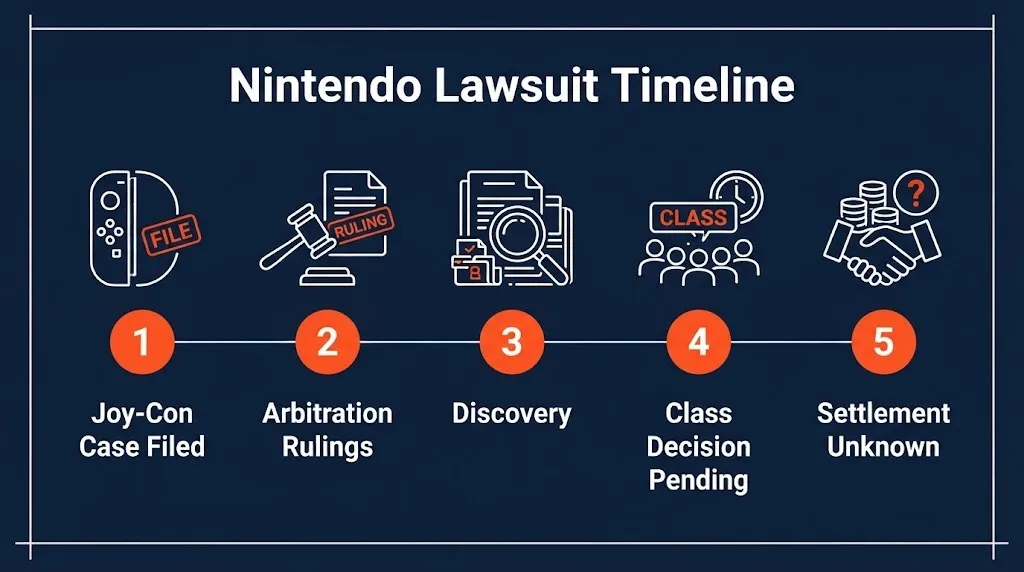
- September 2026: Active patent cases continue through discovery and motion practice.
- Late 2026: Possible rulings on pending motions in the Joy-Con drift litigation.
- Early 2027: Court may decide whether any consumer class can proceed despite arbitration clauses.
- Mid 2027: If a class survives, settlement talks could begin.
- Late 2027 or beyond: Any approved settlement would set a claim deadline and payout process.
Frequently Asked Questions
Is there a Nintendo lawsuit I can join?
No Nintendo consumer settlement is open for claims in 2026.
What was the Joy-Con drift lawsuit about?
It alleged that Nintendo sold controllers with defective joysticks that drifted without input.
Will I get money from Nintendo?
No money is being paid to consumers from any Nintendo settlement right now.
How do I report a Joy-Con defect?
Contact Nintendo support directly through the official website or phone line.
Can I sue Nintendo in small claims court?
You may be able to, depending on your state’s rules and Nintendo’s arbitration clause.
What is Nintendo being sued for in 2026?
Most active cases are patent and business disputes, not consumer class actions.
Do I need a receipt for a future Nintendo claim?
If a settlement opens, a receipt will strengthen your claim, but requirements are not yet set.
Is Nintendo a litigious company?
Yes, Nintendo actively files and defends lawsuits to protect its products and business.
Closing
Nintendo is no stranger to lawsuits, but no consumer settlement is open in 2026. The Joy-Con drift case continues, but no claims are being accepted.
The smart move is to document any defect, contact Nintendo support, and save your receipts. If a settlement ever opens, you will get official notice. Until then, ignore anyone asking for money to join a Nintendo lawsuit.