Nintendo Switch Piracy Lawsuit 2026: What’s Real, What’s Not
Quick Answer
- Real litigation: Nintendo has filed and won multiple confirmed piracy lawsuits against device sellers and emulator makers.
- No consumer payout exists: these are copyright cases against sellers, not a class action settlement for Switch owners.
- No deadline applies to ordinary owners, since there’s no claims process for consumers to join.
If you’re searching “Nintendo Switch piracy lawsuit,” here’s the direct answer: it’s real litigation, but it’s Nintendo suing piracy device sellers, not a settlement that pays consumers.
This matters if you’ve seen headlines about huge damage figures and wondered whether it applies to you. Nintendo won a confirmed $2 million judgment against one flashcart seller in September 2025, and its broader anti-piracy campaign continues into 2026.
This article separates confirmed court outcomes from the vaguer claims circulating on other sites, and tells you plainly whether ordinary Switch owners face any real risk. One detail worth knowing upfront: several competing articles cite large 2026 damage figures without a named defendant or case number, and we flag those clearly below rather than repeating them as fact.
The Facts
| Case | Multiple separate Nintendo copyright and DMCA lawsuits, not one consolidated case |
| Status | Active enforcement campaign, with the Ryan Daly (MIG Switch) case resolved in September 2025 |
| Fund Size | Not applicable, these are copyright infringement suits, not a consumer settlement fund |
| Est. Per Person | Not applicable, no payout exists for Switch owners in any confirmed case |
| Claim Deadline | Not applicable, there is no claims process for consumers to join |
| Administrator | Not applicable |
| Proof Needed | Not applicable, these lawsuits target commercial sellers, not the general public |
Is the Nintendo Switch piracy lawsuit real?
Yes, several confirmed federal lawsuits exist, filed by Nintendo of America against people and companies selling piracy hardware or hosting pirated Switch games.
The most concrete, court-confirmed example is Nintendo’s case against Ryan Daly, a Michigan resident who sold the MIG Switch flashcart and pre-modded consoles through his website, Modded Hardware. That case reached a resolution in September 2025, with a court-confirmed $2 million judgment against Daly.
Nintendo has also pursued other confirmed cases, including a 2024 lawsuit against Tropic Haze LLC, developer of the Yuzu Switch emulator, which settled for $2.4 million almost immediately after filing.
Key confirmed facts:
- Ryan Daly / Modded Hardware / MIG Switch case: $2 million judgment, September 2025
- Tropic Haze LLC / Yuzu emulator case: $2.4 million settlement, 2024
- Gary Bowser / Team Xecuter case: $14.5 million civil judgment, plus a separate criminal conviction
Is there a Nintendo Switch piracy settlement you can join?
No. There is no consumer settlement fund, claim form, or payout process tied to any Nintendo Switch piracy lawsuit.
This is the most important correction in this entire article. These are copyright infringement and DMCA anti-circumvention cases, where Nintendo is the plaintiff suing sellers and developers, not a consumer class action where Switch owners could file a claim.
If you’ve seen a message or website suggesting Switch owners can get paid through a “Nintendo piracy settlement,” that claim doesn’t match any confirmed court record we could find.
What these lawsuits are, and are not:
- They ARE copyright and DMCA cases Nintendo filed against commercial sellers.
- They ARE NOT class actions where consumers can file a claim.
- There IS NOT a settlement fund for Switch owners in any confirmed case.
- There IS NOT a deadline for consumers to do anything, since no consumer process exists.
How much money has Nintendo won in Switch piracy lawsuits?
Nintendo has won or settled for several confirmed dollar amounts across separate cases, ranging from $2 million to $14.5 million depending on the defendant.
None of this money goes to consumers. These are damages awarded to Nintendo itself, based on copyright infringement and DMCA violations tied to selling circumvention devices or pirated software.
| Case | Defendant | Confirmed Amount | Status |
|---|---|---|---|
| MIG Switch / Modded Hardware | Ryan Daly | $2 million | Resolved, September 2025 |
| Yuzu emulator | Tropic Haze LLC | $2.4 million | Settled, 2024 |
| Team Xecuter | Gary Bowser | $14.5 million (civil) | Judgment entered, plus separate criminal sentence |
We also found reporting that Nintendo is seeking $4.5 million in a separate case against a defendant identified in filings as “Archbox,” described as operating multiple piracy sites. We could not independently confirm the current status or outcome of that specific case, so treat it as pending rather than resolved.
Could you personally be sued for Nintendo Switch piracy?
If you’re an ordinary Switch owner using a modded console or watching pirated content for personal use, Nintendo has not pursued lawsuits against individual consumers in that category based on available records.
Nintendo’s documented enforcement pattern targets commercial actors specifically: people who sell circumvention devices, distribute pirated games at scale, or develop emulation software. The company has not filed suits against private individuals simply for personal-use modding.
Reality Check: No legitimate Nintendo lawsuit works by sending consumers a text or email demanding an immediate payment. If you receive a message claiming you owe Nintendo money over piracy, verify it directly through an attorney before responding, since scammers sometimes exploit real legal news to pressure people.
That said, the legal exposure isn’t zero. Downloading pirated ROMs from monitored distribution sites can expose your IP address, and copyright law technically allows damages of $750 to $30,000 per infringed work for non-willful infringement, up to $150,000 for willful infringement, under federal copyright statute.
Do you qualify for any compensation as a Switch owner?
No. There is no compensation, payout, or settlement available to ordinary Switch owners connected to any of Nintendo’s piracy lawsuits.
Key Takeaway: Nintendo’s Switch piracy lawsuits result in Nintendo collecting damages from sellers and developers, not in any payout for consumers, so no Switch owner qualifies for compensation through these cases.
If you bought a device like the MIG Switch or a pre-modded console, that purchase doesn’t create a legal claim for you against Nintendo. It may, however, create risk if your console gets banned from online services for using unauthorized hardware.
What should you do if Nintendo contacts you about piracy?
If you receive a cease and desist letter or legal notice referencing Nintendo, take it seriously and don’t ignore it, since courts treat non-response as evidence of willfulness.
- Read the letter carefully and note any deadlines mentioned.
- Do not respond immediately without understanding the full claim.
- Save all related correspondence, including emails and packaging.
- Consult an intellectual property attorney before replying.
- Avoid making public statements about the situation online.
- Confirm the letter is genuinely from Nintendo or its legal representatives, not a scam.
How to tell if a “Nintendo settlement” claim is a scam
A genuine Nintendo legal notice will typically reference a specific court, case number, and come from a verifiable law firm, not an unsolicited text demanding quick payment.
- Search the referenced case number on a federal court records system.
- Check whether the sender’s law firm has a verifiable, real presence.
- Never click links in unexpected texts claiming to be from Nintendo.
- Be skeptical of any message promising a payout tied to Nintendo piracy news.
- Contact an attorney directly rather than replying to the message yourself.
Key Takeaway: Nintendo’s real piracy lawsuits target sellers and developers with verifiable court records, so any message suggesting a consumer payout or urgent personal liability deserves independent verification first.
What is the latest update on Nintendo’s Switch piracy lawsuits in 2026?
The most recent confirmed major resolution is the September 2025 judgment against Ryan Daly, and Nintendo’s broader enforcement activity has continued into 2026.
Nintendo shut down Daly’s Modded Hardware storefront, secured a permanent injunction preventing him from selling circumvention devices, and required him to surrender relevant domain names. Coverage throughout 2026 describes Nintendo continuing to pursue additional cases against other sellers and distributors, though not every claimed case includes a verifiable court record.
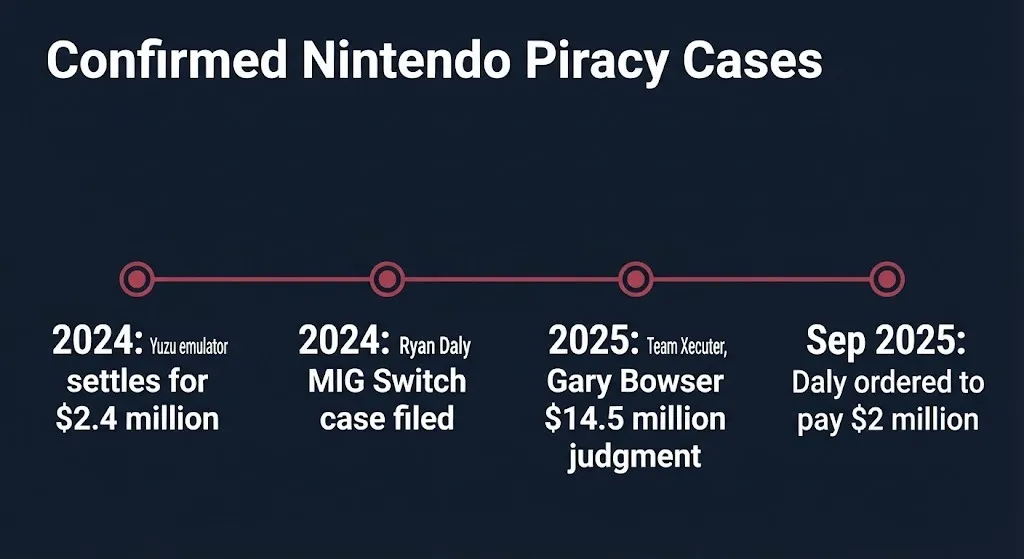
Confirmed timeline of major cases:
- 2024: Nintendo sues Tropic Haze LLC (Yuzu emulator), settles for $2.4 million
- 2024: Nintendo sues Ryan Daly over MIG Switch and Modded Hardware
- September 2025: Court confirms $2 million judgment against Daly
- 2026: Continued enforcement activity reported, including a separate case seeking $4.5 million from a defendant identified as “Archbox,” status not independently confirmed
What happened in the MIG Switch lawsuit against Ryan Daly?
Nintendo sued Ryan Daly for selling the MIG Switch flashcart, the MIG Dumper, and pre-modded Switch consoles preloaded with pirated games through his online store, Modded Hardware.
The case was filed in federal court in Washington. Nintendo argued the devices allowed users to create, distribute, and play pirated Switch games on a massive scale, causing significant and irreparable harm to the company.
In September 2025, the court confirmed Daly must pay Nintendo $2 million in damages. The judgment also included a permanent injunction barring Daly from any future activity connected to selling, marketing, or promoting piracy devices, and required him to surrender relevant domains to Nintendo.
What happened to the Yuzu emulator lawsuit?
Nintendo sued Tropic Haze LLC, the company behind the popular Yuzu Switch emulator, in 2024, and the case settled for $2.4 million within days of filing.
Nintendo’s complaint argued that Yuzu was designed to circumvent the Switch’s security protections, enabling widespread piracy of Switch games even before their official release dates in some cases. The rapid settlement effectively ended Yuzu’s development.
This case remains one of the most cited examples in Nintendo’s broader anti-piracy strategy, since it demonstrated the company would pursue emulator developers directly, not just hardware sellers.
What happened to Team Xecuter and Gary Bowser?
Team Xecuter was a coordinated group that developed and sold circumvention products including SX OS software and SX Pro and SX Core hardware, and its case ended with both criminal and civil consequences.
The U.S. Department of Justice filed criminal charges against key Team Xecuter members. Gary Bowser, one of those members, pleaded guilty and separately faced a civil judgment ordering him to pay Nintendo $14.5 million.
Bowser has publicly stated that judgment will affect him for the rest of his life, illustrating just how severe the financial consequences can be for commercial-scale circumvention activity.
Why is Nintendo suing over Switch piracy?
Nintendo sues over Switch piracy to protect its copyrighted games and enforce the DMCA’s anti-circumvention provisions, which make bypassing copy protection illegal regardless of the seller’s stated intent.
The Switch uses layered hardware and software security specifically designed to prevent unauthorized code from running. Nintendo treats any device or software built to defeat that system as a direct legal target, separate from whether individual buyers actually pirate games.
Think of it like a store selling master keys advertised for “emergency access.” Even if some buyers use them innocently, selling a tool built primarily to bypass a lock creates legal exposure regardless of intent.
What counts as illegal Switch piracy under the DMCA?
Selling or distributing tools that bypass the Switch’s copy protection is illegal under DMCA Section 1201, regardless of whether the buyer actually pirates games with it.
Downloading pirated game ROMs is a separate legal issue, treated as standard copyright infringement. Running homebrew software that doesn’t involve piracy sits in a legally gray area that courts have rarely prosecuted for personal, non-commercial use.
How different activities are generally treated:
- Selling circumvention hardware or software: clearly illegal, civil and criminal exposure
- Distributing pirated ROMs at scale: copyright infringement, high legal risk
- Downloading pirated ROMs personally: copyright infringement, lower but real risk
- Personal-use homebrew with no piracy involved: legally gray, rarely prosecuted
Who has Nintendo targeted in these lawsuits?
Nintendo’s confirmed lawsuits target commercial actors specifically: mod chip and flashcart sellers, emulator developers, and operators of large-scale piracy distribution sites.
Categories Nintendo has pursued:
- Flashcart and mod chip sellers, like Ryan Daly’s Modded Hardware
- Emulator developers, like Tropic Haze LLC (Yuzu)
- Coordinated circumvention groups, like Team Xecuter
- Individuals running large piracy distribution operations, based on ongoing 2026 reporting
Nintendo has not documented lawsuits against private individuals for personal, non-commercial modding of their own consoles, based on available case records.
Will Nintendo pursue piracy lawsuits for the Switch 2?
Nintendo built the Switch 2 with additional anti-piracy protections, and industry coverage indicates modders are actively working to circumvent those measures.
Not yet confirmed: any specific lawsuit tied directly to Switch 2 piracy circumvention as of this writing. Given Nintendo’s consistent enforcement pattern against the original Switch, similar legal action against commercial Switch 2 circumvention tools would be consistent with the company’s history, though that remains an expectation rather than a confirmed case.
What happens next
September 2025: Court confirms $2 million judgment against Ryan Daly in the MIG Switch case.
Ongoing through 2026: Nintendo continues pursuing additional enforcement actions against piracy sellers and distributors.
Unconfirmed: Current status of the separate case reportedly seeking $4.5 million from a defendant identified as “Archbox.”
Expected ongoing: Continued legal activity anticipated around Switch 2 circumvention tools as modders target the newer console’s protections.
Frequently Asked Questions
Is the Nintendo Switch piracy lawsuit real?
Yes, multiple confirmed federal lawsuits exist against piracy device sellers and developers.
The most concrete example is the $2 million judgment against Ryan Daly in September 2025.
These are real court cases, verifiable through federal court records.
Can Switch owners get money from a Nintendo piracy lawsuit?
No, there is no consumer settlement fund or payout in any confirmed case.
These lawsuits result in Nintendo collecting damages from sellers, not paying consumers.
Any claim suggesting otherwise does not match confirmed court records.
Can I be sued for owning a modded Switch?
Nintendo has not documented lawsuits against individuals for personal-use modding.
Its confirmed enforcement targets commercial sellers, distributors, and developers.
Selling circumvention devices or pirated games carries far higher legal risk than personal use.
How much has Nintendo won in piracy lawsuits?
Confirmed amounts range from $2 million to $14.5 million across separate cases.
The Yuzu emulator case settled for $2.4 million in 2024.
The Team Xecuter case resulted in a $14.5 million civil judgment against Gary Bowser.
What is the MIG Switch lawsuit?
It’s Nintendo’s case against Ryan Daly, who sold MIG Switch flashcarts and pre-modded consoles.
The court confirmed a $2 million judgment against him in September 2025.
Daly was also permanently barred from future piracy-related sales.
Is downloading Switch ROMs illegal?
Yes, downloading pirated Switch ROMs is copyright infringement under federal law.
Statutory damages range from $750 to $30,000 per work for non-willful infringement.
Willful infringement can raise that to as much as $150,000 per work.
Will Nintendo sue me if I bought a used modded Switch?
Nintendo has not shown a pattern of suing individual consumers for this specific situation.
Its lawsuits target the sellers of piracy hardware and pirated software, not typical buyers.
Your console could still face an online ban for using unauthorized hardware or software.
If you’re unsure whether a message claiming to be from Nintendo is legitimate, verify it through an attorney before responding or paying anything. There is no consumer claim process tied to any of these cases, so treat payout claims with skepticism.
The fact to remember: Nintendo’s confirmed piracy judgments range from $2 million to $14.5 million, and none of it goes to Switch owners.