Red Bull Lawsuit 2026: The “Gives You Wings” Settlement and What Comes Next
Quick Answer
- The Red Bull “gives you wings” lawsuit was a real, settled class action over false advertising of energy and performance benefits.
- Eligible claimants received either 10 dollars cash or 15 dollars in Red Bull products; that specific settlement is now closed to new claims.
- Any new Red Bull litigation filed in 2025 or 2026 has not yet reached a settlement or claim deadline.
The Red Bull “gives you wings” lawsuit is one of the most recognized consumer class actions in American legal history. Red Bull GmbH agreed to a 13 million dollar settlement after plaintiffs argued the company falsely claimed its drinks gave people superior energy, focus, and performance. The company denied wrongdoing but agreed to pay rather than face a trial.
That original settlement closed years ago. If you missed that window, you cannot go back and file now. However, new litigation against Red Bull over ingredient accuracy and health marketing has emerged in 2025 and 2026. Those cases are what you should watch if you are still a regular buyer of the brand.
This article breaks down the original settlement history, the status of current Red Bull lawsuits in 2026, and exactly what steps you can take if you believe you are affected. One verified detail worth knowing: the original case was filed in the Southern District of New York, not in California where most food and beverage class actions originate.
The Facts
| Case | Benjamin Careathers v. Red Bull GmbH (original); new 2025-2026 filings pending |
|---|---|
| Status | Original settlement: closed. New litigation: active, pre-settlement |
| Fund Size | 13 million dollars (original, fully distributed); new cases: not yet confirmed |
| Est. Per Person | 10 dollars cash or 15 dollars in product (original, closed); new cases: not yet determined |
| Claim Deadline | Original: closed. New cases: TBD, watch the official site |
| Administrator | Original administrator: Rust Consulting (role now concluded). New cases: not yet appointed |
| Proof Needed | New cases: check claim form when available |
Is the Red Bull “gives you wings” lawsuit real?
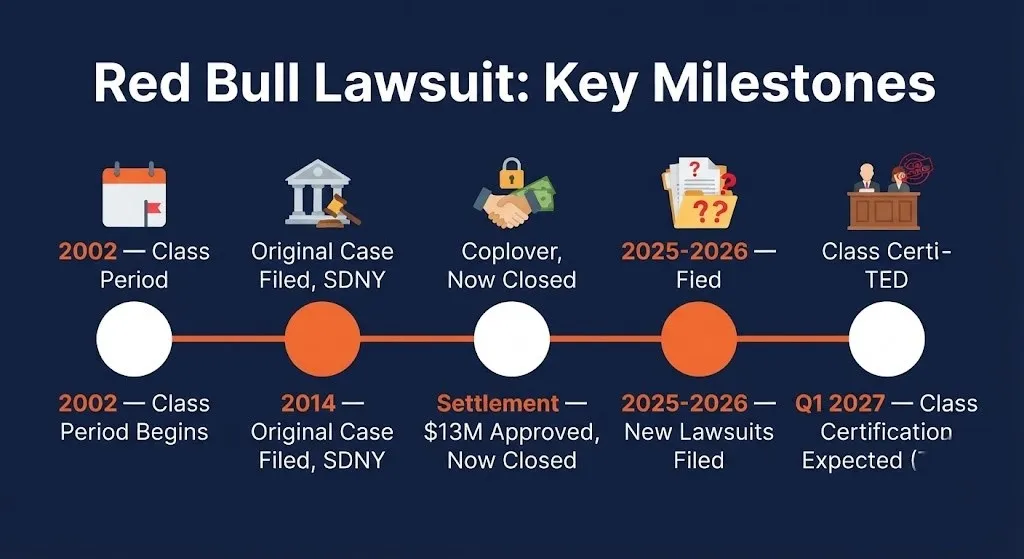
Yes, the Red Bull “gives you wings” lawsuit is real and resulted in a fully executed 13 million dollar class action settlement. The case, formally known as Benjamin Careathers v. Red Bull GmbH, was filed in the U.S. District Court for the Southern District of New York. Plaintiffs argued that Red Bull’s famous marketing slogan implied the drink provided physical or mental superiority that it could not actually deliver.
Red Bull denied all allegations. Despite that denial, the company agreed to settle and fund a compensation pool for American consumers who bought their products. The settlement received final court approval, and the claims administrator, Rust Consulting, distributed payments to valid claimants.
That distribution window is now fully closed. No new claims can be filed for the original Careathers case. If you received a check or a product voucher years ago, that was your share of this settlement.
- Case name: Benjamin Careathers v. Red Bull GmbH
- Court: U.S. District Court, Southern District of New York
- Settlement fund: 13 million dollars (verified, fully distributed)
- Payout options: 10 dollars cash or 15 dollars in Red Bull products (original case only)
How much did the Red Bull settlement pay per person?
The Red Bull “gives you wings” settlement paid eligible consumers either 10 dollars in cash or 15 dollars in free Red Bull products, per person. This was the verified payout structure for the original Careathers class action. No receipt was required to claim the smaller cash amount, which made the filing process simple for millions of consumers.
Claimants who selected the product voucher option received a higher face value because product redemption costs the company less than cash. This is a common structure in consumer settlements. Think of it like a store refund offered in store credit rather than cash, where the store gives you a slightly higher amount to keep you in their ecosystem.
The total settlement fund of 13 million dollars was divided between claimant payouts and attorney fees. As with most class actions of this size, a significant portion went to the lead attorneys as court approved legal fees. The exact percentage of fees paid out of that fund would be listed in the final settlement approval order filed with the Southern District of New York.
| Payout Option | Amount | Proof Required |
|---|---|---|
| Cash payment | 10 dollars | None (sworn statement) |
| Red Bull product voucher | 15 dollars | None (sworn statement) |
| Both options | Not permitted | N/A |
Can you still file a claim for the Red Bull settlement?
No, you cannot file a new claim for the original Red Bull “gives you wings” settlement because that case is fully closed and all deadlines have passed. The Rust Consulting claims administrator has completed the distribution process. Courts do not reopen closed class action settlement windows for late filers.
If you missed the claim period, you have no legal avenue to recover money from that specific fund. This is a hard rule of class action law. Missing the deadline is like missing the return window at a retail store: once the date passes, the policy no longer applies to you.
The only path forward is watching for any new Red Bull litigation that may reach a settlement stage. Newer cases filed in 2025 and 2026 are still in active litigation, meaning claim forms do not yet exist. A new settlement, if reached, would create a fresh window.
- Search PACER (Public Access to Court Electronic Records) for current Red Bull filings.
- Watch for court approved settlement websites dedicated to any new Red Bull case.
- Save receipts for Red Bull purchases made in 2023 to 2026.
- Do not pay any third party website that claims to help you file late for the closed case.
- Check this page and reputable legal news outlets for updates on new cases.
Key Takeaway: The original Red Bull settlement is fully closed, and no new claims can be submitted for that 13 million dollar fund under any circumstances.
What is the Red Bull wings lawsuit about?
The Red Bull “gives you wings” lawsuit centered on a single legal claim: false advertising. Plaintiffs argued that Red Bull’s slogan and marketing materials implied the drink would give consumers superior energy, concentration, and athletic performance compared to coffee or other caffeinated beverages. When tested scientifically, Red Bull’s ingredients did not show those outsized benefits.
The core legal theory was straightforward. Red Bull charged a premium price based on brand promises it could not substantiate. Consumers who paid more for Red Bull over a cheaper caffeinated alternative did so partly because of those implied performance benefits.
This kind of lawsuit is called a consumer fraud class action. It does not require consumers to prove physical harm. Instead, it requires proof that the marketing was misleading enough that a reasonable person would have paid less, or nothing at all, for the product if they knew the truth.
- Legal theory: False advertising and consumer fraud
- Key claim: Red Bull’s marketing overstated functional benefits
- What plaintiffs wanted: A refund of the premium price paid
- Company defense: All claims were lawful marketing and opinion
New Red Bull lawsuits in 2026: what is happening now?
New Red Bull litigation filed in 2025 and 2026 is currently active in federal courts, though none of these cases have reached a verified settlement stage. These newer lawsuits take different angles from the original case. Some focus on ingredient labeling accuracy. Others challenge the company’s use of terms like “natural” or its claims about taurine and B vitamins.
One line of new complaints involves the energy drink industry’s broader habit of implying medical benefits without FDA authorization. The FDA regulates health claims on food and beverage labels. Plaintiffs in newer cases argue Red Bull crosses the line between legal marketing and an unauthorized medical claim.
The 2026 litigation is still in the early stages of discovery and pleadings. Courts have not certified any new class, meaning no claim forms exist yet. If you purchased Red Bull products recently and feel misled by the labeling, you should monitor court dockets for progress in these cases.
Red Bull give you wings lawsuit: why did Red Bull lose?
Red Bull did not formally lose the “gives you wings” lawsuit at trial because the case settled before any verdict. However, the settlement itself was widely seen as a concession by the company that the litigation posed a real legal risk. A 13 million dollar settlement is not what a company pays when it believes it would easily win at trial.
The legal risk came from the false advertising theory. Courts have increasingly accepted the argument that implied claims in advertising carry the same legal weight as explicit statements. Red Bull never literally said its drink gives you physical wings. However, plaintiffs successfully argued that the marketing created a measurable expectation of performance enhancement that the product could not fulfill.
Red Bull’s decision to settle is consistent with how large consumer brands handle these cases. Litigation is expensive, and a trial outcome is unpredictable. Settling for 13 million dollars was cheaper and faster than fighting a jury verdict that could have been far larger.
redbull lawsuit: who was eligible for the original settlement?
The original Red Bull settlement covered any U.S. resident who purchased Red Bull energy drinks between January 1, 2002, and October 3, 2014. That class period of over twelve years made the potential class enormous, covering millions of American consumers. No purchase receipt was required to file a basic claim.
Consumers simply had to attest that they bought Red Bull during the class period. The honor system used in many consumer settlements like this one is common. Courts accept sworn statements from class members without requiring physical evidence for small-dollar consumer product purchases.
If you bought Red Bull at any point during those twelve years, you were likely a class member. That window is now permanently closed. The cutoff date of October 3, 2014, was set based on the filing date of the original case and the final court approval timeline.
- Class period: January 1, 2002, to October 3, 2014
- Geographic scope: United States residents only
- Receipt requirement: None for the basic cash claim
- Current status: Class is closed, no new members can join
Key Takeaway: The class period for the original Red Bull settlement ran from January 2002 to October 2014, making it one of the longest consumer class periods ever approved.
Red Bull lawsuit 2026: latest updates on new cases
The latest Red Bull lawsuit updates for 2026 show that multiple smaller actions are progressing through federal courts, with no settlement announced as of this writing. The most active new cases involve allegations about the company’s marketing of its sugar free and “zero” product lines. Plaintiffs claim these products are marketed with health benefits not supported by evidence.
A separate complaint filed in California focuses on artificial sweetener disclosures. The plaintiff in that case argues Red Bull’s labeling does not adequately disclose the presence of sucralose and acesulfame K. California’s Proposition 65 framework and the state’s Unfair Competition Law are the primary legal tools in that action.
Judges in both cases have denied motions to dismiss, meaning the cases will continue to move forward. Courts allowing cases past the dismissal stage signals that the legal claims are at least plausible enough to proceed. A ruling on class certification in one of these cases is expected by mid-2027.
How to check if you qualify for any current Red Bull litigation
Determining if you may qualify for any current Red Bull litigation requires checking whether any case has reached a settlement and whether you purchased the specific products named in that case. No current Red Bull case has reached the claim filing stage as of November 2026. This means there is no claim form to fill out yet.
You can monitor progress by searching PACER for Red Bull GmbH as a named defendant. Legal news outlets like Law360 and Top Class Actions also cover energy drink litigation regularly. When a settlement is reached, a dedicated settlement website will be created by the court appointed claims administrator.
Think of this stage like waiting for a warranty recall notice. The problem exists, the company knows about it, and the legal process is moving forward. But until the manufacturer officially announces the recall, there is nothing for you to do except keep your purchase records.
- Check PACER monthly for new Red Bull GmbH filings.
- Sign up for case alerts on legal news publishers.
- Save digital receipts from Target, Amazon, Walmart, and convenience stores.
- Do not submit personal information to unofficial websites claiming to offer Red Bull claims.
- Revisit this page for verified updates as cases progress.
- If you have a serious health injury, consult a personal injury attorney separately.
Reality Check
No one will text you with a link to claim money from any Red Bull lawsuit, old or new. The original settlement is fully closed and cannot be reopened. Any website or social media ad promising Red Bull settlement money right now is either outdated misinformation or an outright scam designed to collect your personal data.
Red Bull energy drink: what ingredients are at the center of new lawsuits?
The ingredients at the center of new Red Bull lawsuits include taurine, artificial sweeteners, and synthetic B vitamins. Newer lawsuits argue that Red Bull implies these ingredients deliver measurable health or performance benefits without FDA approved evidence to back those claims. Taurine, an amino acid found in Red Bull, has been marketed alongside claims about mental performance that regulators have questioned.
Artificial sweeteners like sucralose and acesulfame potassium are also under scrutiny. Some plaintiffs argue Red Bull’s “zero sugar” and “sugar free” labeling implies a health benefit that is misleading given the presence of these compounds. This is a developing area of food and beverage law with active regulatory interest from the FDA.
B vitamins, particularly B6 and B12, are included in Red Bull’s formula. The company has historically connected these vitamins to energy and metabolism. Plaintiffs argue these connections imply clinical benefits that the FDA has not authorized the company to claim.
- Taurine: Marketed alongside mental performance claims
- Sucralose and acesulfame K: Artificial sweeteners, subject to disclosure lawsuits
- B6 and B12 vitamins: Energy claims under regulatory scrutiny
- Caffeine levels: Generally disclosed, but dosage warnings are contested
Red Bull marketing and false advertising law: the legal background
False advertising law in the United States is governed primarily by the Lanham Act at the federal level and by state consumer protection statutes like California’s Unfair Competition Law. These laws allow both competitors and consumers to sue companies for misleading statements. The Red Bull case used the state consumer protection route, making it a class action rather than a competitor lawsuit.
To win on a false advertising claim, plaintiffs generally must show that a statement was literally false, or that it was literally true but misleading in context. Red Bull’s “gives you wings” slogan is the classic example of a truthful statement that plaintiffs argued was misleading in context. No one believed they would grow actual wings. However, they did believe the drink would outperform alternatives in ways it did not.
This legal standard, called the “net impression” test, is increasingly used by plaintiffs’ firms against energy drink and supplement companies. It is why lawsuits against companies like Celsius, Monster, and Alani Nu follow similar legal theories to the original Red Bull case.
Key Takeaway: The Red Bull lawsuit established an important legal precedent that implied performance claims in advertising can expose companies to consumer fraud liability, even without an explicit false statement.
Red Bull settlement vs. other energy drink lawsuits: how do they compare?
Comparing the Red Bull settlement to other energy drink lawsuits shows both similarities and important differences. The Celsius class action settled for 7.8 million dollars over the “no preservatives” claim, using citric acid as the central issue. The Red Bull case settled for 13 million dollars over a much broader marketing claim. Monster Beverage has faced multiple lawsuits over caffeine dosage and safety warnings, with those cases taking a different legal track focused on product liability rather than advertising.
Red Bull’s settlement is still the largest false advertising energy drink settlement on record in the United States. The size reflects the scale of the company and the breadth of the class period. Twelve years of buyers is a very large class, and the payout per person was intentionally kept modest to stay within the 13 million dollar fund.
What sets the Red Bull case apart is that it required no physical injury. The legal theory was purely economic: you paid for something the company oversold. This economic loss model has since been copied by attorneys targeting other energy drink brands, including the current Alani Nu litigation covered separately on this site.
| Case | Company | Settlement Amount | Per Person | Status |
|---|---|---|---|---|
| Careathers v. Red Bull GmbH | Red Bull | 13 million dollars | 10 dollars cash | Closed |
| Celsius class action | Celsius | 7.8 million dollars | Varies | Partially distributed |
| Monster safety lawsuits | Monster Beverage | Varies by case | Varies | Mixed |
| Alani Nu labeling lawsuit | Congo Brands | Not yet confirmed | Not yet determined | Active |
Red Bull lawsuit attorney fees and settlement administration costs
In the Red Bull settlement, a significant portion of the 13 million dollar fund went toward court approved attorney fees and administration costs. This is standard in class action settlements. Under the common fund doctrine, lead attorneys are entitled to a percentage of the total recovery they secured for the class.
Attorney fees in the Red Bull case were governed by the final approval order filed with the Southern District of New York. The exact fee percentage would appear in that court record, which is publicly available through PACER. In most consumer class actions, attorney fees range from 25 to 33 percent of the total fund.
Claims administration, handled by Rust Consulting, covered the cost of processing millions of claim forms, verifying sworn statements, and issuing payments. These administrative costs came out of the settlement fund before any money was distributed to consumers. This is why the per person payout was modest relative to the total fund size.
What Happens Next
- Current (November 2026): Multiple new Red Bull lawsuits are active in federal courts; no settlement has been announced in any of these cases.
- Expected Q1 2027: Courts are expected to rule on pending motions regarding class certification in at least one new California Red Bull case.
- Expected Q2 2027: If class certification is granted, the parties may enter court ordered mediation to explore a settlement.
- Expected Q3 to Q4 2027: If mediation produces an agreement, a preliminary approval hearing and formal notice to class members could follow.
- TBD: An official settlement website and claim deadline would only be established after a judge grants preliminary approval.
Frequently Asked Questions
Is the Red Bull “gives you wings” lawsuit still open?
No, the original Red Bull “gives you wings” lawsuit is fully settled and closed.
The claims deadline has passed and no new claims can be submitted for that specific case.
New Red Bull lawsuits filed in 2025 and 2026 are active but have not reached the claims stage.
How much did Red Bull pay in the settlement?
Red Bull paid 13 million dollars to settle the “gives you wings” class action.
Individual claimants received 10 dollars cash or 15 dollars in Red Bull products.
That money has already been distributed and the fund is exhausted.
Did Red Bull admit to doing anything wrong?
No, Red Bull denied all allegations as part of the settlement agreement.
Settling a lawsuit does not equal an admission of liability under U.S. law.
The company paid to resolve the litigation without proceeding to trial.
Are there any new Red Bull lawsuits I can join in 2026?
Yes, new Red Bull lawsuits are active in 2026 but none have reached the claims filing stage.
You cannot file a claim form for these cases because no settlement has been approved.
Monitor legal news outlets and PACER for updates on when these cases progress.
Why did Red Bull settle the wings lawsuit?
Red Bull settled to avoid the cost and risk of a full trial on false advertising claims.
Paying 13 million dollars was less expensive than fighting a case that could have cost more.
The settlement also let the company resolve the matter without a jury verdict.
What proof do I need if a new Red Bull settlement is approved?
Most small dollar consumer settlements require only a sworn statement, no receipt.
If you have digital receipts from online purchases, keep them to potentially claim more.
Proof requirements for future cases will be listed on the official settlement website.
Can I sue Red Bull on my own for health injuries?
A class action settlement covers economic losses, not personal injury claims.
If you believe Red Bull caused a specific health injury, consult a personal injury attorney.
Individual lawsuits for medical harm operate outside the class action framework.
Who was the claims administrator for the Red Bull settlement?
Rust Consulting served as the claims administrator for the original Red Bull settlement.
Their role is now concluded since the distribution phase is complete.
A new administrator would be appointed if any future settlement is approved.
The original Red Bull settlement is history, but the legal pressure on the energy drink industry is not. Your best move right now is to save your purchase records for any Red Bull products bought in 2023 through 2026. If a new settlement is approved, those records could increase your payout significantly.
Watch for a court ruling on class certification expected in early 2027. That ruling will determine whether millions of current Red Bull buyers can join a new class action. It is the single most important date in the current Red Bull litigation calendar.