Facebook Settlement Payout Per Person 2026: Amounts, Status, and How to Claim
Quick Answer
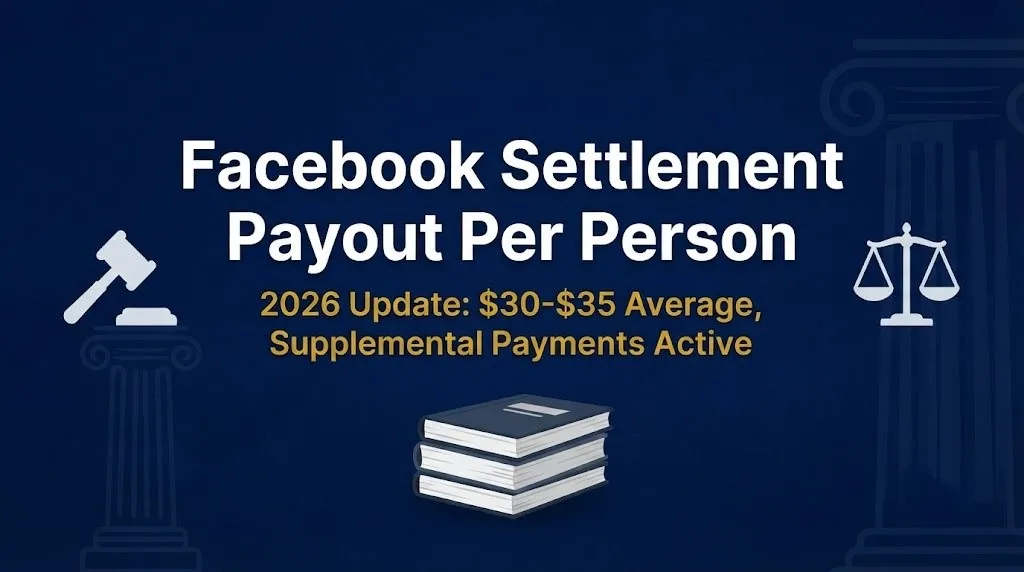
- The Facebook privacy settlement is real and paid most claimants $30 to $35 per person in early 2025.
- A supplemental distribution is now processing payments for those with uncashed or reissued checks.
- The $90 million Facebook tracking settlement has no payout date yet, stuck in the appeals process through 2026.
If you searched for “Facebook settlement payout per person,” you probably heard someone got a check and want to know if yours is coming. The short answer is that most payments went out already. The main $725 million settlement paid roughly $30 to $35 per person to about 17 million claimants. If you filed a claim but never got paid, you might still get money from a supplemental distribution happening right now.
This article covers every Facebook class action that could put money in your pocket in 2026. The most surprising detail: some people are getting second payments from the privacy settlement because their first check went uncashed, and the court ordered the leftover money redistributed rather than returned to Meta.
The Facts
| Detail | Verified Information |
|---|---|
| Case 1 | In re Facebook Inc. Consumer Privacy User Profile Litigation |
| Case 2 | In re Facebook Internet Tracking Litigation |
| Court | U.S. District Court, Northern District of California |
| Case Number (Privacy) | 3:18-md-02843-VC |
| Status (Privacy) | Payments distributed; supplemental round active |
| Total Settlement Fund (Privacy) | $725 million |
| Per Person Payout (Privacy) | $30 to $35 average; some received less |
| Claim Deadline (Privacy) | August 25, 2023 (closed) |
| Settlement Administrator (Privacy) | Angeion Group |
| Tracking Settlement Fund | $90 million |
| Tracking Settlement Status | Final approval granted; under appeal |
| Tracking Per Person Payout | Not yet determined |
Is the Facebook Settlement Real or a Scam?
The Facebook privacy settlement is real. It is one of the largest consumer data privacy settlements in U.S. history. Meta, Facebook’s parent company, agreed to pay $725 million to resolve claims that it shared user data with third parties, including Cambridge Analytica, without proper consent.
The court granted final approval in 2023. Payments began flowing in early 2025. Millions of people received checks or electronic payments. The settlement administrator, Angeion Group, handled the distribution. This was not a scam. It was a legitimate class action settlement with a massive claims process.
A second Facebook settlement, the tracking case, is also real but not paying yet. That $90 million settlement addresses allegations that Facebook tracked users across other websites even when they were logged out. Final approval was granted, but appeals have delayed payments. The case remains in the Ninth Circuit Court of Appeals as of mid-2026.
Scam actors have exploited both settlements. Fake emails and texts claiming to offer Facebook settlement money continue to circulate. Real settlement administrators never ask for your Social Security number through unsolicited messages. They never request payment to release your settlement check. If you receive a message demanding money or sensitive data, it is fraudulent.
Key Takeaway: Both Facebook settlements are court-approved and legitimate. Payments from the main privacy case already went out. Scams exist, so verify any communication through the official settlement website.
How Much Will I Get From the Facebook Settlement?
Most claimants in the Facebook privacy settlement received between $30 and $35 per person. That was the average payout. Some received less, particularly if they filed late or submitted incomplete information. The exact amount depended on how many valid claims were filed and how long each person had a Facebook account during the class period.
The math worked like this: the $725 million fund, minus attorney fees of roughly $180 million and administrative costs, left about $540 million for distribution. Approximately 17 million valid claims were filed. Dividing the net fund by the number of claimants produced the per-person amount.
Point allocation determined individual payouts. Claimants earned one point for each month they had an active Facebook account between May 24, 2007, and December 22, 2022. Those with longer account histories earned more points and received slightly higher payouts. But the difference was modest. Most people fell into a narrow range.
Here is how the payout structure worked:
| Factor | Detail |
|---|---|
| Base calculation | Net fund divided by total points of all claimants |
| Point value | Approximately $0.03 to $0.04 per point |
| Average payout | $30 to $35 |
| Minimum payout | Around $10 to $15 for short account histories |
| Maximum payout | Roughly $50 to $60 for full class period accounts |
If you have not received a payment but believe you filed a valid claim, a supplemental distribution is now underway. Uncashed checks and rejected electronic payments created a residual fund. The court ordered that money redistributed to eligible claimants who did not receive their initial payment. That process is active in mid-2026.
The tracking settlement payout per person is not yet known. The $90 million fund will be divided among eligible claimants after appeals conclude. Estimates are not reliable until the claims period closes and the administrator counts valid submissions.
How to Check Your Facebook Settlement Payment Status
Checking your payment status is straightforward. You do not need a lawyer. You do not need to pay anyone. The settlement administrator provides a free online lookup tool.
Follow these steps to check your status:
- Go to the official Facebook User Privacy Settlement website administered by Angeion Group.
- Locate the “Check Payment Status” or “Contact Us” section.
- Enter the email address you used when filing your claim.
- If prompted, provide your claim confirmation number from your original filing.
- Review your payment status, which will show as paid, pending reissue, or under review.
- If your payment was returned or uncashed, follow the instructions to request a reissue.
- Update your mailing address if it has changed since you filed your claim.
The status checker will tell you whether your payment was issued, whether it was cashed, and whether you are eligible for the supplemental distribution. If your check was lost, stolen, or expired, you can request a replacement through the same portal.
Do not call Meta or Facebook directly. They cannot help with settlement payments. The settlement administrator is the only entity that can look up your claim, reissue a payment, or update your information. Calling Facebook customer service will only waste your time.
For the tracking settlement, no payment status tool exists yet. Payments have not begun. The claims period has not opened. If you see a website claiming to check your tracking settlement payment, it is likely a scam or a pre-claim data collection effort.
When Will Facebook Settlement Checks Be Mailed?
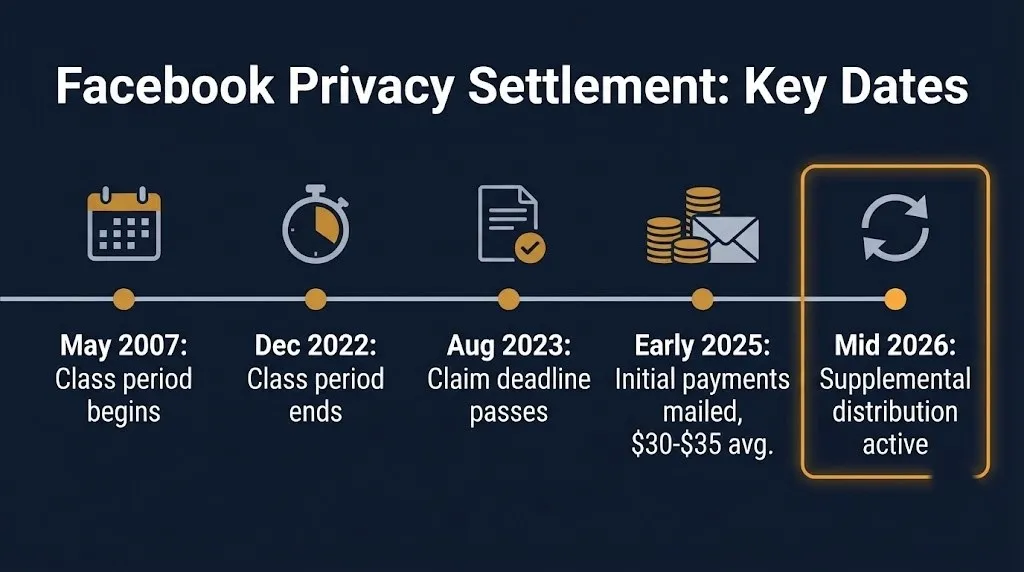
Most Facebook privacy settlement checks were mailed in early 2025. The initial distribution wave began in January 2025 and continued through March 2025. Electronic payments through Venmo, PayPal, and direct deposit arrived around the same time.
If you are still waiting for a payment, the supplemental distribution is your remaining chance. This second wave began in mid-2026 and is expected to continue through late 2026. It covers claimants whose original checks went uncashed, were returned as undeliverable, or failed to process electronically.
The timeline for the privacy settlement looks like this:
- January to March 2025: Initial payment distribution.
- March to December 2025: Reissue requests processed for bounced or lost payments.
- Mid-2026: Supplemental distribution begins using residual funds from uncashed checks.
- Late 2026: Supplemental distribution expected to conclude.
For the tracking settlement, no mailing date exists. The appeals process must conclude first. The Ninth Circuit has not scheduled oral arguments as of July 2026. A realistic estimate for tracking settlement payments is 2027 or later.
If you moved after filing a privacy settlement claim, contact the settlement administrator immediately. Uncashed checks are a leading reason people miss out on class action money. It is like leaving a rebate card in a drawer until it expires. The money is yours, but only if you claim it.
Key Takeaway: Privacy settlement checks already mailed. Supplemental payments are active now. Update your address with the administrator if you moved.
What Is the Facebook Privacy Settlement About?
The Facebook privacy settlement resolved allegations that Facebook allowed third parties to access user data without proper consent. The most famous example was Cambridge Analytica, a political consulting firm that harvested data from up to 87 million Facebook profiles. But the case went beyond that single incident.
Plaintiffs alleged that Facebook shared user data with app developers, advertisers, and business partners in violation of its own privacy promises. They claimed Facebook’s practices violated state consumer protection laws, federal privacy statutes, and common law privacy rights. The complaint spanned years of alleged misconduct.
Meta denied all wrongdoing. The company maintained that users consented to data sharing through its terms of service and privacy settings. But after years of litigation, including a trip to the U.S. Supreme Court, Meta agreed to the $725 million settlement rather than risk a trial.
The settlement class included anyone in the United States who had a Facebook account between May 24, 2007, and December 22, 2022. That is approximately 250 million people. Not everyone filed a claim. Roughly 17 million did. The settlement compensates for the alleged privacy violations themselves, not for any specific financial harm.
The tracking settlement is similar but narrower. It alleges Facebook tracked users across non-Facebook websites through the Facebook pixel and social plugins, even after users logged out. That case settled for $90 million.
Key Takeaway: Both cases involved alleged unauthorized data collection. Neither required proof of financial harm to file a claim.
Who Is Eligible for Facebook Settlement Money?
Eligibility for the privacy settlement is closed. The claim deadline was August 25, 2023. If you filed a valid claim by that date, you are eligible for payment or for the supplemental distribution if your first payment failed. If you did not file a claim, you cannot get money from the privacy settlement now.
To have been eligible to file a claim, you needed to meet these criteria:
- You were a Facebook user in the United States.
- You had an account at any point between May 24, 2007, and December 22, 2022.
- You filed a claim online or by mail before August 25, 2023.
There is no reopening of the claims period. The settlement agreement does not provide for late claims. The supplemental distribution only covers people who already filed claims but did not receive or cash their payments.
For the tracking settlement, eligibility is broader but the claims period has not opened. You may be eligible if you were a Facebook user in the United States who visited non-Facebook websites that used Facebook tracking tools between April 22, 2010, and September 26, 2017. When the claims period opens, you will need to file a claim to receive payment. No one is eligible by default.
Reality Check: If you see an ad saying you can still file a new claim for the $725 million Facebook settlement, it is false. The deadline passed in 2023. Any site offering to file a new claim is collecting your data under false pretenses.
Why Did Some People Get More Facebook Settlement Money Than Others?
Payout differences came down to three factors: how long you had Facebook, when you filed, and whether your payment was cashed. The point system was the primary differentiator.
Each month of active Facebook use during the class period earned one point. The total points across all claimants determined the value of each point. Someone who had Facebook since 2007 had roughly 186 points. Someone who joined in 2020 had about 30 points. The difference in payout was roughly $5 to $25 between the shortest and longest account holders.
Here is what influenced individual payouts:
| Factor | Effect on Payout |
|---|---|
| Account duration | More months meant more points and slightly higher payouts |
| Filing accuracy | Errors in claim forms could reduce or void payments |
| Payment method | Electronic payments arrived faster; paper checks sometimes went uncashed |
| Address accuracy | Wrong addresses caused returned checks and payment delays |
The supplemental distribution adds another layer. People whose checks went uncashed forfeited their initial payment. That money went into a residual fund. The court ordered it redistributed. Now those same people can claim their payment again, and other eligible claimants may receive small top-up amounts if funds remain.
This is not typical. Most class action settlements return residual funds to the defendant or donate them to charity through a cy pres process. The Facebook settlement’s redistribution is unusual and worth watching.
Key Takeaway: Longer account histories earned more points and higher payouts. The supplemental distribution is giving uncashed money a second chance to reach claimants.
Is There a Facebook Class Action in 2026 That Still Accepts Claims?
No major Facebook class action is accepting new claims as of July 2026. The privacy settlement claims period closed in 2023. The tracking settlement has not opened its claims period yet. Other Facebook class actions are in earlier stages of litigation and have no claims process.
Several active Facebook lawsuits could eventually result in settlements. These include cases related to Facebook’s algorithmic promotion of harmful content, alleged antitrust violations by Meta, and privacy claims under state laws like the Illinois Biometric Information Privacy Act. None of these cases have reached a settlement that offers consumer compensation.
The Illinois biometric privacy case against Facebook resulted in a separate $650 million settlement in 2021. That claims period is long closed. Payments went out in 2022. If you missed that deadline, you cannot claim now.
The antitrust cases against Meta are brought by government agencies, not private plaintiffs. The Federal Trade Commission and multiple state attorneys general are seeking to break up Meta’s alleged monopoly. Those cases would not result in consumer payments even if successful. They seek structural remedies, not damages.
The bottom line: no new claim forms are available for any Facebook settlement in mid-2026. If you have an old claim for the privacy settlement, check your status. If you want to file for the tracking settlement, wait for the official claims period to open. Nothing else is claimable right now.
How Do Facebook Settlement Payments Compare to Other Tech Settlements?
The Facebook privacy settlement payout of roughly $30 to $35 per person is mid-range for tech class actions. Some payouts are higher. Some are much lower. The comparison helps set expectations.
The Equifax data breach settlement paid about $80 to $100 per person for those who filed claims early. The Yahoo data breach settlement paid around $60 per person. The TikTok privacy settlement paid about $27 per person. The Google Plus privacy settlement paid roughly $5 to $12 per person after a large number of claims diluted the fund.
Here is how the Facebook settlement compares:
| Settlement | Fund Size | Approx. Per Person Payout |
|---|---|---|
| Facebook Privacy | $725 million | $30 to $35 |
| Equifax Data Breach | $425 million | $80 to $100 |
| TikTok Privacy | $92 million | $27 |
| Yahoo Data Breach | $117 million | $60 |
| Google Plus Privacy | $7.5 million | $5 to $12 |
The Facebook payout is on the higher end for privacy settlements but lower than data breach settlements that involved actual financial fraud. Privacy cases rarely generate large per-person awards because the harm is harder to quantify. Data breach cases sometimes pay more because victims can document out-of-pocket losses.
The $30 to $35 average for Facebook reflects the enormous class size. With 17 million claims, even a $725 million fund produces modest individual payments. If fewer people had filed, the per-person payout would have been higher. That is the trade-off in any class action.
Key Takeaway: The Facebook payout is reasonable by tech settlement standards. Higher payouts typically come from cases with smaller classes or documented financial losses.
What Happens Next
The privacy settlement is winding down but not finished. The tracking settlement is still far from paying out. Here is what to expect:
- Mid to Late 2026: Supplemental distribution continues for the privacy settlement. Unclaimed residual funds are being reissued to eligible claimants.
- Late 2026: The supplemental distribution is expected to conclude. Any remaining uncashed funds may go to cy pres recipients.
- Late 2026 or Early 2027: Ninth Circuit expected to hear oral arguments in the tracking settlement appeal. A ruling could take months after argument.
- 2027: If the tracking settlement appeal is resolved favorably, the claims period may open. Notices would go out by email and mail to potential class members.
- 2028 or Later: Tracking settlement payments could begin, assuming no further appeals and a smooth claims process.
The key date for privacy settlement claimants is now. Check your payment status immediately. If your check went uncashed or your electronic payment failed, the supplemental distribution is your window. That window will not stay open forever.
Frequently Asked Questions
How much was the average Facebook settlement check?
The average payout was $30 to $35 per person.
Some received less, around $10 to $15, for shorter account histories.
The highest payouts reached about $50 to $60 for full class period accounts.
When did Facebook settlement checks go out?
Initial payments went out between January and March 2025.
Electronic payments through Venmo, PayPal, and direct deposit issued at the same time.
Supplemental distributions for uncashed checks began in mid-2026.
Can I still file a claim for the Facebook privacy settlement?
No. The claim deadline was August 25, 2023.
Late claims are not accepted under the settlement agreement.
Only existing claimants can request payment reissues.
Why didn’t I get my Facebook settlement check?
Your address may have been incorrect or outdated.
Your payment may have gone to spam if it was electronic.
Check your status with the Angeion Group settlement administrator.
Is the $90 million Facebook tracking settlement paying yet?
No. The settlement is under appeal in the Ninth Circuit.
No claims period has opened.
Payments are not expected before 2027 or 2028.
How many points did I earn toward my Facebook settlement?
You earned one point per month of active Facebook use during the class period.
The period ran from May 24, 2007, to December 22, 2022.
Maximum points were about 186 for accounts active the entire time.
Will Facebook send me a settlement check automatically?
No. You had to file a claim by August 25, 2023.
No automatic payments were sent to non-claimants.
Future settlements will require claim filing.
What is the Facebook biometric privacy settlement?
That was a separate $650 million Illinois settlement resolved in 2021.
Claims closed in 2022 and payments went out the same year.
It is not related to the $725 million national privacy settlement.
Check your payment status today if you filed a privacy settlement claim. The supplemental distribution is active now and will not wait. If you moved, update your address with the administrator. If your check expired, request a reissue. The money is allocated for you, but you have to take the final step to claim it.