Camp Lejeune Lawsuit Update 2026: Payout Status and Trial Results
Quick Answer
- Is it legit? Yes, this is a multi-billion dollar federal litigation process authorized by the 2022 Camp Lejeune Justice Act.
- How much? Payouts range from $100,000 to $450,000 for elective offers, while trial awards and private settlements may be higher.
- Key Deadline: The administrative filing deadline passed on August 10, 2024. Current activity focuses on litigation and settlement distribution.
The Camp Lejeune water lawsuit has moved into its most critical phase. After years of administrative delays, 2026 marks the year of significant financial recovery for thousands of veterans and families. The court is now resolving cases through both the Elective Option and individual trials for those who opted out of early offers.
You may qualify for a payout if you lived or worked at Camp Lejeune for at least 30 days between 1953 and 1987. The Department of Justice (DOJ) and the Navy are now prioritizing the oldest claims and the most severe medical conditions. Over 100,000 lawsuits were filed before the 2024 deadline, and the court is working through them in specific tracks.
This article covers the 2026 payout tiers, the latest trial results from the Eastern District of North Carolina, and how to track your claim status. We also examine the gap between government settlement offers and the actual medical costs for conditions like Parkinson’s and bladder cancer.
The Facts
| Fact | Detail |
|---|---|
| Case Name | In re: Camp Lejeune Water Litigation |
| Status | Active Payouts and Litigation |
| Fund Size | No fixed cap: Estimates exceed $21 billion |
| Est. Per Person | $100,000 to $450,000 (Elective) or higher via trial |
| Claim Deadline | August 10, 2024 (Closed for new filings) |
| Administrator | Navy JAG and Department of Justice |
| Proof Needed | Military records and certified medical diagnosis |
Is the Camp Lejeune lawsuit real?
The Camp Lejeune lawsuit is a massive federal legal action based on the Camp Lejeune Justice Act (CLJA). This law allowed people to sue the government for toxic water exposure at the base. It is one of the largest litigations in U.S. history. If you see ads or receive notices about it, the underlying case is verified and official.
The government admitted that water at the base contained high levels of benzene, TCE, and PCE. These chemicals came from a nearby dry cleaner and leaking fuel tanks. For decades, the military ignored the risks. Now, the federal court in North Carolina handles all these cases. Judges are currently overseeing thousands of active lawsuits.
Scams do exist, but the litigation itself is sanctioned by Congress. You should only work with verified legal representatives or the official Navy portal. Legitimate lawyers will not ask for money upfront. They take a percentage of your final settlement. This percentage is capped by federal law to protect veterans.
- Congress passed the CLJA in August 2022.
- The President signed it into law immediately.
- The U.S. Navy JAG handles the initial claim review.
- The Department of Justice manages the litigation in court.
- All cases are centralized in the Eastern District of North Carolina.
Camp Lejeune settlement update 2026
As of early 2026, the Department of Justice has accelerated the Elective Option (EO) payout system. Thousands of families have already received checks. However, the backlog of administrative claims remains a significant hurdle. Many claimants are choosing to move their cases from administrative review into federal court to force a resolution.
The court has divided the cases into “Tracks” based on medical conditions. Track 1 included cases of bladder cancer, kidney cancer, leukemia, and Parkinson’s disease. Most of these cases have seen either settlement offers or trial dates by now. Track 2 and Track 3 cases, which include other cancers and birth defects, are the current focus of 2026 proceedings.
If your case is in the administrative phase, the Navy has 180 days to respond. Because of the volume, they almost never meet this deadline. This allows you to file a lawsuit in federal court. Most 2026 updates involve these court filings and the subsequent discovery process where evidence is exchanged.
- Pace: Payouts are moving faster than in 2024 but slower than survivors hope.
- Volume: Over 250,000 administrative claims were filed by the 2024 deadline.
- Court Action: Judges have ordered the government to streamline the medical record verification process.
- New Rulings: Recent rulings have clarified how much “proof of causation” a veteran needs to provide.
Camp Lejeune payout tiers and amounts
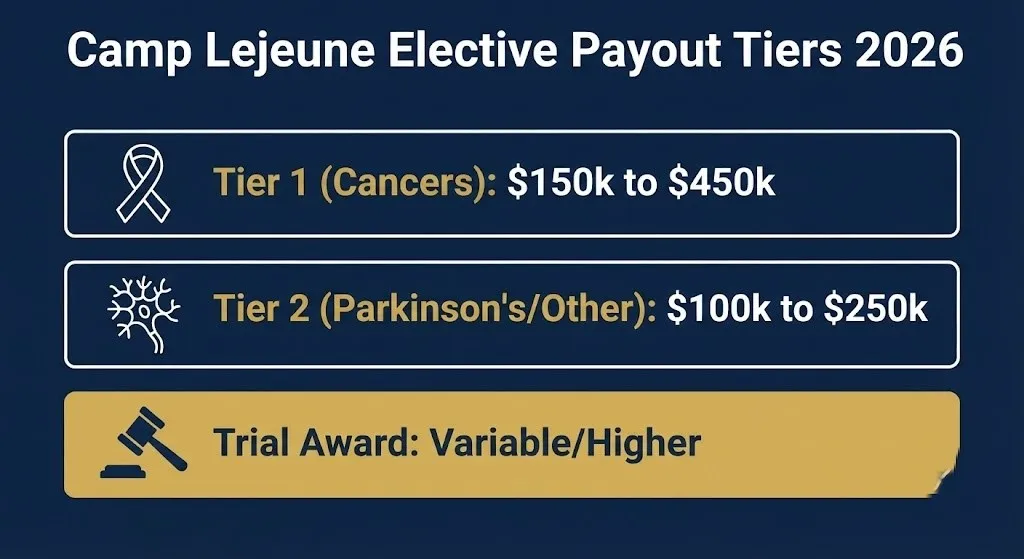
The Elective Option (EO) uses a specific grid to determine how much you may receive. These amounts are based on your diagnosed condition and how long you stayed at the base. The government designed this to provide fast money without a trial. Many veterans find these amounts lower than what a jury might award.
Tier 1 conditions pay the highest amounts. These include kidney cancer, liver cancer, non-Hodgkin’s lymphoma, leukemia, and bladder cancer. If you were at the base for more than five years, you get the maximum amount for your tier. If you were there for less than a year, the payout is smaller.
Tier 2 conditions include multiple myeloma, Parkinson’s disease, and systemic sclerosis. These payouts are slightly lower than Tier 1 but still significant. If you choose the EO, you must waive your right to sue the government later. This is a trade-off between speed and the potential for a larger court award.
| Time at Base | Tier 1 Payout | Tier 2 Payout |
|---|---|---|
| 30 to 364 days | $150,000 | $100,000 |
| 1 to 5 years | $300,000 | $150,000 |
| Over 5 years | $450,000 | $250,000 |
Key Takeaway: The government is actively paying out claims through a tiered system, but many veterans are choosing trials to seek higher compensation.
How much money will I get from Camp Lejeune?
Your total payout depends on several factors beyond just your medical diagnosis. If you accept the Elective Option, your amount is fixed by the grid mentioned above. If you pursue a lawsuit, your settlement or jury verdict could be much higher. Some lawyers estimate trial values for Parkinson’s or bladder cancer could reach seven figures.
However, a higher potential award comes with higher risks. Trials take a long time and require expert witnesses. You must also consider “offsets.” The government may try to reduce your settlement if you already receive VA disability benefits for the same condition. Recent 2026 rulings have limited how much the government can take back from your check.
Your payout also depends on your proof of residence. You must show you were at Camp Lejeune for at least 30 days between 1953 and 1987. Military orders, utility bills, or school records are standard forms of proof. Without these, the government will likely deny or delay your claim regardless of your illness.
- Gather all military service records (DD-214).
- Collect medical records showing a “qualifying condition.”
- Determine your exact duration of stay at the base.
- Calculate any potential VA benefit offsets.
- Consult with your attorney about the Elective Option versus litigation.
- Review the settlement offer letter carefully with a professional.
What is the current Camp Lejeune settlement status?
The litigation is currently in a state of high-volume processing. In 2026, the court is focused on resolving Track 2 cases. These include conditions like prostate cancer, lung cancer, and liver cancer. The government has been under pressure from federal judges to stop delaying the medical review process.
The “Global Settlement” that many expected has not happened yet. Instead, the DOJ is settling cases individually or in small groups. This means there is no single “pot of money” that gets split among everyone. Each person’s case moves at its own pace based on when it was filed and the severity of the illness.
If you have already filed, your status is likely “pending review” or “in discovery.” If you accepted an Elective Option offer, you should receive your funds within 60 to 90 days of signing the agreement. The government has set up a specialized payment unit to handle these checks to avoid standard Treasury delays.
- Status: Active litigation and ongoing elective payments.
- Next Milestone: Completion of Track 2 discovery phase.
- Latest Action: Judges ordered the Navy to increase staffing for claim processing.
- Check Status: You can check through your attorney or the Navy’s claim portal.
Who is eligible for the Camp Lejeune Elective Option?
Eligibility for the fast-track Elective Option is stricter than for the general lawsuit. You must have one of the specific “presumptive” conditions listed by the government. If your condition is not on the list, you cannot take the EO. You must pursue a traditional lawsuit and prove the water caused your specific illness.
The qualifying conditions for the EO include kidney, liver, and bladder cancers. It also covers leukemia, non-Hodgkin’s lymphoma, and multiple myeloma. Parkinson’s disease and systemic sclerosis are also covered. If you have a different condition, like esophageal cancer or a birth defect, you are currently excluded from the EO.
You must also meet the 30-day residency requirement. This time does not have to be consecutive. If you visited for two weeks twice over a year, you meet the requirement. Eligibility also extends to “unborn” children who were in the womb while their mother lived at the base during the contamination period.
- Primary Eligibility: 30 days of exposure between 1953 and 1987.
- Condition List: Must have a Tier 1 or Tier 2 condition for EO.
- Documentation: Must provide a certified medical diagnosis.
- Exclusions: Dishonorable discharges are generally excluded from the CLJA.
Key Takeaway: The Elective Option is the fastest way to get paid, but it is only available for a specific list of medical conditions.
Camp Lejeune water lawsuit trial results
By 2026, the first wave of trials has concluded, setting a “benchmark” for what cases are worth. These early trials are called bellwether trials. They help both sides understand how a jury will react to the evidence. The results from these trials usually lead to larger settlement offers for everyone else.
In 2025 and early 2026, juries heard stories of veterans who developed Parkinson’s and bladder cancer decades after leaving the base. The results have been a mix of government victories and significant plaintiff awards. When a plaintiff wins, the award often covers medical bills, lost wages, and “pain and suffering.”
These trial results are public record. They show that the government’s defense often relies on “alternative causes.” For example, they might argue that a veteran’s smoking habit caused their bladder cancer, not the water. However, the CLJA has a lower burden of proof than most lawsuits, which has helped many families win.
- Track 1 trials focused on five core illnesses.
- Juries have awarded amounts higher than the Elective Option in several cases.
- The government has appealed some large verdicts, delaying those specific payments.
- Bench trials (trials by a judge) are also occurring to speed up the calendar.
- Trial results are used to adjust the settlement offers for future tracks.
How to check your Camp Lejeune claim status
Checking your status depends on how you filed your claim. If you have an attorney, they are your primary source of information. The Department of Justice communicates directly with them. Do not call the court or the Navy yourself if you have a lawyer, as they will not speak with you.
If you filed pro se (without a lawyer), you must use the Navy JAG CLJA portal. You should have received a claim number when you submitted your administrative form. Use this number to log in and check for updates. In 2026, the portal has been updated to show whether your claim is “Under Review,” “Offer Pending,” or “Sent to DOJ.”
Checking your status is like checking the progress of a delayed tax refund. It often sits in one stage for months before suddenly moving to the next. The most common delay in 2026 is the “Medical Verification” stage. This is where the government double-checks that your doctors are qualified and your diagnosis is firm.
- Step 1: Locate your 2024 administrative claim number.
- Step 2: Contact your law firm’s “Case Manager” specifically.
- Step 3: Log into the Navy JAG portal if you are unrepresented.
- Step 4: Verify that all your contact information is current.
- Step 5: Ensure your medical records have been fully uploaded.
- Step 6: Wait for the “Packet Complete” notification.
Camp Lejeune lawsuit update 2026 for late filers
A common question in 2026 is whether you can still file a new claim. The short answer is no. The Camp Lejeune Justice Act had a two-year window that ended on August 10, 2024. If you did not file an administrative claim by that date, your rights to sue under this specific law have likely expired.
There are very few exceptions to this deadline. Some people may try to file under different legal theories, but the CLJA was a unique waiver of government immunity. If you missed the date, you may still qualify for standard VA disability benefits. These benefits are separate from the lawsuit and do not have the same 2024 deadline.
If you did file on time but haven’t heard anything, you are not a “late filer.” You are just in the backlog. In 2026, the Navy is still processing forms that were submitted in the final rush of August 2024. Your claim is still active as long as you received a confirmation of receipt before the deadline.
Reality Check: No one can “re-open” the filing window for you in 2026. Beware of any law firm or website claiming they can still file a new Camp Lejeune claim for you. The federal deadline was firm. Filing a claim is free, and anyone asking for a “late filing fee” is likely running a scam.
Why are Camp Lejeune settlements taking so long?
The delay in payouts is caused by the sheer volume of cases. The Navy was not prepared to handle 250,000 medical claims at once. Each claim requires a person to look at military records and medical files. In 2026, even with increased staffing, the process is still slow.
Another reason for the delay is the dispute over “causation.” The government often fights back on whether the water was the primary cause of a person’s illness. This leads to long legal battles and expert testimony. The judges in North Carolina have expressed frustration with this slow pace and have ordered the DOJ to settle cases faster.
Finally, the probate process adds time. Many veterans have passed away since the contamination happened. Their families are now the claimants. This requires a “wrongful death” or “survival” claim, which involves extra paperwork and proving who the legal heirs are. This process can add six to twelve months to a settlement.
Key Takeaway: High claim volume and disputes over medical evidence are the primary reasons payouts are not yet universal in 2026.
Tracking the Camp Lejeune administrative claim backlog
The administrative backlog is the number of claims waiting for a response from the Navy. In 2026, this number is slowly decreasing. However, a large percentage of people are choosing to bypass the administrative process. Once a claim has been sitting for six months, you can “remove” it and file a lawsuit.
Tracking this backlog is important because it tells us how the government is performing. The DOJ releases monthly reports to the court. These reports show how many offers were made and how many were accepted. In 2026, the acceptance rate for the Elective Option has increased as the government improved the payout amounts for certain conditions.
If you are in the backlog, you are essentially in a digital waiting room. Your goal is to move from the “General Backlog” into the “Active Litigation” group. Once you are in litigation, you have a court-ordered schedule. This provides more certainty than the administrative phase.
- The Navy receives the claim.
- The claim enters the “Development” phase for record gathering.
- Medical professionals review the diagnosis.
- The Navy makes an EO offer or denies the claim.
- If denied or ignored for 180 days, you file a lawsuit.
- The DOJ takes over from the Navy JAG.
Camp Lejeune lawsuit deadlines you should know
While the filing deadline has passed, there are new deadlines for those with active cases. If the government sends you an Elective Option offer, you only have 60 days to accept it. If you miss this window, the offer expires. You would then have to continue with a full lawsuit, which could take years.
There are also deadlines for “Discovery.” This is when your lawyer must turn over your medical records and military history to the government. If you miss these court-ordered dates, the judge could dismiss your case. This is why staying in contact with your legal team in 2026 is vital.
If you are a family member of a deceased veteran, you may have a deadline to be appointed as the “Representative” of the estate. Every state has different rules for this. If you are not the legal representative, you cannot sign a settlement agreement. This is a common hurdle that stops payouts in their tracks.
- Acceptance Deadline: 60 days from the date of an EO offer.
- Discovery Deadline: Set by the court for your specific “Track.”
- Response Deadline: Usually 30 days for any formal “Request for Admission.”
- Payment Timeline: Usually 60 to 90 days after final paperwork is signed.
How to respond to a Camp Lejeune settlement offer
When you receive a settlement offer in 2026, it will likely come as a formal letter via your attorney. This letter will state the amount and the condition it is for. You must decide if this amount is fair. You cannot negotiate the Elective Option amounts; they are set in stone. You either take it or you fight in court.
If you accept, you will sign a “Release of Claims.” This document says you will never sue the government for Camp Lejeune water again. It also says you agree to any “offsets.” An offset is when the government takes back money you already received through the VA for that specific illness.
If you reject the offer, your case remains in the litigation track. You will eventually get a trial date or a private settlement offer. Most lawyers recommend rejecting an offer only if the evidence for your case is very strong and the medical costs far exceed the offer.
- Read the offer letter with your attorney or a financial advisor.
- Confirm the “Tier” assigned to your condition is correct.
- Check the “Years of Service” used to calculate the amount.
- Calculate the net payout after attorney fees and offsets.
- Sign the release form in the presence of a notary if you accept.
- Keep a copy of the signed agreement for your records.
Key Takeaway: Deciding between an Elective Option offer and a trial is the most important financial decision in a 2026 claim.
What conditions qualify for the highest Camp Lejeune payouts?
The highest payouts in 2026 go to people with “Tier 1” cancers who were at the base for a long time. Kidney cancer and bladder cancer are among the most highly compensated. This is because the scientific link between these cancers and the chemicals in the water is the strongest.
The government also pays more for “Latent” injuries that appeared years later. Parkinson’s disease is a major focus of 2026 litigation. Because Parkinson’s requires lifelong care and expensive medication, these settlements are often among the largest. If a veteran passed away from one of these conditions, the family can claim the same amounts.
Other conditions like lung cancer or esophageal cancer are being litigated in Track 2 and Track 3. While not on the Elective Option list, they can still result in high payouts if the evidence is strong. In these cases, your lawyer must hire a “Toxicologist” to prove that the specific level of PCE or TCE in the water caused your tumor.
- Top Tier: Bladder Cancer, Kidney Cancer, Liver Cancer.
- Mid Tier: Multiple Myeloma, Non-Hodgkin’s Lymphoma, Leukemia.
- Special Cases: Parkinson’s Disease and Systemic Sclerosis.
- Litigation Only: Lung cancer, Breast cancer, Prostate cancer.
The role of the Navy JAG in Camp Lejeune claims
The Navy JAG (Judge Advocate General) was the first agency to handle these claims. Their role in 2026 has shifted from processing new claims to verifying old ones. They manage the “Tort Claims Unit” in Norfolk, Virginia. This unit is the gateway for every payout.
The JAG office is responsible for checking your DD-214 against the contamination dates. They also verify that you were actually on the base. If you were a civilian contractor, they check your employment records. If the JAG office finds an error, they will flag your claim, which stops the payout until the error is fixed.
Many people find the JAG process frustrating because it is a “black hole” of information. However, the 2026 court orders have forced the JAG to be more transparent. They now must provide regular updates to the federal judges in North Carolina. This has helped clear up some of the mystery around why certain claims were stuck.
Reality Check: The Navy JAG is not your advocate. They represent the interests of the government. Their job is to verify claims strictly and minimize the government’s financial liability where the law allows.
What Happens Next
The following timeline shows the expected path for the remainder of 2026 and into 2027.
- Expected Q3 2026: Completion of Track 2 bellwether trials and announcement of results.
- Expected Q4 2026: Expansion of the Elective Option to include additional medical conditions.
- Expected Early 2027: Start of Track 3 trials for reproductive issues and birth defects.
- Ongoing: Monthly distribution of settlement checks for accepted elective offers.
Frequently Asked Questions
Can I still file a Camp Lejeune claim in 2026?
No, the legal deadline to file an administrative claim was August 10, 2024.
If you did not file by that date, you generally cannot start a new claim under the CLJA now.
Check with a lawyer only if you believe you have an extremely rare exception.
How much is the average Camp Lejeune settlement?
There is no single “average” because payouts are based on tiers.
Elective offers range from $100,000 to $450,000 based on the condition.
Trial verdicts have the potential to be much higher but are less common.
When will I get my Camp Lejeune payout check?
Most people receive their check within 60 to 90 days after the final settlement is approved.
If you are in litigation, it may take several months for the DOJ to finalize the paperwork.
Administrative claims take longer due to the medical verification backlog.
Does a Camp Lejeune settlement affect my VA benefits?
It does not stop your VA benefits, but there may be an “offset.”
The government can reduce your settlement amount by the amount of disability pay you received for the same condition.
New 2026 rules have limited these offsets to ensure veterans still receive a significant award.
What if the veteran is deceased?
Family members and estates can still file and collect the settlement.
You must have legal documentation showing you are the authorized representative of the estate.
These “wrongful death” claims follow the same payout tiers as claims for living veterans.
Is Parkinson’s disease covered in the 2026 updates?
Yes, Parkinson’s is a Tier 2 condition in the Elective Option.
Payouts for Parkinson’s range from $100,000 to $400,000 depending on the length of exposure.
Many Parkinson’s patients are choosing trials because their long-term care costs exceed the EO offers.
Do I need a lawyer for my Camp Lejeune claim?
While not strictly required, most claimants use one due to the complexity of the litigation.
Lawyers handle the medical expert testimony and the North Carolina court filings.
Fees are capped at 20 percent for administrative settlements and 25 percent for litigation.
Closing
The Camp Lejeune lawsuit in 2026 is finally delivering the results families have waited decades to see. While the filing window has closed, the payout window is wide open for those with active claims. Your primary focus should be responding to government offers quickly and ensuring your medical records are complete.
The litigation in North Carolina continues to set the value of these claims through trial results. Whether you take the Elective Option or go to court, 2026 is the year of financial resolution. Stay in close contact with your legal representative and monitor the official Navy portal for your claim status. The most important date to remember is the 60-day deadline to accept any settlement offer you receive.