Instacart Lawsuit 2026: FTC’s $60 Million Settlement Explained, Refund Status and Who Qualifies
Quick Answer
- This is a real FTC enforcement case, not a scam: Instacart agreed to a $60 million stipulated settlement with the Federal Trade Commission.
- Refund amount per person is not yet determined; the FTC has not announced a claims process yet.
- There is no claim deadline yet; the FTC will announce refund details after the court finalizes the process.
Instacart users have been searching for this one since headlines broke in December 2025: is there really a lawsuit, and can you get money back. Yes, there is. The Federal Trade Commission announced that Instacart will pay $60 million in refunds to consumers to settle allegations that the company engaged in unlawful tactics that harmed shoppers and raised grocery costs.
This affects you if you paid Instacart’s delivery or service fees on orders advertised as “free delivery,” or if you were charged for an Instacart+ subscription you didn’t knowingly agree to. No refund amount has been set per person, and no claim form exists yet.
This article breaks down what the FTC actually alleged, what Instacart agreed to change, and what you can do right now while the refund process gets finalized. One detail that surprises a lot of readers: Instacart denies any wrongdoing, even while agreeing to pay the $60 million.
The Facts
| Case | FTC v. Maplebear Inc. d/b/a Instacart |
| Court | U.S. District Court, Northern District of California |
| Case Number | 4:25-cv-10783 |
| Status | Stipulated final order entered January 13, 2026; refund process not yet launched |
| Fund Size | $60 million |
| Est. Per Person | Not yet determined |
| Claim Deadline | Not yet confirmed, watch the official FTC site |
| Administrator | Not yet appointed |
| Proof Needed | Not yet confirmed; keep Instacart receipts and billing records in the meantime |
Is the Instacart Lawsuit Real, or a Scam?
The Instacart lawsuit is a real federal case brought by the FTC, not a scam or a rumor. It’s formally titled FTC v. Maplebear Inc. d/b/a Instacart, case number 4:25-cv-10783, filed in the U.S. District Court for the Northern District of California.
The FTC Commission approved the stipulated final order with a 2-0 vote, and the order took the force of law once signed by the district court judge. That stipulated final order was entered on January 13, 2026.
How to verify it yourself:
- Search the case number on the court’s public docket or PACER
- Check the FTC’s official case page for Instacart under its legal library
- Look for Instacart’s own public statement, which it published in a company blog post
Instacart didn’t stay quiet about this. The company said in a blog post that it “flatly” denies any allegations of wrongdoing by the agency and believes the foundation of the FTC’s inquiry was fundamentally flawed. A company disputing the claims while still agreeing to pay is common in FTC settlements and doesn’t make the case any less real.
How Much Money Will I Get From the Instacart Settlement?
Not yet determined. The FTC has not announced a refund process, per-person payout figures, or a claims administrator.
The settlement administrator will determine the payment amount each qualifying customer receives based on the number of eligible consumers identified, the specific amount each person was charged in disputed fees or unauthorized subscriptions, and administrative costs tied to distributing the refunds.
| Detail | Status |
|---|---|
| Total settlement fund | $60 million (confirmed) |
| Per-person refund amount | Not yet calculated |
| Automatic refunds | Not yet confirmed whether available |
| Claim form refunds | Not yet confirmed whether required |
The FTC has said it will announce the refund claim process after the settlement receives final court approval. Some secondary sites have published estimated refund figures, including one citing up to $50 per person. That figure has not been confirmed by the FTC and should be treated as an estimate, not a verified payout.
Key Takeaway: No official per-person refund amount exists yet for the Instacart settlement, and any specific dollar figure you see quoted online right now is not confirmed by the FTC.
How Do I File a Claim in the Instacart FTC Settlement?
You can’t file a claim yet, because the FTC hasn’t opened a claims process or released a claim form.
There’s nothing to submit at this stage. Filing becomes possible only after the FTC finalizes and announces its refund distribution plan.
What you can do while you wait:
- Hold onto your Instacart order history and receipts.
- Save any billing statements showing Instacart+ subscription charges.
- Note the dates you were charged fees advertised as “free delivery.”
- Check the FTC’s official Instacart case page periodically for updates.
- Watch for official communication sent to your Instacart account email.
- Do not respond to unsolicited texts or emails asking for payment or sensitive personal information tied to this case.
Reality Check: The FTC will never ask you to pay a fee to receive a refund, and it will never request your full Social Security number by email. If a message asks you to pay to “claim” your Instacart refund, it’s not from the FTC.
What Did Instacart Actually Do, According to the FTC?
The FTC alleges Instacart advertised free delivery while still charging mandatory fees, and enrolled customers in paid subscriptions without clear consent.
Instacart marketed its app with claims of “free delivery,” while customers actually paid up to 15 percent in “service fees” that were not charged on pickup orders. The FTC alleged those service fees functioned as delivery fees under a different name.
The FTC’s complaint specifically alleges that Instacart falsely advertised free delivery, misrepresented satisfaction guarantees, and enrolled consumers into paid subscriptions without informed consent.
Core allegations:
- False “free delivery” advertising while charging mandatory service fees
- Misleading satisfaction guarantee claims
- Automatic enrollment into Instacart+ after free trials, without clear consent
- Restrictive refund policies that pushed consumers toward account credits instead of cash refunds
Regulators also alleged that Instacart promoted a “100 percent satisfaction guarantee” while often limiting remedies to credits or partial refunds rather than returning money to the original payment method. That’s the equivalent of a store advertising a full refund policy, then handing you store credit instead of your money back.
Did Instacart’s AI Pricing Play a Role in the Case?
Instacart’s algorithmic pricing practices drew regulatory attention alongside the fee and subscription allegations, though pricing wasn’t the core legal claim.
Investigations found that Instacart’s algorithmic pricing experiments led to significant price disparities, up to 23 percent higher for some users, adding to consumer frustration amid already elevated grocery prices.
This wasn’t the central legal violation in the FTC’s complaint, but it added context to why regulators were watching the company closely. The case reinforced that traditional consumer protection laws apply fully to AI-enabled pricing and delivery platforms, not just traditional advertising.
Key Takeaway: The FTC’s case centers on deceptive fee disclosure and subscription enrollment, not on algorithmic pricing itself, though the pricing practices drew scrutiny in the broader investigation.
What Is Instacart Required to Do Under the Settlement?
Instacart must stop misrepresenting delivery costs and satisfaction guarantees, and must get clear consent before charging subscription fees.
Under the terms of the settlement order, Instacart is prohibited from making misrepresentations concerning the costs of delivery services and satisfaction guarantees. Instacart must also clearly and conspicuously disclose terms and obtain express informed consent for subscription models where consumers are automatically charged unless they actively opt out.
Required changes:
- Disclose all fees affecting total price before checkout
- Stop advertising “free delivery” when mandatory fees still apply
- Obtain express consent before converting free trials into paid subscriptions
- Present refund and credit terms clearly and accurately
The settlement remains in effect for 10 years, giving the FTC a long compliance window to monitor Instacart’s practices going forward.
Who Qualifies for a Refund in the Instacart Settlement?
Consumers who were charged fees on orders advertised as free delivery, or who were enrolled in Instacart+ without clear consent, are the groups the FTC has identified as affected.
Individuals potentially eligible for a refund include consumers who paid mandatory service fees on their first order despite “free delivery” advertising, and consumers whom Instacart denied full refunds despite its satisfaction guarantee claims.
Groups the FTC has flagged as potentially affected:
- Customers charged service fees on orders marketed as free delivery
- Customers enrolled in Instacart+ after a free trial without clear consent
- Customers denied cash refunds and given credits instead
No official eligibility criteria or documentation requirements have been published yet. This list reflects the conduct described in the FTC’s complaint, not a confirmed claims process.
When Will the FTC Announce the Instacart Refund Process?
No date has been confirmed. The FTC has said it will release refund process details after the settlement receives full court approval and implementation steps are finalized.
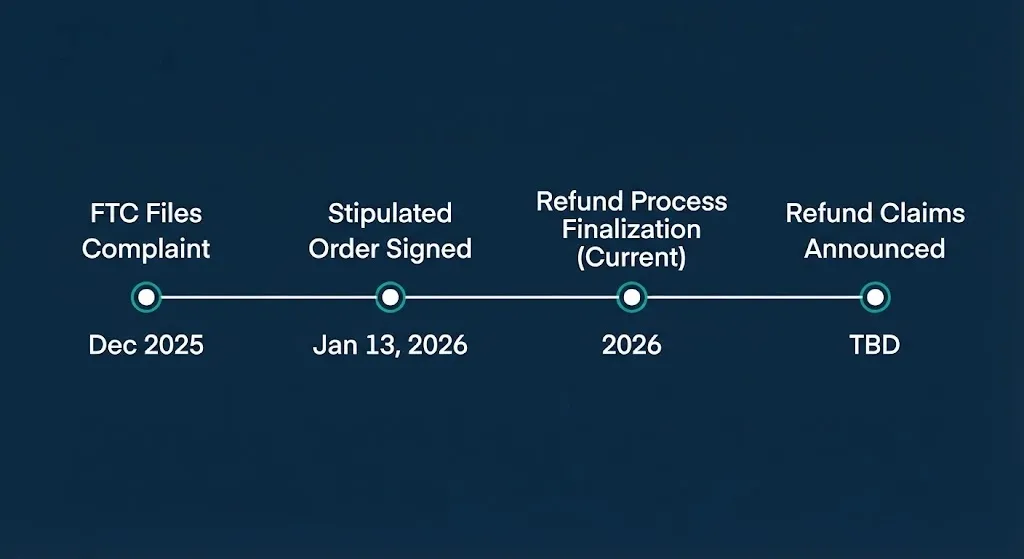
The proposed order for the $60 million judgment moved through the approval process, and the settlement administrator will determine payment timelines for qualifying customers at a later date.
What’s confirmed versus pending:
| Milestone | Status |
|---|---|
| FTC complaint filed | Confirmed, filed alongside settlement announcement |
| Stipulated order signed | Confirmed, January 13, 2026 |
| Refund process announced | Not yet confirmed |
| Claim form released | Not yet confirmed |
| Payments begin | Not yet confirmed |
Some industry commentary has speculated on typical FTC timelines, comparing this case to prior refund rollouts like the Amazon Prime settlement, where automatic refunds and claim forms both played a role. Those comparisons are informed guesses, not confirmed details for this case.
How Will I Know If I’m Eligible for an Instacart Refund?
The FTC has said it will notify eligible consumers directly, likely through the email associated with their Instacart account, once the refund process is finalized.
You likely won’t need to search for a claim form yourself if the FTC can match your account to its own records from Instacart. That’s similar to how a retailer sometimes issues an automatic credit card refund after a recall, without requiring you to submit anything.
What to watch for:
- Official emails referencing the FTC or a court-approved claims administrator
- Communication sent to your Instacart account email address, not a random inbox
- Confirmation the correspondence references case number 4:25-cv-10783
If you’re not contacted directly but believe you were affected, checking the FTC’s official Instacart case page periodically is the safest way to catch an update as soon as it posts.
What Happens Next
- Completed, January 13, 2026: Stipulated final order signed by the district court judge.
- Ongoing: FTC and Instacart finalize implementation details for the $60 million refund fund.
- Expected, later 2026: FTC announces official refund claims process and eligibility criteria.
- TBD: Claims administrator appointed and claim form, if required, released publicly.
- TBD: Refund payments distributed to eligible consumers.
Frequently Asked Questions
Is the Instacart lawsuit real?
Yes, it’s a real FTC enforcement case, formally FTC v. Maplebear Inc. d/b/a Instacart, case number 4:25-cv-10783.
The stipulated final order was signed by a federal judge on January 13, 2026.
How much is the Instacart settlement worth?
The total settlement fund is $60 million, confirmed by the FTC.
The per-person refund amount has not been calculated or announced yet.
Can I file a claim right now?
No, the FTC has not released a claim form or opened a refund process yet.
Details will be announced after implementation steps are finalized.
Who qualifies for an Instacart refund?
Consumers charged fees on orders advertised as free delivery, or enrolled in Instacart+ without clear consent, are among the groups the FTC identified.
Final eligibility criteria have not been published yet.
Did Instacart admit wrongdoing?
No, Instacart has publicly denied any wrongdoing while agreeing to the $60 million settlement.
This is common in FTC stipulated settlements and doesn’t affect the case’s validity.
Is there a deadline to claim a refund?
No deadline has been set because the refund process hasn’t launched yet.
Watch the official FTC case page for Instacart for updates.
What did Instacart actually do wrong, according to the FTC?
The FTC alleged Instacart advertised free delivery while charging mandatory fees, and enrolled customers in paid subscriptions without clear consent.
The company was also accused of limiting refunds to credits instead of cash.
Will I need to submit documents to get a refund?
That’s not yet confirmed since the claims process hasn’t been announced.
Keeping your Instacart receipts and billing records now is a reasonable precaution regardless.
Nothing about filing a claim is possible yet, since the FTC hasn’t opened its refund process. The one date to remember is January 13, 2026, when the $60 million stipulated order became final, and the next thing to watch for is the FTC’s announcement of how refunds will actually be distributed.