Apple Watch Band Lawsuit 2026: PFAS “Forever Chemicals” Case Status, Who’s Covered, and What Happens Next
Quick Answer
- This is a real, active federal lawsuit (not a scam), alleging PFAS “forever chemicals” in three Apple Watch bands.
- Payout amount is not yet determined: no class has been certified and no settlement fund exists.
- No claim deadline exists yet; the case is in discovery, with class certification briefing expected later in 2026.
Apple Watch owners keep asking the same question: is Apple really being sued over toxic chemicals in its watch bands, or is this another inbox rumor. The answer is yes, it’s real. A federal judge in California let the case move forward in March 2026, rejecting most of Apple’s attempt to get it thrown out.
This affects you if you bought an Apple Watch Sport Band, Ocean Band, or Nike Sport Band. There’s no payout figure yet and no deadline to file anything, because the case hasn’t reached a settlement or a certified class.
This article walks through what’s confirmed in the court record, what Apple has said publicly, and what typically happens next in a case like this. One detail that surprises a lot of readers: the lawsuit traces back to a single Notre Dame study that never named Apple at all.
The Facts
| Case | Cavalier et al. v. Apple Inc. |
| Court | U.S. District Court, Northern District of California |
| Case Number | 5:25-cv-00713 |
| Status | Active, in discovery, following a March 16, 2026 ruling on Apple’s motion to dismiss |
| Fund Size | Not yet confirmed, no settlement exists |
| Est. Per Person | Not yet determined |
| Claim Deadline | None set, no class certified and no claim form exists |
| Administrator | Not yet appointed |
| Proof Needed | Check the official case docket or law firm case page for updates |
Is the Apple Watch Band Lawsuit Legit?
The Apple Watch band lawsuit is a real, active federal class action, not a scam or rumor. It’s formally titled Cavalier et al. v. Apple Inc., filed in the U.S. District Court for the Northern District of California under case number 5:25-cv-00713.
Lead plaintiffs Dominique Cavalier and Kiley Krzyzek filed the original complaint on January 21, 2025. They’re represented by attorneys from Clarkson Law Firm, P.C. and Shub Johns & Holbrook LLP.
You can verify this yourself through PACER or CourtListener using the case number above. That’s the fastest way to confirm any lawsuit is genuine rather than a phishing setup.
Key facts:
- Filed in a real federal court, not a private arbitration mill
- Named plaintiffs, named law firms, a public docket
- Apple has responded publicly and in court filings, confirming the case exists
Nothing about this case is anonymous or hidden. That alone separates it from the fake “you’ve been approved for a settlement” texts that circulate whenever a real lawsuit makes news.
How Much Money Could I Get From the Apple Watch Lawsuit?
Not yet determined. No settlement fund exists, no class has been certified, and no payout figures have been set.
Any number you see online right now claiming a specific per-person payout is a guess, not a verified figure. The case is still in discovery, the fact-finding phase where Apple has to turn over internal records.
| Stage | Status |
|---|---|
| Settlement fund | Not established |
| Per-person payout | Not calculated |
| Payment tiers | None exist |
| Claims administrator | Not appointed |
Cases like this typically don’t produce a payout number until one of two things happens: a settlement gets negotiated, or the case goes to trial and plaintiffs win. Both are a long way off here.
Key Takeaway: No amount of money has been set for the Apple Watch band lawsuit, and anyone quoting you a specific payout figure right now is not working from confirmed information.
How Do I Join or File a Claim in the Apple Watch Band Lawsuit?
You can’t file a claim yet because there’s no claim form, no settlement, and no certified class.
At this stage, there’s nothing to sign up for. Filing only becomes possible after a class gets certified or a settlement gets reached and a claims administrator opens a claims window.
What you can do right now:
- Hold onto your Apple Watch band purchase receipts or order history.
- Note which band you bought: Sport Band, Ocean Band, or Nike Sport Band.
- Keep any records of skin irritation or reactions tied to wearing the band.
- Check the case docket periodically under 5:25-cv-00713.
- Watch reputable legal-news trackers for a certification or settlement update.
- Ignore any site or text asking for payment to “register” your claim early.
There is no cost to eventually join a class action if one gets certified. Filing a claim, when the time comes, is always free.
What Is the Apple Watch Band Lawsuit About?
The lawsuit claims three Apple Watch bands contain PFAS, a class of synthetic chemicals nicknamed “forever chemicals” because they barely break down.
The plaintiffs claim Apple falsely advertises its Apple Watch bands as safe and healthy despite containing toxic chemicals, specifically alleging the presence of PFHxA (perfluorohexanoic acid) in the Sport Band, Nike Sport Band, and Ocean Band.
Independent lab testing cited in the complaint found PFHxA concentrations of 1,020 nanograms per gram, which plaintiffs describe as far above safety thresholds set by some international regulators. Apple disputes the safety characterization entirely.
Apple has publicly stated its watch bands are safe for users to wear. The company has not conceded any of the core allegations.
This started with an outside study, not an Apple admission. A study released in December 2024 found at least 22 different smartwatch bands, from multiple brands, contained high levels of PFAS. Neither the study nor early press coverage named Apple specifically. The lawsuit’s plaintiffs later commissioned their own independent testing on an Apple band they purchased and used those results to amend their complaint.
Which Apple Watch Bands Does the Lawsuit Cover?
The lawsuit specifically names three Apple Watch bands: the Sport Band, the Ocean Band, and the Nike Sport Band.
These are the fluoroelastomer bands sold for various Apple Watch models, including the Ocean Band made for the Apple Watch Ultra 2.
Bands named in the complaint:
- Apple Watch Sport Band
- Apple Watch Ocean Band (Apple Watch Ultra 2)
- Apple Watch Nike Sport Band
Other Apple Watch bands, including leather, Milanese loop, and fabric-based Solo Loop styles, are not part of this complaint. The claims are limited to the fluoroelastomer material used in the three bands above.
Key Takeaway: Only three specific fluoroelastomer Apple Watch bands are named in the lawsuit, not the entire Apple Watch band lineup.
Reality Check
No court, law firm, or settlement administrator will text or email you out of the blue asking you to pay a fee to “lock in” your spot in this case. Filing a claim in any real class action is free, and there’s currently no claim form to file at all. Treat any message asking for money or personal financial details tied to this lawsuit as a scam.
What Did the Judge Rule in March 2026?
A federal judge allowed the lawsuit’s core fraud and consumer protection claims to proceed, denying most of Apple’s motion to dismiss.
The March 16, 2026 ruling let key claims, including fraudulent concealment and violations of California’s consumer protection laws, move forward, according to legal analysis of the order. The court found plaintiffs had provided enough initial evidence of potential deception around Apple’s “Green” and “Healthy” marketing claims to justify further proceedings.
Some narrower claims were dismissed. The judge tossed some minor claims while letting the primary fraud and consumer protection theories continue.
A notable legal wrinkle came up around standing. Plaintiffs originally relied on an academic paper that tested various fluoroelastomer watch bands and reported anonymized, aggregated results without naming specific products. Plaintiffs then amended their complaint to add independent lab results from a watch band they purchased themselves after filing suit, which reportedly helped the case survive dismissal.
This is a meaningful early win for plaintiffs, similar to a lender agreeing your loan dispute has enough substance to go to arbitration. It doesn’t mean plaintiffs win the case. It means the case gets to keep going.
What Happens During the Discovery Phase?
Discovery is the phase where both sides exchange evidence, and it’s happening in this case right now.
Apple must turn over internal testing data and communications related to PFAS levels in its wristbands during this phase. This is often where the strongest evidence in a consumer product case surfaces, since it forces a company to disclose what it knew internally.
What discovery typically includes:
- Internal emails and testing reports
- Depositions of company employees and expert witnesses
- Plaintiffs’ own lab results and expert analysis
- Apple’s counter-testing and rebuttal evidence
Discovery in PFAS cases tends to run long because the science is technical and contested. Think of it like a home inspection dispute where both sides bring in their own inspector and neither report agrees.
When Will the Apple Watch Lawsuit Be Certified as a Class Action?
No certification date has been confirmed, but plaintiffs are expected to file a certification motion later in 2026.
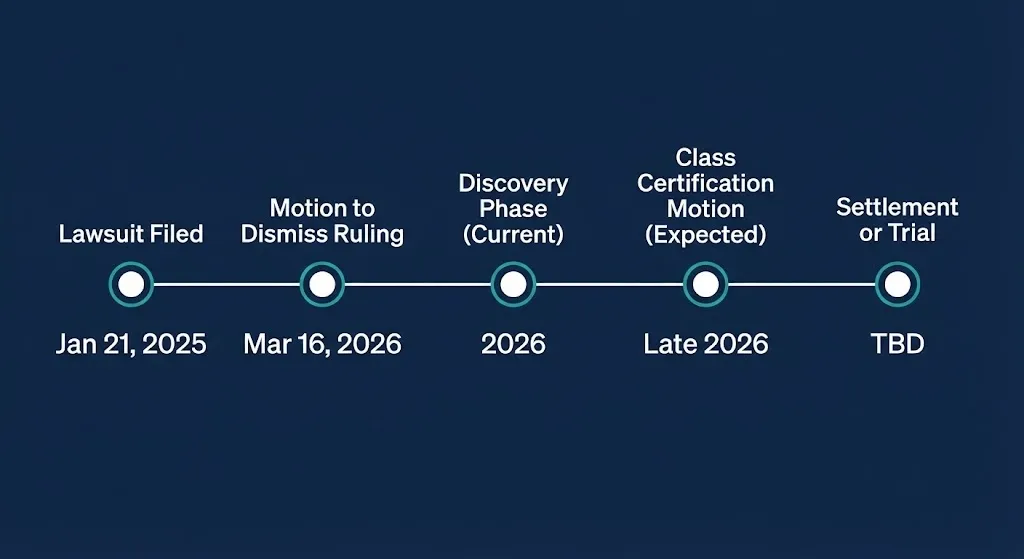
Later in 2026, the plaintiffs will ask the court to officially certify the lawsuit as a class action, which would cover millions of Apple Watch users nationwide if granted.
Certification is not guaranteed. The court has to decide whether the plaintiffs’ claims are similar enough across all buyers to be handled as one case, rather than thousands of individual lawsuits. Apple is expected to fight certification, as companies typically do, since a certified class raises the financial stakes considerably.
Key Takeaway: Class certification, if it happens, is expected sometime after mid-2026, and only after that step would a claims process become possible.
How Long Do PFAS Class Actions Like This Usually Take?
Cases like this typically take two to four years to resolve, counting from filing to settlement or trial, according to legal commentary on similar PFAS litigation.
That timeline reflects the technical complexity of proving chemical exposure and health risk in court. Expert witnesses, lab methodology disputes, and appeals of certification decisions all add time.
Typical PFAS class action timeline:
- Filing and initial motions (completed for this case)
- Motion to dismiss ruling (completed, March 2026)
- Discovery (current stage)
- Class certification motion and ruling
- Settlement negotiation or trial
Comparing this to a home warranty dispute isn’t quite fair; this moves much slower, closer to the pace of a multi-year insurance coverage fight than a simple consumer complaint.
Has Apple Responded to the Lawsuit?
Yes, Apple has publicly denied the core allegations and maintains its watch bands are safe.
Apple has stated that its Apple Watch bands are safe for users to wear, pushing back directly against the lawsuit’s claims. The company maintains it performs rigorous internal and independent testing on its products.
Apple’s legal strategy so far has centered on procedural challenges, including the motion to dismiss that was largely denied in March. The company is expected to continue contesting the claims through discovery and, if it comes to that, oppose class certification.
None of Apple’s public statements constitute an admission of the allegations. The case remains contested on the merits.
Are Other Companies Facing Similar Watch Band Lawsuits?
Yes. Samsung and other smartwatch makers face comparable PFAS allegations tied to the same underlying research.
Samsung is facing PFAS allegations in a separate case, Gonzalez v. Samsung, filed in the U.S. District Court for the Central District of California, covering several Samsung Galaxy Watch band styles.
This isn’t an Apple-only issue. It reflects a broader wave of PFAS litigation touching consumer electronics, food packaging, and apparel. Separate lawsuits over PFAS in chocolate packaging were also filed against The Hershey Company around the same period.
If you own a smartwatch from another brand, check that manufacturer’s band materials separately. Each case is proceeding on its own timeline in its own court.
What Happens Next
- Now through late 2026: Discovery continues; Apple turns over internal PFAS testing records and communications.
- Expected late 2026: Plaintiffs file a motion asking the court to certify the case as a nationwide class action.
- Expected 2026 to 2027: Court rules on class certification; Apple likely appeals if certification is granted.
- TBD, likely 2027 to 2029: Settlement negotiations or trial, based on typical PFAS litigation timelines.
- TBD: If a settlement or verdict occurs, a claims administrator opens a filing window with a public claim form and deadline.
Frequently Asked Questions
Is the Apple Watch band lawsuit real?
Yes, it’s an active federal case, Cavalier et al. v. Apple Inc., case number 5:25-cv-00713 in the Northern District of California.
You can verify it directly through the court’s public docket.
Which Apple Watch bands are named in the lawsuit?
The Sport Band, Ocean Band, and Nike Sport Band are the three bands named in the complaint.
Other band materials, like leather or fabric loops, are not part of this case.
How much money will I get from the Apple Watch lawsuit?
No amount has been determined yet because no settlement or certified class exists.
Ignore any site quoting a specific dollar figure right now.
Can I file a claim right now?
No, there’s no claim form because no class has been certified and no settlement has been reached.
A claims process, if one happens, would open later, after certification or settlement.
Did Apple admit the watch bands are unsafe?
No, Apple has publicly stated its watch bands are safe to wear and disputes the allegations.
The March 2026 ruling only allowed the case to proceed; it didn’t decide who’s right.
What chemical is at the center of this lawsuit?
The complaint centers on PFHxA, a type of PFAS or “forever chemical,” allegedly found in the bands’ fluoroelastomer material.
Plaintiffs cite independent lab testing to support the claim.
How long will this case take to resolve?
Similar PFAS class actions typically take two to four years from filing to resolution.
This case was filed in January 2025, so a resolution before 2027 would be on the faster end for this type of litigation.
Is there a deadline to join the lawsuit?
No filing deadline exists yet since no class has been certified.
Watch the official docket or reputable legal-news sources for updates on certification and any future claims window.
Nothing about filing a claim is possible yet, since the case is still moving through discovery. The one date worth remembering is March 16, 2026, when the court let the core claims survive, and the next milestone to watch for is a class certification ruling later this year.