Kerrygold Butter Lawsuit 2026: PFAS Claims, Class Action Status, and What Consumers Should Know
Quick Answer
- The Kerrygold lawsuit is real and alleges PFAS contamination in butter products despite “pure” marketing claims.
- No settlement fund exists yet; individual payouts are not determined pending class certification and discovery.
- No claim deadline applies because no class has been certified and no settlement has been approved.
The Kerrygold butter lawsuit is real. It is a proposed class action filed against Ornua Foods North America, the company behind Kerrygold. The lawsuit claims Kerrygold butter contains PFAS, synthetic chemicals linked to health risks, despite marketing that suggests the product is pure and natural. The case is pending in federal court.
If you bought Kerrygold butter, you may eventually be part of a class if the court certifies one. No class has been certified yet in 2026. No settlement exists. No claim form is available. Anyone telling you to sign up for a Kerrygold settlement right now is misleading you.
This article explains what is verified: the allegations, the legal status, who may qualify if a class is certified, and how to preserve any future claim. One fact that surprises many consumers: the lawsuit does not allege intentional contamination. It claims the company failed to disclose the presence of PFAS in its packaging or supply chain.
The Facts
| Case | Proposed class action against Ornua Foods North America, maker of Kerrygold |
| Status | Active federal litigation, class certification pending |
| Fund Size | Not applicable; no settlement exists |
| Est. Per Person | Not determined; likely cents to a few dollars per purchase if a class settles |
| Claim Deadline | None; no class certified |
| Administrator | None appointed |
| Proof Needed | Likely proof of purchase if a settlement is approved |
Is the Kerrygold butter lawsuit real or a scam?
The Kerrygold butter lawsuit is real. It is a filed federal court case, not a social media rumor. The case was brought by consumers who allege Kerrygold butter contains PFAS and that the company’s marketing violated consumer protection laws.
The defendant is Ornua Foods North America. The company denies the allegations. It argues its products are safe and comply with all applicable regulations. The litigation is in the discovery phase. Both sides are exchanging evidence.
What is a scam: any website, text, or email asking you to pay a fee to join the Kerrygold lawsuit. You cannot join the case. It is a proposed class action. If the court certifies a class and a settlement is reached, you would file a free claim through a court-approved administrator. That has not happened.
You also should not pay for a third-party service that promises to register you for the Kerrygold settlement. No such settlement exists. Legitimate class action settlements never charge upfront fees to file a claim.
The case name and docket are public record. It is pending in the U.S. District Court for the Southern District of New York. The case number and assigned judge are available on the court’s electronic docket.
Key Takeaway: The Kerrygold lawsuit is a real pending class action, but no class has been certified and no settlement or claim form exists yet.
What is the Kerrygold lawsuit about?
The Kerrygold lawsuit alleges the butter contains per- and polyfluoroalkyl substances, known as PFAS. These are synthetic chemicals used in some packaging and industrial processes. The lawsuit claims Kerrygold’s marketing as a pure, natural, grass-fed product is misleading because it does not disclose PFAS.
PFAS are sometimes called forever chemicals because they persist in the environment and the human body. Some studies have linked certain PFAS to health issues including elevated cholesterol, immune system effects, and certain cancers. The science is still developing.
The lawsuit does not allege acute poisoning. It is a consumer deception case. The theory is that reasonable consumers would not have purchased Kerrygold butter, or would have paid less, had they known about PFAS. That is the standard legal theory in food labeling and contamination class actions.
Kerrygold’s parent company, Ornua, has stated its products are safe and meet regulatory standards. The company has not issued a recall. The FDA has not ordered Kerrygold butter removed from shelves.
The case follows a broader wave of PFAS-related consumer litigation. Similar lawsuits have targeted sparkling water brands, fast food wrappers, and cosmetics.
Key Takeaway: The core claim is that Kerrygold’s packaging or supply chain introduced PFAS into the butter, and the company’s pure and natural marketing failed to disclose it.
How much could the Kerrygold settlement pay per person?
No settlement exists, so no per-person amount is determined. If the case eventually settles, the payout would likely follow the pattern of other consumer food class actions. Those settlements typically pay a few dollars per household without proof of purchase, and slightly more with proof of purchase.
Here is a realistic comparison based on similar food and beverage class action settlements.
| Settlement Type | Typical Payout Without Proof | Typical Payout With Proof |
|---|---|---|
| Sparkling water PFAS case | $2 to $6 per household | $5 to $15 with receipts |
| Juice labeling case | $1 to $3 per household | $5 to $10 with receipts |
| Butter or dairy labeling case | $1 to $4 per household | $4 to $12 with receipts |
These are historical examples, not predictions for Kerrygold. The Kerrygold case is still in early stages. Any payout would depend on the settlement fund size, the number of claims filed, and the claim structure approved by the court.
Consumer class action settlements are not designed to make anyone rich. The point is compensation for a small alleged overcharge or deceptive statement, not for personal injury. If you are looking for a large payout, this case is unlikely to provide one.
Reality Check: No one will text you about a Kerrygold settlement payment. Filing a class action claim is always free. Third-party claim helpers that charge fees are unnecessary for consumer food cases.
Who qualifies for the Kerrygold class action?
No class has been certified. So no one formally qualifies yet. If a class is certified, it would likely include people who purchased Kerrygold butter in the United States during a specific period. The exact dates and product types would be set by the court.
The proposed class definition in the complaint covers consumers who bought Kerrygold butter products for personal use. The period likely begins several years before the lawsuit was filed and continues through the present. The specific start date is not yet confirmed by the court.
What will likely matter: whether you bought the product, when you bought it, and where you bought it. Online purchases may be included. In-store purchases may be included. The final class definition will state the requirements.
Proof of purchase will be the main hurdle. Most people do not keep butter receipts. That is why settlements typically include a no-proof option with a lower payout. If you have receipts, digital purchase history, or loyalty card records, keep them.
You do not need to do anything right now. There is no claim form. There is no registration. The court will notify consumers through a notice program if a class is certified and a settlement is reached.
Key Takeaway: The proposed class would cover U.S. purchasers of Kerrygold butter during a court-determined period, but no class has been certified and no action is required yet.
How do I join the Kerrygold butter lawsuit?
You cannot join the lawsuit. It is a proposed class action. In a class action, the named plaintiffs represent the class. Individual consumers do not sign up. They become part of the class automatically if they meet the class definition, unless they opt out.
The only action available right now is to preserve proof of purchase. Keep receipts, digital order confirmations, and loyalty card records that show Kerrygold butter purchases. Do not throw them away.
If a settlement is reached, here is the process you can expect.
- The court grants preliminary approval of the settlement.
- A settlement administrator is appointed.
- A notice program informs consumers by email, publication, and sometimes social media.
- You file a claim online or by mail before the claim deadline.
- You provide proof of purchase if you have it, or file a no-proof claim.
- The court holds a final approval hearing.
- Payments are issued after final approval and any appeals.
The entire process takes months after a settlement is announced. It has not started yet.
What is the Kerrygold lawsuit update for 2026?
The Kerrygold lawsuit update for 2026 is procedural. The case is in discovery. The parties are exchanging documents about Kerrygold’s packaging, supply chain, and marketing practices. A motion for class certification has not yet been decided, according to the public docket.
The court has not set a trial date. No settlement conference has produced a resolution. The case is moving through standard federal litigation stages.
The judge has ruled on some early motions. Those rulings are publicly available but technical. They involve pleading standards and the scope of discovery, not the merits of the PFAS allegations.
For consumers, the update is simple: nothing to do yet. The case is active but unresolved. The next meaningful milestone is the class certification decision. If the court certifies a class, the case shifts toward settlement or trial. If the court denies certification, the named plaintiffs may appeal or the case may end.
Key Takeaway: The 2026 update is that discovery continues, class certification remains undecided, and no settlement or claim deadline exists.
Is Kerrygold butter safe to eat?
The lawsuit does not allege acute danger. It alleges the presence of PFAS and the failure to disclose it. The FDA has not issued a recall. No public health agency has told consumers to stop eating Kerrygold butter.
PFAS are widespread in the environment. They are found in water, soil, food, and many consumer products. The health debate is about long-term exposure at certain levels, not immediate illness.
Kerrygold’s parent company, Ornua, says its products are safe. The company argues the alleged PFAS levels, if any, are within regulatory limits or result from unavoidable environmental contamination.
This is not medical advice. If you are concerned, consult a healthcare provider. But the legal claim is based on consumer deception, not product defect causing injury.
The comparison is like a store return without a receipt. The legal issue is what the store told you, not whether the product is broken. Here, the claim is about what Kerrygold’s marketing told you, not whether the butter itself is dangerous.
What is PFAS and why is it in food lawsuits?
PFAS stands for per- and polyfluoroalkyl substances. They are a class of thousands of synthetic chemicals used since the 1940s. They repel oil and water. That makes them useful in nonstick cookware, food packaging, stain-resistant fabrics, and firefighting foam.
PFAS are called forever chemicals because they do not break down easily. They accumulate in the environment and in living organisms. Studies have found PFAS in the blood of most Americans. The health effects of long-term, low-level exposure are the subject of ongoing research.
The food connection is indirect. PFAS can migrate into food from packaging. They can also enter the food supply through contaminated water used in agriculture or processing. Some PFAS are approved for use in food contact materials. Others are not.
The legal theory in food cases is not that PFAS make the food acutely toxic. It is that consumers would not have purchased the product, or would have paid less, had the presence been disclosed. That is a consumer protection theory, not a personal injury theory.
Why are so many PFAS lawsuits being filed in 2026?
PFAS litigation has exploded because of improving testing technology and growing regulatory attention. Laboratories can now detect PFAS at extremely low levels. That has allowed researchers and lawyers to find PFAS in products that were not previously tested.
Regulators are also paying attention. The EPA has set new drinking water standards for certain PFAS. The FDA has expanded testing of food products. Some states have enacted their own PFAS restrictions.
The regulatory activity does not automatically mean food products are unsafe. But it creates a legal environment where companies face pressure to test and disclose. When testing reveals PFAS in a product marketed as pure or natural, consumer class actions follow.
The Kerrygold lawsuit is part of that wave. The allegation is not unique. Similar claims have been filed against bottled water brands, baby food makers, and fast food chains.
Key Takeaway: PFAS lawsuits are multiplying because testing is better and regulators are more active, not because food has suddenly become more dangerous.
What should consumers do now about the Kerrygold lawsuit?
The only action that matters is keeping records. If you buy Kerrygold butter regularly, keep your receipts or digital order history. Most people do not keep butter receipts. That is fine. No-proof claims are common in consumer class actions.
Here is a simple checklist.
- Save any receipts that show Kerrygold butter purchases.
- Save digital order confirmations from grocery delivery or pickup services.
- Check loyalty card accounts for purchase history.
- Do not pay anyone to register you for the lawsuit.
- Watch for official court notices if a settlement is approved.
- Ignore social media posts claiming you can sign up now.
The case is not at a stage where consumer action matters. If it settles, the notice program will reach you through email, publication, or retail channels.
What Happens Next
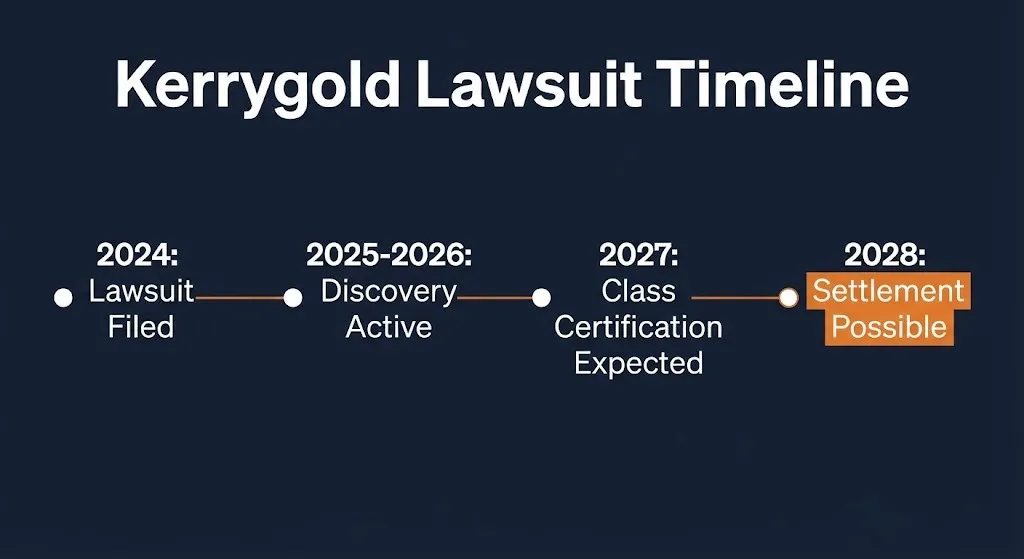
Late 2026: Discovery continues and expert reports are exchanged.
2027: The court is expected to rule on class certification.
If class certified: The case likely proceeds to settlement negotiations or trial.
If settlement reached: A preliminary approval motion, notice program, and claim window would follow.
After final approval: Payments would be issued, likely in 2028 or later.
These dates are estimates based on the current docket. They can change.
Frequently Asked Questions
Is there a Kerrygold class action settlement in 2026?
No. No settlement has been reached or approved. The case is still in discovery.
Can I sign up for the Kerrygold lawsuit?
No. There is no sign-up process. If a class is certified, you may be included automatically.
What proof do I need for a Kerrygold claim?
Nothing yet. If a settlement occurs, proof of purchase such as receipts or digital order history may help. A no-proof option is likely.
Is Kerrygold butter recalled?
No. There is no recall. The lawsuit is about alleged PFAS disclosure, not acute safety.
How much will I get from the Kerrygold lawsuit?
Nothing is determined. If a settlement occurs, payouts will likely be small, similar to other food labeling class actions.
Where is the Kerrygold lawsuit filed?
The case is pending in the U.S. District Court for the Southern District of New York.
What is Ornua Foods?
Ornua Foods North America is the U.S. subsidiary that markets and sells Kerrygold butter.
Will I be notified about the Kerrygold settlement?
If a settlement is approved and you are a class member, you should receive notice through a court-approved notice program.
The Kerrygold butter lawsuit is real but unresolved. No class has been certified. No settlement exists. No claim form is available. The best thing you can do is keep your receipts and ignore anyone asking for money to join. The case is about disclosure, not danger. If it settles, the payout will likely be small, as most consumer food class actions are. The next real milestone is the class certification decision, expected no earlier than 2027.