ChatGPT Lawsuit 2026: Settlement Status, Claim Deadlines, and Who May Qualify
Quick Answer:
- Multiple class action lawsuits against OpenAI over ChatGPT data practices are real and pending in federal courts.
- No settlement fund exists yet, and no per-person payout amounts have been determined.
- There is no claim deadline. Any website asking you to file a ChatGPT claim now is not legitimate.
You’ve likely seen headlines about ChatGPT lawsuits. Maybe you got an email or saw a social media post claiming you can get settlement money. The short answer: the lawsuits are real, but no settlement exists yet.
The cases against OpenAI and related defendants are moving through federal courts. They raise serious questions about how AI models were trained and what data was used without permission. But litigation takes years, and these cases are still in early or middle stages.
This article explains what’s been filed, who may be affected, what the lawsuits actually claim, and what to watch for. One surprising verified detail: some of the most advanced claims aren’t about what ChatGPT said, but about what it allegedly copied from copyrighted work without permission.
The Facts
| Case | ChatGPT and OpenAI class action lawsuits (multiple pending) |
|---|---|
| Status | Active litigation, no consolidated settlement approved |
| Fund Size | Not yet confirmed |
| Est. Per Person | Not yet determined |
| Claim Deadline | None set, do not file anything yet |
| Administrator | Not yet appointed |
| Proof Needed | Check official settlement website when established |
Is the ChatGPT Lawsuit Real?
The ChatGPT lawsuit is real, but it isn’t one single case. Multiple proposed class action complaints have been filed against OpenAI and related defendants in U.S. federal courts since 2023.
The lawsuits fall into several categories. Some allege privacy violations related to data scraping and training practices. Others allege copyright infringement by authors, publishers, and creators who say their work was used without permission. Still others claim defamation when ChatGPT generated false information about named individuals.
These cases have been filed in federal district courts across the country. Some have been consolidated for pre-trial proceedings. Others remain separate. The Judicial Panel on Multidistrict Litigation has weighed in on some of the copyright cases, consolidating them in the Southern District of New York.
The litigation is real. Court records confirm active dockets. But no settlement has been approved in any of the major ChatGPT class actions. Any website claiming a payout is ready is either misinformed or running a scam.
Is the ChatGPT Settlement Legitimate?
There is no ChatGPT settlement to verify as of August 2026. No settlement agreement has received preliminary approval from any court. No settlement administrator has been appointed. No claims process has opened.
This creates a perfect environment for scammers. They know people have heard about ChatGPT lawsuits. They create fake settlement websites, send phishing emails, and run ads promising easy money.
Here’s how to protect yourself:
- Check the official court docket before trusting any settlement claim
- No legitimate class action settlement requires a filing fee
- No real administrator will text you first asking for bank information
- Real settlement notices come from a court-appointed administrator, never from a random website
If you see a website claiming to process ChatGPT settlement claims, verify it against official court records. The U.S. District Court docket will list any approved settlement and the appointed administrator.
Key Takeaway: Real lawsuits exist, but no settlement has been approved. Treat any “claim now” message about ChatGPT as suspicious until a court confirms otherwise.
How Much Could the ChatGPT Settlement Pay Per Person?
No settlement fund exists, so any payout estimate is speculative. The amount a class member might receive depends on which case settles, the size of the class, and the legal theory involved.
Different ChatGPT lawsuits have different damages frameworks. Privacy cases may seek statutory damages under state laws. Copyright cases may seek actual or statutory damages under the Copyright Act. Defamation cases seek compensatory damages for reputational harm.
Here’s a realistic framework based on comparable cases:
| Case Type | Possible Per-Person Range | Likelihood |
|---|---|---|
| Privacy statutory damages | $100 to $5,000 | Depends on state law |
| Copyright infringement | $750 to $30,000 per work | For creators, not general users |
| Defamation | Varies widely | Rarely certified as class action |
| Data scraping without consent | $50 to $500 | Moderate |
| No settlement, case dismissed | $0 | Possible |
The privacy cases against tech companies provide some comparison points. The Google Plus data exposure settlement paid about $7.50 per person. The Facebook biometric privacy settlement in Illinois paid around $397 per person. But those cases involved different legal claims and different class sizes.
For now, the honest answer is: not yet determined. No settlement has been approved. No fund has been established. Anyone quoting a specific number is guessing or misleading you.
Reality Check: No One Is Sending You ChatGPT Settlement Money Right Now
Scammers follow lawsuit news closely. When a case like ChatGPT gains media attention, fake settlement sites appear within days. They use official-sounding names and promise quick payouts. Here’s the reality: legitimate class action settlements never require you to pay a fee to file a claim. No real settlement administrator will ask for your bank password, your Social Security number upfront, or a “processing fee.” Filing a claim, when a real settlement exists, is always free. If someone asks you to pay to get settlement money, it’s a scam. The official court docket and any future settlement website are the only places to trust.
Who Is Affected by the ChatGPT Lawsuit?
The proposed classes in ChatGPT lawsuits vary widely depending on the legal theory. There isn’t one unified class definition because there isn’t one unified case.
For privacy lawsuits, the proposed classes may include:
- Internet users whose data was allegedly scraped for training purposes
- ChatGPT users whose personal information was allegedly exposed through model outputs
- Individuals whose data was allegedly collected without proper consent
- Minors whose data was allegedly collected without parental consent
For copyright lawsuits, the proposed classes are different:
- Authors whose published works were allegedly used in training data
- Visual artists whose images were allegedly used without permission
- Publishers and news organizations claiming systematic infringement
For defamation cases, the claims are individual rather than class-based. A defamation class action is rare because reputational harm is highly personal.
If you’re a regular ChatGPT user, you may eventually be included in a privacy class if one is certified. But class certification hasn’t happened in most ChatGPT cases. No one is automatically enrolled in anything right now.
What Is the ChatGPT Lawsuit About?
The ChatGPT lawsuits center on several distinct legal claims. Understanding them helps you evaluate which cases might affect you.
The primary allegations include:
- OpenAI allegedly scraped personal data from the internet without consent
- Training data allegedly included copyrighted books, articles, and images
- ChatGPT allegedly generated false and defamatory statements about named individuals
- Data collection allegedly violated state privacy laws and federal statutes
- OpenAI allegedly failed to provide proper notice about data usage
The privacy claims draw on laws like the Illinois Biometric Information Privacy Act, the California Consumer Privacy Act, and common law privacy torts. The copyright claims draw on the federal Copyright Act. The defamation claims draw on state defamation law.
The cases are at different stages. Some privacy cases have survived motions to dismiss. Some copyright cases have been consolidated. The defamation cases have had mixed results.
This fragmentation is important. It means there won’t be one single “ChatGPT settlement.” There may be several settlements in different cases, or none at all.
What Happened With ChatGPT and Data Scraping?
The data scraping allegations are among the most significant in the ChatGPT litigation. The complaints allege that OpenAI collected massive amounts of data from the public internet to train its language models.
According to court filings, the alleged data collection included:
- Social media posts and profiles
- Blog comments and forum discussions
- Personal information from public records
- Private conversations exposed through data breaches
- Images and videos containing biometric identifiers
The plaintiffs argue this collection happened without meaningful consent. They claim OpenAI didn’t notify individuals that their data was being scraped, let alone obtain permission to use it.
OpenAI has defended its practices. The company argues that training on publicly available data is lawful and that the models learn patterns rather than storing personal information. The company also argues that some claims are barred by the First Amendment.
These legal questions are unresolved. Courts are still working through whether scraping public data for AI training violates privacy laws. The answers will shape the entire AI industry, not just ChatGPT.
Key Takeaway: The data scraping claims are unresolved. Courts haven’t ruled on whether training AI on public data violates privacy laws.
What Are the Copyright Claims Against OpenAI?
The copyright lawsuits against OpenAI are some of the most closely watched cases in the AI space. Authors, publishers, and artists allege that OpenAI used their copyrighted works to train ChatGPT without permission.
The copyright claims include:
- Direct infringement by copying protected works into training datasets
- Vicarious infringement by profiting from infringing outputs
- Contributory infringement by enabling users to generate infringing content
- Violations of the Digital Millennium Copyright Act by removing copyright management information
The plaintiffs include well-known authors and major publishers. They argue that ChatGPT can reproduce portions of copyrighted books and articles, proving the works were included in training data.
OpenAI argues that training on copyrighted works is fair use. The company compares AI training to a person reading books and learning from them. That argument is untested in the courts.
Several of these cases have been consolidated in the Southern District of New York. The court has allowed some claims to proceed while dismissing others. A trial date hasn’t been set.
How to File a ChatGPT Lawsuit Claim
You can’t file a claim yet because no settlement exists. When and if a settlement is approved in one of the ChatGPT cases, here’s how the process will work:
- The court will issue a preliminary approval order.
- A settlement administrator will be appointed.
- The administrator will create an official settlement website.
- Notice will be sent by email or mail to potential class members.
- You’ll complete a claim form online or by mail.
- You’ll provide basic identifying information and possibly proof of eligibility.
- You’ll submit the claim before the deadline.
The process takes months. Between preliminary approval and the claim deadline, there’s typically a 60 to 90 day window. That gives class members time to receive notice and respond.
When a real settlement is announced, you’ll hear about it from multiple reliable sources: the court docket, legal news outlets, and the official settlement website. You won’t hear about it first from a random social media ad.
For now, the best action is to check the official court docket periodically or follow reputable legal news coverage. There’s nothing to file, no form to complete, and no deadline to meet.
What Is the Current Status of ChatGPT Lawsuits in 2026?
As of August 2026, the ChatGPT litigation remains fragmented across multiple federal courts. No consolidated settlement has been approved. No class has been certified in the major privacy cases. No trial date has been set in the consolidated copyright cases.
The privacy cases are at various stages. Some have survived motions to dismiss. Others have been dismissed with leave to amend. The class certification process hasn’t begun in most of them.
The copyright cases have made more progress. The consolidated action in the Southern District of New York has completed some discovery. The court has issued rulings on pre-trial motions. But a trial is still months or years away.
The defamation cases have had mixed results. Some have been dismissed on jurisdictional grounds. One notable case against OpenAI involving a radio host was dismissed because ChatGPT’s output wasn’t considered defamatory under the applicable legal standard.
The practical takeaway: none of these cases are close to settlement. Anyone claiming otherwise is wrong.
What Evidence Do You Need for a Future ChatGPT Claim?
You won’t need much proof if a settlement is reached in a privacy case. Class action settlements typically require only basic identifying information.
For privacy cases, you might need:
- Proof that you used ChatGPT or other OpenAI services
- Evidence that your data was publicly available online
- Email confirmations from OpenAI
- Account creation details
For copyright cases, the proof requirements would be different:
- Proof of copyright ownership
- Publication records
- ISBNs for books or registration numbers for articles
- Evidence the work was likely included in training data
The exact requirements will depend on the settlement terms. When a real settlement is approved, the claim form will specify what’s needed.
Don’t stress about documentation right now. No claim form exists. When one does, it will specify exactly what’s required. Most class members simply fill out a short online form and don’t need to submit supporting documents.
Who Are the Defendants in the ChatGPT Lawsuits?
The primary defendant in most ChatGPT lawsuits is OpenAI, the company that developed and operates ChatGPT. OpenAI is a U.S.-based artificial intelligence research organization with a for-profit subsidiary.
In some cases, additional defendants are named:
- Microsoft, which has invested heavily in OpenAI and integrated ChatGPT into its products
- Companies that allegedly provided training data
- Data brokers that allegedly collected and sold personal information
The relationship between OpenAI and Microsoft is a key issue in some cases. Plaintiffs argue that Microsoft is jointly liable for alleged violations because of its deep integration with OpenAI’s technology.
Microsoft disputes this. The company argues it’s a separate legal entity that shouldn’t be liable for OpenAI’s alleged misconduct. Courts are still working through these questions.
For class members, the exact defendant list matters less than the outcome. A settlement could come from OpenAI, Microsoft, or both. The source of the fund doesn’t change how claims are filed.
Key Takeaway: OpenAI is the primary defendant, with Microsoft named in some cases. No defendant has agreed to a settlement in the major ChatGPT class actions.
When Could a ChatGPT Settlement Be Announced?
No settlement announcement date has been scheduled. Settlement negotiations can happen at any point in litigation, but they often accelerate after key rulings.
The most likely trigger for settlement talks in the privacy cases is a class certification ruling. If the court certifies the class, the defendant faces the prospect of a large damages award. That creates pressure to settle. If the court denies certification, the plaintiffs’ leverage drops significantly.
For the copyright cases, the trigger could be a summary judgment ruling. If the court rules on fair use, the case may settle quickly. A ruling that training on copyrighted works isn’t fair use would dramatically increase OpenAI’s exposure.
Other potential settlement triggers include:
- A favorable evidentiary ruling for either side
- Discovery revealing damaging internal documents
- A ruling on the admissibility of expert testimony
None of these events are scheduled. The cases could settle next month or go to trial in 2027 or 2028. Anyone claiming to know the settlement date is speculating.
What Should You Do Right Now About the ChatGPT Lawsuit?
There’s nothing to do right now except stay informed. No claim form exists. No deadline is approaching. No payment is pending.
Here’s what you can do to prepare for a possible future settlement:
- Save any emails from OpenAI or ChatGPT, especially account confirmation or purchase receipts
- Note the approximate dates you used ChatGPT if applicable
- Check the official court docket every few months for updates
- Follow reputable legal news coverage, not social media ads
- Ignore any website claiming to process claims now
The most important step: don’t give your personal information to any website claiming to handle ChatGPT settlement claims. Those sites are collecting data for lead generation or worse.
When a real settlement is reached, you’ll have plenty of notice. Class action settlements are announced through official channels, and the notice period is typically several months.
What Are the Privacy Claims Specifically?
The privacy claims in ChatGPT lawsuits fall into several distinct categories. Understanding them helps you evaluate whether you might be included in a future class.
The main privacy claims include:
- Violation of the Illinois Biometric Information Privacy Act for alleged voice and facial data collection
- Violation of the California Consumer Privacy Act for alleged data collection without proper notice
- Violation of the federal Children’s Online Privacy Protection Act for alleged collection of minors’ data
- Common law intrusion upon seclusion claims
- State wiretapping and eavesdropping claims
The biometric privacy claims are potentially the most valuable. The Illinois law provides for statutory damages of $1,000 per negligent violation and $5,000 per intentional violation. That’s per person, per violation.
But class certification is required before any of these claims can proceed as a class action. The court hasn’t certified a class in any major ChatGPT privacy case. That’s the next major milestone to watch.
What Is the Status of the Copyright Cases?
The copyright cases against OpenAI are the most advanced of the ChatGPT lawsuits. Several have been consolidated in the Southern District of New York before a single judge.
The consolidated action includes claims from authors, publishers, and other copyright holders. The plaintiffs allege that OpenAI copied their works into training datasets without permission.
The court has ruled on some pre-trial motions. Some claims have been dismissed. Others have survived. The case is moving through discovery, with both sides exchanging documents and taking depositions.
A trial date hasn’t been set. Summary judgment motions are expected, but the timing hasn’t been announced. If the case survives summary judgment, a trial could happen in 2027.
The outcome of these cases matters beyond individual payouts. A ruling on fair use for AI training would reshape the entire AI industry. That’s one reason OpenAI is likely to fight rather than settle quickly.
What Does the Defamation Litigation Look Like?
The defamation cases against OpenAI are distinct from the class actions. They’re individual lawsuits brought by people who claim ChatGPT generated false statements about them.
One notable case involved a radio host who alleged ChatGPT falsely accused him of embezzlement. The court dismissed the case, ruling that OpenAI wasn’t liable for ChatGPT’s output under the applicable legal standard.
Another case involved a mayor in Australia who threatened to sue after ChatGPT allegedly made false statements about him. That case didn’t result in a U.S. federal filing.
The defamation cases are less likely to produce class action settlements. Defamation is inherently personal. The harm varies from person to person. Courts are also reluctant to hold AI companies liable for generated content under current defamation law.
If you believe ChatGPT generated false information about you, you might have an individual claim. But that’s not a class action. You’d need to consult a lawyer about your specific situation.
Key Takeaway: The defamation cases are individual lawsuits, not class actions. They’re unlikely to produce a settlement fund for general ChatGPT users.
What Happens Next in the ChatGPT Lawsuits?
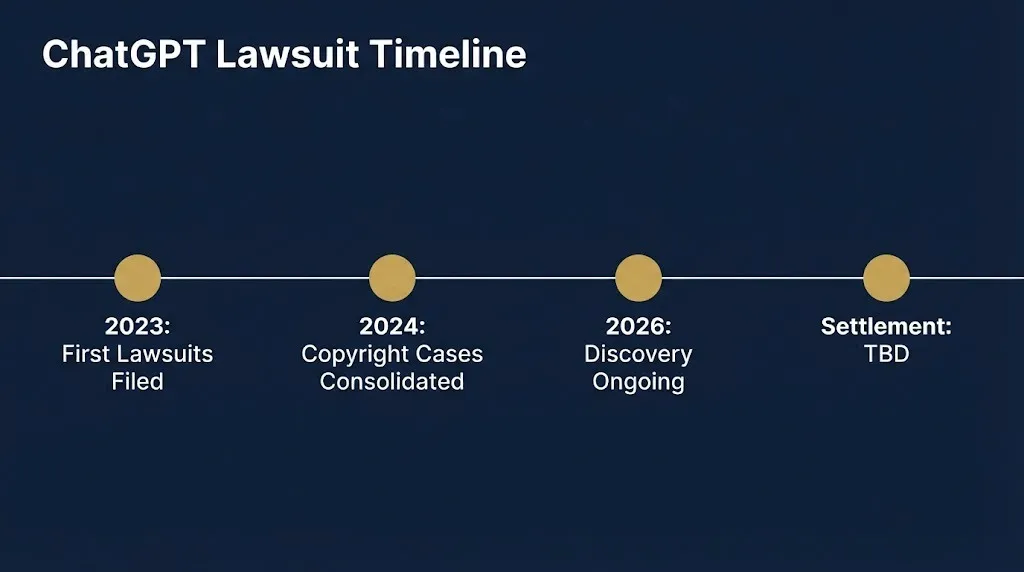
The ChatGPT litigation is following the standard path for complex federal litigation. Here’s the expected timeline:
- Late 2026 or 2027: Class certification rulings in privacy cases expected
- 2027: Summary judgment motions in consolidated copyright cases
- 2027 or 2028: Possible trial dates if cases don’t settle
- 6 to 9 months after any settlement: Claim filing period opens
- 3 to 6 months after claim deadline: Payments distributed, if approved
These dates are estimates. The courts haven’t set trial dates in most ChatGPT cases. No class certification hearings have been scheduled.
The most important point: nothing is happening quickly. This is a slow process, and there’s no action required from you at this stage.
Frequently Asked Questions
Is there a ChatGPT class action settlement in 2026?
No settlement has been approved as of August 2026.
The cases are still in active litigation.
No claim deadline exists because no settlement exists.
How do I know if I qualify for the ChatGPT lawsuit?
You may qualify if you used ChatGPT or had your data scraped for training.
The exact class definitions haven’t been finalized.
Class certification hasn’t been granted in the major privacy cases.
How much will I get from the ChatGPT settlement?
No settlement amount has been determined.
No settlement fund has been established.
Any payout figures you see online are speculative.
Is the ChatGPT lawsuit a scam?
The lawsuits themselves are real and filed in federal court.
But any website asking you to file a claim now is suspicious.
No legitimate claim process exists yet.
When will ChatGPT settlement checks be mailed?
No checks have been authorized.
No payment date has been scheduled.
Payments are at least a year away, if they happen at all.
Do I need a lawyer to file a ChatGPT claim?
No lawyer is needed to file a class action claim.
When a settlement is reached, you’ll file through a simple online form.
Hiring a lawyer for a class action claim is almost never necessary.
What is the ChatGPT lawsuit deadline?
There is no deadline to file a claim.
No claim form has been created.
When a settlement is approved, the deadline will be announced publicly.
What did OpenAI allegedly do wrong?
The lawsuits allege OpenAI scraped personal data without consent.
Training data allegedly included copyrighted works without permission.
Some cases claim ChatGPT generated false statements about individuals.
The ChatGPT lawsuits are real, but they haven’t produced a settlement. If you used ChatGPT or had your data scraped for training, you may eventually be included in a class. For now, the best thing you can do is avoid fake claim websites, hold onto any account emails, and check the official court docket periodically.
The single most important fact: no claim deadline exists because no settlement has been approved. When that changes, you’ll hear about it from official sources, not random online ads.