Is the Camp Lejeune Lawsuit Real and Still Active in 2026?
Quick Answer
- Individual Elective Option payouts run $100,000 to $550,000 based on illness tier and years of exposure, not a single flat number.
- DOJ has approved offers averaging roughly $294,000 per accepted claim as of the last public count, but most of the 400,000-plus filed claims have not been resolved.
- New administrative claims closed August 10, 2024; anyone who did not file by that date cannot start a new Camp Lejeune Justice Act claim.
If you were stationed at, worked at, or lived at Camp Lejeune between 1953 and 1987 and later got sick, you’ve probably searched this exact phrase. You want one number. The honest answer is that there isn’t one yet.
The Camp Lejeune Justice Act lets veterans, family members, and civilian workers sue the federal government over the base’s contaminated drinking water. As of mid-2026, the government has resolved fewer than 1 percent of roughly 400,000 filed claims, and the one deadline that already passed, August 10, 2024, closed the door on new filings.
This article walks through the real payout ranges, the tier system that actually decides your number, how to check your claim status, and what happens next in the federal litigation. One detail most articles skip: no Camp Lejeune bellwether trial has produced a verdict yet, despite the case being filed in 2022.
The Facts
| Case | In re: Camp Lejeune Water Litigation, Case No. 7:23-cv-897 |
| Court | U.S. District Court, Eastern District of North Carolina |
| Status | Active litigation and administrative claims; no bellwether trial held; no global settlement fund confirmed |
| Fund Size | CBO estimate of roughly $21 to $22 billion (projection, not a confirmed appropriated fund) |
| Est. Per Person | $100,000 to $550,000 under the Elective Option; federal court verdicts uncapped but none have occurred yet |
| Claim Deadline | New claims closed August 10, 2024 (passed) |
| Administrator | No single administrator; claims run through the U.S. Department of the Navy Tort Claims Unit and DOJ |
| Proof Needed | 30+ days at Camp Lejeune between August 1953 and December 1987, plus a qualifying diagnosis |
Is the Camp Lejeune Lawsuit Real and Still Active in 2026?
Yes, the Camp Lejeune litigation is a real, active federal case, not a scam or a closed matter.
Congress passed the Camp Lejeune Justice Act in 2022, opening a two-year window for people harmed by the base’s contaminated water to file claims against the federal government. That filing window closed on August 10, 2024, but the claims already filed are still working through both an administrative settlement track and the federal court system in the Eastern District of North Carolina.
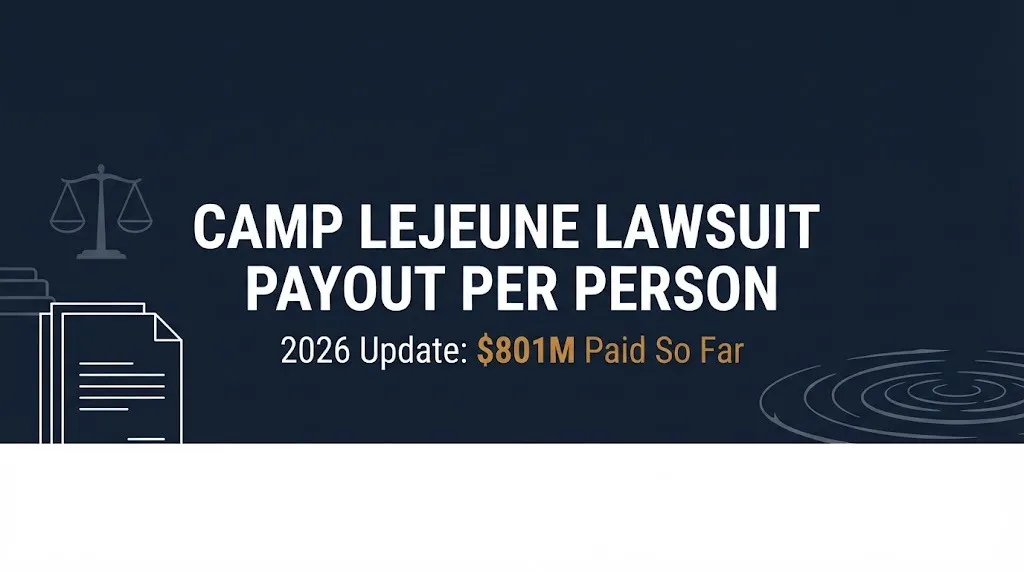
As of July 17, 2026, the Department of Justice reported total settlement offers exceeding $968 million, with paid settlements exceeding $801 million. That money is real and it is moving, just slowly against a claim pool that size.
Key Takeaway: The lawsuit is legitimate and government-run, but “active” does not mean “resolved,” most claims are still waiting.
Camp Lejeune Lawsuit Payout Per Person: What the Numbers Actually Show
There is no fixed Camp Lejeune payout per person. Your number depends on your diagnosis tier and how long you were exposed.
The closest thing to a real average comes from DOJ’s own reporting. In February 2026, the government had approved offers for 2,353 claimants worth a combined $691.3 million, an average of roughly $294,000 per approved claim. That average includes both smaller and larger tier payouts blended together, so it is not what any individual claimant should expect.
Compare it to a delayed tax refund: the IRS can tell you the average refund nationally, but yours depends entirely on your own return. Camp Lejeune works the same way.
Key Takeaway: Treat any “average payout” figure as a blended number, not a personal estimate, your tier and exposure length set your actual range.
Camp Lejeune Elective Option: Payout Tiers Explained
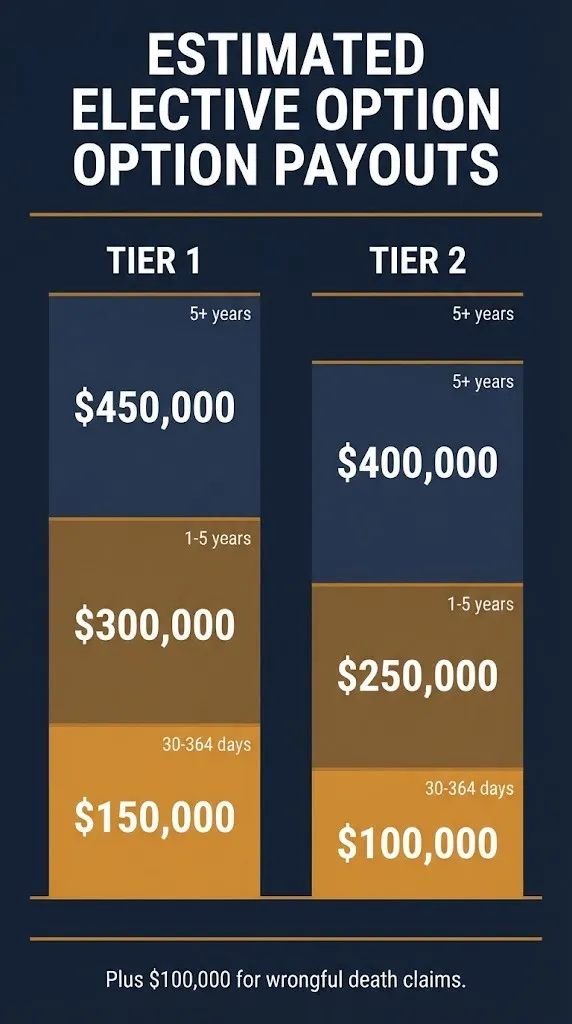
The Elective Option is the government’s expedited settlement track, and it pays based on a fixed grid, not negotiation.
Claimants choose between two illness tiers. Tier 1 covers diseases with the strongest scientific link to the water: kidney cancer, liver cancer, bladder cancer, leukemia, and non-Hodgkin’s lymphoma. Tier 2 covers conditions with a weaker but still recognized link.
Elective Option Payout Grid
| Exposure Length | Tier 1 Payout | Tier 2 Payout |
|---|---|---|
| 30 to 364 days | $150,000 | $100,000 |
| 1 to 5 years | $300,000 | $250,000 |
| More than 5 years | $450,000 | $400,000 |
Claimants filing on behalf of someone who died from a qualifying illness receive an additional $100,000, which can push a Tier 1, long-exposure claim to $550,000. Accepting an Elective Option offer means giving up the right to sue in federal court for that claim.
Key Takeaway: The Elective Option pays fast but caps at $550,000, federal litigation has no cap but currently has zero completed verdicts to point to.
Should You Accept an Elective Option Offer or Wait for Trial?
Whether to accept depends on how strong your case is for a federal court verdict and how quickly you need money.
Accepting the Elective Option typically means payment within 60 days of accepting the offer, and claimants generally have 60 days to decide whether to accept or decline. Declining preserves your right to pursue the case in the Eastern District of North Carolina, where damages are not capped, but that route takes years and has not yet produced a single verdict.
A few things to weigh before deciding:
- Your illness tier and whether it’s likely to be valued much higher at trial.
- Your age and health, since litigation can take years longer than the EO track.
- Whether your attorney believes your case is strong on causation evidence.
- Your need for near-term money versus a potentially larger, uncertain future payout.
Reality Check: No government agency or law firm will text you out of nowhere asking you to “confirm” a Camp Lejeune payment or pay an upfront fee to release your settlement. Filing a claim and checking your status is always free. If someone contacts you demanding money first, that is not the Navy, DOJ, or a legitimate settlement administrator.
Camp Lejeune Lawsuit Update: What’s Happened So Far in 2026
The litigation moved through discovery and pretrial disputes for most of 2026 without a single bellwether trial verdict.
As of the June 15, 2026 status report, DOJ settlement offers had reached $907 million, with $723 million actually paid, out of roughly 407,000 filed claims. That number rose again by mid-July, with offers passing $968 million and payments passing $801 million.
One correction worth flagging: some legal-marketing sites circulated a claim earlier in 2026 that three Track 1 bellwether cases had already settled for small dollar amounts. No court docket or DOJ statement backs that up, and it appears to be unsourced. As of this writing, no Camp Lejeune bellwether trial has occurred and no verdict exists.
Key Takeaway: Total dollars paid keep climbing, but they still represent well under 1 percent of the claims filed, resolution is happening in a trickle, not a wave.
How Much Has Camp Lejeune Paid Out So Far?
As of the most recent public DOJ figures, roughly $801 million has actually been paid out, against $968 million in total offers.
| Reporting Date | Offers Made | Amount Paid |
|---|---|---|
| February 2026 | $691.3 million | Not separately reported |
| April 2026 | $794 million | $543 million |
| June 15, 2026 | $907 million | $723 million |
| July 17, 2026 | $968 million | $801 million |
The Congressional Budget Office has projected a total cost around $21 to $22 billion to fully resolve every Camp Lejeune claim, but that figure is a projection, not money that has been appropriated or committed as a settlement fund. Treat it as a ceiling estimate, not a confirmed pot of money.
When Will the Camp Lejeune Bellwether Trial Happen?
No firm trial date has been set for the first Camp Lejeune bellwether trial as of August 2026.
The court organized a Track 1 group of roughly 23 to 25 plaintiffs covering five illnesses most strongly linked to the water: bladder cancer, kidney cancer, leukemia, non-Hodgkin’s lymphoma, and Parkinson’s disease. Judge Dever in the Eastern District of North Carolina is overseeing this track, with early trials expected to focus on leukemia and non-Hodgkin lymphoma cases.
Before any trial can start, the court still has to resolve:
- Disputes over which expert testimony on causation each side can use.
- Whether the government can offset damages using VA, Medicare, or Medicaid benefits already paid.
- The legal standard for proving that Camp Lejeune water caused a specific illness.
In March 2026, the court struck reports from a key DOJ expert witness, a win for plaintiffs on one procedural front. The government has said it wants its remaining bellwether cases positioned for trial by the end of 2026, but the court has explicitly said it will set dates only after these threshold issues are decided.
Who Qualifies for Camp Lejeune Compensation?
You may qualify if you spent at least 30 days at Camp Lejeune between August 1953 and December 1987 and later developed a qualifying illness.
This covers active-duty service members, family members who lived on base, and civilian workers. The Agency for Toxic Substances and Disease Registry has documented volatile organic compounds, including trichloroethylene (TCE), tetrachloroethylene (PCE), benzene, and vinyl chloride, in the base’s drinking water systems at levels far above safe limits.
Who May Qualify, at a glance:
- Marines, sailors, and other service members stationed at Camp Lejeune for 30+ days in the exposure window.
- Family members who lived on base during that period.
- Civilian employees who worked on base during that period.
- People later diagnosed with a recognized qualifying illness (cancer types, Parkinson’s disease, and others tied to the ATSDR research).
- Family members filing on behalf of someone who died from a qualifying illness.
Because the filing window for new administrative claims closed in August 2024, qualifying today mostly matters for people who already filed and are tracking or contesting their claim status, not for starting something new.
What Illnesses Qualify for a Camp Lejeune Settlement?
Qualifying illnesses fall into the same two tiers used for Elective Option payouts, based on the strength of the scientific link to the water.
Tier 1 illnesses (strongest evidence): kidney cancer, liver cancer, bladder cancer, leukemia, and non-Hodgkin’s lymphoma.
Tier 2 illnesses (weaker but still recognized evidence): a broader set of conditions the Navy’s public Elective Option guidance lists separately, including additional cancers and neurological conditions linked to the ATSDR’s research.
Claims involving Parkinson’s disease sit outside the standard Elective Option grid and are more often pursued through federal litigation, since attorneys have generally projected higher potential values for these cases than the EO tiers offer, though no verdict has confirmed that yet.
How to Check Your Camp Lejeune Claim Status
If you already filed a claim, you can track it directly, no lawyer required to check status alone.
- Log into the Navy’s Camp Lejeune claims portal with your claim confirmation information.
- Review whether your claim shows as pending, under review, or resolved.
- Check for any requests for additional medical or service records.
- Upload any missing documentation promptly to avoid delays.
- Contact your attorney, if you have one, for updates on Elective Option eligibility.
- Watch for a formal settlement offer letter before assuming any payout amount.
- Confirm any communication came from an official government or verified law firm source before responding.
How to File a Camp Lejeune Claim (For Claims Already in the System)
New administrative claims can no longer be filed, since the deadline passed on August 10, 2024. If you already have a pending claim, here is how the process moves forward.
- Your attorney or you submit medical and service records establishing your diagnosis and time on base.
- The Navy’s Tort Claims Unit reviews the claim for Elective Option eligibility.
- If eligible, you receive a settlement offer letter with a specific dollar figure.
- You have roughly 60 days to accept or decline the offer.
- Accepted claims are typically paid within about 60 days of acceptance.
- Declined claims proceed into the federal litigation track in the Eastern District of North Carolina.
Key Takeaway: The claim-filing door is closed, but claim tracking, documentation, and offer decisions remain very active for the roughly 400,000 people already in the system.
What Happens Next in the Camp Lejeune Litigation
- Late 2026 (expected): The court aims to resolve remaining expert testimony and causation disputes before setting Track 1 trial dates.
- Expected, no confirmed date: First Track 1 bellwether trials, likely starting with leukemia and non-Hodgkin lymphoma cases before Judge Dever.
- Ongoing: Elective Option offers and payments continue to climb month over month for claimants who already filed.
- TBD: Whether bellwether outcomes push the government toward a broader global settlement framework, which would set clearer numbers for the remaining claims.
- TBD: Any Congressional action on adding judges to the Eastern District of North Carolina to speed processing, a bill has been introduced but not passed.
Frequently Asked Questions
Is the Camp Lejeune lawsuit a scam?
No, it’s a real federal legal process created by the 2022 Camp Lejeune Justice Act.
Settlement offers and payments are tracked publicly through Department of Justice reporting, not through private companies promising guaranteed money.
How much is the average Camp Lejeune settlement?
The most recent DOJ data shows approved Elective Option offers averaging around $294,000 per claimant.
Your actual number depends on your illness tier and how long you were exposed, not this blended average.
Can I still file a new Camp Lejeune claim in 2026?
No, the deadline to file a new administrative claim was August 10, 2024, and that window has closed.
If you already filed before that date, your claim remains active in the system.
What is the Camp Lejeune Elective Option?
It’s a faster, government-run settlement track that pays fixed amounts based on illness tier and years of exposure.
Payouts range from $100,000 to $550,000, but accepting one means giving up your right to sue in federal court for that claim.
When will Camp Lejeune settlement checks go out?
For approved Elective Option claims, payment typically follows within about 60 days of accepting the offer.
For claims heading to federal court, no trial verdict has occurred yet, so there’s no fixed payment timeline for that track.
Do I need a lawyer to file or track a Camp Lejeune claim?
No, you can track an existing claim yourself through the Navy’s claims portal without an attorney.
Many claimants use an attorney for evidence gathering and to evaluate whether to accept an Elective Option offer or pursue litigation.
What illnesses qualify for Camp Lejeune compensation?
Tier 1 illnesses include kidney cancer, liver cancer, bladder cancer, leukemia, and non-Hodgkin’s lymphoma.
Tier 2 covers additional conditions with a recognized but less certain link, and Parkinson’s disease claims are typically handled through litigation rather than the standard tier grid.
Has any Camp Lejeune case gone to trial yet?
No, as of August 2026, no Camp Lejeune bellwether trial has been held and no verdict exists.
The court is still resolving pretrial disputes over expert testimony before it will set trial dates.
If you already have a claim in the system, the single most useful thing you can do right now is check your status through the Navy’s claims portal and keep your medical documentation current. Watch for any Elective Option offer letter closely, since you’ll typically have about 60 days to decide whether to accept it.
The number that matters most today isn’t a payout figure, it’s this: as of July 17, 2026, only a small fraction of roughly 400,000 filed claims have actually been resolved.