Ozempic Lawsuit 2026: MDL Update, Settlement Status, and Who May Qualify
Quick Answer
- The Ozempic lawsuit is real: over 3,800 gastrointestinal cases (MDL 3094) and 146 vision loss cases (MDL 3163) are pending in federal court as of July 1, 2026.
- No payout amount exists yet. No settlement has been reached, and any figures you see online are attorney projections, not confirmed payments.
- There is no claim deadline right now, because there is no settlement fund. State statutes of limitations for filing an individual lawsuit still apply and vary by state.
Yes, the Ozempic lawsuit is real, and it’s grown into one of the largest pharmaceutical mass torts moving through federal court right now. Thousands of people who took Ozempic, Wegovy, or Rybelsus say the drug caused gastroparesis or sudden vision loss, and that Novo Nordisk didn’t warn them.
This affects anyone who used a semaglutide drug and later developed stomach paralysis, intestinal blockage, or the eye condition NAION. There’s no settlement check coming yet. That’s the single most important thing to understand before you read another word.
This article walks through where the litigation actually stands, what you’d need to qualify, and what the realistic timeline looks like. One detail most headlines skip: two separate federal court cases exist here, not one, and they’re moving at very different speeds.
The Facts
| Case | In re: GLP-1 Receptor Agonists (GLP-1 RAs) Products Liability Litigation, MDL No. 3094 (gastrointestinal); MDL No. 3163 (NAION/vision loss) |
| Court | U.S. District Court, Eastern District of Pennsylvania |
| Judge | Hon. Karen S. Marston |
| Status | Active discovery and pretrial motions. No trials held. No settlement. |
| Fund Size | Not yet confirmed. No settlement fund exists. |
| Est. Per Person | Not yet determined. Attorney projections range widely and are not guarantees. |
| Claim Deadline | None yet. Watch for MDL developments; state filing deadlines still apply separately. |
| Administrator | Not yet appointed. |
| Proof Needed | Prescription records plus medical documentation of a qualifying diagnosis (details below). |
Is the Ozempic Lawsuit Real? (VERIFY)
Yes. The Ozempic lawsuit is a confirmed, active federal litigation, not a rumor or a scam. Thousands of plaintiffs allege Novo Nordisk failed to warn them about gastroparesis and vision loss risks.
The federal Judicial Panel on Multidistrict Litigation consolidated these cases in September 2024 into MDL 3094, formally titled In re: Glucagon-Like Peptide-1 Receptor Agonists Products Liability Litigation. As of July 1, 2026, that docket held 3,848 pending cases. A second, newer MDL (3163) was created in December 2025 specifically for vision loss claims and held 146 pending cases as of the same date.
Both MDLs sit in the Eastern District of Pennsylvania before Judge Karen S. Marston, who took over after the death of the original presiding judge, Gene E.K. Pratter, in May 2024.
Key Takeaway: The Ozempic lawsuit is a confirmed, court-verified federal litigation with nearly 4,000 pending cases, but no money has changed hands yet.
Is the Ozempic Lawsuit a Scam? (VERIFY)
No, the underlying litigation is legitimate. But the space around it attracts opportunists, and that’s worth understanding before you engage with anyone claiming to represent your interests.
Real law firms take Ozempic cases on contingency, meaning you pay nothing upfront. Legitimate firms don’t ask for advance fees, gift cards, or “processing charges” to review your case.
If someone texts or calls claiming you’re already approved for an Ozempic settlement payout, that’s a red flag. No settlement has been reached, so nobody can promise you a check right now.
What Is the Ozempic Class Action Lawsuit? (BACKGROUND)
The Ozempic litigation is technically a multidistrict litigation (MDL), not a class action, though many people search for it using that term. The distinction matters for what you can expect.
In a class action, one settlement typically applies to an entire group with similar payouts. In an MDL, cases are consolidated for shared pretrial proceedings like discovery and expert testimony, but each plaintiff’s case keeps its own value based on their specific injury and damages.
Think of it like a group of homeowners suing a contractor over the same defective roofing material. They share the same expert witnesses and evidence about the product, but each homeowner’s payout depends on their own roof damage, not a flat per-person number.
Novo Nordisk Ozempic Lawsuit: Who Is Being Sued? (BACKGROUND)
Novo Nordisk, the Danish manufacturer of Ozempic, Wegovy, and Rybelsus, is the primary defendant. Eli Lilly, maker of Mounjaro, Zepbound, and Trulicity, is also named in the consolidated litigation since both companies’ GLP-1 drugs face similar allegations.
The core legal theory across both MDLs is failure to warn. Plaintiffs argue the companies knew or should have known about gastroparesis and vision loss risks and didn’t adequately disclose them on drug labels.
Novo Nordisk’s defense: The company maintains its products are safe and has moved to exclude plaintiffs’ expert witnesses. In a recent motion, Novo Nordisk argued the FDA-approved labeling was adequate and that expert causation testimony should be barred under evidentiary rules. That motion has not been granted as of this writing.
Lawsuit Against Ozempic: What Are the Claims? (BACKGROUND)
At a January 13, 2026 hearing, Novo Nordisk’s own attorney gave the court a breakdown of injuries alleged across the MDL 3094 docket:
| Injury Type | Share of Complaints |
|---|---|
| Gastroparesis / stomach paralysis | 75% |
| Ileus (intestinal blockage) | 18% |
| Gallbladder complications | 8% |
| Other severe GI conditions | 8% |
Vision loss claims (NAION) are handled separately in MDL 3163 and aren’t reflected in that table. Legal observers note NAION cases are drawing increasing attention because the injury, permanent blindness, is so severe.
Ozempic Lawsuit Stomach Paralysis: What Counts as Gastroparesis Here? (VERIFY)
Gastroparesis means your stomach muscles slow down or stop moving food into the small intestine properly. It’s the single most common injury alleged in the litigation.
Symptoms plaintiffs report include persistent nausea, repeated vomiting, bloating, abdominal pain, and unintended malnutrition. In August 2025, Judge Marston ruled that plaintiffs claiming gastroparesis must now support their diagnosis with a gastric emptying study (scintigraphy), a specific medical test. Subjective symptoms alone are no longer considered sufficient for these claims.
The FDA added intestinal blockage (ileus) warnings to the Ozempic label in September 2023. In January 2025, the label was updated again to state Ozempic “is not recommended in patients with severe gastroparesis,” though it stops short of saying the drug causes the condition. That gap between the warning and the allegation is exactly what the lawsuits are arguing about.
Ozempic Lawsuit Update: What’s Happened Recently? (STATUS)
Several developments have moved the litigation forward through mid-2026:
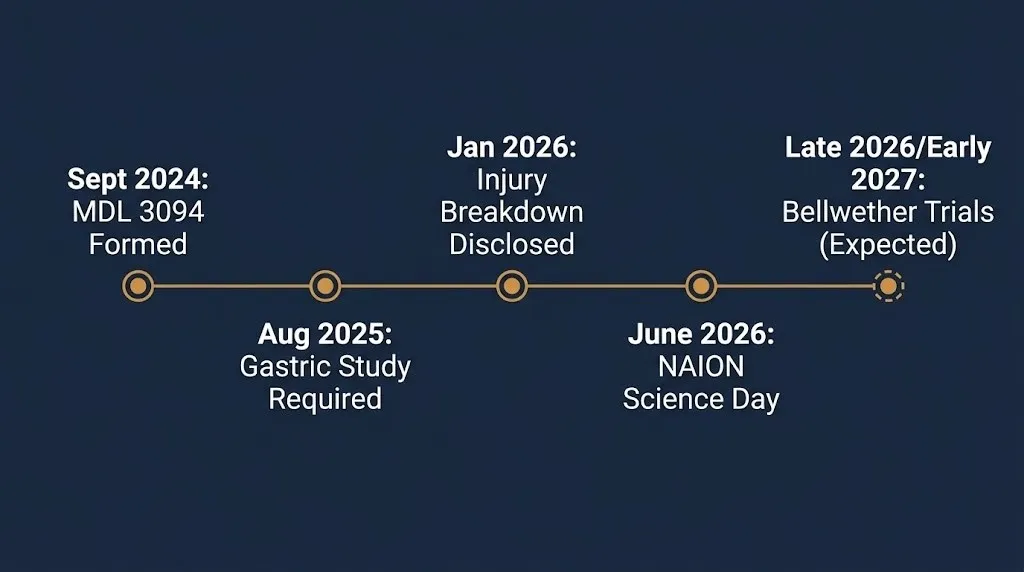
- January 13, 2026: Novo Nordisk disclosed the injury breakdown across pending MDL 3094 cases.
- May 2026: Judge Marston denied Eli Lilly’s motion to restrict testimony from former FDA Commissioner Dr. David Kessler, a win for plaintiffs on an expert-evidence dispute.
- June 2, 2026: A “Science Day” was held in MDL 3163, where both sides presented scientific evidence on the semaglutide-NAION link directly to the judge, an educational proceeding rather than a ruling.
- July 1, 2026: Case counts stood at 3,848 (MDL 3094) and 146 (MDL 3163).
Key Takeaway: No trial, verdict, or settlement has occurred in either MDL as of July 2026. Everything currently reported online is procedural movement, not a resolution.
Ozempic Lawsuit Latest News: Is There a Global Settlement Coming? (STATUS)
Not yet, and not soon. Legal analysts widely expect the earliest bellwether trials, test cases used to gauge how juries respond, to begin in late 2026 or early 2027, and some project settlement talks may not seriously start until 2027.
Bellwether trials work like a trial run before the main event. The court picks a handful of representative cases to try first. The outcomes help both sides estimate what larger settlements or verdicts might look like across the full docket, similar to how a home appraisal in your neighborhood sets expectations before you list your own house.
Fact discovery in MDL 3094 was targeted for completion around October 2025, with expert disclosures following. No trial date has been formally locked in as of this writing.
Ozempic Lawsuit $2 Billion: Where Does That Number Come From? (MONEY)
That figure is a projection of total potential liability across the entire litigation, not a confirmed settlement fund or a per-person payout. Legal and financial analysts, not the court, produced the estimate.
Multiple outlets citing outside analysts put Novo Nordisk’s total exposure across the Ozempic and related GLP-1 litigation at more than $2 billion, based on the volume of pending cases, injury severity, and potential punitive damages. That number reflects a ceiling analysts see as plausible if the litigation resolves unfavorably for the company, not money that has been awarded or is available to claim.
Reality Check: No court has ordered Novo Nordisk to pay $2 billion or any other figure. No settlement fund exists, no claims administrator has been appointed, and nobody can file a claim form for this litigation right now. Anyone contacting you to “process” an Ozempic payout is getting ahead of a case that hasn’t settled.
When Will the Ozempic Lawsuit Be Settled? (MONEY / STATUS)
There is no confirmed settlement date, and industry projections put any resolution well into 2027 or later. That timeline depends entirely on how bellwether trials go first.
Here’s the general sequence large pharmaceutical MDLs tend to follow, based on how this litigation has progressed so far:
- Discovery and expert disclosures (largely complete for MDL 3094 as of late 2025)
- Summary judgment motions and evidentiary rulings (ongoing through 2026)
- Bellwether trial selection and scheduling (underway)
- Bellwether trials themselves (expected late 2026 to early 2027)
- Settlement negotiations, if bellwether outcomes favor plaintiffs (no earlier than 2027 by most estimates)
Key Takeaway: Any date you see for a “settlement” right now is a forecast, not a scheduled event. Treat specific settlement dates you find elsewhere with real skepticism.
Ozempic Side Effects Lawsuit: What Payout Ranges Are Being Projected? (MONEY)
Not yet determined. No settlement values exist because no case in this MDL has resolved through trial or negotiated settlement.
Some legal analysts have published projected ranges based on comparable pharmaceutical mass torts, not on any actual Ozempic verdict or settlement:
| Injury Category | Projected Range (unconfirmed) |
|---|---|
| Gastroparesis requiring hospitalization | Analysts cite figures near $100,000 to $700,000 |
| Gastroparesis with gallbladder removal | Higher end of that same range, per some projections |
| NAION / permanent vision loss | Some analysts project over $1 million given the permanence of the injury |
These are speculative comparisons attorneys use to talk about potential case value. They are not confirmed payouts, and no one, including your own attorney, can guarantee what your case would be worth if a settlement eventually happens.
Ozempic Weight Loss Lawsuit: Does It Matter If I Took It for Weight Loss? (VERIFY)
No, off-label weight loss use doesn’t disqualify you. The litigation covers patients regardless of whether they took Ozempic for type 2 diabetes or for off-label weight loss.
Ozempic was FDA-approved in 2017 for type 2 diabetes. It’s widely prescribed off-label for weight loss, and plaintiffs in both categories are part of the consolidated litigation. Wegovy, the higher-dose version approved specifically for weight management, faces the same allegations.
One detail that does matter: some firms report that plaintiffs older than 75 at the time they started the medication, or those with a history of major gastric surgery like gastric bypass, may face additional hurdles establishing that the drug, rather than another factor, caused their injury.
Semaglutide Class Action Lawsuit: Does Compounded Semaglutide Count? (VERIFY)
Generally, no. The federal MDLs focus on brand-name products from Novo Nordisk (Ozempic, Wegovy, Rybelsus) and Eli Lilly (Mounjaro, Zepbound, Trulicity), not compounded semaglutide from weight loss clinics or compounding pharmacies.
Compounded products raise separate legal issues around dosing errors and different salt forms, which the FDA has separately warned about. The agency has said products using semaglutide sodium or semaglutide acetate haven’t been shown to be safe and effective in the way FDA-approved semaglutide has.
If you used a compounded version without a prescription for FDA-approved Ozempic or Wegovy specifically, your situation may need separate legal evaluation outside the current MDL structure.
Ozempic Lawsuit Lawyer: How Do I Know If I Qualify? (ACTION)
There’s no single official form to fill out yet, since no settlement exists. But you can take concrete steps now to protect your position if you believe you were injured.
- Gather your prescription records. Pharmacy printouts or insurance statements showing you were prescribed Ozempic, Wegovy, or Rybelsus.
- Collect your medical records. Documentation of your diagnosis, ideally including a gastric emptying study if your claim involves gastroparesis.
- Note your timeline. When you started the drug and when symptoms began matters for how strong a causation argument looks.
- Check your state’s statute of limitations. This is a real deadline, even though no settlement deadline exists yet. It typically runs two to three years from when you discovered the injury, but varies by state.
- Consult a product liability attorney. Most work on contingency, meaning no upfront cost.
- Avoid unsolicited offers. If you didn’t seek out a firm, be cautious about who’s reaching out to you first.
Key Takeaway: The state statute of limitations for filing your own individual lawsuit is the one deadline that’s real right now, and it doesn’t wait for the MDL to settle.
Are There Lawsuits Against Ozempic Specifically for Vision Loss? (VERIFY)
Yes. A separate federal MDL, No. 3163, was created in December 2025 specifically to handle claims that GLP-1 drugs caused NAION, a form of sudden and typically permanent vision loss affecting one eye.
Research cited in these cases, including a study published in JAMA Ophthalmology in 2024 examining over 16,000 patient records, found diabetic patients prescribed semaglutide had roughly four times the risk of developing NAION compared to those on other diabetes medications. Some more recent analyses put the relative risk as high as seven times for GLP-1 users.
As of July 2026, MDL 3163 held 146 pending cases, up sharply from the 21 cases the panel first consolidated in December 2025. That growth signals more vision loss claims are being filed as awareness spreads.
What Happens Next
Late 2025 through 2026: Fact and expert discovery continue in MDL 3094; NAION docket in MDL 3163 builds case volume following the June 2026 Science Day.
Expected late 2026 or early 2027: First bellwether trials in MDL 3094 are anticipated, pending court scheduling.
Expected 2027 or later: If bellwether verdicts favor plaintiffs, settlement negotiations for a broader resolution could begin. No formal timeline is confirmed.
Ongoing: State statutes of limitations continue to run for individuals who haven’t yet filed. This deadline does not pause for the MDL process.
Frequently Asked Questions
Is the Ozempic lawsuit real or a scam?
The litigation itself is real and verified in federal court records. Scams exist around it, mainly people promising a guaranteed payout that doesn’t exist yet.
How much is the average Ozempic lawsuit settlement?
There is no average settlement yet, because no settlement has been reached. Any dollar figures you see are attorney projections, not confirmed payouts.
Is Ozempic part of a class action or something else?
It’s technically an MDL (multidistrict litigation), not a class action. Cases are consolidated for shared pretrial proceedings, but each plaintiff’s payout would be individually determined.
What injuries qualify for an Ozempic lawsuit?
Gastroparesis, ileus, intestinal obstruction, gallbladder disease, and NAION (vision loss) are the primary injuries currently being litigated.
When will Ozempic lawsuits be decided?
Bellwether trials are expected late 2026 or early 2027. A broader settlement, if one happens, likely wouldn’t come before 2027.
Do I need a lawyer to file an Ozempic claim?
You’re not required to have one, but most people pursuing these claims work with an attorney on contingency, meaning no upfront legal fees.
Does taking Ozempic for weight loss instead of diabetes affect my claim?
No. Both diabetes and off-label weight loss use are covered under the current litigation.
What is MDL 3163 and how is it different from MDL 3094?
MDL 3163 handles NAION vision loss claims specifically. MDL 3094 handles gastrointestinal injuries like gastroparesis and ileus. Both sit before the same judge in the same court.
If you believe Ozempic caused a serious gastrointestinal or vision injury, the most useful thing you can do today is gather your medical and pharmacy records while they’re fresh. No settlement exists yet, but your state’s filing deadline for an individual claim does, and it doesn’t wait for the MDL to resolve.