Wegovy Lawsuit 2026: Where the Litigation Actually Stands
Quick Answer
- Yes, the Wegovy lawsuit is real: 3,928 cases are pending in federal MDL 3094 as of August 2026.
- No settlement fund exists yet, so per-person payout amounts are not yet determined.
- There’s no single national filing deadline. Your state’s statute of limitations controls your window.
If you took Wegovy and are searching “Wegovy lawsuit,” you likely want a straight answer. Is this litigation real, and could you have a claim.
Yes, it’s real. Federal courts have consolidated 3,928 pending cases into one multidistrict litigation as of August 2026, with a second track handling vision loss claims separately.
This article breaks down what’s confirmed, what’s still pending, and one detail most coverage buries: this isn’t technically a class action, and that distinction affects how any eventual payout would work.
The Facts
| Category | Details |
|---|---|
| Case | In re: Glucagon-Like Peptide-1 Receptor Agonists (GLP-1 RAs) Products Liability Litigation, MDL No. 3094 |
| Court | U.S. District Court, Eastern District of Pennsylvania |
| Presiding Judge | Karen S. Marston |
| Status | Pretrial, no settlement reached |
| Fund Size | Not yet confirmed (no settlement exists) |
| Est. Per Person | Not yet determined |
| Claim Deadline | No single deadline; governed by your state’s statute of limitations |
| Administrator | Not yet appointed |
| Proof Needed | Medical diagnosis and treatment records for a qualifying condition |
Is the Wegovy lawsuit real?
Yes, the Wegovy lawsuit is a real, active federal litigation, not a rumor or a scam solicitation. Thousands of plaintiffs have filed individual lawsuits against manufacturer Novo Nordisk over alleged inadequate warnings.
The Judicial Panel on Multidistrict Litigation created MDL 3094 in February 2024, centralizing gastrointestinal injury cases in the Eastern District of Pennsylvania. Judge Karen S. Marston oversees the litigation.
As of August 2026, 3,928 cases are pending in that MDL, according to court tracking sources. A separate MDL, numbered 3163, was created at the end of 2025 specifically for vision loss claims.
If you’ve received an unsolicited text claiming you’re “already approved” for a Wegovy payout, that’s not how this litigation works. No settlement or payout structure exists yet.
Is the Wegovy lawsuit a class action?
No, technically it isn’t a class action. It’s a multidistrict litigation, or MDL, which groups individual lawsuits for shared pretrial proceedings without merging them into one combined case.
That distinction matters for your expectations. In a class action, everyone in the class typically shares a fund based on a formula. In an MDL, each plaintiff keeps an individual case and negotiates or litigates their own damages.
Cases share discovery, expert testimony fights, and procedural rulings. But your eventual outcome, if any, would depend on your own injury severity and evidence, not a flat per-person amount.
Key Takeaway: The Wegovy litigation is a mass tort MDL, not a certified class action, so any future compensation would be evaluated case by case rather than split from one shared pool.
What is the Wegovy lawsuit about?
The Wegovy lawsuit alleges Novo Nordisk failed to adequately warn patients that the drug could cause severe gastrointestinal injuries and, in some cases, vision loss. Wegovy is a semaglutide-based GLP-1 receptor agonist originally marketed for weight management.
Plaintiffs argue the company knew or should have known about risks like gastroparesis (stomach paralysis) but didn’t disclose them clearly enough on the label or in patient materials. Legal claims include failure to warn, negligence, breach of warranty, and strict product liability.
Novo Nordisk has not admitted liability. The litigation remains in the fact-gathering and expert-testimony phase, with no trial verdicts yet establishing fault.
What side effects qualify for a Wegovy lawsuit?
Qualifying conditions generally include gastroparesis, ileus, bowel obstruction, gallbladder complications, and NAION-related vision loss. A documented medical diagnosis is required, not just a self-reported symptom.
Based on a court hearing where Novo Nordisk’s own attorney summarized the docket, here’s how the current gastrointestinal cases break down:
| Alleged Injury | Share of GI Lawsuits |
|---|---|
| Gastroparesis / stomach paralysis | 75% |
| Ileus | 18% |
| Gallbladder complications | 8% |
| Other severe GI conditions | 8% |
Some plaintiffs allege more than one condition, which is why the percentages add up to more than 100%.
Vision loss claims are handled separately. Those cases involve NAION, a form of sudden and sometimes permanent vision loss tied to reduced blood flow to the optic nerve.
Who can file a Wegovy lawsuit?
You may be eligible to file if you took Wegovy and were later diagnosed with a qualifying condition your doctor didn’t attribute to another clear cause. Mild, temporary side effects like ordinary nausea typically don’t meet the threshold.
Courts generally look for:
- Documented use of Wegovy for a meaningful period.
- A formal medical diagnosis of gastroparesis, ileus, bowel obstruction, gallbladder injury, or NAION.
- Treatment records tied to that diagnosis.
- No major pre-existing condition that fully explains the injury.
- A filing timeline that fits your state’s statute of limitations.
Key Takeaway: Eligibility hinges on a documented diagnosis and treatment history, not simply having taken the drug or experienced mild, short-term nausea.
Why is Novo Nordisk being sued over Wegovy?
Novo Nordisk is being sued because plaintiffs claim the company marketed Wegovy as safe without disclosing the full extent of gastrointestinal and eye-related risks. The lawsuits accuse the company of prioritizing sales growth over clear warnings.
Wegovy’s own current label states it “is not recommended in patients with severe gastroparesis.” Critically, plaintiffs point out the label doesn’t state that Wegovy itself might cause gastroparesis in the first place.
That’s the central legal argument: a warning about who shouldn’t take the drug isn’t the same as a warning about what the drug can do to you.
Novo Nordisk denies wrongdoing and continues to defend the litigation in court.
Wegovy vision loss lawsuits: the NAION claims explained
Wegovy vision loss lawsuits allege the drug is linked to NAION, a condition causing sudden, often permanent, vision loss from restricted blood flow to the optic nerve. These claims are now handled in a track separate from the gastrointestinal cases.
At the end of 2025, the Judicial Panel on Multidistrict Litigation created MDL 3163 specifically for federal NAION claims. Around the same time, the New Jersey Supreme Court consolidated related state-court NAION lawsuits into a Multicounty Litigation (MCL).
A widely cited study found semaglutide users faced a four-fold higher risk of NAION compared to patients on other diabetes or weight-loss treatments. That research is central to the plaintiffs’ scientific argument.
Notably, in January 2026, the FDA announced it would remove suicide-risk language from GLP-1 drug labels, stating current evidence didn’t support a causal link. That FDA decision applies to a different alleged side effect than the gastroparesis and NAION claims driving most current litigation.
How much money can you get from a Wegovy lawsuit?
Not yet determined. No settlement fund exists, and no jury verdict has set a payout benchmark, so any dollar figure right now would be a guess, not a fact.
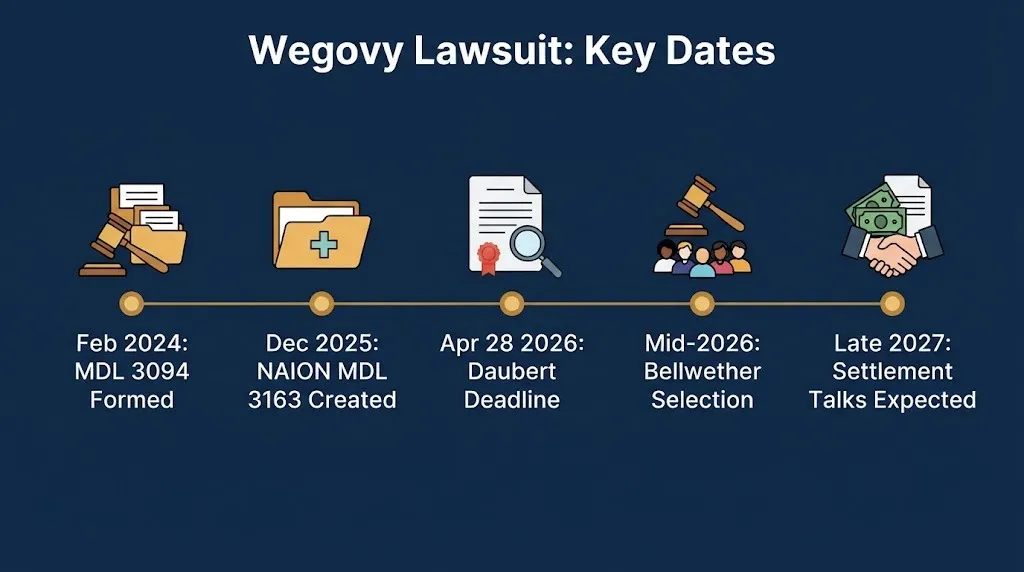
Legal analysts commonly note that mass tort pharmaceutical cases take three to five years from MDL formation to final settlement. MDL 3094 formed in February 2024, which puts a possible resolution window somewhere between 2027 and 2029 if that historical pattern holds. That timeline is an industry pattern, not a confirmed court date.
Reality Check: No settlement administrator exists yet for the Wegovy litigation, so anyone contacting you with a specific payout number or asking for an upfront fee to “process” your claim is not operating through the actual court system. Filing a lawsuit through an attorney typically involves no upfront cost in these cases, since most personal injury firms work on contingency.
Wegovy lawsuit settlement amounts: what’s confirmed and what isn’t
Confirmed fact: zero settlements have been finalized in either the gastroparesis MDL or the NAION vision loss litigation as of August 2026. Bellwether trials, the test cases that typically shape eventual settlement ranges, haven’t concluded.
Here’s what’s actually verified right now:
| Detail | Status |
|---|---|
| Settlement fund | None exists |
| Per-person payout range | Not yet determined |
| Bellwether trial selection | Expected mid-2026 |
| First trials | Possible late 2026 |
| Mass settlement likelihood | Considered unlikely before late 2027, per litigation trackers |
Treat any specific dollar amount you see elsewhere as speculation. In mass torts, real numbers typically don’t emerge until after bellwether trial verdicts give both sides a benchmark.
What is the Wegovy lawsuit deadline?
There’s no single deadline for the Wegovy lawsuit, because filing windows are set by each state’s statute of limitations, not by the MDL itself. Most states give you one to three years from the date you discovered your injury, not from the date you first took the drug.
That detail trips people up constantly. It’s less like a class action claim deadline and more like the clock on a personal injury claim after a car accident: it starts running from when the harm became clear, not from the original event.
Some plaintiffs face state-specific deadlines as early as mid-2026, according to legal trackers monitoring the litigation. Because rules vary significantly by state, a specific deadline can’t be generalized here without knowing where you live and when your diagnosis occurred.
How to file a Wegovy lawsuit
Filing a Wegovy lawsuit generally means retaining an attorney who then files your case in federal court, where it typically gets transferred into the existing MDL. Here’s the general process reported across current litigation trackers:
- Gather medical records documenting your Wegovy prescription and usage dates.
- Obtain your official diagnosis records for the qualifying condition.
- Collect documentation of related treatment, hospitalization, or ongoing care.
- Consult an attorney to evaluate your state’s statute of limitations.
- Have your attorney file the complaint in the appropriate federal court.
- Your case gets transferred into MDL 3094 or MDL 3163 for pretrial proceedings.
- Your individual case continues through discovery alongside the broader litigation.
What proof do you need for a Wegovy lawsuit claim?
You generally need documented proof of Wegovy use, a formal medical diagnosis, and records connecting your treatment to that diagnosis. Self-reported symptoms without clinical documentation typically aren’t enough.
Courts overseeing this MDL have been strict about diagnostic standards. Judge Marston has required objective diagnostic testing for gastroparesis claims specifically, not just a doctor’s informal note.
Useful documentation generally includes:
- Pharmacy or prescription records showing Wegovy use and dates.
- Diagnostic test results confirming gastroparesis, NAION, or another qualifying condition.
- Hospital or specialist treatment records tied to that diagnosis.
- A timeline connecting your Wegovy use to when symptoms began.
Key Takeaway: Objective diagnostic testing, not just symptom complaints, is now a requirement the court has emphasized for gastroparesis claims in this litigation.
Wegovy lawsuit update: where the litigation stands now
As of mid-2026, the litigation is deep in pretrial motion practice, with both sides fighting over expert testimony standards before any trial happens. Novo Nordisk and Eli Lilly both filed formal answers to the amended master complaint on December 10, 2025.
Judge Marston issued Case Management Order No. 29 on December 17, 2025, extending certain expert disclosure deadlines into early 2026 to address scientific disputes. That was followed by a Daubert motions deadline on April 28, 2026, covering fights over whether certain expert witnesses can testify at all.
Summary judgment briefing has continued through July 2026. Case counts have climbed steadily, growing by hundreds of new filings some months.
When will Wegovy lawsuit trials begin?
Bellwether trial selection is expected around mid-2026, with the first actual trials possible in late 2026. These early “test” trials help both sides gauge how juries respond before broader settlement talks begin.
Legal trackers following the litigation describe mass settlements as unlikely before late 2027, based on how similar pharmaceutical MDLs have historically unfolded. That’s an informed estimate from litigation analysts, not a court-ordered date.
Think of it the way a delayed insurance claim works after a major disaster. The process moves in defined stages, and the payout stage only comes after liability gets sorted out first.
What Happens Next
Mid-2026 (expected): Bellwether trial selection for the gastrointestinal injury MDL.
Late 2026 (possible): First bellwether trials begin in MDL 3094.
Ongoing through 2026: NAION vision loss claims continue developing in MDL 3163 and the related New Jersey MCL.
Late 2027 (expected, per litigation trackers): Earliest realistic window for broader settlement negotiations, based on historical mass tort patterns.
Frequently Asked Questions
Is the Wegovy lawsuit legitimate?
Yes.
It’s an active federal multidistrict litigation with 3,928 pending cases as of August 2026.
No settlement has been reached, so treat any guaranteed payout claim you see elsewhere with skepticism.
How much is the average Wegovy lawsuit settlement?
There is no average settlement amount yet, because no settlements have been finalized.
Court watchers expect real payout ranges to emerge only after bellwether trials produce verdicts.
Any specific dollar figure circulating online right now is not yet confirmed.
What is the deadline to file a Wegovy lawsuit?
There’s no single national deadline.
Your filing window is set by your state’s statute of limitations, typically one to three years from when you discovered your injury.
Some state deadlines arrive as early as mid-2026, so earlier consultation with an attorney is generally advised.
Do I need a lawyer to file a Wegovy lawsuit?
Filing an individual federal lawsuit that gets transferred into an MDL generally requires an attorney to handle the complaint and procedural requirements.
Most personal injury attorneys in this type of case work on contingency, meaning no upfront legal fees.
What side effects qualify for a Wegovy lawsuit?
Documented gastroparesis, ileus, bowel obstruction, gallbladder complications, and NAION-related vision loss are the primary qualifying conditions reported in current filings.
Mild or temporary nausea generally does not meet the threshold.
A formal medical diagnosis and treatment record are required.
Is Wegovy still on the market despite the lawsuits?
Yes, Wegovy remains FDA-approved and available by prescription.
The lawsuits target alleged inadequate warnings, not the drug’s approval status.
The FDA has made separate labeling adjustments, including removing suicide-risk language in January 2026 after finding insufficient evidence of a causal link.
How is the Wegovy lawsuit different from a class action?
It’s a multidistrict litigation, which shares pretrial proceedings but keeps each plaintiff’s case individual.
A class action would pool claims into one combined case with one shared outcome.
Here, your eventual result would depend on your specific injury and evidence, not a flat per-person split.
There’s no settlement fund, no payout amount, and no single deadline to circle on your calendar yet. If you believe you developed gastroparesis, bowel obstruction, or vision loss after taking Wegovy, gather your medical records now and confirm your state’s statute of limitations before it runs out.