Wrongful Termination Lawsuit: 2026 Guide to Claims, Settlements, and Deadlines
Quick Answer:
- Wrongful termination lawsuits are real and common, but most terminations are legal unless they violate specific laws.
- Settlement amounts vary widely, with many cases settling between $10,000 and $100,000 depending on damages.
- The most important deadline is your state’s statute of limitations, often 180 to 300 days to file with a government agency.
A wrongful termination lawsuit claims that your employer fired you for an illegal reason. The key word is illegal. Most firings are lawful because most employment is at-will, meaning either side can end the relationship at any time.
If you were fired and suspect the reason was discrimination, retaliation, or a breach of contract, you may have a case. The deadline to act is short, and the process starts with a government agency, not a court.
This article explains what makes a termination wrongful, how much cases settle for, what proof you need, and the deadlines that can end your case before it begins. One fact most workers miss: you usually must file with the EEOC or a state agency before you can sue.
The Facts
| Item | Detail |
|---|---|
| Case Type | Individual and class employment lawsuits |
| Legal Basis | Discrimination, retaliation, breach of contract, public policy |
| Status | Active litigation category, no single settlement fund |
| Settlement Range | Commonly $10,000 to $100,000, higher for strong cases |
| Filing Deadline | 180 to 300 days with EEOC or state agency |
| Administrator | No central administrator, cases are individual |
| Proof Needed | Termination notice, performance records, evidence of illegal motive |
Is a Wrongful Termination Lawsuit Legit?
Yes, wrongful termination lawsuits are legitimate legal claims. They are filed every day in state and federal courts across the country.
The term is often misused. Many workers believe any unfair firing is wrongful termination. That is not how the law works. You need an illegal reason, not just a bad boss or a questionable decision.
The legal bases for wrongful termination include discrimination, retaliation, breach of contract, and violations of public policy. Each requires specific proof.
Key Takeaway: The lawsuit is real, but your case is only as strong as the illegal reason you can prove.
What Qualifies as Wrongful Termination?
Wrongful termination means you were fired for a reason that violates the law. That can be discrimination based on race, sex, age, religion, disability, or other protected characteristics.
Retaliation is another common basis. If you complained about harassment, reported safety violations, or filed a workers compensation claim, and then got fired, that may be retaliation.
Breach of contract also qualifies. If you had an employment contract that limited the employer’s right to fire you, and the employer violated it, that is wrongful termination.
- Discrimination based on a protected characteristic.
- Retaliation for a protected activity like reporting misconduct.
- Breach of an employment contract.
- Violation of public policy, like firing for jury duty.
- Constructive discharge, where working conditions forced you to quit.
How Much Is a Wrongful Termination Lawsuit Worth?
Wrongful termination settlements commonly fall between $10,000 and $100,000. Strong cases with clear evidence and high damages can exceed that range.
The value depends on your lost wages, emotional distress, the strength of the evidence, and the employer’s exposure. A short unemployment period with quick reemployment means lower damages. A long job search means higher damages.
Punitive damages are rare but possible in egregious cases. Most settlements are based on actual economic losses plus a negotiated amount for emotional distress and attorney fees.
| Case Strength | Typical Settlement Range |
|---|---|
| Weak evidence | Under $10,000 |
| Moderate evidence | $10,000 to $50,000 |
| Strong evidence | $50,000 to $100,000 |
| Exceptional evidence | Over $100,000 |
Reality Check: No lawyer can promise a settlement amount before reviewing your records. Be wary of anyone who guarantees a specific payout.
What Is the Average Wrongful Termination Settlement?
The average wrongful termination settlement is often reported in the $40,000 to $60,000 range, but that figure hides huge variation. Many cases settle for less. A few settle for far more.
The average is skewed by high-value cases involving executives, long tenures, or egregious discrimination. Median settlements, which are more representative, often fall lower.
Your specific number depends on your salary, how long you were out of work, the strength of your evidence, and the employer’s willingness to settle.
What Is the Deadline to File a Wrongful Termination Claim?
The deadline is short. For discrimination and retaliation claims, you must file with the Equal Employment Opportunity Commission or your state fair employment agency within 180 to 300 days of the termination.
The exact deadline depends on your state and whether a state agency also covers the claim. Some states give you 300 days. Others give you less.
For breach of contract claims, the deadline is the state’s statute of limitations for contract claims, often two to four years.
- Determine the legal basis of your claim.
- For discrimination, file with the EEOC within 180 to 300 days.
- Check if your state agency extends the deadline.
- For contract claims, check your state’s contract statute of limitations.
- Do not wait. Missing the deadline is fatal to most claims.
Key Takeaway: The government filing deadline is the one that kills most cases. Know it and meet it.
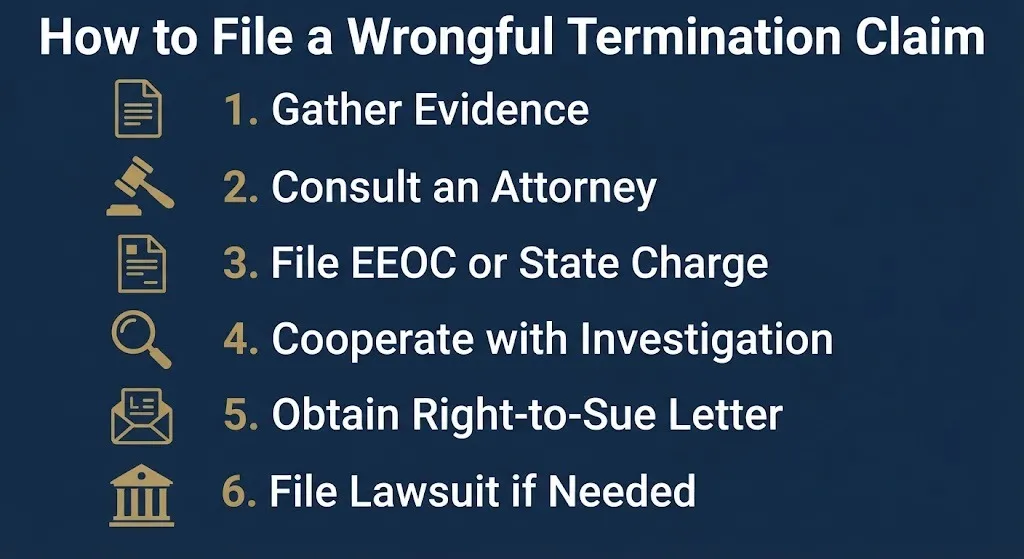
How Do You File a Wrongful Termination Lawsuit?
You start with a government charge, not a lawsuit. For discrimination and retaliation, you file a charge with the EEOC or your state agency.
The agency investigates and may issue a right-to-sue letter. Only after that letter can you file a lawsuit in court.
For breach of contract or public policy claims, you may be able to file directly in court without a government charge. An attorney can advise which path applies.
- Gather your termination letter, performance reviews, and evidence of the illegal reason.
- File a charge with the EEOC or state agency before the deadline.
- Cooperate with the agency investigation.
- Obtain the right-to-sue letter if the agency does not resolve the case.
- File a lawsuit within the deadline after the right-to-sue letter.
- Proceed with discovery, settlement negotiations, or trial.
What Evidence Do You Need for a Wrongful Termination Case?
The strongest evidence shows a connection between your firing and an illegal reason. Emails, text messages, witness statements, and timing all matter.
If you complained about discrimination and were fired two weeks later, that timing is evidence. If your boss made discriminatory comments before firing you, that is stronger.
Performance records matter too. If your employer claims you were fired for poor performance, but your reviews were positive, that contradiction helps your case.
- Termination letter or notice.
- Performance reviews and disciplinary records.
- Emails or messages showing the illegal motive.
- Witness statements from coworkers.
- A timeline of events leading to the firing.
- Any complaints you filed before the termination.
What Is At-Will Employment and How Does It Affect Wrongful Termination?
At-will employment means either the employer or the employee can end the relationship at any time, for any reason, or for no reason, as long as the reason is not illegal.
Most states follow at-will rules. That means your employer can fire you because they do not like you, because business is slow, or for no reason at all.
The at-will doctrine is the biggest obstacle in most wrongful termination cases. You have to prove the real reason was illegal, not just unfair.
What Is Constructive Discharge?
Constructive discharge happens when working conditions become so intolerable that a reasonable person would feel forced to resign. The law treats it like a firing.
If you quit because of harassment, discrimination, or retaliation that made the workplace unbearable, you may have a wrongful termination claim even though you resigned.
The standard is high. The conditions must be severe, not just unpleasant. A hostile work environment that a reasonable person could not tolerate is the benchmark.
What Is Retaliation in Wrongful Termination Cases?
Retaliation happens when your employer punishes you for engaging in a protected activity. Firing you is the most severe form of punishment.
Protected activities include complaining about discrimination, reporting safety violations, filing a workers compensation claim, or cooperating with an investigation.
The timing between your protected activity and your firing is key evidence. A short gap suggests retaliation. A long gap makes the connection harder to prove.
- Identify your protected activity.
- Document the date of the activity.
- Note the date of the firing.
- Calculate the time gap.
- Gather evidence connecting the two.
Key Takeaway: Retaliation cases often hinge on timing. A short gap between complaint and firing is powerful evidence.
What Is the Difference Between Wrongful Termination and Discrimination?
Discrimination is one type of wrongful termination. Wrongful termination is the broader category that includes discrimination, retaliation, breach of contract, and public policy violations.
A discrimination claim must show that your firing was because of a protected characteristic like race, sex, age, or disability. A wrongful termination claim can rest on any illegal reason.
The proof requirements differ. Discrimination cases often rely on comparative evidence showing that similarly situated employees of a different group were treated better.
What Are the Most Common Wrongful Termination Claims in 2026?
Retaliation claims are among the most common. Workers who report misconduct and then face firing have strong legal protections.
Discrimination claims based on race, sex, age, and disability remain frequent. The EEOC tracks these categories and publishes annual enforcement data.
Whistleblower claims, where workers report fraud or safety violations and face retaliation, are a growing category in several industries.
| Claim Type | Common Scenario |
|---|---|
| Retaliation | Fired after reporting harassment or discrimination |
| Race discrimination | Fired for reasons that differ by race |
| Sex discrimination | Fired due to pregnancy or gender |
| Age discrimination | Fired and replaced by a younger worker |
| Disability discrimination | Fired after requesting accommodation |
What Happens Next With a Wrongful Termination Claim?
First 30 days: Gather evidence and consult an attorney.
First 180 to 300 days: File a charge with the EEOC or state agency.
Next 6 to 12 months: Agency investigation and possible mediation.
Next 12 to 24 months: Lawsuit filed, discovery, and settlement negotiations.
Beyond: Trial or resolution.
These timelines are typical. Your case may move faster or slower.
Frequently Asked Questions
Is a wrongful termination lawsuit worth it?
It depends on your evidence and damages. Strong cases with clear evidence can recover significant amounts.
How do I prove wrongful termination?
Prove the employer’s stated reason was false or that an illegal reason motivated the firing.
What is the average payout for wrongful termination?
Many cases settle between $10,000 and $100,000. Averages are often reported around $40,000 to $60,000.
Can I sue for wrongful termination if I quit?
Possibly, if the working conditions were so intolerable that quitting was the only reasonable option.
How long do I have to file a wrongful termination claim?
You often have 180 to 300 days to file with the EEOC or state agency.
Do I need a lawyer for a wrongful termination case?
Not required, but strongly recommended. The process is procedural and deadlines are strict.
What is the difference between at-will and wrongful termination?
At-will means any legal reason can justify firing. Wrongful termination requires an illegal reason.
Can I get unemployment after a wrongful termination?
Possibly, depending on your state’s rules and the reason for the firing.
Wrongful termination cases are real, winnable, and time-sensitive. The difference between a paying case and a dead one is often the speed of your first filing.
The single most important deadline is the government charge deadline. Find it, calendar it, and meet it.