Settlement Patterns 2026: What the Data Actually Shows About Payouts
Quick Answer
- Settlement patterns are backed by real 2026 litigation data: $53.795 billion in aggregate class action settlements in H1 2026 alone.
- Individual payouts vary enormously by case type, from $5 in minor cases to nearly $2,000 in cases like the Bumble settlement.
- There is no single deadline, since settlement patterns describe trends across many separate cases, each with its own claim window.
If you are trying to figure out what a “normal” class action settlement looks like in 2026, the data is louder than any single case. Aggregate settlements across all class action litigation and government enforcement lawsuits hit $53.795 billion in the first half of 2026, according to the Duane Morris Class Action Review.
This affects anyone weighing whether to file a claim, wondering if their expected payout sounds too low, or trying to spot a scam disguised as a settlement notice. The number that matters most for individual claimants: real 2025 to 2026 payouts ranged from as little as $5 in minor labeling cases to nearly $2,000 in the Bumble settlement, depending entirely on case type.
This article breaks down what the actual 2026 numbers show about settlement size, per-person payouts, and which industries are driving the biggest totals. One detail that surprises people: the first half of 2026 already outpaced the entire first half of 2025 by more than double.
The Facts
| Scope | Aggregate U.S. class action and government enforcement settlements across all sectors |
| Data Status | H1 2026 figures confirmed by legal-industry trackers; full-year 2026 totals not yet final |
| H1 2026 Aggregate Total | $53.795 billion (Duane Morris Class Action Review) |
| Individual Payout Range | $5 to nearly $2,000 depending on case type, based on 2025 to 2026 settlements |
| Claim Deadline | Not applicable; each individual settlement sets its own deadline |
| Data Sources | Duane Morris Class Action Review, NERA Economic Consulting, Cornerstone Research, Gallagher |
| Proof Needed | Varies by settlement; documented losses generally increase individual payout amounts |
Are 2026 settlement patterns based on real verified data
Yes, 2026 settlement patterns are tracked by several established legal and economic research firms that publish regular, sourced reports. This is not guesswork or SEO speculation, it comes from firms that specialize in analyzing court-approved settlements.
The most cited aggregate figure comes from the Duane Morris Class Action Review, which tracks settlements across all substantive areas of class action litigation and government enforcement. Separately, NERA Economic Consulting and Cornerstone Research both track securities class action settlements specifically, using data drawn from actual court filings.
These are not competing estimates that contradict each other. They measure different slices of the same overall litigation landscape, which is why combining them gives a clearer picture than relying on any single source.
Key Takeaway: Settlement pattern data in 2026 comes from named research firms tracking actual court filings, not from anonymous online estimates.
Is a bigger settlement fund always better for individual claimants
No, a larger total settlement fund does not automatically mean a larger individual payout. This is one of the most misunderstood patterns in class action settlements.
Your actual payout depends on four factors: the total fund size, the number of people who file claims, whether payments are fixed per person or calculated pro-rata, and whether you have documentation supporting your loss. A massive fund split among millions of claimants can produce a smaller check than a modest fund split among a small, well-documented group.
The Blue Cross Blue Shield antitrust settlement illustrates this pattern well. It covered people who paid premiums from 2008 to 2020, and when checks went out, roughly 6 million claims were filed, putting the average payout at around $333 per claim, even though the total fund was large.
Key Takeaway: A headline-grabbing total settlement figure tells you almost nothing about what an individual claimant will actually receive.
How much do class action settlements actually pay per person in 2026
Individual class action payouts in 2025 to 2026 ranged from $5 in minor cases to nearly $2,000 in higher-value cases, based on reported settlement data.
| Case Type | Reported Per-Person Payout |
|---|---|
| Minor food labeling cases | Around $5 |
| Cash App spam text settlement | $394.36 flat |
| Blue Cross Blue Shield antitrust | Around $333 average |
| Bumble settlement | Nearly $2,000 |
| 2015 CFPB study, general consumer class actions | $32.95 average (historical baseline) |
Not yet determined for your specific claim. Amounts depend on your documented losses, the total fund, and how many other people file, none of which can be predicted from general patterns alone.
A useful comparison: this works like a warranty claim. Two people can file for the same product defect and get different amounts depending on how much documentation each one provides.
What is the average class action settlement payout by case type
Payout ranges vary widely by legal category, and general reporting places data breach settlements around $25 to $100 per person, employment-related settlements around $100 to $3,000, and product defect settlements from roughly $20 to over $10,000, according to settlement-tracking sites monitoring active 2026 cases.
These figures are broad ranges reported by industry trackers, not guarantees for any specific case. The wide spread within each category reflects how much individual documentation and injury severity can change the outcome.
Reality Check: No website or calculator can tell you your exact payout before a settlement is finalized and claims are counted. Anyone promising a guaranteed dollar amount before you file is overselling what the data can actually support.
How much have class action settlements totaled in 2026 so far
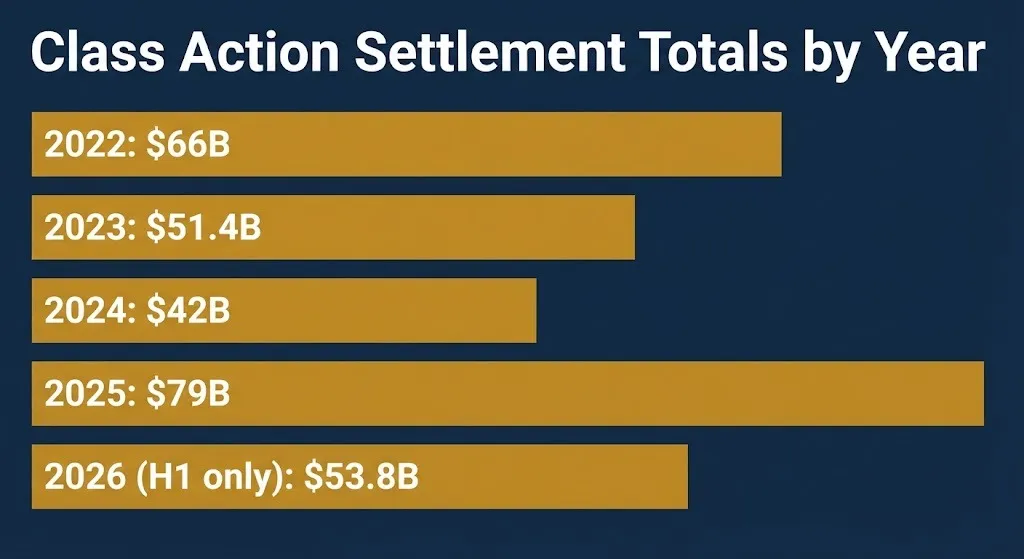
Class action and government enforcement settlements totaled $53.795 billion in the first half of 2026 alone, according to the Duane Morris Class Action Review, counting the top five settlements across each substantive area of law.
That figure already dwarfs the same period a year earlier. The aggregate total at the halfway mark in 2025 was $21.77 billion, meaning H1 2026 more than doubled that pace.
| Year | Full-Year or H1 Aggregate Total |
|---|---|
| 2022 | $66 billion (full year) |
| 2023 | $51.4 billion (full year) |
| 2024 | $42 billion (full year) |
| 2025 | $79 billion (full year); $21.77 billion (H1) |
| 2026 | $53.795 billion (H1 only, as of this writing) |
Key Takeaway: If 2026’s second half tracks anywhere close to its first half, the year is positioned to challenge or exceed 2025’s record $79 billion total.
Why do some settlements pay $5 and others pay thousands
A settlement pays more per person when the fund is large relative to the number of claimants, and when individual harm is easier to document with specific dollar losses.
Cases involving physical injury or clear financial loss, like the Bumble settlement’s nearly $2,000 payouts, tend to pay more than cases involving small, hard-to-quantify harm, like minor labeling violations paying around $5. Strength of documentation also matters directly: claimants who can show specific dollar losses generally receive more than those filing a bare-bones claim.
Factors that tend to push payouts higher:
- Fewer total claimants relative to the fund size
- Physical injury or clear economic loss, rather than a technical violation
- Strong supporting documentation, like receipts or account statements
- Fixed per-person payments rather than funds split proportionally among everyone
Key Takeaway: The type of harm and the strength of your documentation matter more to your payout than the total headline size of the settlement fund.
How to check where your claim falls within typical settlement patterns
You can gauge where your expected payout might fall by comparing your case type and documentation level against publicly reported ranges for similar settlements, though this only gives context, not a guarantee.
- Identify the exact category your claim falls under, such as data breach, employment, or product defect.
- Check the reported payout range for that category from an established settlement tracker.
- Gather receipts, account statements, or other documentation supporting your specific loss.
- Compare your documentation strength to what similar claimants reported receiving.
- Check the official settlement website for that specific case, since fund size and claimant count drive the real number.
- Avoid comparing across unrelated case types, since a data breach case and a product injury case follow very different patterns.
Reality Check: These patterns describe averages across many settlements, not a promise for your case. Two people in the exact same settlement can receive very different amounts based on documentation alone.
What factors increase your individual settlement payout
Documentation is the single factor most within your control when it comes to increasing your individual payout inside a class settlement. Everything else, like total fund size, is set before you ever file.
Steps that tend to strengthen a claim:
- Save receipts, statements, or account records tied to your loss.
- File before the claim deadline, since late claims are typically rejected outright.
- Choose the payment method the settlement administrator supports, avoiding processing delays.
- Read the claim form carefully, since higher-documentation tiers often pay more than basic tiers.
- Keep confirmation numbers and correspondence from the settlement administrator.
Key Takeaway: Filing early with strong documentation is the most reliable way to land at the higher end of a settlement’s reported payout range.
How to use settlement patterns to spot a lowball or scam offer
Comparing an offer against known settlement patterns is a legitimate way to sanity-check whether something looks off, whether that is a suspiciously low real settlement payout or a fake settlement scam entirely.
If an unsolicited message promises a specific, unusually high payout before any claims process has even opened, that is inconsistent with how real settlements work. Real per-person payouts are not knowable until claims are counted and the fund is divided, which is why legitimate settlement notices describe ranges or “up to” amounts, not guaranteed fixed sums delivered instantly.
Warning signs inconsistent with real settlement patterns:
- A guaranteed dollar amount before any claim has been filed or processed
- A request for payment to “unlock” or “release” your settlement funds
- Pressure to act within hours rather than the weeks or months typical of real claim windows
- No verifiable case name, court, or settlement administrator you can independently confirm
What is the latest 2026 class action settlement data showing
The latest confirmed data through mid-2026 shows securities class actions specifically running at elevated settlement values, with the average securities settlement reaching $54 million in H1 2026, a 32% increase over the 2025 inflation-adjusted average of $41 million.
Separately, Cornerstone Research counted 39 securities class action settlements in H1 2026 totaling $2.2 billion, while a Gallagher report on directors and officers litigation found $2.1 billion in H1 2026 securities settlements, a 48% jump over the same period in 2025, with 48 settlements compared to 41 a year earlier.
Notable H1 2026 individual settlements include Goldman Sachs at $500 million over oversight and misappropriation allegations, and Estee Lauder at $210 million over allegations of misrepresenting revenue growth.
Are settlement amounts trending up or down in 2026
Settlement amounts are trending up in 2026 across nearly every measure tracked so far, both in aggregate totals and in average per-case value.
Securities class action filings are also up: H1 2026 saw 118 federal securities class actions, putting the full year on pace for 236 filings, with AI-related cases already surpassing the entire 2025 total for that category. Of H1 2026 securities settlements, 21% exceeded $50 million, according to Gallagher’s report.
Key Takeaway: Every major tracker measuring 2026 so far, aggregate class actions, securities settlements, and settlement filing counts, points in the same direction: higher totals than 2025’s already-record pace.
Why are 2026 class action settlements at a decade high
Settlements are climbing partly because AI-related litigation has surged, and partly because corporate defendants are facing what researchers describe as a new era of heightened litigation risk following record-setting years in 2022 through 2025.
NERA’s report specifically noted that securities settlements in H1 2026 reached the highest average value in a decade. Duane Morris researchers have described the trend across 2022 through 2025 as corporate defendants entering elevated risk territory, with cumulative top-ten settlement values hitting record highs in 2025 that surpassed the previous 2022 peak.
Historical year-over-year data shows how sharply mass tort and product liability settlements grew earlier in this cycle: in 2022, product liability and mass tort settlements exceeded $50 billion, a 267% increase from 2021, while consumer fraud settlements rose 640% to almost $8.6 billion that same year.
Which industries see the biggest settlement patterns
Product liability and mass tort litigation has historically driven the largest total settlement dollars among all class action categories, based on 2022 data showing that category alone exceeding $50 billion that year.
Securities litigation is the category with the most current, detailed 2026 tracking, given specialized firms like NERA and Cornerstone Research that publish regular reports specifically on that sector. Consumer fraud, antitrust, privacy, data breach, and employment discrimination round out the categories tracked in aggregate reports, though 2026-specific totals for each individual category beyond securities were not independently confirmed in this research.
| Category (2022 data, for historical context) | Settlement Total |
|---|---|
| Product liability and mass torts | Over $50 billion |
| Consumer fraud | Almost $8.6 billion |
| Antitrust | Nearly $3.8 billion |
| Securities fraud | $3.254 billion |
| Civil rights | $1.31 billion |
| Privacy | $896.7 million |
| Data breach | $719.21 million |
| Employment discrimination | $597 million |
How settlement patterns have changed since 2022
Aggregate class action settlement totals have grown substantially since 2022, moving from $66 billion that year to a record $79 billion in 2025, with 2026 already on pace to challenge that record based on H1 figures alone.
The clearest structural shift is the emergence of AI-related litigation as a distinct, fast-growing category, with H1 2026 AI-related securities filings already surpassing the entirety of 2025. This did not exist as a meaningful settlement category in 2022.
Key Takeaway: The shape of settlement litigation has shifted from a product liability and mass tort dominated landscape in 2022 toward one where AI-related securities litigation is now a fast-emerging, closely tracked category.
What Happens Next
Expected Q3 2026: Nine-month aggregate settlement data from tracking firms like Duane Morris and Cornerstone Research typically follows their mid-year reports.
Expected late 2026: Full-year securities litigation filing counts should clarify whether 2026 reaches the projected pace of 236 total filings.
Expected Q1 2027: Full-year 2026 aggregate settlement totals, likely published by Duane Morris and similar trackers, will show whether 2026 surpassed 2025’s $79 billion record.
Ongoing: Individual settlement administrators continue processing claims and issuing payments on a rolling basis, each governed by its own separate deadline.
Frequently Asked Questions
What is the average class action settlement payout in 2026?
There is no single average that applies across all case types, since reported 2025 to 2026 payouts ranged from $5 to nearly $2,000 depending on the case.
Your specific payout depends on the fund size, number of claimants, and your documentation.
Are class action settlements getting bigger in 2026?
Yes, aggregate settlement totals reached $53.795 billion in the first half of 2026 alone, more than double the same period in 2025.
Securities settlements specifically hit a decade-high average value of $54 million in H1 2026.
How do I know if my expected settlement payout is normal?
Compare your case type against reported ranges for similar settlements, keeping in mind these are broad patterns, not guarantees.
Data breach, employment, and product defect cases each show different typical payout ranges based on 2026 tracking.
Why did I get a smaller check than I expected from a class action settlement?
Smaller-than-expected payouts often result from a large number of claimants splitting a fixed fund, or limited documentation of your specific loss.
The total settlement fund size does not determine your individual payout on its own.
What industry sees the biggest class action settlements?
Product liability and mass tort litigation historically produced the largest total settlement dollars, exceeding $50 billion in 2022 alone.
Securities litigation is currently the most closely tracked category for real-time 2026 data.
Can I predict my exact settlement payout before checks are mailed?
No, exact per-person amounts are not knowable until the claims filing period closes and the fund is divided among all valid claimants.
Any source promising a guaranteed exact amount before that point is not describing how real settlements work.
Is a text or email promising a large settlement payout automatically a scam?
Not automatically, but a guaranteed, unusually high payout offered before any claims process has run is inconsistent with real settlement patterns.
Verify any settlement claim independently through its official settlement website before responding.
If you are weighing whether to file a claim in an active settlement, use these patterns as context, not as a promise. Check the individual settlement’s own official website for the actual claim deadline and fund details that apply to your specific case.