Tylenol ADHD Lawsuit 2026: Second Circuit Revives 500+ Cases, No Settlement Yet
Quick Answer
- Real litigation: MDL No. 3043 is active in federal court after a July 13, 2026 appeals ruling revived it.
- Payout: not yet determined, no settlement fund exists and no bellwether trial has happened.
- Deadline: no fixed federal filing deadline is confirmed, state statutes of limitations vary by state.
If you’re searching “Tylenol ADHD lawsuit” right now, here’s the direct answer: it’s a real, currently active federal mass tort, not a settled class action with checks going out.
This matters because the case status just changed dramatically. On July 13, 2026, the U.S. Court of Appeals for the Second Circuit revived more than 500 previously dismissed lawsuits, reversing a lower court ruling that had nearly ended the case in 2024.
This article walks through what actually happened in that ruling, who may qualify, what’s known and unknown about payouts, and why some competing sites are quoting settlement figures that no court has confirmed. One detail worth knowing upfront: the appeals court explicitly said it was not ruling on whether Tylenol causes autism or ADHD at all.
The Facts
| Case | In re: Acetaminophen ASD-ADHD Products Liability Litigation, MDL No. 1:22-md-03043 |
| Status | Revived and active, following July 13, 2026 Second Circuit reversal |
| Fund Size | Not yet confirmed, no settlement exists |
| Est. Per Person | Not yet determined by any court |
| Claim Deadline | No confirmed federal deadline, varies by state statute of limitations |
| Administrator | Not yet appointed, no settlement has been reached |
| Proof Needed | Documentation of acetaminophen use during pregnancy and a child’s ASD or ADHD diagnosis, exact requirements not finalized |
Is the Tylenol ADHD lawsuit real?
Yes, it’s a real, active federal mass tort with a case number, an assigned judge, and named corporate defendants.
The litigation is formally called In re: Acetaminophen ASD-ADHD Products Liability Litigation, MDL No. 1:22-md-03043, consolidated in the Southern District of New York before U.S. District Judge Denise L. Cote. It began with an individual case, Rutledge v. Walmart, filed in June 2023.
What’s not real is any claim that this is a settled class action already paying out. It’s a mass tort, not a class action, meaning each case is evaluated somewhat individually even though they’re managed together.
Key facts anchoring this case:
- Formed by the Judicial Panel on Multidistrict Litigation in October 2022
- Consolidated case number: 1:22-md-03043 (S.D.N.Y.)
- Overseen by Judge Denise L. Cote
- More than 500 cases currently active as of July 2026
Is there a Tylenol ADHD lawsuit settlement in 2026?
No. As of August 2026, no settlement exists in the federal Tylenol ADHD and autism litigation.
This is the single most important correction we can offer against other coverage of this case. Several competing articles describe payout ranges and settlement tiers as though a fund already exists. It doesn’t.
Here’s the actual sequence required before any payout happens, and where the case sits right now:
| Step | Status |
|---|---|
| Expert testimony admitted | Partially reinstated, July 13, 2026 |
| Bellwether trials held | Not yet scheduled |
| Settlement negotiated | Not started |
| Settlement fund approved | Does not exist |
| Claim form released | Does not exist |
Key Takeaway: No Tylenol ADHD settlement exists as of August 2026, and any specific payout figure you see elsewhere is a law firm’s estimate, not a court-confirmed number.
How much money could you get from the Tylenol ADHD lawsuit?
Not yet determined. No court, jury, or settlement administrator has set a payout figure in this litigation.
You’ll see wildly different numbers floating around, and that variance itself is a warning sign. One firm’s marketing page cites $50,000 to $300,000. Another cites $300,000 to $600,000. A third cites $50,000 to over $500,000.
None of these figures come from a settlement fund, a jury verdict, or a court order. They’re pre-trial marketing estimates based on comparable mass torts, not this case’s actual outcome.
What would need to happen before real numbers exist:
- Bellwether trials would need to go forward and produce verdicts.
- Those verdicts would establish a rough value range for similar cases.
- Defendants and plaintiffs would then typically negotiate a broader settlement.
- A claims administrator would set individual payout tiers based on severity and proof.
Do you qualify for the Tylenol ADHD lawsuit?
You may qualify if you took Tylenol or a generic acetaminophen product while pregnant, and your child was later diagnosed with ADHD or autism spectrum disorder.
Eligibility rules for this litigation have not been finalized into a single confirmed standard, since no settlement or claims process exists yet. Attorneys currently screening cases generally look for a documented pattern of use and a formal diagnosis.
Reality Check: No one will text or email you out of nowhere to say you’ve qualified for a Tylenol settlement check, because no settlement exists yet to qualify for. Signing up with a law firm to investigate a potential claim is normal and typically free, but paying any upfront fee to “register” for a payout that doesn’t exist yet is not necessary.
What if you took Tylenol while pregnant, does that alone qualify you?
Taking Tylenol during pregnancy alone does not automatically qualify you, a diagnosed condition in your child is also required.
Roughly 70% of pregnant women in the United States use acetaminophen at some point, according to figures cited across multiple legal and medical sources. That widespread use is exactly why the litigation focuses narrowly on cases involving a confirmed autism or ADHD diagnosis afterward.
The named defendants include Kenvue Inc., the Johnson & Johnson consumer health spinoff that now makes brand-name Tylenol, along with major retailers.
Retailers named in the litigation over store-brand acetaminophen include:
- Walmart
- CVS
- Walgreens
- Target
- Costco
- Kroger
How to file a Tylenol ADHD lawsuit claim
There’s no single public claim form yet, since the case hasn’t reached a settlement stage. Filing currently means starting an individual mass tort case through an attorney, not submitting a simple online form.
- Gather records of acetaminophen or Tylenol use during pregnancy.
- Collect your child’s ASD or ADHD diagnosis records from a licensed provider.
- Note approximate dates, brands, and frequency of use if you can.
- Consult an attorney who handles mass tort or MDL cases specifically.
- Confirm your state’s statute of limitations before waiting further.
- Ask directly whether your case would join the federal MDL or a state court case.
- Avoid any site or caller demanding payment before a case review happens.
What proof do you need for a Tylenol autism or ADHD claim
You generally need proof of use and proof of diagnosis, since prescription records aren’t available for an over-the-counter drug.
Because Tylenol and generic acetaminophen are sold without a prescription, courts have indicated that receipts, pharmacy loyalty records, prenatal care notes mentioning pain or fever treatment, and even personal notes or texts can help establish use.
Documentation that may support a claim:
- Pharmacy or store purchase records
- Prenatal medical records noting acetaminophen use
- A formal ASD or ADHD diagnosis from a qualified provider
- Any contemporaneous notes, messages, or records from the pregnancy
Key Takeaway: Because acetaminophen is sold over the counter, proving use often relies on receipts and medical notes rather than prescription records, so gathering documentation early matters.
What is the latest Tylenol autism lawsuit update?
The latest confirmed update is the July 13, 2026 Second Circuit ruling that revived more than 500 previously dismissed federal cases.
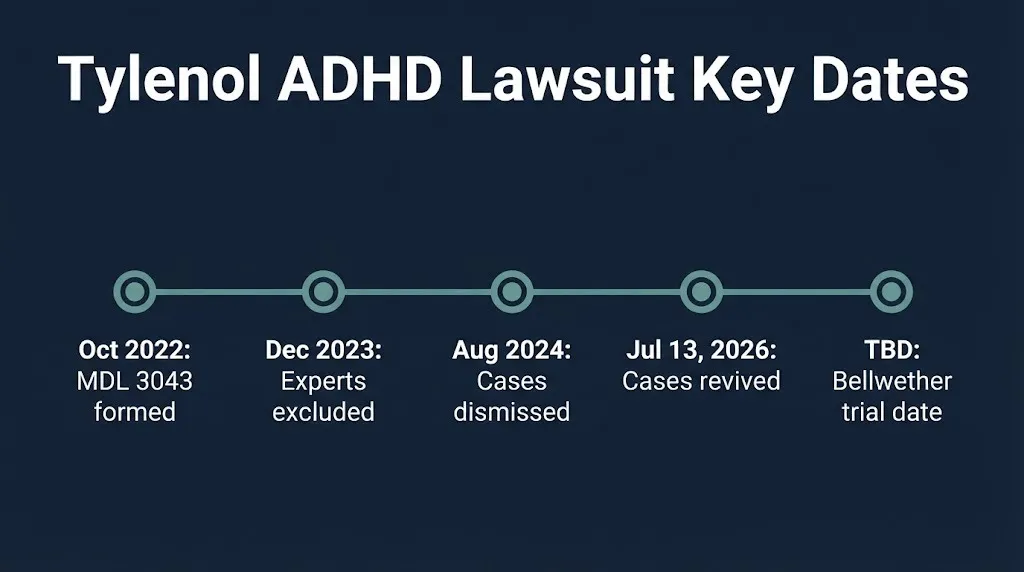
Before that, the case had been effectively shut down. In December 2023, Judge Cote excluded the plaintiffs’ general causation experts. In August 2024, she granted summary judgment for the defendants, dismissing the federal MDL cases.
Plaintiffs appealed, oral arguments were held on November 17, 2025, and the Second Circuit issued its reversal on July 13, 2026 in the underlying appeal captioned Rutledge v. Walgreen Co.
Confirmed timeline of major events:
- October 2022: MDL No. 3043 formed
- June 2023: First case filed (Rutledge v. Walmart)
- December 2023: Cote excludes plaintiffs’ causation experts
- August 2024: Cote grants summary judgment, dismissing MDL cases
- November 17, 2025: Second Circuit oral arguments held
- July 13, 2026: Second Circuit reverses, revives 500+ cases
What did the Second Circuit actually decide on July 13, 2026?
The Second Circuit ruled only on which expert witnesses could testify, not on whether Tylenol actually causes autism or ADHD.
A unanimous three-judge panel found that Judge Cote applied the wrong legal standard when she excluded three plaintiff experts: Dr. Andrea Baccarelli, Dr. Eric Hollander, and Dr. Brandon Pearson. The court said she should have focused on whether their methods were scientifically reliable, not on whether their conclusions were correct.
Kenvue responded the same day, saying it was “exploring all options” and would “continue to defend these cases.” Legal reporting indicates defendants may seek a rehearing from the full appeals court, which could still delay how quickly the case moves forward.
What this ruling does and does not mean:
- It does mean over 500 cases return to district court for further proceedings.
- It does mean three key experts can now testify on general causation.
- It does not mean a jury or judge has found Tylenol causes autism or ADHD.
- It does not create a settlement or payout of any kind.
When will Tylenol ADHD lawsuit bellwether trials happen?
No bellwether trial date has been confirmed as of late August 2026.
Bellwether trials are a small number of representative cases tried first, to help both sides gauge how juries might respond across the larger MDL. Legal commentary suggests these could happen in late 2026 or into 2027, but that is an expectation, not a scheduled date.
Think of this stage like a home warranty dispute that just got past a paperwork rejection: the door is open again, but the actual hearing where anyone determines fault hasn’t happened yet.
Key Takeaway: The July 13, 2026 ruling reopened the litigation procedurally, but no bellwether trial date, settlement talks, or payout structure has been confirmed yet.
Why are parents suing over Tylenol and ADHD?
Parents allege that acetaminophen use during pregnancy is linked to their children’s autism spectrum disorder or ADHD diagnoses, and that manufacturers and retailers failed to warn them.
The lawsuits argue that acetaminophen crosses the placental barrier and may affect fetal brain development. Plaintiffs claim companies knew or should have known about a possible risk and failed to include a warning on product labels.
Legal claims in the litigation include failure to warn, design defect based on inadequate warnings, negligence, and negligent misrepresentation, with an added claim against retailers for selling store-brand products under their own labels.
What does the science actually say about Tylenol and ADHD?
The science remains genuinely disputed, with some studies suggesting an association and no major regulatory body having confirmed a proven causal link.
In September 2025, the Trump administration and the FDA announced the agency would begin a process to update acetaminophen labeling to address potential prenatal risk. As of this writing, we could not confirm whether that label update process has been finalized, so treat it as pending.
Health authorities have historically recommended acetaminophen over alternatives like ibuprofen during pregnancy, since those alternatives carry their own documented fetal risks. Medical groups continue to caution that observed associations in some studies don’t automatically prove causation, and other factors may be involved.
Who are the defendants in the Tylenol ADHD lawsuit?
The primary defendant is Kenvue Inc., the branded Tylenol manufacturer spun off from Johnson & Johnson’s consumer health division in 2023.
A group of major retailers are also named as defendants over store-brand generic acetaminophen products sold under their own labels. Court filings reference roughly fourteen retailer defendants in the model complaint structure used across the MDL.
Retailers named across filings include:
- Walmart, CVS, Walgreens, Target, Costco
- Kroger, Rite Aid, Family Dollar, Dollar Tree, Safeway
What is MDL No. 3043?
MDL No. 3043 is the federal court structure consolidating hundreds of individual Tylenol autism and ADHD lawsuits before a single judge for coordinated proceedings.
An MDL isn’t a class action. Each case keeps its own facts and, potentially, its own outcome, but shared legal questions like expert admissibility get decided once for everyone in the group. That’s part of why the July 13 ruling affected so many cases simultaneously.
State court cases are also proceeding separately in states like California, Massachusetts, and Illinois, where expert admissibility standards can differ from the federal Daubert test.
What happens next
July 13, 2026: Second Circuit revives 500+ federal cases and reinstates three plaintiff experts.
Expected late 2026: Possible ruling on whether the full appeals court will rehear Kenvue’s request, if filed.
Expected late 2026 to 2027: Renewed pretrial proceedings and possible scheduling of bellwether trials in district court.
Expected following bellwether verdicts: Settlement negotiations would likely intensify if plaintiffs win early trials, though this remains unconfirmed.
TBD: Any settlement fund, claims process, or payout structure.
Frequently Asked Questions
Is the Tylenol ADHD lawsuit legit?
Yes, it’s a genuine federal mass tort with an assigned judge and case number.
It is not a settled class action currently distributing payments.
Verify details through official court records rather than marketing pages.
How much is the Tylenol ADHD lawsuit settlement worth?
No settlement exists, so no confirmed payout amount exists either.
Figures you see cited online are attorney marketing estimates, not court numbers.
Real numbers would only emerge after bellwether trials or a negotiated settlement.
What is the deadline to file a Tylenol lawsuit?
There is no single confirmed federal deadline for this litigation.
Deadlines depend on your state’s statute of limitations for product liability claims.
Speak with an attorney promptly, since waiting can affect your legal options.
Does taking Tylenol during pregnancy prove a claim?
No, use alone is not enough to support a claim in this litigation.
A documented ASD or ADHD diagnosis in your child is also required.
Courts have not ruled that acetaminophen causes either condition.
Did the Second Circuit rule that Tylenol causes autism?
No, the court ruled only on which expert witnesses can testify.
It explicitly declined to decide whether acetaminophen causes autism or ADHD.
That underlying scientific and legal question remains open in district court.
Is this a class action or a mass tort?
It’s a mass tort, organized as a multidistrict litigation, not a class action.
Each case is evaluated with some individual facts, even while managed together.
That structure is why eventual payouts, if any, would likely vary by case.
Who is being sued in the Tylenol ADHD lawsuit?
Kenvue Inc., the Johnson & Johnson spinoff that makes Tylenol, is the main defendant.
Major retailers selling store-brand acetaminophen are also named as defendants.
The full defendant list appears in the MDL’s model complaint filings.
Nothing about this case requires immediate panic, but the July 13, 2026 revival is real and worth tracking if it applies to your family. Gather your records now, and confirm any settlement claims against official court sources before believing a payout number.
The single most important fact right now: as of August 30, 2026, no Tylenol ADHD lawsuit settlement, payout, or claim form exists anywhere.