New Jersey Workers Compensation Insurance 2026: Rates, Rules, Penalties
Quick Answer
- It’s legally required: every NJ employer with at least one employee must carry workers’ comp insurance or self-insure.
- Cost varies by industry and payroll, but statewide rates fell 4.3% effective January 1, 2026.
- No filing deadline exists, coverage is required starting the day you hire your first employee.
If you’re asking about New Jersey workers’ compensation insurance, here’s the direct answer: state law requires nearly every employer with even one employee to carry it, effective from the moment that employee is hired.
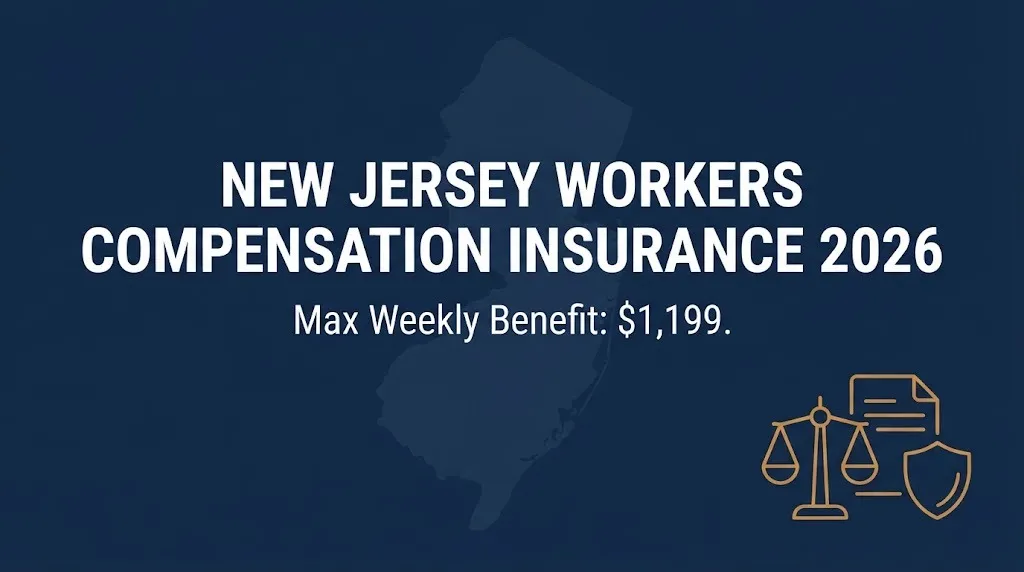
This affects small business owners, contractors, and anyone managing payroll in New Jersey, and the number that matters most right now is $1,199. That’s the new maximum weekly benefit rate for 2026, set by the state and confirmed in an official Department of Labor announcement.
This article covers who must carry coverage, what it costs, current 2026 rates, and the real penalties for skipping it. One detail that surprises a lot of employers: New Jersey has no state-run fund, coverage comes entirely from more than 400 private carriers or the assigned risk pool.
The Facts
| Program | New Jersey Workers’ Compensation Law, N.J.S.A. 34:15-1 et seq. |
| Status | Mandatory statewide, 2026 rates in effect since January 1, 2026 |
| 2026 Rate Change | Overall workers’ comp insurance rates decreased 4.3% effective January 1, 2026 |
| Max Weekly Benefit | $1,199 (2026), up from $1,159 in 2025 |
| Min Weekly Benefit | $320 (2026) |
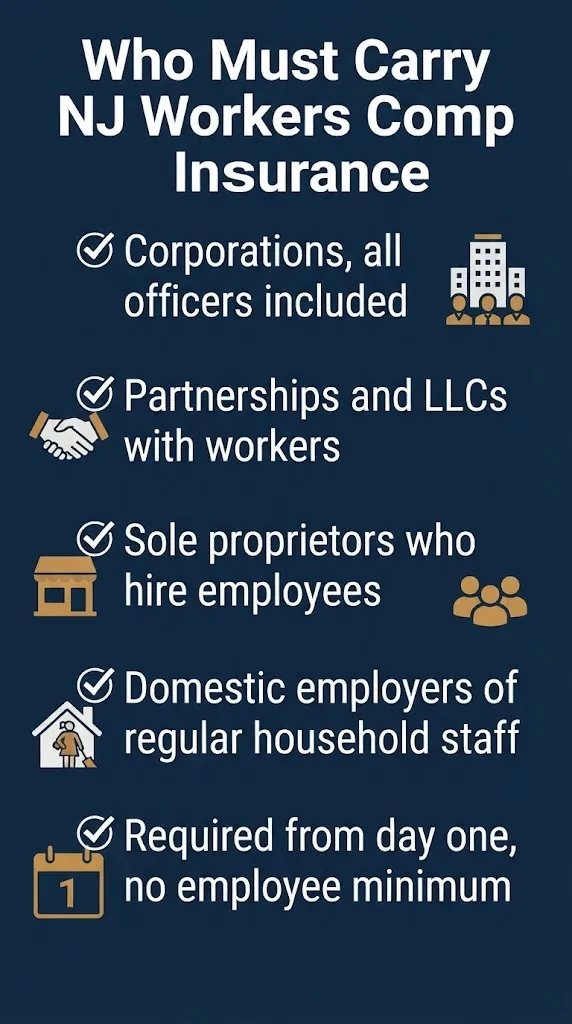
| Coverage Trigger | Required from the day you hire your first employee, no waiting period |
| Regulator | NJ Compensation Rating and Inspection Bureau (NJCRIB), NJ Division of Workers’ Compensation |
| Proof Needed | Certificate of insurance, posted notice of coverage at the worksite |
Is New Jersey workers compensation insurance legally required?
Yes. New Jersey law requires nearly every employer with one or more employees to carry workers’ compensation insurance or qualify as self-insured.
There’s no minimum employee threshold. Full-time, part-time, and seasonal workers all count toward triggering the requirement, according to the state’s own guidance for employers.
Corporations must carry coverage for all employees, including corporate officers. Partnerships and LLCs that have anyone performing services for them generally need coverage too.
Who the law covers, at minimum:
- Corporations operating in New Jersey, including their officers
- Partnerships and LLCs with individuals performing services
- Domestic employers of nannies or housekeepers working regular hours
- Any business the moment it hires its first employee
Is workers compensation in NJ a state-run fund or private insurance?
New Jersey has no state insurance fund for workers’ compensation, coverage comes from private carriers or the assigned risk pool.
That surprises a lot of first-time employers who expect a single state-run system like some other states operate. Instead, New Jersey is what’s called a competitive state, meaning you can shop for coverage.
You can buy a policy from any of more than 400 private licensed carriers, directly, through an agent, or through a broker. If no voluntary carrier will write your policy, the New Jersey Workers’ Compensation Insurance Plan, administered through NJCRIB, exists as a last resort.
Key Takeaway: New Jersey has no state workers’ comp fund, so coverage always comes from a private carrier or the assigned risk pool administered by NJCRIB.
How much does workers compensation insurance cost in New Jersey?
Cost depends on your payroll, industry classification, and claims history, but statewide base rates fell 4.3% effective January 1, 2026.
NJCRIB, the state’s official rating bureau, filed that rate decrease as the tenth consecutive year of reductions since 2017. The weighted average manual rate has dropped from $2.15 per $100 of payroll in 2017 to $1.43 per $100 of payroll in 2026, roughly a 33.5% decline over nine years.
That base rate isn’t the final number you’ll pay. Individual carriers can apply credits or debits of up to 15% based on your specific loss history and risk profile.
Not yet determined for your business specifically: your exact premium, since it depends on your industry classification code, total payroll, and claims experience. Request quotes from licensed carriers for an actual figure.
What drives your NJ workers’ comp premium:
- Your industry classification code and its base rate
- Total annual payroll for covered employees
- Your experience modification factor, based on past claims
- Carrier-applied credits or debits, up to 15% either direction
- Whether you qualify for the voluntary market or land in assigned risk
What are the 2026 NJ workers compensation benefit rates?
The 2026 maximum weekly workers’ compensation benefit rate is $1,199, and the minimum is $320, both effective January 1, 2026.
The New Jersey Department of Labor and Workforce Development confirmed these numbers in an official December 2025 press release. The maximum rate applies to temporary disability, permanent total disability, permanent partial disability, and dependency benefits alike.
Injured workers generally receive 70% of their average weekly wage, capped at the maximum rate. These figures are recalculated every year based on the statewide average weekly wage from two years earlier, which was $1,598.66 for 2024.
| Year | Max Weekly Benefit |
|---|---|
| 2022 | $1,065 |
| 2023 | $1,099 |
| 2024 | $1,131 |
| 2025 | $1,159 |
| 2026 | $1,199 |
What happens if you can’t get coverage in the voluntary market?
You can access New Jersey’s assigned risk plan, the state’s insurer-of-last-resort system administered through NJCRIB.
This pool exists for employers that voluntary carriers won’t write, usually due to a poor claims history or a high-hazard industry classification. Recent NJCRIB reporting shows the residual market covers only about 3% of the roughly 327,000 active workers’ comp policies in the state, with 97% placed in the standard voluntary market.
Reality Check: No legitimate insurance process starts with an unsolicited call or text promising a guaranteed low rate. Getting a real quote always requires sharing your actual payroll, industry code, and claims history with a licensed carrier or broker, and there’s no fee just to ask for one.
Assigned risk coverage tends to come with less favorable terms than the voluntary market. Reported industry sources note assigned risk policies can require a down payment near 40% of the annual premium and may cap coverage limits lower than what a voluntary market policy would offer.
How to get workers compensation insurance in NJ
Getting covered is a straightforward process, whether you’re a brand-new employer or switching carriers.
- Determine your industry classification code, since it drives your base rate.
- Calculate your estimated annual payroll for covered employees.
- Request quotes from licensed carriers, an agent, or a broker.
- Compare voluntary market quotes before assuming you need assigned risk.
- Confirm the policy meets New Jersey’s statutory minimum requirements.
- Post the required notice of coverage at your worksite.
- Keep proof of coverage on file in case of a state cross-match check.
- Contact NJCRIB directly if you need help locating a carrier.
Which employers must carry workers compensation insurance in NJ
Nearly every employer in New Jersey with at least one employee must carry coverage, with only narrow exceptions.
Corporations, including all their officers, must maintain coverage or gain approved self-insured status. Partnerships and LLCs with anyone performing services for them generally need active coverage as well.
Employers who typically must carry coverage:
- Any corporation operating in New Jersey
- Partnerships and LLCs with workers performing services
- Sole proprietorships that employ others
- Households employing domestic workers on a regular schedule
Key Takeaway: New Jersey requires coverage starting with your first employee, corporate officer, or regularly scheduled household worker, with no minimum size exemption.
Who is exempt from NJ workers compensation insurance requirements
Sole proprietors and certain LLC members with no employees are generally exempt from carrying workers’ compensation insurance in New Jersey.
Independent contractors are also typically excluded from coverage requirements, but New Jersey applies a strict ABC test to determine whether a worker is truly an independent contractor or a misclassified employee. Getting that classification wrong can trigger the same penalties as having no coverage at all.
Who may be exempt:
- Sole proprietors who hire no employees
- Certain LLC members without employees, depending on structure
- True independent contractors under the ABC test
If you’re unsure whether a worker qualifies as an independent contractor, treat that uncertainty seriously, since misclassification penalties can be significant.
What are the penalties for not having workers compensation insurance in NJ
Operating without required workers’ compensation insurance in New Jersey can trigger civil fines up to $5,000 for the first ten days uninsured, and $5,000 for every additional ten-day period after that.
New Jersey’s Department of Labor confirms this penalty structure directly. State law also classifies failing to insure as a disorderly persons offense, and willful failure can be prosecuted as a fourth-degree crime.
The Director of the Division of Workers’ Compensation can also issue a stop-work order within 72 hours for employers found to have knowingly failed to maintain coverage, under New Jersey’s administrative code.
Confirmed penalty structure:
| Violation | Consequence |
|---|---|
| Uninsured, first 10 days | Up to $5,000 fine |
| Each additional 10-day period | Up to $5,000 fine |
| Failure to insure | Disorderly persons offense |
| Willful failure | Fourth-degree crime |
| Knowing violation | Possible stop-work order within 72 hours |
Penalties are docketed as liens against the employer and can be pursued through property seizure to collect. Think of it less like a parking ticket and more like unpaid property taxes: the state can eventually attach your assets to collect.
What is the current status of NJ workers compensation rates in 2026
As of January 1, 2026, New Jersey workers’ compensation insurance rates decreased 4.3% overall, continuing a decade-long trend of annual rate reductions.
NJCRIB filed this change in Circular Letter No. 2510, its official rate filing document. The filing reflects rising loss experience offset by a larger downward trend adjustment tied to changing exposures and claim patterns.
At the same time, injured workers’ maximum benefit rate rose to $1,199, a 3.5% increase from 2025. Both trends, falling employer rates and rising worker benefits, are moving in the same direction industry analysts have tracked for several years.
How does NJ verify employers have coverage
New Jersey runs a Cross-Match Program that compares state employment records against workers’ compensation insurance records to identify potentially uninsured employers.
If the cross-match flags a business, the state’s Office of Special Compensation Funds sends a letter and a response form. Employers must then provide proof of coverage promptly, even if they believe the flag was a mistake.
What happens during a cross-match review:
- State systems compare employment and insurance databases.
- Flagged employers receive a letter and a Cross-Match Response Form.
- Employers must submit proof of current coverage.
- Penalties can still apply for any period found uninsured, even if coverage exists now.
What happens if an employee gets hurt and the employer is uninsured
If an employer is uninsured when an employee is injured, the worker may seek benefits through New Jersey’s Uninsured Employers Fund.
This fund pays medical expenses and temporary disability benefits when an uninsured employer fails or refuses to pay a workers’ compensation award. It does not cover permanent disability payments, those remain the employer’s direct liability.
To access the fund, an injured worker or their attorney files a motion to join the Uninsured Employers Fund as part of a formal workers’ compensation claim. If a judge issues an award, the fund pays the temporary and medical portions covered under that order.
Not yet determined for any individual case: the exact benefit amount, since that depends on the judge’s specific order and the worker’s average wage.
Why does New Jersey require workers compensation insurance
New Jersey requires this coverage to guarantee injured workers get medical care and wage replacement without needing to sue their employer over every workplace injury.
In exchange, employers generally gain protection from broader personal injury lawsuits tied to workplace accidents. It’s similar to how a warranty on a major appliance works: you give up separately negotiating every repair, but you get a guaranteed, faster process when something breaks.
Without required coverage, injured workers would face uncertain outcomes, and employers would face unpredictable, potentially far larger, lawsuit exposure.
Who regulates workers compensation insurance in New Jersey
The NJ Compensation Rating and Inspection Bureau sets rates and classification rules, while the NJ Division of Workers’ Compensation handles claims, enforcement, and penalties.
NJCRIB is a statutory rating organization operating under the state’s Department of Banking and Insurance. It sets base manual rates, maintains the classification system, and administers the residual market for employers who can’t find voluntary coverage.
The Division of Workers’ Compensation, part of the Department of Labor and Workforce Development, oversees claims, benefit rates, the Cross-Match Program, and non-insurance penalties, including stop-work orders.
What happens next
January 1, 2026: New 2026 maximum weekly benefit rate of $1,199 and 4.3% overall rate decrease took effect.
Ongoing throughout 2026: NJCRIB continues issuing monthly circular letters on assigned risk plan policy expirations and updates.
Expected late 2026: NJCRIB typically files its next annual rate revision proposal for review by the Department of Banking and Insurance.
Expected January 2027: New maximum and minimum weekly benefit rates take effect, based on the statewide average weekly wage.
Frequently Asked Questions
Do all NJ employers need workers compensation insurance?
Yes, nearly every employer with at least one employee must carry it.
This includes corporate officers, partnerships, and LLCs with workers.
Sole proprietors without employees are generally the main exception.
How much is workers compensation insurance in New Jersey?
Cost depends on your industry, payroll, and claims history.
Statewide base rates dropped 4.3% effective January 1, 2026.
Request quotes from licensed carriers for your specific premium.
What is the maximum workers comp benefit in NJ for 2026?
The 2026 maximum weekly benefit rate is $1,199.
That’s up from $1,159 in 2025, a 3.5% increase.
The minimum weekly rate for 2026 is $320.
What happens if I don’t have workers compensation insurance in NJ?
You can face civil fines up to $5,000 per uninsured ten-day period.
Failing to insure is also a disorderly persons offense under state law.
Willful violations can be prosecuted as a fourth-degree crime.
Can I get workers comp insurance if no private carrier will cover me?
Yes, through New Jersey’s assigned risk plan administered by NJCRIB.
This residual market option covers about 3% of active state policies.
Terms are typically less favorable than standard voluntary market coverage.
Does New Jersey have a state workers compensation fund?
No, New Jersey has no state-run workers’ compensation insurance fund.
Coverage comes from more than 400 private licensed carriers.
The assigned risk plan serves as the insurer of last resort.
Are independent contractors covered under NJ workers comp law?
Typically not, since true independent contractors fall outside employee coverage rules.
New Jersey applies a strict ABC test to determine correct worker classification.
Misclassifying an employee as a contractor can trigger the same penalties as no coverage.
If you’re setting up coverage for the first time, request quotes from a few licensed NJ carriers and confirm your industry classification before you commit. Keep proof of coverage on hand in case a state cross-match letter arrives.
The number to remember for 2026: the maximum weekly workers’ compensation benefit rate is $1,199, effective January 1, 2026.