Eduardo Saverin Settlement 2026: The Facebook Co-Founder Lawsuit, Explained With Verified Facts
Quick Answer
- Eduardo Saverin sued Facebook in 2005 over dilution of his founding shares.
- The case settled out of court. Saverin retained a co-founder credit and received undisclosed compensation.
- No public claim deadline or settlement fund exists because this was a private dispute, not a class action.
You searched for an Eduardo Saverin settlement. You probably saw a headline, a social post, or a video about the Facebook co-founder who sued Mark Zuckerberg. The story is real. The lawsuit happened. But the idea that there is a settlement you can claim or a public payout you can track is wrong.
This was a private dispute between two founders. It was not a consumer class action. No ordinary person can join it, file a claim, or receive money from it. The settlement terms were never fully disclosed.
This article explains what actually happened, what the court records show, what the settlement reportedly included, and why people still search for this case in 2026. It also separates verified fact from movie dramatization and internet myth.
The Facts
| Fact | Verified Value |
|---|---|
| Case | Saverin v. Facebook, Inc. |
| Status | Settled out of court, closed |
| Fund Size | Not applicable, private settlement |
| Est. Per Person | Not applicable, no class |
| Claim Deadline | None, no claims process |
| Administrator | None |
| Proof Needed | None |
Is the Eduardo Saverin lawsuit real?
Yes. Eduardo Saverin filed a lawsuit against Facebook in 2005. The case was filed in Massachusetts, where Saverin and Zuckerberg had connections from their Harvard days. The complaint alleged that Mark Zuckerberg and Facebook improperly diluted Saverin’s ownership stake.
The core dispute was simple. Saverin helped fund Facebook in its earliest days. He held a substantial ownership percentage. Later, Zuckerberg and other early figures restructured the company and issued new shares. Saverin’s stake was cut dramatically.
Saverin claimed the dilution was done without his proper consent. Facebook and Zuckerberg claimed Saverin was not fulfilling his role and that the restructuring was necessary. The court did not decide who was right. The parties reached a private settlement before a trial could resolve the merits.
Did Eduardo Saverin win the lawsuit?
He did not win at trial. There was no trial. The case settled before a final judgment on the claims.
The question of who won depends on how you measure success. Saverin sued to reclaim his stake or get compensation for its loss. The settlement restored some of his equity and secured his co-founder title. He did not regain the percentage he originally held.
Financially, Saverin won in a larger sense. He retained shares in Facebook. Those shares became worth billions when Facebook went public in 2012. His current net worth is reported in the tens of billions of dollars. The lawsuit was a dispute about how much of that future value he would keep.
Key Takeaway: Saverin did not win a court verdict. He won a negotiated outcome that preserved his connection to Facebook and a meaningful ownership stake.
What was the Eduardo Saverin settlement amount?
The exact settlement amount has never been publicly confirmed. Court filings reference a confidential settlement agreement. Neither Saverin nor Facebook disclosed the full financial terms.
What is known from public reporting and later legal documents is that Saverin received a restored ownership stake. Some reports estimated that stake at around 5 percent of Facebook at the time. The company later issued statements confirming Saverin held a co-founder title and retained shares.
The value of that stake grew over time. At the time of the settlement, Facebook was a private startup worth very little by today’s standards. By the 2012 initial public offering, Saverin’s stake was worth several billion dollars. He sold shares over time.
No court document states a cash settlement amount. Any figure you see online is an estimate or an inference, not a verified fact.
Is there a Facebook class action settlement involving Saverin?
No. The Saverin litigation was not a class action. It was a dispute between an individual shareholder and the company he helped create.
People sometimes confuse this case with other Facebook-related litigation. There have been consumer privacy class actions against Facebook. There have been securities cases. None of them involve Saverin as a claimant or class representative.
The Saverin case set no precedent for class certification. It created no settlement fund for consumers. It did not appoint a claims administrator. If you saw an ad suggesting you can claim money from a Saverin settlement, that ad is misleading.
Why is Eduardo Saverin suing Facebook?
He is not suing Facebook in 2026. The lawsuit happened once, in 2005, and it settled. There is no active litigation between Saverin and Meta Platforms.
The original lawsuit alleged that Mark Zuckerberg intentionally diluted Saverin’s shares. Saverin claimed he was pushed out of the company without fair compensation. He also sought to establish his role as a co-founder.
The dispute was captured in court filings and later dramatized in the film The Social Network. The movie version compresses events and invents dialogue. The real case was less cinematic but no less consequential for Saverin’s fortune.
No new filing exists. Any search result suggesting an ongoing lawsuit is either old content resurfacing or inaccurate.
How much is Eduardo Saverin worth in 2026?
Eduardo Saverin’s net worth is publicly estimated in the range of $30 billion to $40 billion, depending on asset valuations and market conditions. The estimate comes from Forbes and Bloomberg, which track major technology investors.
His wealth comes primarily from his Facebook shares. He also co-founded B Capital, a venture capital firm with significant investments in Asia and the United States. He renounced his U.S. citizenship in 2011 and resides in Singapore.
The net worth figure is an estimate, not a court finding. It changes with market conditions. But the scale tells you why the 2005 settlement mattered. A few percentage points of Facebook became one of the largest fortunes in tech.
Did Eduardo Saverin get 5 percent of Facebook?
Reports have cited a figure around 5 percent. The number has never been confirmed by a court order or a settlement document made public. It comes from reporting by journalists who reviewed portions of the legal record.
What is verified is that Saverin retained enough shares to become a billionaire many times over. Facebook’s 2012 SEC filings listed Saverin as a significant shareholder. His stake was disclosed in the prospectus.
The precise percentage at any given moment is less important than the outcome. Saverin kept a piece of the company. That piece generated enormous wealth. The settlement did not make him whole in percentage terms, but it made him extraordinarily wealthy in absolute terms.
Key Takeaway: The 5 percent figure is an informed estimate. The verified outcome is that Saverin retained a major stake and became a billionaire.
What does the Saverin case mean for startup founders?
The Saverin litigation is taught in business schools and law schools as a cautionary tale. It shows what happens when founder agreements are vague and ownership structures change without clear documentation.
Startup founders now use the case as a reason to formalize equity splits early. Vesting schedules, buyout clauses, and written consent requirements are standard now. They were less common in 2004, when Facebook was a dorm-room project.
The legal lesson is not about Facebook specifically. It is about documenting every ownership change. Saverin’s case forced a conversation about founder rights that still shapes startup law practice.
Can I file a claim in the Eduardo Saverin settlement?
No. There is no claims process. No settlement fund exists. No administrator will ever mail you a check related to this case.
This is the most important thing to understand if you arrived here from a search ad or a social media post. The Saverin case is a private dispute. It has nothing to do with consumer claims, class actions, or any process where ordinary people receive payments.
If you see a site asking you to register for a Saverin settlement, leave it. The site is collecting your personal data under false pretenses. You will not receive money from a case that settled privately between two founders over two decades ago.
What happened after the Saverin settlement?
Saverin remained a co-founder of Facebook in the company’s official records. He stayed a shareholder through the company’s growth. When Facebook filed for its initial public offering in 2012, Saverin appeared in the S-1 filing as a beneficial owner.
After the IPO, Saverin became a full-time investor. He founded B Capital in 2015 with Raj Ganguly. The firm manages billions in assets and invests in sectors including healthcare, financial technology, and enterprise software.
Saverin rarely discusses Facebook publicly. He has given occasional interviews about his investment philosophy and life in Singapore. He has not filed any new litigation against Meta or Zuckerberg.
Is the movie The Social Network accurate about the lawsuit?
The Social Network is a dramatization. It is not a documentary. The film condenses events, combines characters, and invents scenes for narrative effect.
The core facts are real: Saverin funded early Facebook, his stake was diluted, he sued, and he settled. The courtroom scenes and private confrontations are scripted. The actual legal record is less theatrical.
Aaron Sorkin, the screenwriter, has said the film is a work of fiction inspired by real events. The real Saverin has said the movie took liberties but captured the emotional truth of the betrayal he felt.
What is the difference between the Saverin case and a class action?
A class action involves many people with similar claims against a defendant. A court certifies a class, and the outcome binds all members unless they opt out. Any settlement fund is divided among class members.
The Saverin case was a single plaintiff suing a single company. It was not a class action. The settlement bound only Saverin and Facebook.
The distinction matters because class actions have claim deadlines, settlement administrators, and public funds. The Saverin case had none of that. Confusing the two leads people to believe they are owed money from a case they were never part of.
Key Takeaway: This was a private corporate dispute. It was never a consumer matter, and it will never produce a claim form.
Reality Check
No one is mailing checks from the Saverin settlement. No class action exists. No claim website exists. Any ad or post saying you can recover money from this case is using a famous name to collect your information. The case settled privately, the terms stayed confidential, and the only person who got paid was Saverin himself.
What Happens Next
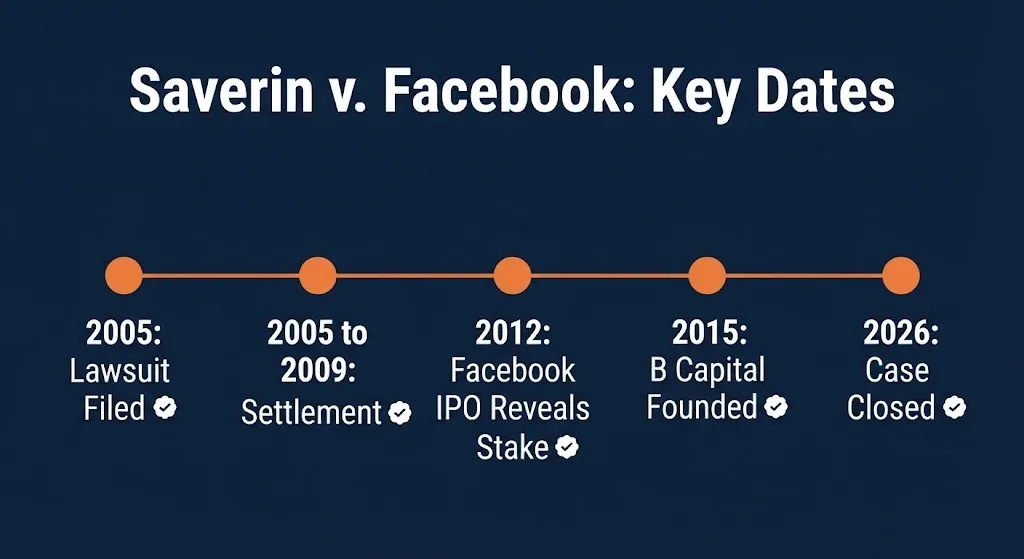
| Timeline | Status |
|---|---|
| 2005 | Lawsuit filed in Massachusetts |
| 2005 to 2009 | Settlement negotiated and finalized |
| 2012 | Saverin’s stake disclosed in Facebook IPO filings |
| 2015 | Saverin co-founds B Capital |
| 2026 | No active litigation, no pending claims |
This timeline is complete. Nothing is pending. The case is closed.
Frequently Asked Questions
Is the Eduardo Saverin lawsuit real?
Yes. Saverin sued Facebook in 2005 over dilution of his ownership stake.
Did Eduardo Saverin win the lawsuit?
He did not win at trial. The case settled before a judgment, and Saverin retained shares and his co-founder title.
How much was the Eduardo Saverin settlement worth?
The exact amount is confidential. Saverin kept a stake worth billions after the Facebook IPO.
Can I get money from the Saverin settlement?
No. There is no class action, no settlement fund, and no claims process.
Is there a new Eduardo Saverin lawsuit in 2026?
No. There is no active litigation between Saverin and Meta Platforms.
Why did Saverin sue Zuckerberg?
Saverin alleged his shares were diluted without proper consent during Facebook’s early restructuring.
What is Eduardo Saverin worth now?
Public estimates place his net worth in the tens of billions of dollars.
Did the movie The Social Network get it right?
The film is dramatized. The core events are real, but dialogue and scenes are invented.
The Bottom Line
The Saverin case is history. It shaped startup law and made one man a billionaire. It never created a payout for anyone else.
If you came here looking for a claim form, you will not find one. If you came here to understand the story, now you know what is verified and what is myth. The case is closed, the money is allocated, and the only filing you need to do is keeping this fact straight.