Incentive Compensation Management 2026: How Plans Work, What They Pay, and Legal Issues to Watch
Quick Answer
- Incentive compensation management is the process of designing, tracking, and paying performance-based rewards.
- Common incentive types include bonuses, commissions, profit sharing, and equity awards.
- Disputes over incentive pay often appear in wage lawsuits, breach of contract claims, and discrimination cases.
You were promised a bonus. Or a commission. Or equity that would vest over time. Now you are not sure whether the company owes you, how much, or what you can do if it does not pay.
Incentive compensation is the part of pay tied to performance. It is not base salary. It is conditional. The conditions matter. The documentation matters. When disputes arise, the plan document is the first thing a lawyer reads.
This article explains how incentive compensation management works, what the plans include, and the legal issues that arise when promises are not kept.
The Facts
| Fact | Verified Value |
|---|---|
| Concept | Incentive Compensation Management |
| Common Types | Bonuses, commissions, profit sharing, equity |
| Governing Documents | Plan documents, employment agreements |
| Legal Issues | Nonpayment, discrimination, breach of contract |
| Typical Dispute Value | Depends on the plan and the amount owed |
| Resolution | Negotiation, arbitration, or litigation |
What is incentive compensation management?
Incentive compensation management is the system companies use to design, administer, and pay performance-based rewards. The goal is to motivate employees to hit targets.
The plans are usually formal documents. They define who qualifies, what metrics trigger a payout, how much is paid, and when. The plan document is the controlling authority.
When a dispute arises, the plan document is the first evidence. If the plan says a bonus is discretionary, the company has broad power to withhold it. If the plan says a bonus is earned upon meeting specific metrics, the company must pay.
Key Takeaway: The plan document controls everything. If you do not have a copy, get one.
What are the types of incentive compensation?
Incentive compensation takes many forms. The most common are bonuses, commissions, profit sharing, and equity.
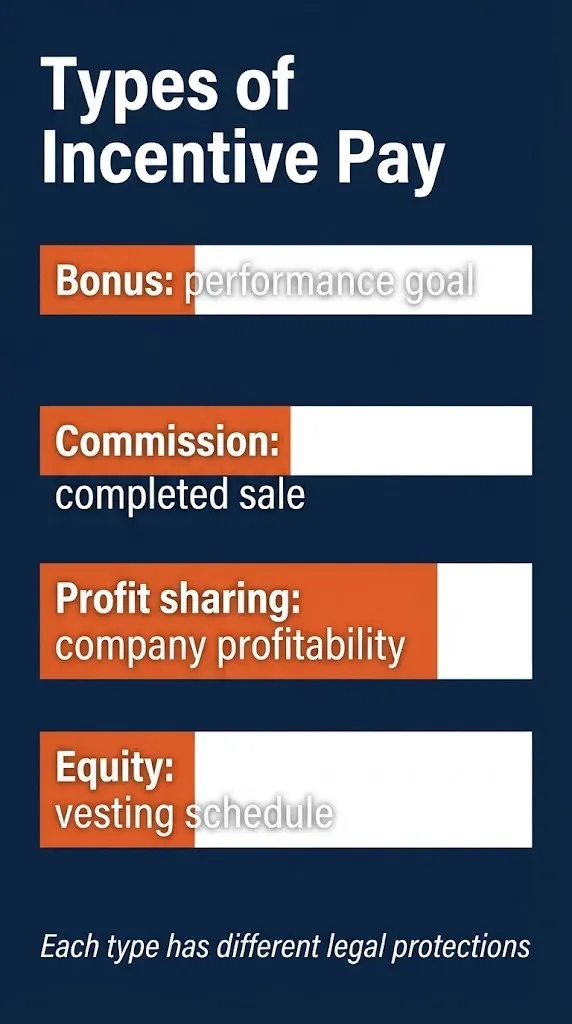
A bonus is a lump sum paid for achieving a goal. It may be discretionary or formula-based. A discretionary bonus is not guaranteed. A formula-based bonus is earned when the formula is met.
A commission is a percentage of sales. Commission plans are common in sales roles. Disputes often arise when a deal closes after termination or when the commission formula changes.
Profit sharing distributes a portion of company profits to employees. Equity compensation includes stock options, restricted stock units, and similar awards. Equity vests over time and may be forfeited if you leave.
Here is a breakdown:
| Type | Trigger | Risk |
|---|---|---|
| Bonus | Performance goal | Discretionary language |
| Commission | Completed sale | Post-termination disputes |
| Profit sharing | Company profitability | Formula changes |
| Equity | Vesting schedule | Forfeiture on departure |
What is an incentive compensation plan?
An incentive compensation plan is the formal document that defines the terms of the incentive program. It is sometimes called an incentive plan or a bonus plan.
The plan describes the performance period, the metrics, the payout formula, and the eligibility requirements. It also states whether the plan is discretionary or contractual.
Some plans are simple. A one-page bonus policy. Others are complex, with multiple tiers, clawback provisions, and legal conditions.
The plan is the contract between the company and the employee for incentive pay purposes. When a dispute arises, the plan language decides the outcome.
Key Takeaway: The plan is the source of truth. Everything else is commentary.
What is a management incentive compensation program?
A management incentive compensation program is a plan specifically for executives and senior managers. These programs tie pay to company performance over a longer period.
The programs often include a mix of cash bonuses and equity awards. The equity may vest over three to five years. The cash bonus may be based on annual or multi-year performance targets.
Management programs are more complex than broad employee plans. They often include change-in-control provisions, severance triggers, and clawback clauses.
If you are a manager or executive, your incentive plan is likely a separate document from the general employee plan. Read both.
What legal issues arise with incentive compensation?
The most common legal issue is nonpayment. An employee says the company owes a bonus or commission. The company says the payout was not earned or was discretionary.
Other issues include discrimination, retaliation, and breach of contract. If incentive pay is distributed unevenly based on protected characteristics, a discrimination claim may follow.
Here are the common legal disputes:
- Nonpayment of earned bonuses or commissions.
- Changes to the plan after the performance period begins.
- Termination before a bonus vests.
- Discrimination in bonus distribution.
- Retaliation for complaining about pay.
- Clawback of previously paid amounts.
Each dispute turns on the plan language and the facts. A lawyer can evaluate whether the company’s position is defensible.
What should I do if my employer does not pay my bonus?
First, get the plan document. Read it. Understand whether the bonus is discretionary or earned. Then document everything.
Here is the practical checklist:
- Request a copy of the incentive plan document.
- Review the eligibility and payout conditions.
- Gather evidence of your performance against the metrics.
- Document any promises made by managers.
- Put your demand in writing.
- Escalate to HR or senior management.
- Consult an employment lawyer if the dispute is significant.
- File a claim or lawsuit before any deadline.
Do not rely on verbal promises. The written plan controls. If the promise is not in writing, it may not be enforceable.
Key Takeaway: The time to read the plan is before the dispute, not after.
What is a discretionary bonus?
A discretionary bonus is one the company may pay or not pay at its option. The plan document usually says the bonus is discretionary and does not create a contractual right.
Courts generally enforce discretionary language. If the plan says the bonus is discretionary, the company can withhold it without breaching the contract. There are exceptions for discrimination or bad faith, but the bar is high.
A formula-based bonus is different. If the plan says you earn 10 percent of sales over a target, that is a contractual obligation. The company must pay when the formula is met.
The distinction between discretionary and formula-based is the single most important issue in bonus disputes.
What is a clawback provision?
A clawback provision allows the company to recover incentive pay already distributed. Clawbacks are common in executive compensation and in regulated industries.
The provision may trigger if the company restates financial results, if the executive engaged in misconduct, or if a risk event occurs. The terms are in the plan document.
Clawbacks are controversial. Employees do not want to return money they received. Companies argue the provision protects against paying for performance that did not actually occur.
If your plan has a clawback, know the triggers. The company can come for the money later.
What happens to my incentive pay if I am terminated?
It depends on the plan language. Some plans forfeit unvested equity and unpaid bonuses on termination. Others pay a pro-rated bonus. The answer is in the document.
If you are terminated for cause, forfeiture is more likely. If you are terminated without cause, you may have a stronger argument for pro-rated pay. The plan and your employment agreement control.
Do not assume you lose everything. Do not assume you keep everything. Read the termination provisions.
What is the difference between incentive compensation and base salary?
Base salary is fixed. It is paid regardless of performance. Incentive compensation is conditional. It is paid only when the conditions are met.
The legal protections differ. Base salary is protected by wage laws. Incentive pay may be protected too, depending on whether it is earned and the state’s laws.
In most states, earned commissions and earned bonuses are considered wages. They must be paid. Unearned or discretionary bonuses are not wages and are not protected in the same way.
Key Takeaway: Earned incentive pay is wages. Discretionary incentive pay is not.
What is the role of incentive compensation in a discrimination case?
Incentive pay can be evidence of discrimination. If bonuses are distributed unevenly across demographic groups without a legitimate explanation, a pattern may emerge.
The plaintiff may use statistical analysis to show that women or minorities received lower bonuses than similarly situated white men. That evidence supports a discrimination claim.
The company must then explain the disparity with legitimate, non-discriminatory reasons. If it cannot, the case proceeds.
Incentive compensation data is often discoverable in discrimination litigation. Companies must produce records showing who received what and why.
What is a change-in-control provision?
A change-in-control provision is a clause in a management incentive plan that triggers payment or acceleration when the company is acquired or merges.
The provision protects executives from losing their incentive pay when ownership changes. It may accelerate vesting or pay out a bonus upon the change.
These provisions are common in executive compensation. They are less common in broad employee plans.
If your company is being acquired, read the change-in-control language carefully. It may mean a significant payout.
Reality Check
No one will call you to tell you about a bonus you did not know existed. Legitimate employers communicate incentive plans in writing. If someone asks you to pay a fee to claim a bonus, it is a scam. Incentive pay disputes are resolved through negotiation, arbitration, or litigation, not through third-party claim services.
What Happens Next
| Timeline | Expected Stage |
|---|---|
| Now | Get the plan document |
| Before dispute | Understand the eligibility and payout terms |
| If dispute | Document everything and make a written demand |
| If unresolved | Consult an employment lawyer |
| Before deadline | File a claim or lawsuit |
These steps apply to most incentive pay disputes. The specific path depends on your plan and your state.
Frequently Asked Questions
What is incentive compensation management?
The process of designing, tracking, and paying performance-based rewards.
What are the types of incentive compensation?
Bonuses, commissions, profit sharing, and equity awards.
What is a discretionary bonus?
A bonus the company may pay or not pay at its option.
What happens to my bonus if I am terminated?
It depends on the plan language. Some forfeit, some pro-rate.
Can I sue for unpaid commissions?
Yes, if the commissions were earned and the plan defines them as earned.
What is a clawback provision?
A clause allowing the company to recover incentive pay already distributed.
What is a change-in-control provision?
A clause that triggers payment or acceleration when the company is acquired.
Do I need a lawyer for an incentive pay dispute?
Not for small disputes. Yes for significant amounts or complex plans.
The Plan Is the Promise
Incentive compensation is only as good as the plan document behind it. The promise matters. The paper matters more.
Get the plan. Read the terms. Know what is earned versus discretionary. Then you will know what the company actually owes you.