Product Liability Lawsuit 2026: What It Is, Who Can File, and How Settlements Work
Quick Answer
- A product liability lawsuit claims a defective product caused injury or damage.
- Anyone injured by a defective product may file, but they must prove the defect caused the harm.
- Settlement amounts vary widely based on injury severity, product type, and state law.
Product liability lawsuits hold manufacturers, distributors, and retailers responsible for injuries caused by defective products.
If a toaster catches fire, a drug causes unexpected side effects, or a car part fails, the injured person may have a claim. The legal theory is that the product was unreasonably dangerous and the company should pay.
No single settlement fund covers all product liability cases. Each case stands on its own facts, and each state has its own rules.
This article explains what product liability is, the types of defects, who can be sued, how settlements work, and what to do if a defective product hurt you.
The Facts
| Item | Details |
|---|---|
| Legal Area | Product liability |
| Common Defects | Design, manufacturing, warning failures |
| Defendants | Manufacturers, distributors, retailers |
| Statute of Limitations | Varies by state, typically 2 to 4 years |
| Settlement Structure | Individual cases, not a national fund |
| 2026 Law Change | None confirmed federally |
What Is a Product Liability Lawsuit?
A product liability lawsuit is a legal claim that a defective product caused injury or property damage.
The injured person sues the company that made, sold, or distributed the product. The claim can be based on negligence, strict liability, or breach of warranty.
Strict liability is the most common theory. It means the injured person does not need to prove the company was careless. They only need to prove the product was defective and the defect caused the harm.
Here are the three legal theories:
| Theory | What You Must Prove |
|---|---|
| Strict liability | Product was defective, defect caused injury |
| Negligence | Company failed to use reasonable care |
| Breach of warranty | Product did not meet its promises |
What Are the Three Types of Product Defects?
Product liability claims fall into three categories: design defects, manufacturing defects, and warning defects.
A design defect means the product was dangerous from the start. Every unit has the same flaw.
A manufacturing defect means one unit or batch was made wrong. The design was fine, but the production was faulty.
A warning defect means the product lacked adequate instructions or warnings about known risks.
Here is how they compare:
| Defect Type | What It Means | Example |
|---|---|---|
| Design defect | Flaw in the product’s plan | Car rolls over too easily |
| Manufacturing defect | Error during production | Batch of medication contaminated |
| Warning defect | Missing or inadequate warnings | No label about choking hazard |
Who Can Be Sued in a Product Liability Lawsuit?
Anyone in the chain of distribution can be sued, from the manufacturer to the retailer.
The manufacturer is the most common defendant. But distributors, wholesalers, and retailers can also be liable if they sold a defective product.
Here is the chain of potential defendants:
| Party | Role |
|---|---|
| Manufacturer | Made the product |
| Component supplier | Made a defective part |
| Distributor | Moved the product to stores |
| Retailer | Sold the product to the consumer |
| Importer | Brought a foreign product into the U.S. |
Key Takeaway: You do not need to sue everyone. But the more parties in the chain, the more potential sources of compensation.
How Much Is a Product Liability Settlement Worth?
No national average exists for product liability settlements. The value depends on the injury, the product, and the state.
A minor injury from a defective household product might settle for a few thousand dollars. A catastrophic injury from a defective medical device or vehicle might settle for millions.
Here are reported ranges by product category:
| Product Type | Reported Settlement Range |
|---|---|
| Defective household product | $5,000 to $100,000 |
| Defective medication | $50,000 to $1 million plus |
| Defective medical device | $100,000 to $5 million plus |
| Defective vehicle part | $50,000 to $10 million plus |
These are historical ranges from legal industry reporting, not guarantees for any specific case.
What Is a Defective Product Lawsuit Class Action?
A class action is a product liability case where many people with similar claims sue together.
Instead of thousands of individual lawsuits, one case represents everyone who bought or used the defective product. Class members share any settlement.
Class actions are common for consumer products with widespread but relatively small harms, like defective appliances or contaminated food.
Here is how class actions compare to individual cases:
| Feature | Class Action | Individual Lawsuit |
|---|---|---|
| Number of plaintiffs | Many, represented by one | One person |
| Payout per person | Usually smaller | Potentially larger |
| Injury severity | Usually similar | Can be catastrophic |
| Control over case | Limited | Full control |
What Is the Deadline to File a Product Liability Lawsuit?
The deadline depends on your state’s statute of limitations. Most states give you two to four years from the injury date.
Some states use the discovery rule. That means the clock starts when you discovered or should have discovered the injury, not when it happened.
Here is the general framework:
| State Rule | Typical Deadline |
|---|---|
| Injury date rule | 2 to 4 years from injury |
| Discovery rule | 2 to 4 years from discovery |
| Wrongful death | 1 to 3 years from death |
| Minor plaintiff | Clock may pause until age 18 |
Missing the deadline bars your case. Courts rarely grant exceptions.
What Should I Do If a Defective Product Injured Me?
Act fast. Preserve the product, document your injury, and talk to a lawyer.
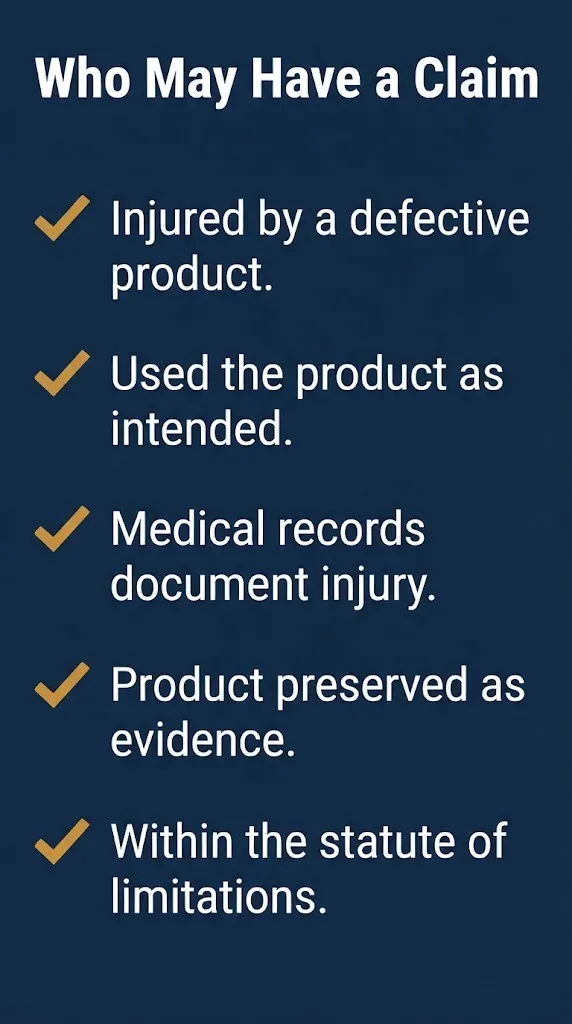
Do not throw away the defective product. It is the most important piece of evidence in your case.
Here is the action plan:
- Seek medical attention immediately.
- Preserve the product and its packaging.
- Photograph the product, the injury, and the scene.
- Keep receipts and proof of purchase.
- Write down the date, time, and circumstances of the injury.
- Report the incident to the manufacturer and retailer.
- Consult a product liability attorney before giving statements.
Reality Check: No legitimate product liability settlement asks you to pay a fee to file a claim. If someone demands money to process your claim, it is a scam.
What Is Strict Liability in a Product Liability Case?
Strict liability means you do not need to prove the company was careless.
You only need to prove the product was defective, you were using it as intended, and the defect caused your injury.
The doctrine exists because manufacturers are in the best position to prevent defects. They bear the cost when their products fail.
Here is what strict liability does not require:
| Element Not Required | Why |
|---|---|
| Proof of negligence | Not needed under strict liability |
| Proof of intent | Not needed, this is not a fraud case |
| Direct contract with manufacturer | Not needed, privity not required |
What Happens Next
Expected 2026: No federal product liability reform is pending.
Ongoing: State courts continue hearing individual and class action product cases.
Your move: Preserve the product, document the injury, and consult a lawyer before the statute of limitations runs.
Product liability law exists to make companies pay when their products hurt people. The rules are state-specific, the deadlines are real, and the evidence is everything.
If a defective product hurt you, act now. Preserve the product, document the injury, and get legal advice before you sign anything or give a recorded statement.
The strength of your case depends on what you can prove. The product, the medical records, and the timeline are your proof.