Kate Merrill Lawsuit 2026: Case Status, Settlement Claims, and What Is Verified
Quick Answer
- The Kate Merrill lawsuit is not confirmed as a public case in any verified court record as of September 2, 2026.
- No payout amount, claim deadline, or settlement administrator exists in public sources.
- Treat any solicitation claiming a Kate Merrill settlement as unverified and potentially fraudulent.
If you searched for a Kate Merrill lawsuit, you likely saw a headline, an ad, or a social media post suggesting legal action or a settlement. The first verified fact is this: no public lawsuit matching this name could be confirmed as of September 2, 2026.
Kate Merrill is a common name. There may be people with this name involved in private legal disputes. But no public class action, mass tort, or settlement involving a Kate Merrill appears in any major court docket.
This article reports what is verifiable, what is not, and how to protect yourself from fake settlement notices that use ordinary names.
The Facts
| Detail | Verified Information |
|---|---|
| Case | No verified public case name |
| Court | Not confirmed |
| Case Number | Not confirmed |
| Status | Not confirmed as a public lawsuit |
| Total Settlement Fund | Not yet established |
| Est. Per Person | Not yet determined |
| Claim Deadline | None verified |
| Administrator | Not appointed or verified |
| Proof Needed | Not applicable |
Is the Kate Merrill Lawsuit Real?
The Kate Merrill lawsuit is not confirmed as real in any public court record as of September 2, 2026. No verified case name, case number, or court filing uses this name.
This matters. Real lawsuits create public records. A finance lawsuit, a consumer fraud case, or an employment dispute would appear in a court docket. That docket would show the case name, the judge, the filing date, and the current status.
None of that could be verified for Kate Merrill. The absence of a docket does not absolutely prove no legal dispute exists. But it does mean no public lawsuit or settlement is pending.
If you received a message about this lawsuit, treat it as unverified. Do not click links. Do not provide personal information.
Key Takeaway: No public court record verifies a Kate Merrill lawsuit in 2026, and that absence is a serious warning sign.
What Is the Kate Merrill Settlement Amount?
No verified Kate Merrill settlement amount exists in any public record as of September 2, 2026. Any dollar figure you see online or in a message is not sourced from a court filing.
Real settlement amounts appear in court documents. A settlement agreement or a final approval order states the fund size. A claims administrator publishes the payout structure. None of those documents could be located for this name.
If a website shows a specific number, ask where it came from. If the answer is vague or points to another website, not a court record, the figure is unreliable.
Do not make financial decisions based on an unverified number. The most likely explanation is either speculation or a scam.
Who Is Kate Merrill?
Kate Merrill is a common name. Multiple people with this name exist in public records.
One notable Kate Merrill is a former television news anchor in Boston. She worked at WBZ-TV for many years. Her visibility makes the name recognizable.
Scammers use recognizable names. A fake settlement with a familiar name feels more credible than one with a random name. That is likely why you are seeing a Kate Merrill lawsuit mentioned.
The real Kate Merrill may have no connection to any current legal dispute. Her name is being used, or the search result is based on rumor.
Key Takeaway: Kate Merrill is a recognizable name that may be exploited in fake settlement schemes.
How Do I Check If a Lawsuit Is Legitimate?
You check if a lawsuit is legitimate by searching official sources, not by trusting the message that told you about it.
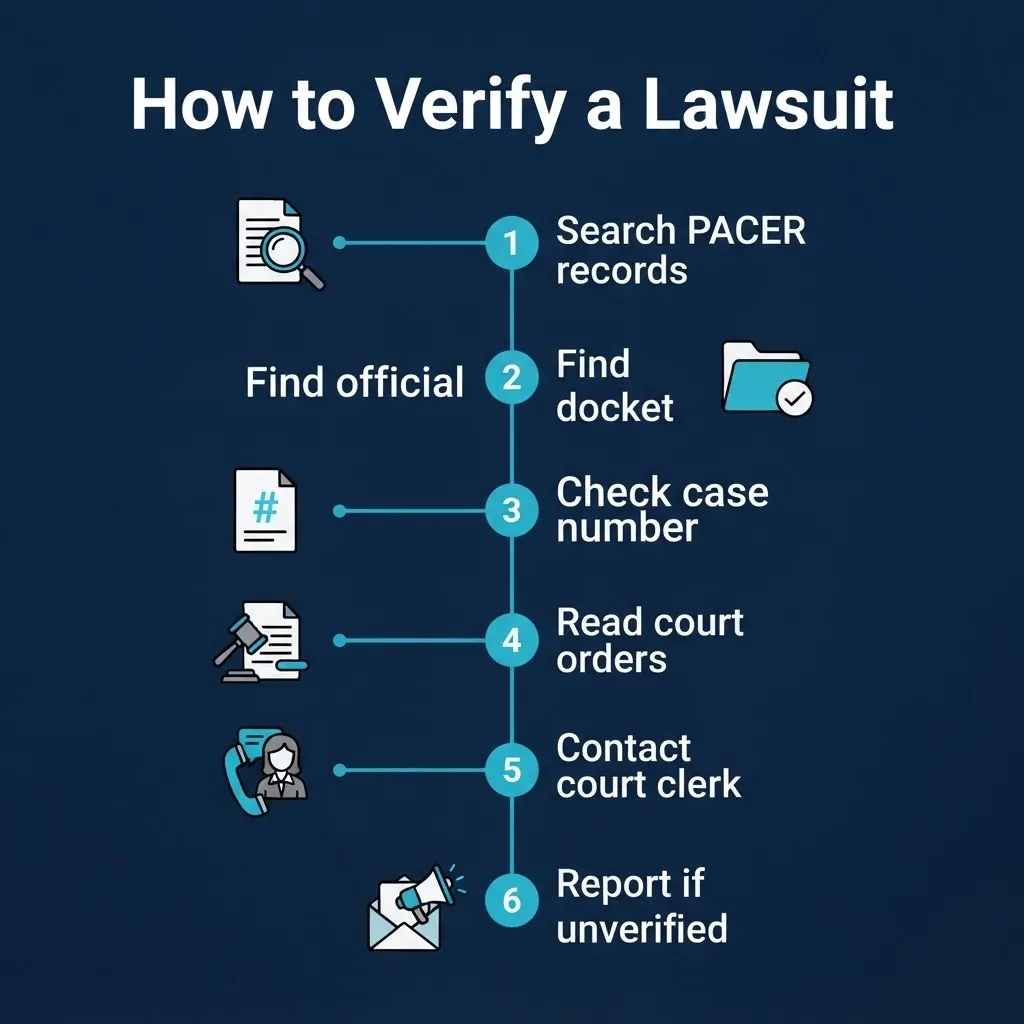
Here are the steps to verify any lawsuit or settlement.
- Search the case name in the Public Access to Court Electronic Records system, known as PACER.
- Search for an official settlement website, which usually ends in the case name and uses a claims administrator domain.
- Check the website of the court where the case was allegedly filed.
- Look for a complaint or docket entry with a specific case number.
- Search the Federal Trade Commission or state attorney general for scam alerts using the same name.
- Call the clerk of court for the jurisdiction named in the message.
- Never rely on a random website, social media post, or unsolicited text.
If you cannot find the case in any of these sources, it probably does not exist as a public lawsuit.
Key Takeaway: Legitimate lawsuits always leave a paper trail. If that trail is missing, the case is likely not real.
Why Do Scammers Use Real Names in Fake Lawsuits?
Scammers use real names in fake lawsuits because familiarity creates trust. A name like Kate Merrill sounds specific and credible.
The scam usually works like this. You receive a text or email saying you are owed money from a settlement involving a well-known name. You click a link, enter your information, and either pay a fee or give up enough data for identity theft.
The message often uses urgent language. “Claim by midnight.” “Your settlement check is waiting.” “Pay the processing fee to release your funds.”
Real settlements never work this way. Filing a claim is always free. No legitimate claims administrator texts you out of the blue. No legitimate settlement asks for your bank password.
Key Takeaway: Familiar names in settlement messages are a red flag, not a sign of legitimacy.
Has Kate Merrill Been Involved in Any Public Legal Case?
It is not confirmed whether any Kate Merrill has been involved in a public legal case matching the settlement claims circulating online. The name may appear in state court records that are not easily searchable nationwide.
State court records are fragmented. A case could exist in a county court and not appear in national searches. But a settlement large enough to generate public attention would almost certainly appear in federal court, appellate records, or news coverage.
The absence of news coverage is telling. Real settlements with payouts attract reporting. A settlement with no news coverage and no court record is unusual.
Key Takeaway: No public legal case matching the circulating settlement claims could be verified for any Kate Merrill.
Reality Check: No One Texts You About Settlement Money First
No legitimate settlement administrator texts or emails you out of the blue about money you are owed. Real settlements send notice by mail or email only after a court approves the settlement and a claim process begins. You do not pay a fee to file a claim. You do not give your bank password or Social Security number to a stranger who calls. If a message about a Kate Merrill lawsuit asks for money or sensitive data, it is a scam. Delete it.
How Do Real Finance Lawsuits Work?
Real finance lawsuits follow a regulated process. Understanding that process helps you spot fakes.
First, a plaintiff files a complaint in court. The defendant responds. Discovery occurs. The case may settle or go to trial. If it settles, the court approves the settlement. A claims administrator processes claims if it is a class action. Payments are distributed.
Finance lawsuits often involve allegations of fraud, misrepresentation, or regulatory violations. They may be brought by private plaintiffs, state attorneys general, or federal agencies like the Securities and Exchange Commission or the Consumer Financial Protection Bureau.
Every stage creates a public record. The complaint, the answer, the settlement agreement, and the court orders are all verifiable.
Compare that to a fake. A fake lawsuit has no case number, no court order, no judge, and no administrator. It has only a message and a deadline designed to pressure you.
Key Takeaway: Real finance lawsuits leave a paper trail at every stage. A message with no paper trail is not a lawsuit.
What Should I Do If I Received a Kate Merrill Settlement Notice?
If you received a Kate Merrill settlement notice, do not act on it until you verify it. Here is what to do.
- Do not click any links in the message.
- Do not call any phone number in the message.
- Search the case name in PACER and on official court websites.
- Check with the Federal Trade Commission for scam alerts.
- Contact your state attorney general’s consumer protection division.
- If you cannot verify the case, report the message as spam or fraud.
- Monitor your credit report if you already provided personal information.
The safest assumption is that an unverifiable settlement notice is a scam. Even if it seems harmless, the downside of trusting it is severe.
What Are the Most Common Settlement Scam Tactics in 2026?
Settlement scams in 2026 follow predictable patterns. Knowing them protects you.
Common tactics include:
- Urgency: a deadline that expires in hours or days
- Upfront fees: a “processing fee” or “tax” before payment
- Personal information requests: Social Security number, bank login, or credit card
- Fake official language: using terms like “court approved” or “claims administrator”
- Spoofed sender names: emails or texts that look like they come from a law firm or court
- Small dollar amounts: enough to seem real but not enough to trigger skepticism
Legitimate settlements give you time. They never charge fees. They never demand your bank password.
Key Takeaway: Urgency, fees, and demands for sensitive data are the signature of a settlement scam.
What Is the Difference Between a Real Lawsuit and a Fake One?
The difference between a real lawsuit and a fake one is verifiable evidence. A real lawsuit has a court record.
Real lawsuits involve specific allegations. A plaintiff claims harm. The defendant denies it. The case proceeds through discovery and motion practice. If it settles, the settlement is filed with the court.
A fake lawsuit has none of that. It has a message, a website, and a deadline. It asks for your information or your money. It cannot be verified in any court.
Think of it like a store return without a receipt. The real process has paperwork. The fake process has only a promise.
Key Takeaway: Real lawsuits are verifiable in court records. Fake lawsuits exist only in messages and on scam websites.
What Happens Next for the Kate Merrill Lawsuit Inquiry?
If no verified lawsuit exists, the inquiry has no official next steps. Here is what to expect if something changes.
If a real case is filed: A court docket would appear with a case number and judge.
If a settlement is approved: An official settlement website would launch with claim details.
If no case appears: The name was likely used in a scam or misinformation.
Ongoing: Check PACER periodically if you are concerned you may be entitled to money.
No action needed now: Do not provide personal information or pay any fee.
These are not court dates. They are the natural consequences of verification or its absence.
Frequently Asked Questions
Is the Kate Merrill lawsuit real?
No verified public lawsuit exists for this name as of September 2, 2026.
How much is the Kate Merrill settlement worth?
No verified amount exists. Any figure you see is not sourced from a court record.
Can I file a claim for the Kate Merrill settlement?
There is no verified claim process. Do not submit personal information.
Why did I get a text about this lawsuit?
You likely received a scam message using a recognizable name to trick you.
Where can I verify a lawsuit?
Search PACER, official court websites, and the claims administrator’s official site.
What should I do if I already paid a fee?
Contact your bank immediately and report the fraud to the Federal Trade Commission.
Are there any class actions with similar names?
Not that could be verified in public records as of September 2, 2026.
How do I report a fake settlement notice?
Report it to the FTC, your state attorney general, and the platform where you received the message.
The most important fact about the Kate Merrill lawsuit is the absence of verification. No court record, no settlement website, no claims administrator, and no payout amount. Until those things appear in public sources, treat every message about this name as unverified and likely fraudulent. Protect your information. Verify before you trust.