3M Earplug Lawsuit 2026: Settlement Payouts, Claim Status, and Latest Updates
Quick Answer
- The 3M earplug lawsuit is real. It settled for over $6 billion to resolve claims from veterans who suffered hearing loss.
- Payouts vary widely based on injury severity and documentation. Some claimants receive six-figure awards. Others receive much less.
- The main registration deadline has passed. If you have not filed yet, your options are now very limited. Speak to a lawyer immediately.
If you served in the U.S. military and used 3M Combat Arms earplugs between 2003 and 2015, you may already know about the largest mass tort settlement in American history. 3M agreed to pay more than $6 billion to resolve roughly 260,000 claims from veterans who say the earplugs were defective and failed to protect their hearing. Payments are now flowing, but the process has been anything but smooth. Some veterans report receiving far less than they expected after deductions.
This article covers the current payout status, the average award amounts by injury tier, the deductions that have angered many claimants, how to check your payment status, and what to do if you believe you still have a viable claim. One hard truth you will not see in 3M’s press statements: many veterans who received the lowest-tier expedited payouts netted less than $5,000 after attorney fees and liens.
The Facts
| Case | In re 3M Combat Arms Earplug Products Liability Litigation, MDL No. 2885 |
| Status | Settlement approved and paying claims |
| Fund Size | Over $6 billion total (combination of settlement fund and 3M subsidiary bankruptcy trust) |
| Est. Per Person | Varies by tier; expedited payments from a few thousand dollars, higher-tier awards reach six figures |
| Claim Deadline | Main registration deadline passed. Earplug-specific deadline was January 25, 2024 |
| Administrator | Archer Systems (settlement claims administrator) |
| Proof Needed | Military service records, medical records documenting hearing loss or tinnitus, audiograms |
Is the 3M Earplug Lawsuit Settlement Real?
Yes, the settlement is real, court-approved, and actively paying claims. It is one of the largest mass tort resolutions in U.S. history. The total value exceeds $6 billion when combining the primary settlement agreement with the related 3M subsidiary bankruptcy trust.
The settlement resolved claims brought by current and former U.S. military service members. They alleged that 3M’s dual-ended Combat Arms earplugs, version 2, were defectively designed, too short to fit properly in many users’ ears, and could loosen imperceptibly during use. The result, veterans claimed, was hearing loss and tinnitus that could have been prevented.
3M did not admit liability. The company maintained the earplugs were effective when used correctly. But facing roughly 260,000 individual lawsuits consolidated in a federal multidistrict litigation in Florida, 3M chose to settle rather than litigate each case individually. The settlement was structured to pay claimants on an expedited basis if they qualified for certain injury tiers.
Payments are not theoretical. Veterans have received checks. Some are still waiting. The settlement administrator, Archer Systems, is processing claims in waves. The process has been criticized for delays, opaque deductions, and lower-than-expected net payouts. But the payments are real.
Key Takeaway: The $6 billion 3M earplug settlement is paying out. It is not a scam. Payments are real, but the amount each veteran receives depends heavily on their injury tier, documentation, and various deductions.
What Is the 3M Earplug Lawsuit About?
The lawsuit claimed 3M sold defective Combat Arms earplugs to the U.S. military for more than a decade. The earplugs were issued to service members deployed to Iraq, Afghanistan, and other combat zones.
The earplugs had a dual-ended design. One end was yellow and intended to block loud impulse noises like explosions while allowing quieter sounds like voices through. The other end was olive green and designed for continuous noise blocking. Veterans alleged both ends failed. The earplugs were too short, the materials degraded, and they loosened without the wearer noticing.
The defect allegation was not just theoretical. A whistleblower lawsuit filed by a competitor, Moldex-Metric, accused 3M of knowing the earplugs failed safety tests. The Department of Justice joined that case. 3M settled the government fraud claims for $9.1 million in 2018. That settlement became a roadmap for the veterans’ injury litigation that followed.
Veterans claimed the earplug failures caused permanent hearing loss, tinnitus (constant ringing in the ears), and related auditory damage. Some also claimed balance problems, cognitive difficulties, and reduced quality of life. The noise exposure in combat zones, combined with defective hearing protection, allegedly created a lifetime of auditory damage.
How Much Is the Average 3M Earplug Lawsuit Payout?
The average payout depends entirely on the claimant’s injury tier. No single “average” figure captures the range. The settlement created multiple tiers based on the severity of documented hearing loss and whether tinnitus was present.
The lowest tier, sometimes called the expedited payment tier or Tier 1, was designed for claimants with milder hearing loss who could provide qualifying audiograms. These payments were intended to be fast and predictable, but relatively small. Early reports from attorneys and veterans indicate net expedited payouts have often landed in the range of $3,000 to $10,000 after deductions.
Higher tiers produce larger awards. Claimants with more severe, well-documented hearing loss and tinnitus have reported gross awards ranging from $20,000 to over $100,000, though deductions can take a significant bite.
The top tier, reserved for claimants with profound hearing loss or additional injuries like vestibular damage, can produce gross awards exceeding $200,000. These cases require extensive medical documentation and typically took longer to process.
A significant source of frustration has been the gap between gross and net payouts. Attorney fees, typically 33 to 40 percent, come off the top. Then come liens for VA healthcare, TRICARE, or Medicare if those programs paid for hearing-related treatment. Some veterans also had litigation finance loans with their own fees and interest.
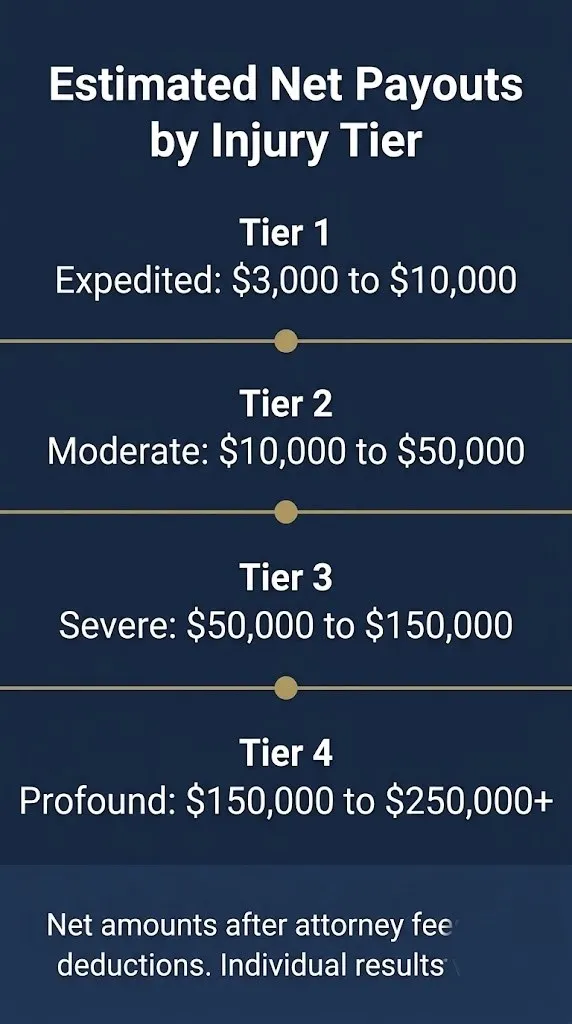
Payout Tier Estimates (Net to Claimant After Deductions)
| Tier | Injury Description | Estimated Net Range |
| Expedited Tier 1 | Mild hearing loss, qualifying audiogram | $3,000 to $10,000 |
| Tier 2 | Moderate hearing loss, tinnitus documented | $10,000 to $50,000 |
| Tier 3 | Severe hearing loss, strong documentation | $50,000 to $150,000 |
| Tier 4 | Profound loss, vestibular injury, exceptional documentation | $150,000 to $250,000+ |
These ranges are estimates based on attorney-reported data. They are not guarantees. Every case is different. Deductions vary. The settlement administrator, not this article, determines your actual payment.
Reality Check: Some law firms advertised “average payouts” of $50,000 or more during the recruitment phase. For many veterans in the expedited tier, the actual net check was under $5,000. That gap has generated anger and some bar complaints. File your claim with realistic expectations. Nobody gets rich from this settlement. The money is meant to compensate for a permanent injury, not to provide a windfall.
Who Qualifies for the 3M Earplug Settlement?
Qualification is now largely closed. The deadline to register for the primary settlement was in early 2024. If you have not filed by now, you may be out of options unless you fall into a narrow exception.
To have qualified, a claimant needed to be a U.S. military service member or veteran who used 3M Combat Arms earplugs version 2 between roughly 2003 and 2015 and who subsequently experienced hearing loss, tinnitus, or both. Documentation was key. Claimants needed military service records placing them in the affected timeframe, medical records showing a diagnosis of hearing loss or tinnitus, and ideally an audiogram from a licensed audiologist.
The settlement allowed for different levels of proof depending on the tier sought. Expedited tiers required less documentation but paid less. Higher tiers required more extensive medical evidence and faced more scrutiny.
If you served during the relevant period and have hearing problems but never filed a claim, you need to speak with a lawyer immediately. Some firms are still evaluating late claims under limited exceptions. The statute of limitations has likely run on most unfiled cases, but your individual circumstances may differ. Do not rely on a website to tell you whether your window is open. A lawyer must evaluate your specific timeline.
Key Takeaway: New claims are mostly closed. The main filing deadline passed in January 2024. If you never filed, contact a lawyer this week to see whether any exception applies. Assume the door is shut until a lawyer tells you otherwise.
What Deductions Reduce the 3M Settlement Payout?
Several deductions come out of the gross settlement award before the veteran receives a net check. These deductions have been a major source of complaints.
Attorney fees are the largest single deduction. Most law firms handling 3M earplug cases worked on contingency. They took 33 to 40 percent of the gross recovery. On a $50,000 gross award, a 40 percent fee removes $20,000 before anything else.
Government healthcare liens come next. If the VA, TRICARE, or Medicare paid for any hearing-related medical treatment, those agencies have a legal right to recover those costs from your settlement. The amount varies. Some veterans saw liens of a few hundred dollars. Others saw liens in the thousands.
Litigation finance repayments affect some claimants. If your law firm or a third-party lender advanced money during the case, that loan gets repaid from your settlement with interest. Some of these loans carry high interest rates that compound over the years a case was pending.
Case expenses are deducted by the law firm for things like medical record retrieval, expert review fees, and administrative costs. These typically range from a few hundred to a few thousand dollars.
The net result for some veterans: a gross award that looked substantial on paper became a much smaller check. This is not unique to the 3M settlement. It is how mass tort settlements work. But many veterans say their lawyers did not adequately explain the deductions when they signed up.
How to Check Your 3M Lawsuit Settlement Status
The settlement claims administrator, Archer Systems, maintains a portal where claimants and their attorneys can check case status. Access is typically through your law firm, not directly.
If you have an attorney, contact them first. Your lawyer has access to the settlement portal and can tell you your case status, whether your award has been calculated, and whether any issues are holding up payment. Law firms receive batch updates from the administrator. Yours should be able to give you a status within a few business days of asking.
If you do not have an attorney, or your attorney is unresponsive, you can contact Archer Systems directly. The administrator’s contact information is on the official settlement website. You will need your claimant ID or case number. Be prepared for delays. The administrator is handling hundreds of thousands of files.
Some veterans report that their cases have been stuck in “under review” status for months. This may mean the administrator needs additional documentation or that your case is flagged for closer scrutiny. Your attorney is responsible for resolving these holds. Persistent follow-up is often necessary.
Key Takeaway: Contact your law firm for status updates. They have portal access. If your lawyer will not return calls, you can try the administrator directly, but your options are limited without attorney cooperation.
When Will 3M Earplug Settlement Checks Be Mailed?
Checks are being mailed now. The settlement began distributing expedited payments in 2024 and early 2025. Higher-tier payments are ongoing through 2026.
The payment timeline depends on your tier. Expedited claimants were paid first. These payments were intended to be quick, with some arriving within months of the settlement’s effective date. Higher-tier claims require more review. Each claim must be validated against medical records, and lien amounts must be calculated and negotiated. That takes time.
Some veterans are still waiting. Payment waves continue to go out. The administrator processes claims in batches. Being later in the queue does not mean your claim is denied. It may mean your case is in a later batch or requires more documentation.
If your address has changed since you filed, update it immediately with both your attorney and the settlement administrator. Undeliverable checks are a common problem in mass tort settlements. A check sent to an old address may not be reissued for months.
Direct deposit was available to some claimants. If you opted for direct deposit, your payment should arrive faster and with less risk of address problems. Check with your attorney on which payment method applies to your case.
What Is the 3M Aearo Technologies Bankruptcy?
3M placed its subsidiary, Aearo Technologies, into bankruptcy in 2022. That move was widely seen as an attempt to limit 3M’s liability. The bankruptcy created confusion and delay.
Aearo manufactured the earplugs. By putting the subsidiary into Chapter 11, 3M tried to funnel all earplug claims through the bankruptcy court, where recoveries are often lower than in civil litigation. The bankruptcy judge initially paused all earplug lawsuits. Veterans and their attorneys fought back.
A settlement was eventually reached that required 3M to contribute billions directly, bypassing the bankruptcy limits. The Aearo bankruptcy trust became part of the overall settlement structure. 3M committed over $6 billion total between the direct settlement fund and the trust.
The bankruptcy strategy delayed the litigation by more than a year. Many veterans were outraged. 3M, a company worth tens of billions of dollars, was accused of hiding behind a subsidiary to avoid paying injured service members. The settlement resolved that standoff, but the bad taste remains.
What Was the 3M Earplug Whistleblower Case?
Before the veterans’ lawsuits, a whistleblower case exposed the alleged defect. Moldex-Metric, a competitor of 3M, filed a False Claims Act lawsuit accusing 3M of selling defective earplugs to the government while knowing they failed safety tests.
The Department of Justice investigated and joined the case. The government alleged 3M knew the earplugs were too short for proper insertion, that the company manipulated test results, and that it continued selling the product for years without disclosing the problems.
In 2018, 3M paid $9.1 million to settle the government fraud claims. The company admitted no wrongdoing. But the settlement documents became a key piece of evidence in the veterans’ litigation that followed. They showed internal company testing and communications that plaintiffs’ lawyers used to argue 3M knew the earplugs were defective and sold them anyway.
The whistleblower case was the spark. Without it, the scale of the alleged defect might never have become public. Moldex received a whistleblower award from the government’s recovery, a standard practice in False Claims Act cases.
How Did the 3M Earplug MDL Work?
The 3M earplug cases were consolidated into a multidistrict litigation, MDL No. 2885, in the U.S. District Court for the Northern District of Florida. Judge M. Casey Rodgers presided.
An MDL is not a class action. Each veteran kept their own case. The consolidation was for pretrial efficiency: discovery, motions, and bellwether trials were handled collectively. This prevented 260,000 individual cases from proceeding separately across the country.
Bellwether trials began in 2021. These test cases were tried to verdict to give both sides a realistic view of case values. The results were mixed but leaned toward plaintiffs. Several early trials produced multi-million-dollar verdicts for veterans. Those verdicts created enormous settlement pressure on 3M.
The MDL process was unusually fast for a mass tort of this size. From the first bellwether to the settlement announcement took about two years. That speed was driven by the judge’s aggressive scheduling and the sheer weight of evidence from the whistleblower case.
Key Takeaway: The MDL consolidated pretrial proceedings. Bellwether trial verdicts pushed 3M toward settlement. The process moved faster than most mass torts of comparable size.
What Happens Next in the 3M Earplug Settlement?
The settlement is in its payment phase. Here is the remaining timeline.
- Ongoing through 2026: Higher-tier claims continue to be processed and paid. The administrator addresses lien disputes and documentation deficiencies.
- Late 2026 into 2027: The bulk of higher-tier payments are expected to complete. Remaining disputed claims are resolved individually.
- 2027 and beyond: Any remaining funds or unresolved claims are administered through the Aearo bankruptcy trust. Late-filed or exceptional cases may receive final determinations.
- Veteran lawsuits against law firms: Some veterans who feel misled about fees or payout estimates are pursuing separate claims against their own attorneys. Those cases are independent of the 3M settlement.
The settlement will eventually wind down. The exact end date is not confirmed, but the administrator is expected to complete most distributions by late 2026 or early 2027.
Frequently Asked Questions
Can I still file a 3M earplug lawsuit in 2026?
Probably not. The main filing deadline passed in January 2024.
Contact a lawyer to check whether any narrow exception applies to your situation.
How much will I get from the 3M earplug settlement?
It depends on your injury tier, documentation, and deductions.
Expedited claims netted roughly $3,000 to $10,000. Higher tiers can reach six figures.
Why is my 3M settlement check taking so long?
Higher-tier claims require detailed medical review and lien resolution.
Some cases are stuck pending additional documentation. Contact your lawyer for status.
What deductions come out of my 3M settlement?
Attorney fees (typically 33 to 40 percent), government healthcare liens, and case expenses.
Some claimants also repay litigation loans from their recovery.
Is the 3M earplug settlement a class action?
No. It was an MDL settlement resolving individual lawsuits.
Each veteran kept their own case and received their own award.
Who is the settlement administrator for the 3M earplug case?
Archer Systems is the court-appointed claims administrator.
Your attorney has portal access. You may contact Archer directly with your claimant ID.
What if my lawyer will not return my calls?
This is a common complaint. Document your attempts to reach them.
You may file a bar complaint or consult another attorney about your options.
Did 3M admit the earplugs were defective?
No. The settlement included no admission of liability.
3M maintained the earplugs worked when used correctly.
The 3M earplug settlement is real, and payments are going out. If you filed a claim, your money may already be on the way, or it may still be tied up in the higher-tier review process. Contact your lawyer for specifics. If you never filed, your window is almost certainly closed, but a quick call to a law firm this week will confirm that one way or the other.
For everyone still waiting, the hard reality is that net payouts, especially at the expedited tier, have been smaller than many veterans expected. The deductions are real. The delays are real. The money is also real, and it should arrive eventually. The official settlement website and your attorney remain your only reliable sources for status updates.