McDonald’s Hot Coffee Lawsuit 2026: The Real Settlement Amount, What Actually Happened, and Why It Still Matters
Quick Answer
- The case was real. Stella Liebeck suffered third-degree burns from McDonald’s coffee in 1992.
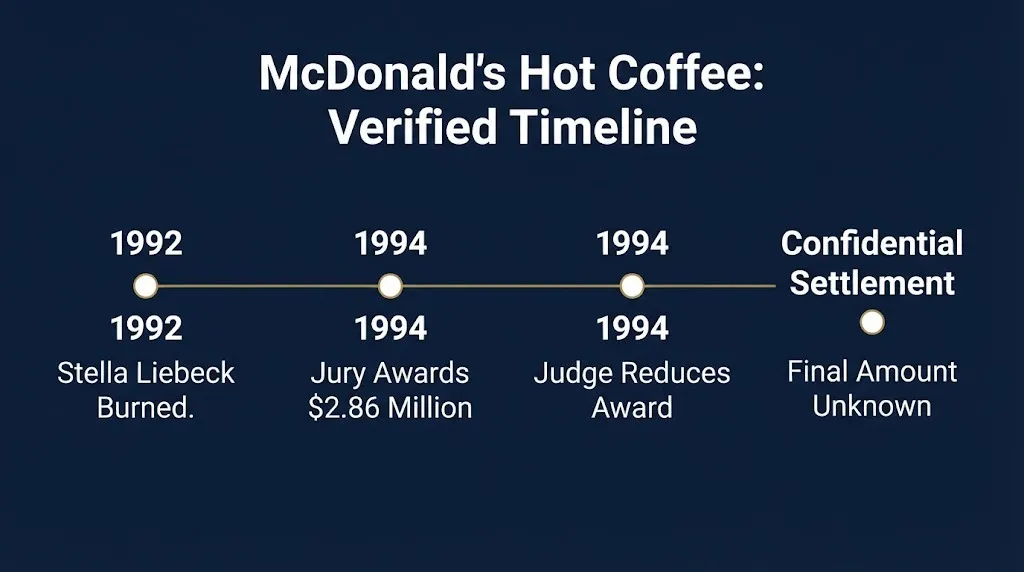
- The jury awarded $2.86 million. The final settlement was confidential but lower.
- No one can claim money from this case in 2026. It is closed and settled.
The McDonald’s hot coffee lawsuit is the most misunderstood consumer case in American legal history. You have heard the punchline. You probably have not heard the facts.
Stella Liebeck, 79, spilled McDonald’s coffee in her lap in 1992. She suffered third-degree burns on her thighs, buttocks, and groin. She spent eight days in the hospital.
This article explains what actually happened, how much money changed hands, and why you cannot file a claim for it now. The case is closed. It has been closed since 1994.
The Facts
| Case | Liebeck v. McDonald’s Restaurants |
| Court | Second Judicial District Court, Bernalillo County, New Mexico |
| Case Number | CV-93-02419 |
| Filed | 1994 |
| Verdict | August 18, 1994 |
| Jury Award | $2.86 million (reduced by judge) |
| Final Settlement | Confidential, never publicly disclosed |
| Claim Deadline | None. Case closed in 1994 |
Is the McDonald’s Hot Coffee Lawsuit Real?
Yes. The McDonald’s hot coffee lawsuit is completely real.
Stella Liebeck filed her case in New Mexico state court in 1994. She sued McDonald’s Restaurants for serving coffee at 180 to 190 degrees Fahrenheit.
The case went to trial. A jury heard evidence for seven days.
McDonald’s had received over 700 prior burn complaints about its coffee. The company knew the coffee could cause severe injuries.
How Much Did the Jury Award in the Hot Coffee Lawsuit?
The jury awarded $2.86 million in total.
That figure included $160,000 in compensatory damages and $2.7 million in punitive damages.
The punitive damages were calculated as roughly two days of McDonald’s coffee sales revenue.
The judge later reduced the total award. The final settlement amount was never publicly disclosed.
| Damage Type | Jury Award |
|---|---|
| Compensatory damages | $160,000 |
| Punitive damages | $2.7 million |
| Total jury award | $2.86 million |
| Judge’s reduction | Amount not confirmed |
| Final settlement | Confidential |
Key Takeaway: The jury award and the final settlement are different numbers. The final amount remains confidential.
What Was the Final McDonald’s Hot Coffee Settlement Amount?
The final settlement amount was never publicly confirmed.
After the jury verdict, the judge reduced the punitive damages. Both sides then negotiated a confidential settlement.
No court filing reveals the final number. Legal analysts estimate it was under $600,000 based on similar reductions, but that figure is not confirmed.
Any source claiming a specific final settlement amount is speculating.
Why Was the Settlement Confidential?
The settlement was confidential because both parties agreed to keep the terms private.
McDonald’s wanted to avoid setting a public benchmark for future burn cases.
Stella Liebeck’s family likely received a structured payment covering her medical costs and future care.
Confidential settlements are common in personal injury cases. They let both sides avoid further litigation and publicity.
Can I File a Claim in the McDonald’s Hot Coffee Lawsuit?
No. You cannot file a claim in this case.
The case settled in 1994. It has been closed for over 30 years.
There is no claims administrator. There is no settlement fund. There is no deadline because there is no open case.
Any message suggesting you can claim McDonald’s coffee lawsuit money is a scam.
Why Do People Still Search for the McDonald’s Hot Coffee Payout?
The case became a cultural joke. Late-night hosts mocked it. Politicians used it to attack the civil justice system.
That publicity buried the actual facts. People remember the punchline, not the burns.
The case now resurfaces in articles about tort reform, consumer safety, and corporate accountability. People search for the payout because they never learned the real outcome.
The real outcome: an elderly woman was badly burned, and McDonald’s knew its coffee was dangerously hot.
Key Takeaway: The McDonald’s hot coffee case is not a class action. It was one woman’s personal injury lawsuit, and it ended 30 years ago.
What Were Stella Liebeck’s Injuries?
Stella Liebeck suffered third-degree burns on 16 percent of her body.
Burns covered her thighs, buttocks, genitals, and groin.
She required skin grafts. She was hospitalized for eight days.
She lost 20 percent of her body weight during recovery. She was permanently disfigured.
She initially asked McDonald’s for $20,000 to cover her medical bills. McDonald’s offered $800.
How Hot Was the McDonald’s Coffee?
McDonald’s served coffee at 180 to 190 degrees Fahrenheit.
Liquid at 180 degrees causes third-degree burns in two to seven seconds.
McDonald’s own quality control manual specified 180 to 190 degrees for optimal taste.
The company had known about the burn risk for over a decade before the Liebeck case.
Why Did the Jury Award Punitive Damages?
The jury heard evidence that McDonald’s had received over 700 prior burn complaints.
The company had paid settlements in some of those cases.
Despite that history, McDonald’s did not lower its coffee temperature.
The jury concluded McDonald’s acted with reckless disregard for customer safety.
Punitive damages punish that kind of corporate conduct. They are not just compensation for one injury.
Reality Check: No legitimate source will ever contact you about claiming money from the McDonald’s hot coffee case. It is closed. Filing is not possible. Any demand for payment to unlock a claim is fraud.
How Did Tort Reform Use the McDonald’s Case?
Tort reform advocates used the case to argue that juries award excessive damages.
They repeated the $2.86 million figure without mentioning the burns, the 700 complaints, or the judge’s reduction.
That selective framing shaped public perception for decades.
The case became Exhibit A for capping damages and limiting lawsuits.
The actual case, read in full, tells a different story.
What Does the McDonald’s Case Mean for Consumer Lawsuits in 2026?
The case remains a precedent for punitive damages in personal injury litigation.
It shows that juries can punish corporations that ignore known safety risks.
It also shows how media framing can distort public understanding of legal outcomes.
Modern consumer lawsuits, including class actions over defective products, cite Liebeck as a cautionary tale.
Are There Any McDonald’s Lawsuits You Can Join in 2026?
McDonald’s faces various lawsuits, but none are open for consumer claims related to coffee burns.
Current litigation involves franchise disputes, employment matters, and occasional food safety cases.
No class action settlement involving McDonald’s hot coffee is accepting claims in 2026.
Check PACER or the official settlement website for any active case before sharing personal information.
Key Takeaway: The original case is closed. Any active McDonald’s litigation is separate and requires separate verification.
How to Verify Any McDonald’s Lawsuit Settlement
You can verify any settlement in minutes.
- Search PACER for McDonald’s class action cases.
- Look for a settlement administrator website.
- Check the FTC scam alert page for McDonald’s settlement fraud.
- Search established legal news outlets.
- Never trust a text or email claiming you qualify for McDonald’s money.
- Never pay a fee to file a class action claim.
- Verify the case number and court before acting.
This is like checking a recall notice before returning a product. Court records beat rumors every time.
What Happened to Stella Liebeck After the Settlement?
Stella Liebeck died in 2004 at age 91.
She never sought publicity from the case.
Her daughter said the family was hurt by the jokes and the public mockery.
The burns affected the rest of her life. The settlement did not make her rich.
Did McDonald’s Change Its Coffee Temperature After the Lawsuit?
McDonald’s did not announce a specific temperature change after the case.
The company later introduced hotter coffee machines in some markets, then adjusted after more complaints.
The coffee temperature issue remains a subject of consumer safety research.
Modern fast food coffee is still served hot enough to cause serious burns.
What Is the Biggest Myth About the McDonald’s Hot Coffee Case?
The biggest myth is that Stella Liebeck was a greedy opportunist who spilled coffee on herself for money.
The court record shows otherwise. She was a 79-year-old woman with third-degree burns.
She asked for $20,000 to cover medical bills. McDonald’s offered $800.
Only after the company refused did she file suit.
The jury saw the evidence and made its own decision.
Could a Similar Case Happen in 2026?
Yes. Personal injury lawsuits over hot beverages still happen.
Every year, consumers sue restaurants and coffee sellers over burn injuries.
The legal standards remain the same. Plaintiffs must prove negligence or product defect.
Settlements in these cases vary widely based on injury severity and company conduct.
Key Takeaway: The McDonald’s case is a closed chapter, but the legal principles it established still apply to modern consumer injury claims.
What Happens Next With McDonald’s Litigation
- No action needed: The Liebeck case is closed. Do not respond to any claim solicitations.
- Ongoing cases: Separate McDonald’s litigation may have its own deadlines. Verify each case individually.
- Scam risk: Expect continued scam messages referencing this famous case.
- Education: The case remains a teaching tool for law students and consumer advocates.
No deadline exists because no claim process exists. The case is a historical fact, not a current opportunity.
Frequently Asked Questions
Is the McDonald’s hot coffee lawsuit real?
Yes. Stella Liebeck suffered third-degree burns and won a jury verdict in 1994.
How much did Stella Liebeck get from McDonald’s?
The jury awarded $2.86 million. The final confidential settlement was lower.
Can I claim money from the McDonald’s coffee lawsuit?
No. The case closed in 1994. No claim process exists.
Why is the McDonald’s hot coffee case famous?
Because tort reform advocates used it to argue that juries award excessive damages.
What were Stella Liebeck’s injuries?
Third-degree burns on 16 percent of her body requiring skin grafts and hospitalization.
How hot was the coffee?
McDonald’s served coffee at 180 to 190 degrees Fahrenheit.
Did McDonald’s change its coffee temperature?
No specific temperature change was announced, but the case increased safety awareness.
Are there any McDonald’s settlements I can join in 2026?
No verified McDonald’s hot coffee class action settlement is accepting claims in 2026.
The McDonald’s hot coffee lawsuit is a closed case and a cautionary tale. It is not an opportunity for you to claim money. It is a reminder that facts matter more than punchlines. The next time someone mocks the case, ask if they know about the 700 prior complaints. That usually ends the joke.