When Will the Taxotere Lawsuit Be Settled in 2026? Latest Update on Claims, Payouts, and Deadlines
Quick Answer:
- Taxotere lawsuits are real and centralized in a federal multidistrict litigation in Louisiana, but no global settlement exists yet.
- No per-person payout amount is confirmed because no master settlement has been approved by the court.
- There is no claim deadline. Anyone offering to file your Taxotere claim for a fee is likely running a scam.
You searched this because you or someone you love took Taxotere, lost hair permanently, and now you want to know if compensation is coming. The honest answer is more complicated than most websites admit.
The litigation is real. The science is contested. The settlement is not here yet.
This article tells you exactly where the cases stand, what verified bellwether outcomes mean, why no money has been distributed, and how to protect yourself from the flood of misinformation around this litigation.
The most surprising verified fact: some early bellwether trials produced defense verdicts, while others settled for confidential amounts. That mixed record is precisely why there is no global settlement yet.
The Facts
| Detail | Verified Information |
|---|---|
| Case | In Re: Taxotere (Docetaxel) Products Liability Litigation |
| Status | Active multidistrict litigation, no global settlement |
| Fund Size | Not yet confirmed |
| Est. Per Person | Not yet determined |
| Claim Deadline | None set, watch the official court docket |
| Administrator | Not yet appointed |
| Proof Needed | Medical records, chemotherapy history, permanent alopecia diagnosis |
Is the Taxotere lawsuit real?
Yes, the Taxotere litigation is real and remains one of the largest active pharmaceutical product liability proceedings in the United States.
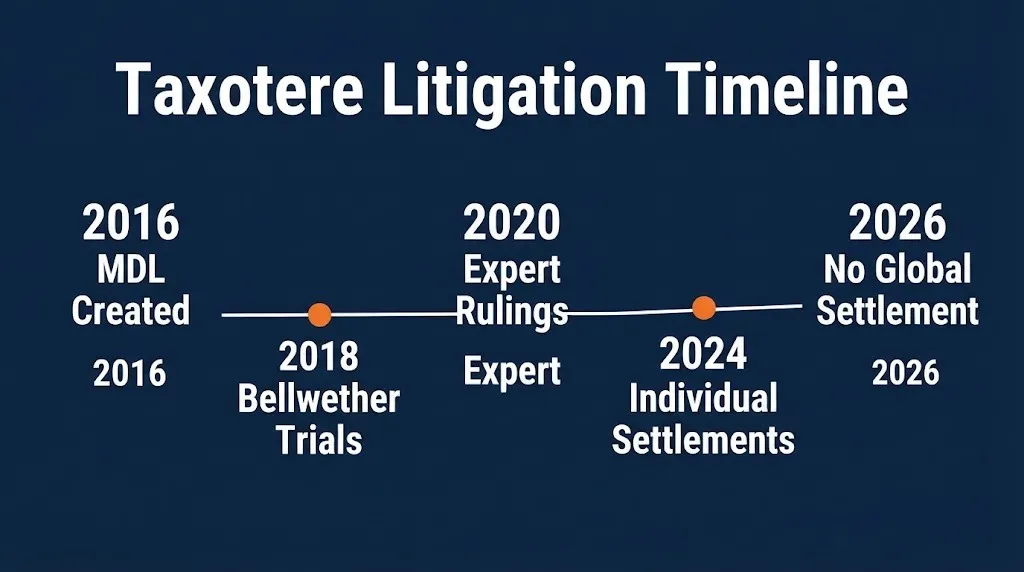
The cases were consolidated into a multidistrict litigation, known as an MDL, in the Eastern District of Louisiana. The MDL was created in 2016 to handle the growing number of claims from cancer survivors who experienced permanent hair loss after treatment with Taxotere, also known by its generic name docetaxel.
More than 10,000 cases have been filed at various points in this litigation, though the active case count fluctuates as cases are dismissed, settled individually, or remanded for trial.
The central allegation is that Sanofi, the manufacturer, knew or should have known that Taxotere carried a higher risk of permanent alopecia compared to alternative chemotherapy drugs, and failed to adequately warn patients and oncologists in the United States. The company has consistently denied these claims.
The litigation is real. What does not exist is a certified class action settlement or a global resolution that would send checks to every eligible claimant. That distinction matters more than most people realize.
Why is there no Taxotere settlement yet?
No global Taxotere settlement exists because the litigation has produced mixed results in the early bellwether trials, and neither side has enough leverage to force a comprehensive resolution.
The bellwether process is how MDL courts test the strength of both sides. A handful of representative cases go to trial. The verdicts and settlement values from those trials are supposed to guide the remaining cases toward resolution.
Here is what the bellwether process has actually produced:
| Bellwether Outcome | What It Means |
|---|---|
| Some defense verdicts | Jury found Sanofi not liable in those specific cases |
| Some plaintiff verdicts | Juries found Sanofi failed to warn and awarded damages |
| Some confidential settlements | Individual cases resolved before or during trial |
| No class-wide resolution | Each case still turns on individual medical history |
The mixed record matters. If plaintiffs won every bellwether, Sanofi would face overwhelming pressure to settle globally. If defendants won every case, the litigation might collapse. Neither happened.
The result is a slow, expensive, individual case-by-case process. That is frustrating for plaintiffs waiting for compensation. It is also the honest reality.
Key Takeaway: The Taxotere litigation is not stalled because the court is slow. It is stalled because the science and the law remain genuinely contested in early trials.
What are the Taxotere lawsuit settlement amounts?
There are no confirmed Taxotere settlement amounts because no global settlement has been reached.
Individual cases have settled for confidential amounts. Some bellwether trials produced verdicts that were later reduced or appealed. But the idea that there is a set dollar figure per plaintiff is false.
Here is what we know about the range of possible outcomes, based on publicly available trial results and the structure of similar pharmaceutical litigations:
| Potential Outcome | Verified Status |
|---|---|
| Confidential individual settlements | Confirmed to exist, amounts not public |
| Jury verdicts in bellwether trials | Public record, amounts vary widely |
| Global settlement fund | Not yet established |
| Per-person payout grid | Not yet created |
| Injury tier system | Not yet announced |
In other pharmaceutical injury litigations with permanent side effects, settlements have ranged dramatically based on the severity of the injury, the strength of the causation evidence, and the plaintiff’s medical history. But applying those numbers to Taxotere would be speculation.
The only honest answer about settlement amounts is that they do not exist yet. Anyone quoting a specific number is inventing it.
What is the average payout per person in Taxotere lawsuits?
The average payout per person is not calculable because no master settlement has been reached.
Here is why that matters. In a settled MDL, the settlement agreement usually creates a tiered system. Plaintiffs with stronger medical evidence and more severe injuries receive higher amounts. Plaintiffs with weaker causation evidence receive less.
No such tier system exists for Taxotere. The court has not approved a settlement allocation plan. No claims administrator has been appointed to evaluate individual claims.
If a global settlement eventually emerges, the average payout will depend on:
- The total settlement fund size
- The number of eligible claimants who file claims
- The tier structure created by the settlement agreement
- The strength of each plaintiff’s medical records and expert testimony
- Whether the plaintiff can document permanent alopecia directly linked to Taxotere
Until those variables are known, any average payout figure is fiction.
Key Takeaway: The most common question people ask is how much they will get. The most honest answer is that no one knows yet, because no settlement exists.
How do I join the Taxotere lawsuit?
You cannot join a class action because the Taxotere litigation is not a class action.
The cases are individual personal injury lawsuits consolidated into an MDL for pretrial efficiency. Each plaintiff has their own case with their own medical records, their own expert witnesses, and their own damage claims.
Here is how you would actually pursue a Taxotere claim:
- Gather your complete oncology records showing Taxotere or docetaxel administration.
- Obtain a medical diagnosis of permanent alopecia from a dermatologist or oncologist.
- Document the timeline from chemotherapy to hair loss onset to present day.
- Collect photographs showing the permanence of the hair loss over years.
- Consult with a law firm experienced in pharmaceutical product liability litigation.
- Ask the firm directly whether they are accepting new Taxotere clients.
- Confirm whether your case falls within the statute of limitations for your state.
The statute of limitations is critical. Each state has its own deadline for filing personal injury claims. Some plaintiffs have already been dismissed from the MDL for missing those deadlines.
You cannot file a claim through a website. You cannot join a class action settlement. You need individual legal representation and a case filed in the appropriate court.
What is the statute of limitations for Taxotere lawsuits?
The statute of limitations varies by state, and many potential plaintiffs have already been barred from filing.
The general rule in personal injury cases is that the clock starts running when the plaintiff knew or should have known about the injury and its potential cause. For Taxotere plaintiffs, that usually means when they learned their hair loss was permanent and possibly linked to the drug.
Here is the complication. Many patients experienced permanent hair loss years before the litigation became widely publicized. They did not connect the hair loss to Taxotere until they saw a lawyer advertisement, a news story, or a support group post.
Courts have applied the discovery rule in different ways across different states. Some plaintiffs who reasonably could have learned about the connection earlier have been dismissed. Others who can show they only recently discovered the link have survived dismissal challenges.
The lesson is simple. If you believe you have a Taxotere claim, do not wait. The clock may already be running, or it may have already run out. Only a qualified attorney can assess your specific situation.
Reality Check
No lawyer, claims service, or website can guarantee you a Taxotere settlement. The litigation remains unresolved. Any service asking for upfront fees to “expedite” your claim or “guarantee” compensation is taking advantage of cancer survivors. Legitimate pharmaceutical injury attorneys work on contingency, meaning they only get paid if you recover money.
What is the latest Taxotere lawsuit update in 2026?
The latest verified update is that the MDL continues to process individual cases through discovery, expert challenges, and occasional remands for trial, but no global settlement is imminent.
The presiding judge has overseen the litigation since 2016. The court has issued rulings on expert testimony admissibility that significantly shaped the litigation. Some plaintiffs’ experts were excluded, which weakened many cases. Other experts were allowed, which kept the litigation alive.
In recent years, the pace of new case filings has slowed dramatically. The active case count has declined as cases are dismissed, remanded, or settled individually. But thousands of cases remain pending.
No trial date has been set for a global resolution. No settlement conference has produced a comprehensive agreement. No claims administrator has been appointed.
The litigation is not over. But it is also not close to a master settlement.
Key Takeaway: The Taxotere MDL is active but slow. The court is processing cases individually, not moving toward a class-wide resolution.
When will Taxotere checks be mailed?
No Taxotere settlement checks will be mailed because no settlement fund exists.
This is the hardest truth for most people searching this topic. You may have seen headlines, YouTube videos, or social media posts suggesting checks are imminent. Those are misleading.
In a typical settled MDL, the timeline from settlement approval to mailed checks runs six to twelve months. The settlement agreement must be negotiated, submitted to the court, preliminarily approved, noticed to all plaintiffs, and finally approved after a fairness hearing. Then the claims administrator must evaluate every claim form. Then the fund is allocated. Then checks are issued.
None of those steps has occurred for Taxotere. The litigation is not at the settlement stage. It is still at the pretrial litigation stage.
If a global settlement is reached in the future, expect at least a year between the announcement and the first checks being mailed. That is the normal timeline for complex pharmaceutical MDLs.
How many Taxotere lawsuits are still pending?
The exact number of pending Taxotere cases is not publicly updated in real time, but thousands remain active in the MDL.
The litigation peaked with over 10,000 filed cases. Many have since been dismissed for failure to meet causation standards or statute of limitations problems. Others have been remanded to their original federal courts for individual trials. Some have settled confidentially.
The Judicial Panel on Multidistrict Litigation publishes periodic statistics on active MDLs. Those reports show the Taxotere MDL still ranks among the larger active pharmaceutical proceedings, though it is no longer the largest.
The important point for potential claimants is not the exact case count. It is that the litigation remains open and active. New cases may still be filed if the statute of limitations has not expired for the individual plaintiff.
What caused permanent hair loss in Taxotere patients?
Taxotere, known generically as docetaxel, is a chemotherapy drug in the taxane class. It is used to treat breast cancer and other cancers.
The drug works by interfering with cell division, which kills rapidly dividing cancer cells. But it also affects hair follicle cells, which divide rapidly. Most chemotherapy causes temporary hair loss that reverses after treatment ends.
The allegation in the litigation is that Taxotere causes permanent alopecia in a subset of patients. Unlike temporary chemotherapy hair loss, permanent alopecia means the hair follicles are destroyed and hair never regrows, even years after treatment ends.
The scientific dispute centers on whether Taxotere carries a meaningfully higher risk of permanent alopecia compared to alternative taxane chemotherapy drugs like paclitaxel. Plaintiffs allege that Sanofi knew about this risk from European studies and failed to warn U.S. patients and physicians.
Sanofi maintains that permanent alopecia is a rare but known risk of taxane chemotherapy generally, not specific to Taxotere, and that U.S. labeling was adequate.
Key Takeaway: The science of Taxotere and permanent alopecia is contested. That scientific dispute is the reason the litigation has not settled globally.
Who is eligible to file a Taxotere lawsuit?
Eligibility is determined individually, not through a class action claim form.
Based on the structure of the litigation and the court rulings to date, a potential plaintiff may have a viable case if they:
- Received Taxotere or generic docetaxel as part of cancer treatment.
- Experienced hair loss during or after treatment.
- The hair loss did not regrow after treatment ended.
- A medical professional has diagnosed permanent alopecia.
- The statute of limitations in their state has not expired.
- There is no other legal barrier specific to their medical history.
These are not confirmed eligibility criteria from a settlement agreement. They are the factual patterns common to the cases that have survived dismissal in the MDL.
The only way to know if you have a viable case is to consult with an attorney who handles pharmaceutical product liability litigation and can evaluate your medical records against the current state of the law.
What is the difference between Taxotere and Taxol?
Taxotere is the brand name for docetaxel. Taxol is the brand name for paclitaxel.
Both are taxane chemotherapy drugs used to treat cancer. Both can cause hair loss during treatment. The key dispute in the litigation is whether docetaxel carries a higher risk of permanent alopecia compared to paclitaxel.
Plaintiffs argue that Sanofi knew from European data that docetaxel was associated with persistent hair loss, while paclitaxel was not. They argue that U.S. patients were denied the chance to choose the lower-risk drug.
Sanofi argues that the scientific evidence does not support a meaningful difference in permanent alopecia risk between the two drugs, and that U.S. labeling was consistent with the known science at the time.
The distinction matters because it goes to the heart of the failure-to-warn claim. If there is no meaningful difference in risk, there is no failure to warn.
Key Takeaway: The Taxotere litigation is not about whether chemotherapy causes hair loss. It is about whether Taxotere caused permanent hair loss at a higher rate than alternatives, and whether patients were warned.
What happens next in the Taxotere litigation?
Here is the expected timeline based on the current posture of the MDL:
- March 2026: Litigation continues with no global settlement. Individual cases proceed through discovery.
- Mid to late 2026: Additional bellwether rulings or remands may shape the remaining case pool.
- No settlement date set: No comprehensive settlement conference has been scheduled on the public docket.
- If a global settlement emerges: A claims administrator would be appointed, a claim deadline set, and a fairness hearing scheduled.
- After any future settlement: Checks would likely mail six to twelve months after final approval.
These are projections, not confirmed dates. The litigation could continue for years without a global resolution. Or a settlement could emerge quickly if the remaining cases shift in one direction.
The only responsible guidance is to monitor the official court docket and maintain contact with your attorney if you have a pending case.
Frequently Asked Questions
Is the Taxotere lawsuit still open?
Yes, the MDL remains open and thousands of cases are still pending. No global settlement has ended the litigation.
Can I still file a Taxotere lawsuit in 2026?
Maybe. It depends on your state’s statute of limitations and your specific medical history. Consult an attorney immediately to assess your situation.
How long does a Taxotere lawsuit take?
There is no fixed timeline. The litigation has been active since 2016, and individual cases can take years.
Will there be a Taxotere class action settlement?
No class action has been certified. The cases are individual lawsuits consolidated in an MDL, not a class action.
How much will I get from the Taxotere settlement?
No amount can be quoted because no settlement exists. Any website quoting a figure is inventing it.
Do I need a lawyer for a Taxotere lawsuit?
Yes, because these are individual personal injury cases, not a claim form you file yourself.
What proof do I need for a Taxotere claim?
You need oncology records showing Taxotere administration, a permanent alopecia diagnosis, and evidence linking the two.
Are there any Taxotere settlement checks being mailed now?
No. No settlement fund exists, so no checks are being mailed. Ignore any message claiming otherwise.
Closing
The single most important fact to hold onto is that no Taxotere settlement exists yet, and no check is coming until a global resolution is reached.
If you have a potential claim, gather your medical records and consult a qualified attorney now. The statute of limitations clock does not pause while you wait for headlines.