Physician Compensation 2026: Verified Data by Specialty, Latest Reports, and Legal Implications
Quick Answer
- Physician compensation is real and tracked by multiple independent survey firms each year.
- Average physician pay now exceeds $363,000, up roughly 3 percent from the prior year.
- No claim form or deadline applies; this is salary data, not a lawsuit settlement.
If you searched for physician compensation, you likely fall into one of three groups. You are a doctor comparing your pay. You are a medical student picking a specialty. Or you are an analyst, journalist, or policymaker trying to understand where healthcare dollars actually go.
The answer starts with one verified number: the most recent Doximity physician compensation report placed average physician pay at approximately $400,000, while Medscape and other survey firms reported figures closer to $363,000. The difference comes down to methodology, sample size, and which specialties are weighted.
This article breaks down what each major report actually found, how the numbers differ by specialty, which data sources to trust, and the legal questions that arise when physician compensation becomes evidence in court.
The Facts
| Report | Doximity 2025-2026 | Medscape 2026 | AMGA / MGMA |
|---|---|---|---|
| Average Pay | ~$400,000 | ~$363,000 | Not yet released |
| Top Specialty | Neurosurgery | Orthopedics | Plastic Surgery |
| Sample Size | 150,000+ | 20,000+ | Provider-reported |
| Methodology | Self-reported survey | Self-reported survey | Administrative data |
| Legal Use | Often cited in court | Often cited in court | Gold standard in disputes |
Is Physician Compensation Data Legitimate?
Physician compensation data is legitimate and comes from multiple independent organizations that have tracked doctor pay for decades. The data is not a scam and not a settlement fund.
The three most cited sources are Doximity, Medscape, and the Medical Group Management Association, known as MGMA. Each uses different methods, which is why their numbers never match exactly.

You should trust these reports for general ranges, not precise dollar figures. Averages hide enormous variation by region, practice type, hours worked, and payer mix. When someone quotes a single number as “the” physician salary, they are already oversimplifying.
Key Takeaway: The data is real, but every report has a methodology, and that methodology determines the number you see.
How Much Do Physicians Actually Earn in 2026?
The average physician in the United States earns between $363,000 and $400,000 per year based on the most recent verified reports. That range reflects different survey methodologies, not disagreement about the underlying trend.
Primary care physicians earn less. The same reports place average primary care pay between $250,000 and $290,000. Specialists earn more, with surgical subspecialties routinely exceeding $500,000.
The gap between primary care and specialties has widened over the past decade. That gap drives medical student specialty choice, which in turn affects the physician workforce and patient access.
| Category | Average Pay Range |
|---|---|
| Primary care | $250,000 to $290,000 |
| All physicians | $363,000 to $400,000 |
| Surgical specialists | $500,000 to $600,000+ |
| Top earners (neurosurgery) | $700,000 to $800,000+ |
What Is the Highest Paid Physician Specialty in 2026?
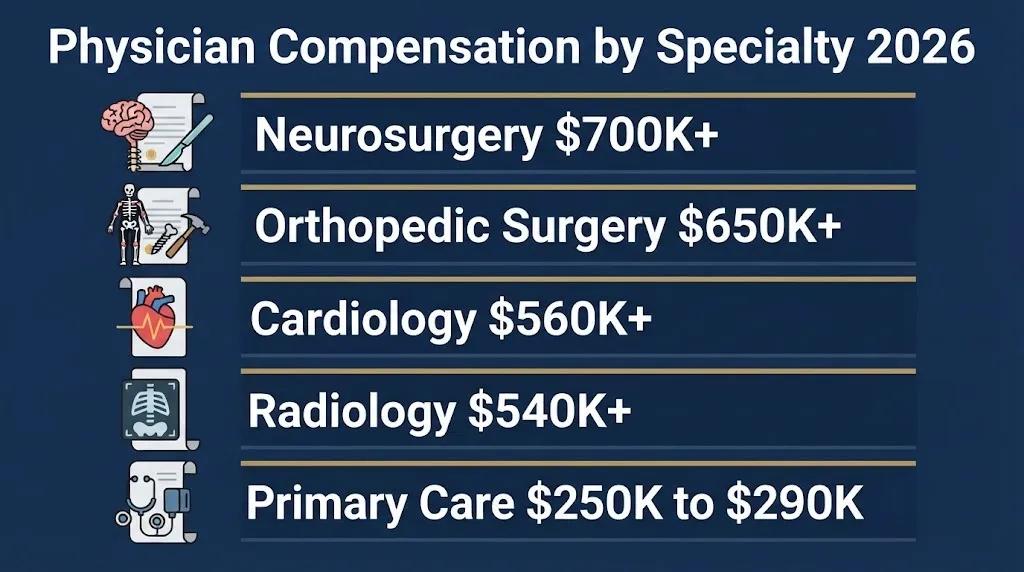
Neurosurgery remains the highest paid physician specialty in most verified reports, with average annual compensation above $700,000 and top earners exceeding $1 million.
Orthopedic surgery and plastic surgery follow closely behind. Cardiology, radiology, and dermatology also rank in the top ten across multiple surveys.
The rankings are stable year to year. Surgical specialties dominate the top of the list because they generate high procedural revenue and require long training, which limits supply.
| Rank | Specialty | Estimated Average Pay |
|---|---|---|
| 1 | Neurosurgery | $763,000 |
| 2 | Orthopedic Surgery | $654,000 |
| 3 | Plastic Surgery | $619,000 |
| 4 | Cardiology | $565,000 |
| 5 | Radiology | $545,000 |
How Much Do Primary Care Physicians Make in 2026?
Primary care physicians earn between $250,000 and $290,000 on average in 2026, depending on the survey source and whether the figure includes bonuses and profit sharing.
Family medicine, internal medicine, and pediatrics sit at the lower end of the physician pay scale. Pediatricians often report the lowest averages, sometimes under $250,000.
The primary care pay gap is a policy concern. Medical students carry the same debt regardless of specialty, but primary care offers a longer path to debt repayment at lower annual income.
Key Takeaway: Primary care pays about half of what surgical specialties pay, which drives specialty shortages in exactly the areas patients need most.
What Did the Doximity Physician Compensation Report Find for 2026?
The Doximity physician compensation report for 2026 is based on survey responses from more than 150,000 licensed U.S. physicians. It places average physician compensation at approximately $400,000.
Doximity’s methodology relies on self-reported income, which tends to skew higher because respondents often include bonus, call pay, and consulting income that base-salary-only figures miss.
The report also tracks year-over-year growth, which has averaged between 3 and 4 percent annually for the past several years. That growth rate outpaces inflation but lags behind the increase in physician workload reported in the same survey.
What Did the Medscape Physician Compensation Report Find for 2026?
The Medscape physician compensation report for 2026 surveyed more than 20,000 physicians across 29 specialties. It found average physician pay closer to $363,000 per year.
Medscape’s sample skews slightly toward employed physicians and primary care, which pulls the average down compared to Doximity’s specialist-heavy respondent pool.
Both reports agree on the trend: physician pay is rising, but not evenly. Specialists gain more, primary care gains less, and geographic differences remain stark.
Why Do Physician Compensation Reports Disagree With Each Other?
Physician compensation reports disagree because they use different samples, different questions, and different definitions of compensation. One report asks for base salary. Another asks for total cash compensation including bonuses.
Self-selection bias plays a role too. Doctors who earn more are more likely to answer a survey about pay. That skews averages upward in some reports.
Administrative data from MGMA avoids self-reporting bias but captures only employed physicians whose employers submit data. Independent private practice doctors may be excluded entirely.
Think of it like comparing two restaurant reviews for the same dish. One reviewer counts the sides and drinks. The other only counts the entree. Both are accurate, but they are measuring different things.
Key Takeaway: When a report quotes a number, ask what was included. Base salary, bonus, and total compensation are three different numbers.
How Does Physician Compensation Vary by Region in 2026?
Physician compensation varies significantly by state and region. The highest averages cluster in the Southeast, Midwest, and Texas, while the Northeast and major coastal cities often pay less on paper.
That regional pattern is partly a cost-of-living illusion. A doctor in rural Nebraska may earn more nominal dollars than a doctor in Manhattan, but the purchasing power may be lower or higher depending on local costs.
States with large rural populations often pay primary care physicians more to attract them. That is a deliberate market response to shortages.
What Legal Issues Involve Physician Compensation Data?
Physician compensation data appears in court cases involving employment disputes, Stark Law violations, kickback allegations, and divorce proceedings. The data is often contested because it drives financial outcomes.
In Stark Law cases, compensation must be set at fair market value. MGMA data is frequently cited to prove or disprove that a hospital paid a doctor too much or too little.
In divorce cases, a physician’s earning capacity is often calculated using specialty compensation data. Future income projections determine spousal support and asset division.
Physician compensation data is also used in whistleblower cases under the False Claims Act. If a hospital pays a doctor above fair market value, that excess can be evidence of an illegal referral scheme.
Key Takeaway: The same compensation report you read for career planning can become Exhibit A in a federal fraud case.
Can I Use Physician Compensation Data in My Own Negotiation?
Yes, you can use verified compensation data to negotiate your own salary or contract. The key is to cite the right report for your situation.
If you are a primary care doctor, citing a specialist-heavy average will hurt your case. Use a report that breaks out your specialty, your region, and your practice type.
Employers use the same data to set offers. Entering a negotiation with MGMA or Doximity numbers in hand puts you on more equal footing.
Here is a simple five-step approach.
- Identify your specialty and region in the report.
- Compare your current pay to the 50th percentile, not just the average.
- Note any productivity bonuses or call pay the report includes.
- Bring printed data to the negotiation meeting.
- Ask for a range, not a single number, to leave room for discussion.
What Is the Difference Between Physician Compensation and Physician Salary?
Physician compensation includes salary, bonuses, profit sharing, call pay, and sometimes benefits. Physician salary is base pay only.
The difference matters. Two doctors can have the same base salary but very different total compensation depending on productivity incentives.
When a report says “average physician compensation,” it usually means total cash compensation, not just base salary. That is why the numbers are higher than what many employed doctors see on their W-2.
Reality Check: No one is mailing you a physician compensation check. This is salary data, not a class action settlement. Any website offering “free physician settlement money” is a scam.
How Has Physician Compensation Changed Since 2020?
Physician compensation has risen every year since 2020, but the gains have been uneven. Specialists saw larger increases than primary care doctors.
The COVID-19 pandemic disrupted the trend temporarily in 2020, when elective procedures stopped and many doctors saw pay cuts. But recovery came quickly, and by 2022 most specialties had surpassed pre-pandemic levels.
Inflation has eroded some of the gains in real terms. A doctor whose pay rose 4 percent in a year with 5 percent inflation effectively lost purchasing power.
What Is the Gender Pay Gap in Physician Compensation?
A gender pay gap in physician compensation persists in 2026, with female physicians earning roughly 25 percent less than male physicians in comparable roles, according to multiple verified surveys.
The gap narrows when researchers control for specialty, hours worked, and practice type, but it does not disappear. Studies that adjust for those factors still find a residual gap of 10 to 15 percent.
The gap is largest in surgical specialties and smallest in salaried primary care roles. It has narrowed slightly over the past decade but remains a significant finding in every major report.
Key Takeaway: The gender pay gap in medicine is not fully explained by specialty choice or hours worked, and the residual gap appears in every major survey.
What Is the Physician Compensation Per Hour in 2026?
Physician compensation per hour varies widely by specialty and work setting. On average, physicians earn between $150 and $200 per hour, but some surgical subspecialists exceed $300 per hour.
Hourly calculations matter because many physicians work far more than 40 hours per week. A doctor earning $400,000 while working 60 hours weekly earns less per hour than one earning $320,000 at 40 hours.
Emergency medicine physicians often quote hourly rates directly, since many are paid by the shift. Locum tenens physicians also think in hourly or daily rates.
How Do Employed Physicians Compare to Private Practice Owners?
Employed physicians now make up the majority of U.S. doctors, and that shift changed compensation patterns. Employed doctors tend to have more predictable income but lower top-end earning potential.
Private practice owners can earn more in good years but carry business risk. They also build equity in their practices, which employed doctors do not.
The trend toward employment has been driven by administrative burden, payer complexity, and the cost of running a practice. The trade-off is autonomy for stability.
What Are RVUs and How Do They Affect Physician Compensation?
Relative value units, or RVUs, are the productivity metric that drives much of physician compensation in employed settings. Each service a doctor performs generates a set number of RVUs.
Compensation plans often include a base salary plus a bonus tied to RVU production. Exceed the target, and the bonus grows. Fall short, and the bonus shrinks.
RVU-based pay rewards volume over value. Critics argue it pushes doctors toward procedures and away from time-intensive cognitive care.
Key Takeaway: If you are an employed physician, your RVU target is the single most important number in your compensation formula.
What Is the 2026 Trend in Physician Signing Bonuses and Incentives?
Signing bonuses for physicians have grown in 2026, especially in primary care and rural areas. Some hospitals and health systems offer bonuses of $50,000 to $100,000 for hard-to-fill positions.
Loan repayment assistance also remains common. Programs often provide $20,000 to $40,000 per year toward medical school debt in exchange for service commitments.
These incentives are a response to persistent shortages in primary care, psychiatry, and rural medicine. They are real money and should be counted as part of total compensation.
How Does Physician Compensation Affect Patient Care and Legal Risk?
Physician compensation models can create legal risk when they incentivize overuse or underuse of medical services. The Stark Law and Anti-Kickback Statute exist to prevent compensation arrangements that reward referrals.
A hospital that pays a surgeon based on the volume of referrals from that surgeon’s office risks a False Claims Act case. The government has recovered billions in such cases.
On the patient side, compensation models that reward RVU volume can lead to unnecessary procedures, which drive up healthcare costs and expose physicians to malpractice claims.
What Happens Next With Physician Compensation Data in 2026?
The next major release will be the MGMA provider compensation data set, typically published mid-year. That report is considered the gold standard in legal disputes and contract negotiations.
Doximity and Medscape will likely release updated reports in late 2026 or early 2027, reflecting full-year 2025 data. Expect continued growth in the 3 to 4 percent range for most specialties.
If you are a physician or analyst, the action item is to collect the reports that match your situation and compare them at the specialty and regional level.
Expected late 2026: Doximity releases its next annual physician compensation report.
Expected early 2027: Medscape releases its next survey findings.
Ongoing: Courts and employers continue to cite MGMA data in Stark Law and contract disputes.
Frequently Asked Questions
Is there a physician compensation settlement in 2026?
No, physician compensation is salary data, not a lawsuit settlement with a claim form.
How much does the average doctor make in 2026?
The average physician earns between $363,000 and $400,000 depending on the survey source.
What specialty pays doctors the most?
Neurosurgery is the highest paid specialty, averaging over $700,000 per year.
Do female doctors earn less than male doctors?
Yes, a gender pay gap of roughly 10 to 25 percent persists even after adjusting for specialty and hours.
How can I see physician compensation data by specialty?
Major reports from Doximity, Medscape, and MGMA publish specialty-specific tables each year.
Is physician compensation rising in 2026?
Yes, physician pay is rising 3 to 4 percent annually, though inflation reduces real gains.
Can I use this data to negotiate my salary?
Yes, citing verified specialty and regional data can strengthen your negotiation position.
Where does physician compensation data come from?
It comes from self-reported surveys like Doximity and Medscape, plus administrative data from MGMA.
Your next step is to pull the compensation report that matches your specialty and region, then compare your current pay to the 50th percentile. If you are using this data for legal purposes, rely on MGMA data, which courts consistently treat as the benchmark.
The single most important number to remember: average physician compensation in 2026 sits between $363,000 and $400,000, with wide variation by specialty, region, and practice model. Know where you fall before you sign anything.