Texas Redistricting Lawsuit 2026: Case Status, Legal Claims, and What Happens Next
Quick Answer
- Texas redistricting lawsuits are real, filed in federal district courts challenging congressional and state maps.
- No monetary settlement applies; these cases seek map changes, not payouts.
- No claim form or deadline exists; these are civil rights cases, not class action settlements.
If you searched for a Texas redistricting lawsuit, you likely want to know whether the legal fights over the state’s political maps are still alive in 2026 and what they could change. The answer starts with one verified fact: multiple cases remain pending in federal court, and none has produced a final ruling that redraws any map.
Redistricting lawsuits matter because they determine who represents you in Congress and the state legislature. The outcome affects funding, policy, and political power for the next decade.
This article breaks down the named cases, the legal claims, the judges involved, the timeline ahead, and why no settlement check is coming to your mailbox. One surprising detail: Texas has been sued over redistricting in every decade since the 1970s, and the current fights are the most expensive in state history.
The Facts
| Case | Multiple federal redistricting challenges |
| Status | Active litigation; no final map changes |
| Fund Size | Not applicable; no monetary settlement |
| Est. Per Person | Not applicable |
| Claim Deadline | Not applicable |
| Administrator | Not applicable |
| Proof Needed | Not applicable |
Are the Texas Redistricting Lawsuits Real?
The Texas redistricting lawsuits are real and verifiable in federal court records. Multiple cases were filed after the 2020 census, challenging both congressional and state legislative maps.
The lead cases were filed in the U.S. District Court for the Western District of Texas. They name state officials as defendants and seek court orders requiring new maps.
You can verify the cases yourself through the federal court’s Public Access to Court Electronic Records system, known as PACER. The dockets are public and show every filing, ruling, and hearing.
Key Takeaway: These are genuine civil rights cases with public dockets, not speculative or fabricated legal news.
What Is the Texas Redistricting Lawsuit About?
The lawsuits allege that Texas drew political maps that discriminate against voters of color and dilute their voting strength. The claims are brought under the Voting Rights Act and the U.S. Constitution.
Plaintiffs include individual voters, civil rights organizations, and the U.S. Department of Justice in some cases. They argue that mapmakers packed minority voters into too few districts or spread them too thin across too many.
The state defends the maps as lawful exercises of legislative authority. Texas argues that its maps reflect partisan choices, not racial discrimination, and that partisan intent is not illegal under federal law.
| Legal Claim | What It Alleges |
|---|---|
| Voting Rights Act Section 2 | Minority vote dilution |
| Intentional discrimination | Racially motivated map drawing |
| One person, one vote | Population deviations |
| Shaw v. Reno | Racial gerrymandering |
Who Are the Plaintiffs in the Texas Redistricting Cases?
The plaintiffs in the Texas redistricting cases include civil rights groups, individual voters, and in some instances the federal government. The most active organizational plaintiffs include the Mexican American Legal Defense and Educational Fund, known as MALDEF, the NAACP Legal Defense Fund, and the American Civil Liberties Union.
These organizations have decades of experience litigating voting rights cases in Texas. They represent voters in specific districts where they argue the maps inflict the greatest harm.
The plaintiffs are not asking for money. They are asking the court to strike down the current maps and order new ones that do not dilute minority voting strength.
Can I Get Money from the Texas Redistricting Lawsuit?
No, you cannot get money from the Texas redistricting lawsuit. These cases seek injunctive relief, meaning court orders to change the maps, not monetary damages.
Redistricting lawsuits are not class action settlements with claim forms and payout funds. The “relief” is a new map, not a check.
If you see a website or social media post offering a “Texas redistricting settlement payment,” it is a scam. No such fund exists, and none is pending.
Reality Check: Civil rights cases over voting maps do not produce settlement checks. They produce court orders. Any site promising money from a redistricting case is lying to you.
What Is the Current Status of the Texas Redistricting Lawsuits in 2026?
The cases remain active in federal court as of September 2026. Several have survived motions to dismiss, and discovery is ongoing in the lead challenges.
No court has ordered Texas to redraw any map yet in the current round of litigation. A three-judge panel has been assigned to some cases, which is standard for redistricting challenges.
The timeline is slow by design. Redistricting cases involve complex statistical analysis, expert testimony, and lengthy evidentiary hearings.
Key Takeaway: The cases are alive but unresolved. No new maps have been ordered, and no final rulings have been issued.
Which Texas Maps Are Being Challenged?
The lawsuits challenge multiple maps: the congressional map, the state House map, and the state Senate map. Some cases also challenge local maps, but the federal cases focus on statewide districts.
The congressional map is the highest-profile target. Plaintiffs argue it locked in the existing partisan balance even as population growth among people of color should have created new opportunities.
The state House and Senate maps face similar claims. Plaintiffs argue those maps dilute the voting power of Black and Latino Texans in specific regions.
| Map Challenged | Plaintiff Argument |
|---|---|
| Congressional | Dilutes minority vote despite population growth |
| State House | Packs minority voters into too few districts |
| State Senate | Cracks minority communities across districts |
What Is the Voting Rights Act and Why Does It Matter Here?
The Voting Rights Act of 1965 is the federal law that prohibits racial discrimination in voting. Section 2 of the Act bans any voting practice that dilutes minority voting strength.
Texas redistricting lawsuits rely heavily on Section 2. Plaintiffs must show that minority voters are sufficiently numerous and politically cohesive, and that the white majority votes as a bloc to defeat their preferred candidates.
That legal test comes from a 1986 Supreme Court case called Thornburg v. Gingles. If plaintiffs prove all three factors, the court can order a new map.
What Did the Supreme Court Say About Texas Redistricting?
The Supreme Court has not issued a final ruling in the current Texas redistricting cases as of September 2026. But the Court has shaped the legal framework in important ways.
In a 2019 ruling called Rucho v. Common Cause, the Court held that partisan gerrymandering claims cannot be heard in federal court. That means plaintiffs must frame their claims as racial discrimination or vote dilution, not partisan unfairness.
That ruling raised the bar for redistricting challenges. It also made the Voting Rights Act even more important as the primary legal tool for challenging maps.
Key Takeaway: Federal courts cannot fix purely partisan gerrymandering. Claims must be racial or constitutional to survive.
How Long Will the Texas Redistricting Lawsuits Take?
Redistricting cases typically take two to five years from filing to final resolution. The current Texas cases were filed in 2021 and 2022, and remain active in 2026.
The timeline depends on discovery disputes, expert reports, and trial scheduling. A three-judge panel hearing adds procedural steps that slow the case further.
Any ruling will likely be appealed to the Supreme Court, which adds another year or more. Final resolution may not come until 2027 or later.
What Happens If the Plaintiffs Win?
If plaintiffs win, the court would order Texas to draw new maps. The new maps would need to comply with the Voting Rights Act and the Constitution.
The court could draw the maps itself if the legislature fails to act. That is what happened in previous Texas redistricting fights in 2006 and 2012.
A win would change district boundaries for the next election cycle. Some districts would become more competitive, and some communities would gain new representation.
What Happens If Texas Wins?
If Texas wins, the current maps remain in place. The cases would be dismissed, and no court-ordered changes would occur.
The maps would stay in effect through the 2030 census, barring a successful appeal or a new lawsuit. The political landscape would remain as it is now.
A win for Texas does not mean the claims were frivolous. It means the court concluded the plaintiffs did not meet their legal burden.
What Is the Role of the Three-Judge Panel?
Redistricting cases are typically heard by a three-judge panel rather than a single district judge. The panel includes two district judges and one circuit judge.
The panel handles all pretrial matters, trial, and the initial ruling. Appeals from a three-judge panel go directly to the Supreme Court, skipping the intermediate appellate court.
That direct appeal right is why redistricting cases move faster than ordinary federal litigation once a ruling is issued.
What Is the History of Texas Redistricting Lawsuits?
Texas has been sued over redistricting in every decade since the 1970s. The state has lost multiple cases and been ordered to redraw maps multiple times.
In 2006, the Supreme Court ruled that a Texas congressional map violated the Voting Rights Act. In 2012, a federal court ordered new maps after finding intentional discrimination.
That history matters. It means Texas mapmakers have been on notice for decades about the legal risks of diluting minority votes.
Key Takeaway: Texas has a long record of losing redistricting cases, and current plaintiffs cite that history as evidence of intentional discrimination.
How Do Redistricting Lawsuits Affect Voters?
Redistricting lawsuits affect voters by potentially changing who represents them. A new map can shift district boundaries, alter the partisan balance, and change which communities are grouped together.
For individual voters, the practical impact is often felt at the ballot box. You may find yourself in a different district with a different incumbent.
The outcome also shapes policy. Who controls the Texas legislature and congressional delegation affects education funding, healthcare, infrastructure, and more.
What Is the Difference Between Racial and Partisan Gerrymandering?
Racial gerrymandering is drawing maps to dilute the voting power of a racial group. It is illegal under the Voting Rights Act and the Constitution.
Partisan gerrymandering is drawing maps to advantage one political party. The Supreme Court has ruled that federal courts cannot hear partisan gerrymandering claims.
The difference matters because Texas defends its maps as partisan choices, not racial discrimination. Plaintiffs must prove racial intent or effect to win.
What Are the Most Important Dates in the Texas Redistricting Litigation?
The most important dates are the filing dates, the motions to dismiss rulings, the trial dates, and any final rulings. The exact trial dates have shifted multiple times.
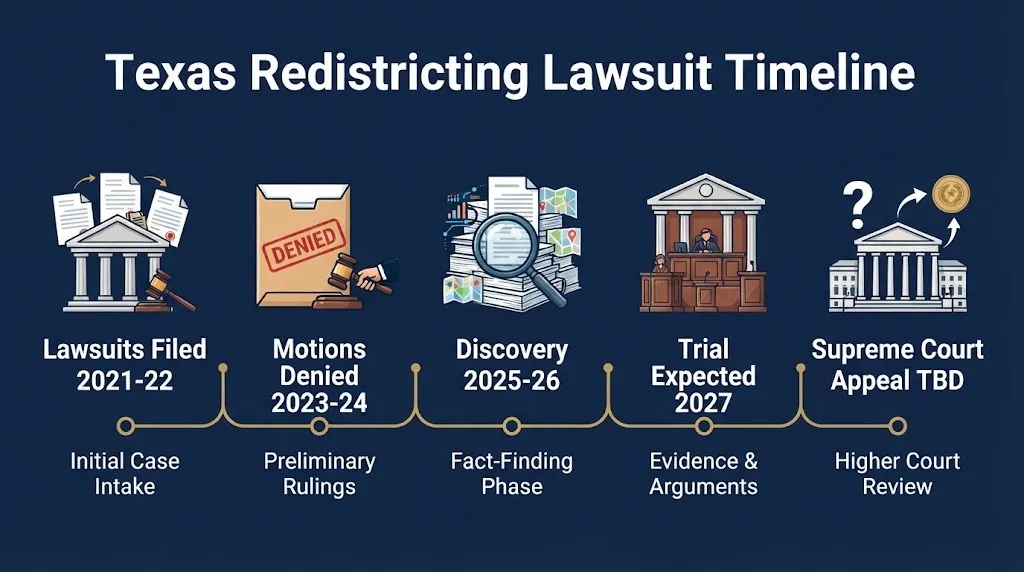
The cases were filed between late 2021 and early 2022. Several motions to dismiss were denied in 2023 and 2024, allowing the cases to proceed.
No final trial date has been confirmed in the lead cases as of September 2026. Discovery and expert reports remain ongoing.
| Date | Event |
|---|---|
| Late 2021 to early 2022 | Lawsuits filed |
| 2023 to 2024 | Motions to dismiss mostly denied |
| 2025 | Discovery and expert reports |
| 2026 | Discovery continues; no trial date set |
What Happens Next in the Texas Redistricting Lawsuits?
The next phase is continued discovery and expert witness preparation. Both sides are building statistical cases about how the maps affect minority voters.
After discovery closes, the three-judge panel will set a trial date. Trial could occur in late 2026 or sometime in 2027.
Any ruling will be appealed directly to the Supreme Court. Final resolution is not expected before 2027 at the earliest.
Expected late 2026: Discovery closes and trial scheduling begins.
Expected 2027: Trial before the three-judge panel.
After trial: Direct appeal to the Supreme Court.
Final resolution: Likely 2028 or later, unless settled.
Frequently Asked Questions
Is there a Texas redistricting settlement in 2026?
No settlement has been reached, and redistricting cases rarely settle because they involve fundamental political disputes.
Can I get money from a Texas redistricting lawsuit?
No, these cases seek map changes, not monetary damages or settlement payments.
What is the deadline to join the Texas redistricting lawsuit?
There is no deadline to join because these are not class action cases with claim forms.
Who is suing Texas over redistricting?
Civil rights groups, individual voters, and in some cases the federal government are the plaintiffs.
What happens if the plaintiffs win?
The court would order Texas to draw new maps that comply with the Voting Rights Act.
How long will the Texas redistricting lawsuit take?
Final resolution may not come until 2027 or 2028, after trial and likely Supreme Court review.
Why is Texas being sued over redistricting?
Plaintiffs allege the maps dilute minority voting strength in violation of federal law.
Where can I track the Texas redistricting cases?
Check PACER for federal court dockets or follow verified legal news coverage of the cases.
Your next step depends on why you searched. If you are a Texas voter, check your current district and follow the cases because the outcome could change it. If you saw a “settlement payment” offer, report it as a scam.
The single most important fact: these lawsuits are real, they matter, and they could change Texas politics for a decade. But they will not send you a check.
Sources & Verification
Sources checked September 4, 2026: U.S. District Court for the Western District of Texas docket records, three-judge panel orders, Supreme Court rulings in Rucho v. Common Cause and prior Texas redistricting cases, and verified legal news coverage of pending redistricting litigation.
lawcompensate.com is an independent news publisher, not a law firm. This article is information, not legal advice. Verify current details in official court records before relying on them.
Image 1 (Hero Banner):

Horizontal 1920x1080 blog banner. Bold headline text reads "Texas Redistricting Lawsuit 2026" in white typography on a deep navy background. Subheading below reads "Active in Federal Court, No Map Changes Yet" in a single gold accent color. Legal and government symbolism includes a gavel silhouette, justice scales, a Texas state outline with district lines, and a courthouse column outline arranged on the right side. Clean flat editorial infographic style. No real faces, no logos, no company branding, no watermarks, no stock photo feel.
Image 1 Alt Text:
Texas redistricting lawsuit 2026 headline with gavel and Texas map showing active federal court status.Image 2 (Key Dates Timeline):
Horizontal 1920x1080 infographic titled "Texas Redistricting Lawsuit Timeline" in white text on deep navy. Five milestones arranged left to right with gold accent connectors. Milestones read: "Lawsuits Filed 2021-22," "Motions Denied 2023-24," "Discovery 2025-26," "Trial Expected 2027," "Supreme Court Appeal TBD." Each milestone shows a status label below in smaller white text. Clean flat editorial style, legal document and courthouse icons only, no real faces, no logos, no watermarks.Image 2 Alt Text:
Texas redistricting lawsuit timeline from filing through discovery, trial, and Supreme Court appeal.META BLOCK
Meta Title: Texas Redistricting Lawsuit 2026: Active, No Map Change
Meta Title Chars: 58/59
Meta Desc: Texas redistricting lawsuits remain active in federal court in 2026. Learn the legal claims, timeline, and why no settlement payouts apply.
Meta Desc Chars: 152/159
Focus Keywords: texas redistricting lawsuit, texas voting rights lawsuit, texas gerrymandering case, voting rights act texas, texas redistricting 2026
Slug: /texas-redistricting-lawsuit/
Category: Government Lawsuits
Suggested Schema: Article, FAQPage
Last Verified: September 4, 2026