Misdiagnosis Lawsuit 2026: What You Must Prove, Case Values, and Statute of Limitations
Quick Answer
- A misdiagnosis lawsuit is a medical malpractice claim alleging a doctor failed to correctly identify your condition.
- You must prove the misdiagnosis caused real harm that a competent doctor would have prevented.
- Statute of limitations deadlines vary by state, often one to three years from discovery.
You went to the doctor with symptoms. The doctor said it was nothing. Or they said it was the wrong thing.
Weeks or months later, you learned the truth. The cancer was there all along. The infection had spread. The heart condition had worsened.
Now you are asking whether you can sue. The answer is maybe. A misdiagnosis lawsuit is not automatic, and not every wrong diagnosis is malpractice. This article explains the legal standard, what your case might be worth, and the deadlines that decide everything.
| The Facts | |
|---|---|
| Claim Type | Medical malpractice, misdiagnosis |
| Legal Standard | Negligence, deviation from standard of care |
| Proof Required | Doctor-patient relationship, negligence, causation, damages |
| Statute of Limitations | Varies by state, often 1 to 3 years |
| Expert Witness Required | Yes, in most states |
| Damage Cap | Varies by state |
| No Federal Law | State law controls |
Is a Misdiagnosis Lawsuit the Same as Malpractice?
Yes, a misdiagnosis lawsuit is a type of medical malpractice claim. It alleges a doctor failed to meet the standard of care by missing or incorrectly identifying your condition.
Medical malpractice is the broader category. Misdiagnosis is one way malpractice happens. Other ways include surgical errors, medication mistakes, and birth injuries.

The key difference between a bad outcome and malpractice is negligence. A doctor is not liable just because the diagnosis was wrong. You must show a competent doctor in the same situation would have gotten it right.
That distinction kills many cases before they start.
How Much Is a Misdiagnosis Lawsuit Worth?
Misdiagnosis lawsuit values vary widely. No fixed amount exists, and outcomes depend on the harm caused by the delayed or incorrect diagnosis.
The most valuable cases involve permanent disability, shortened life expectancy, or death. The least valuable involve temporary delays with no lasting harm.
| Harm Level | Typical Case Value Range |
|---|---|
| Temporary delay, full recovery | Low, often not viable |
| Delayed cancer diagnosis, treatable | Mid to high |
| Permanent organ damage | High |
| Wrongful death | High, with survivor claims |
| Missed infection, sepsis, amputation | High |
These ranges are not guarantees. They reflect how juries and insurers value similar cases.
Key Takeaway: Misdiagnosis cases are worth what the harm costs, and cases with permanent injury or death drive the largest settlements and verdicts.
What Do You Have to Prove in a Misdiagnosis Lawsuit?
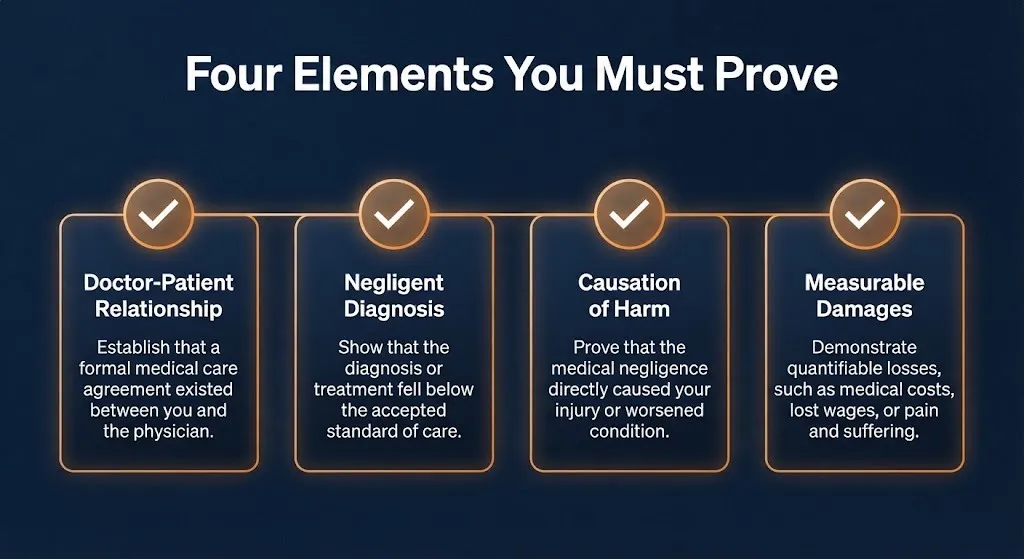
You must prove four elements: a doctor-patient relationship, negligence, causation, and damages.
The doctor-patient relationship is usually easy to show. You sought treatment, and the doctor agreed to treat you.
Negligence means the doctor deviated from the accepted standard of care. You need an expert witness to testify about what a competent doctor would have done.
Causation is the hardest element. You must show the misdiagnosis made your condition worse than it would have been with a timely correct diagnosis.
Damages are the actual losses: medical bills, lost wages, pain and suffering, and in death cases, the value of the life lost.
| Element | What It Means |
|---|---|
| Duty | A doctor-patient relationship existed |
| Breach | The doctor deviated from the standard of care |
| Causation | The deviation caused real harm |
| Damages | You suffered measurable losses |
Missing any one element means the case fails.
How Long Do You Have to File a Misdiagnosis Lawsuit?
The deadline to file a misdiagnosis lawsuit varies by state and often runs one to three years from the date you discovered the error.
Most states use a discovery rule. The clock starts when you knew or should have known you were misdiagnosed, not when the misdiagnosis happened.
Some states also impose a statute of repose, which is an absolute deadline regardless of discovery. That deadline might be four to seven years from the misdiagnosis.
| State Approach | Typical Deadline |
|---|---|
| Discovery rule only | 1 to 3 years from discovery |
| Statute of repose | 4 to 7 years absolute |
| Minor plaintiffs | Extended deadlines |
| Wrongful death | 1 to 3 years from death |
Do not guess at your deadline. A medical malpractice attorney in your state must calculate it.
What Is the Difference Between Misdiagnosis and Failure to Diagnose?
Misdiagnosis means the doctor identified the wrong condition. Failure to diagnose means the doctor found nothing wrong at all.
Both are forms of diagnostic error. Both can support a medical malpractice claim if the error harmed you.
| Error Type | What Happened |
|---|---|
| Misdiagnosis | You were told condition A when you had condition B |
| Failure to diagnose | You were told you were fine when you were not |
| Delayed diagnosis | The correct diagnosis came later than it should have |
The legal standard is the same. The error must fall below the standard of care and cause harm.
Key Takeaway: Misdiagnosis, failure to diagnose, and delayed diagnosis are three versions of the same legal wrong: a doctor missed what a competent doctor would have found.
What Are the Most Common Misdiagnosis Cases?
The most common misdiagnosis cases involve cancer, heart attacks, infections, and stroke.
These conditions are frequently missed because their early symptoms overlap with less serious illnesses. A young woman with breast cancer symptoms may be told it is a cyst. A man with chest pain may be sent home with heartburn.
| Condition | Why It Gets Missed |
|---|---|
| Cancer | Symptoms mimic benign conditions |
| Heart attack | Atypical symptoms in women |
| Sepsis | Early signs resemble flu |
| Stroke | Symptoms dismissed as migraine |
| Pulmonary embolism | Shortness of breath blamed on asthma |
The delay in diagnosis allows the disease to progress. That progression is the harm.
How Does a Misdiagnosis Lawsuit Work?
A misdiagnosis lawsuit follows the same path as any medical malpractice case: investigation, expert review, filing, discovery, and trial or settlement.
The process starts with your attorney obtaining your medical records. A medical expert reviews them to determine whether the standard of care was breached.
If the expert supports the case, the attorney files a complaint in court. The defendant doctor and hospital respond, and discovery begins.
| Stage | What Happens |
|---|---|
| Records review | Attorney obtains and reviews medical records |
| Expert evaluation | A doctor assesses whether negligence occurred |
| Filing | Complaint filed in court |
| Discovery | Depositions, interrogatories, expert reports |
| Settlement or trial | Most cases settle; some go to verdict |
Most malpractice cases never reach trial. Insurers settle the strong ones and fight the weak ones.
What Is the Role of an Expert Witness in a Misdiagnosis Case?
An expert witness is a doctor who testifies about the standard of care and whether the defendant doctor met it.
In most states, you cannot file a medical malpractice lawsuit without an expert affidavit or certificate. The expert must be qualified in the same specialty as the defendant.
The expert’s job is to educate the jury about what a competent doctor would have done. The defense has its own experts who say the opposite.
Your case rises and falls on expert credibility.
Reality Check: A misdiagnosis lawsuit is not a DIY project. You need medical experts and an experienced malpractice attorney just to get past the courthouse door.
What Damages Can You Recover in a Misdiagnosis Lawsuit?
You may recover economic damages, non-economic damages, and in some cases, punitive damages.
Economic damages cover medical bills, lost income, and future care costs. These are calculated from actual records and expert projections.
Non-economic damages cover pain, suffering, emotional distress, and loss of enjoyment of life. Many states cap these amounts.
| Damage Type | What It Covers |
|---|---|
| Medical expenses | Past and future treatment |
| Lost wages | Past and future income |
| Pain and suffering | Physical and emotional harm |
| Loss of consortium | Impact on spouse or family |
| Punitive damages | Rare, for reckless conduct |
State law controls which damages are available and whether caps apply.
What Are the Defenses to a Misdiagnosis Lawsuit?
Common defenses include arguing the diagnosis was reasonable, the harm was inevitable, or the statute of limitations expired.
Doctors often defend by showing that their diagnosis was within the range of reasonable medical judgment. Medicine is uncertain, and not every wrong diagnosis is negligent.
| Defense | What It Argues |
|---|---|
| Reasonable judgment | Another competent doctor might agree |
| No causation | The outcome would have been the same |
| Statute of limitations | You filed too late |
| Contributory negligence | You delayed seeking care |
The causation defense is often the strongest. Even if the diagnosis was wrong, the defense may show earlier detection would not have changed the outcome.
How Do Misdiagnosis Settlements Work?
Most misdiagnosis cases settle before trial. Settlement means the doctor’s insurer pays you in exchange for releasing the claim.
Settlement amounts are confidential in most cases. The terms are not public record.
The settlement process involves:
- Your attorney demands a specific amount with supporting evidence.
- The insurer responds with a lower offer.
- Negotiations continue through mediation.
- If a deal is reached, you sign a release.
- The insurer pays, and the case ends.
If no deal is reached, the case proceeds to trial.
Key Takeaway: Most misdiagnosis lawsuits settle, but the settlement amount depends on the strength of your expert evidence and the severity of your harm.
What Should You Do If You Suspect a Misdiagnosis?
If you suspect a misdiagnosis, get a second opinion immediately, then gather your medical records and consult an attorney.
Your health comes first. Confirm the correct diagnosis and get treatment before worrying about litigation.
Then take these steps:
- Get copies of all medical records from the original doctor.
- Get a written opinion from the second doctor.
- Document all missed work and out-of-pocket costs.
- Do not contact the original doctor about a lawsuit.
- Consult a medical malpractice attorney for a case evaluation.
The records and the second opinion are the foundation of any case.
What Happens Next With a Misdiagnosis Claim
A misdiagnosis claim moves through a defined process once you hire an attorney.
- Month 1: Attorney obtains and reviews medical records
- Month 2 to 4: Expert evaluation of standard of care
- Month 4 to 6: Complaint filed if expert supports the case
- Month 6 to 18: Discovery and depositions
- Month 12 to 24: Settlement negotiations or trial
These timeframes are estimates. Malpractice cases often take two to four years to resolve.
Frequently Asked Questions
Is a wrong diagnosis always malpractice?
No.
You must prove a competent doctor would have made the correct diagnosis.
How much does a misdiagnosis lawsuit cost?
You pay nothing upfront.
Medical malpractice attorneys work on contingency, taking a percentage of your recovery.
Can I sue a hospital for misdiagnosis?
Maybe.
If the misdiagnosing doctor was a hospital employee, the hospital may be liable.
What is the average misdiagnosis settlement?
No reliable average exists.
Settlement amounts vary by state, injury severity, and case strength.
Do I need an expert for a misdiagnosis lawsuit?
Yes, in most states.
An expert affidavit is usually required just to file the case.
How long does a misdiagnosis lawsuit take?
Most take two to four years.
Complex cases with severe injuries can take longer.
The Bottom Line
A misdiagnosis lawsuit is a medical malpractice claim that requires proof of negligence, causation, and real harm. It is not enough that the diagnosis was wrong.
If you suspect a misdiagnosis, get a second opinion now. Then gather your records and call a malpractice attorney. The statute of limitations is running, and it is shorter than you think.
The single most important fact is your state’s filing deadline. Miss it, and no amount of evidence can save your case.