Kalshi Lawsuit 2026: All the States Suing It, Explained
Quick Answer
- The Kalshi lawsuit is really multiple separate cases: state attorneys general suing over gambling law, plus one private trader class action.
- No settlement or consumer payout process exists yet, so any compensation amount is not yet determined.
- The most financially significant filing is New York’s, seeking a minimum of $36 billion in penalties and restitution.
If you searched “Kalshi lawsuit,” here’s the direct answer: there isn’t one case, there are several. New York, Michigan, Connecticut, Arizona, and Massachusetts have all taken legal action against the prediction market company, each alleging it’s running illegal gambling under a different name.
This affects anyone who trades on Kalshi, especially in states actively suing the company, and anyone who held a position in its disputed Iran Supreme Leader market. No settlement fund or consumer claim process exists in any of these cases as of September 2026.
This article breaks down each active lawsuit, what regulators and courts have actually decided so far, and one detail that surprises people: a federal regulator has ordered Kalshi to keep operating in New York while the state’s own lawsuit tries to shut it down.
The Facts
| Case | Multiple: New York v. KalshiEX LLC (state) and Risch v. KalshiEX LLC (private class action, C.D. Cal., No. 2:26-cv-02390) |
| Status | Active litigation across multiple states; no settlement in any case |
| Fund Size | Not applicable, no settlement fund exists in any pending case |
| Est. Per Person | Not applicable, no consumer payout process currently exists |
| Claim Deadline | Not applicable, no claim form has been established |
| Administrator | Not yet appointed in any case |
| Proof Needed | Not applicable at this stage of litigation |
Is there a real Kalshi lawsuit in 2026?
Yes, several real lawsuits against Kalshi are active right now, filed by state governments and private plaintiffs. These aren’t rumors or speculation, they’re documented court filings.
Confirmed active legal actions against Kalshi as of September 2026:
- New York Attorney General lawsuit, filed July 31, 2026
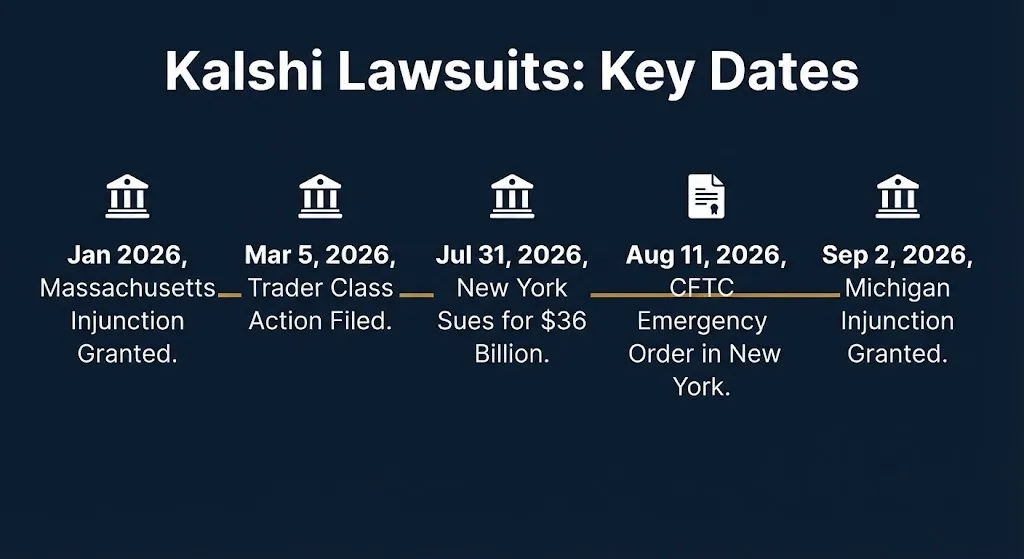
- Michigan Attorney General lawsuit, with a preliminary injunction issued September 2, 2026
- Connecticut Attorney General lawsuit, filed in August 2026
- Arizona criminal charges, a 20-count misdemeanor filing
- Massachusetts preliminary injunction, issued in January 2026
- Risch v. KalshiEX LLC, a private trader class action filed March 5, 2026
Each case involves different courts, different legal theories, and different outcomes so far. Treating this as one unified “Kalshi lawsuit” misses how fragmented the actual legal fight has become.
Is Kalshi legal or an illegal gambling operation?
That question is exactly what these lawsuits are fighting over, and courts have reached different answers depending on the state. Kalshi argues it’s a federally regulated prediction market, not a gambling platform, since it operates under Commodity Futures Trading Commission oversight.
State regulators in New York, Michigan, Connecticut, and Massachusetts argue Kalshi’s sports-related contracts are simply sports betting dressed up in different language. New York Attorney General Letitia James said prediction markets like Kalshi are “gambling platforms, plain and simple.”
Courts have split. Michigan and Massachusetts issued injunctions against Kalshi’s sports contracts, while Nevada and New Jersey federal courts sided with Kalshi’s argument that federal law preempts state gambling rules in those cases.
Key Takeaway: No single court ruling has settled whether Kalshi is legal nationwide, since the outcome currently depends on which state’s courts are involved.
How much money is Kalshi being sued for?
The largest figure comes from New York’s lawsuit, which seeks a minimum of $36 billion pending a full accounting of Kalshi’s gains. That number reflects the state’s request for triple damages plus consumer restitution.
| Case | Amount Sought | What It Covers |
|---|---|---|
| New York v. KalshiEX LLC | Minimum $36 billion | Forfeiture of gains, consumer restitution, triple penalties |
| Michigan preliminary injunction | $500,000 per day | Fine for violating the injunction, not a lawsuit judgment |
| Risch v. KalshiEX LLC | Related to a $54 million market | Disputed payouts on Iran Supreme Leader contracts |
New York’s request specifically asks the court to order Kalshi to forfeit illegal gains, distribute restitution to harmed consumers, and pay fines equal to three times what the company made from its alleged illegal actions.
Can Kalshi traders get money back from a lawsuit?
Not yet determined, since no settlement or judgment has been reached in any pending case. The closest thing to a direct consumer claim right now is the private class action over the Iran Supreme Leader market.
That case, Risch v. KalshiEX LLC, alleges Kalshi didn’t properly disclose a “death carveout” rule before Iran’s Supreme Leader Ali Khamenei’s reported death, then kept accepting new trades anyway. The proposed class covers US traders who held “yes” positions on that specific market when trading halted on February 28, 2026.
Reality Check: No court has certified this class or established any payout yet, so anyone claiming they can process a Kalshi refund for you right now is not connected to any real legal process. Filing a lawsuit or joining a future certified class is never something a legitimate court process charges you a fee to access upfront.
Can you file a claim against Kalshi right now?
No formal consumer claim process exists yet in any of these cases. The state lawsuits seek restitution as part of broader legal action, not through a claim form you can currently submit.
If the private Risch class action eventually gets certified, affected traders may later have a formal way to join that case. Right now, it remains a proposed class action, not a certified one with an open claims process.
What currently exists versus what doesn’t:
- Exists: filed lawsuits, preliminary injunctions, criminal charges
- Doesn’t exist yet: any settlement fund, claim form, or payout process
What should Kalshi traders do if they think they were harmed?
If you believe you were harmed by Kalshi’s handling of a specific market, documenting your trading records and any related communications is a reasonable first step. Consulting an attorney about your specific situation is the appropriate next move, not filing anything through this article.
Steps that generally make sense in this situation:
- Save screenshots or records of your specific trades and positions.
- Note the exact dates and times of any relevant market changes or halts.
- Keep any communications from Kalshi about rule changes or disclosures.
- Watch official court dockets for updates on cases like Risch v. KalshiEX LLC.
- Consult an attorney if you believe you have an individual claim.
There’s no cost to monitor public court records for updates on these cases. Be cautious of anyone charging a fee just to “register” your interest in a lawsuit that hasn’t reached a settlement stage.
What is the latest Kalshi lawsuit update for 2026?
The most recent major development is Michigan’s preliminary injunction, issued September 2, 2026, blocking Kalshi from offering sports-related contracts to Michigan residents. That order requires Kalshi to maintain geofencing and threatens fines of $500,000 per day for violations.
Before that, Connecticut sued Kalshi in August 2026 over allegations its sports-related contracts violate the state’s consumer protection laws against unlicensed sports gambling. Around the same time, the CFTC intervened in the New York case using emergency authority.
New York’s lawsuit itself, filed July 31, 2026, remains active, with the state and Kalshi disputing which court should even hear the case. Motions over whether to move it to federal court are still pending a judge’s ruling.
What did the CFTC do about the New York Kalshi lawsuit?
The Commodity Futures Trading Commission ordered Kalshi to continue operating in New York despite the state’s lawsuit seeking to shut the platform down. That order, issued August 11, 2026, used what the CFTC described as its “emergency authority.”
This creates a direct conflict between a federal regulator and a state attorney general over the same company. The CFTC had previously taken similar action to help Kalshi keep operating in Michigan, though that state’s court later issued its own injunction anyway.
Key Takeaway: A federal regulator is actively countering state enforcement actions against Kalshi, which is a central reason this litigation remains unresolved.
What happened with the Michigan Kalshi lawsuit?
A Michigan judge issued a preliminary injunction on September 2, 2026, blocking Kalshi from offering sports-related contracts to people located in the state. The lawsuit was brought by Michigan Attorney General Dana Nessel and remains ongoing.
The order specifically requires KalshiEx LLC to maintain geofencing that prevents Michigan residents, and anyone physically located in Michigan, from accessing its sports betting contracts. Violating that order could trigger fines of $500,000 per day.
This ruling came despite earlier CFTC intervention attempting to help Kalshi continue operating in Michigan, showing the federal agency’s efforts haven’t uniformly succeeded in state courts.
Why is New York suing Kalshi?
New York sued Kalshi because state investigators concluded its prediction market functions as an unlicensed, illegal gambling operation. The lawsuit, filed by Attorney General Letitia James on July 31, 2026, seeks a permanent injunction against the company.
The state’s investigation found that Kalshi exposed New Yorkers, including people under 21, to gambling risks without the safeguards state law requires for licensed gambling. Governor Kathy Hochul and Attorney General James announced the case jointly.
This wasn’t an isolated move. In April 2026, the same attorney general’s office sued Coinbase and Gemini over similar allegations, and Governor Hochul separately signed an executive order banning state employees from using prediction markets like Kalshi.
Which other states are suing Kalshi?
At least four other states have taken legal or regulatory action against Kalshi beyond New York. Each case involves different legal theories and different current outcomes.
| State | Type of Action | Status |
|---|---|---|
| Michigan | Civil lawsuit by Attorney General | Preliminary injunction granted, Sept 2, 2026 |
| Connecticut | Civil lawsuit by Attorney General | Filed August 2026, active |
| Arizona | Criminal misdemeanor charges | 20 counts filed by Attorney General |
| Massachusetts | Civil injunction request | Preliminary injunction granted, January 2026 |
Arizona’s case stands out as criminal rather than civil, with Attorney General Kris Mayes accusing Kalshi of illegally allowing bets on Arizona elections. That case followed Kalshi’s own earlier lawsuit against Arizona, filed in March 2026, seeking to operate in the state.
What is the Kalshi trader lawsuit over the Iran Supreme Leader market?
Traders sued Kalshi in March 2026 alleging the company failed to properly disclose rules before Iran’s Supreme Leader Ali Khamenei was reported dead following US and Israeli airstrikes. The case is Risch v. KalshiEX LLC, filed in the US District Court for the Central District of California.
The complaint alleges Kalshi’s platform led traders to expect payouts on its “Ali Khamenei out as Supreme Leader?” market, then applied an undisclosed “death carveout” rule after news of his death spread. Rather than pausing trading as military strike reports accumulated on February 28, 2026, the suit claims Kalshi kept accepting new “yes” positions.
What the lawsuit is seeking:
- Damages for affected traders
- Return of what plaintiffs call ill-gotten gains
- Injunctive relief requiring clearer disclosure practices
- Claims include breach of contract and violations of California law
This remains a proposed class action, meaning no court has yet certified it as an official class with a defined group of eligible claimants.
What is Kalshi’s legal argument for operating nationwide?
Kalshi argues that its contracts are federally regulated financial products under the Commodity Exchange Act, which it says preempts state gambling laws. This legal theory is the foundation of its defense across nearly every state dispute.
Rather than waiting to be sued state by state, Kalshi has taken an aggressive approach, filing its own federal lawsuits seeking declaratory rulings that block state enforcement before it happens. That strategy succeeded in Nevada and New Jersey, where federal courts granted Kalshi preliminary injunctions based on federal preemption.
It’s a bit like a company arguing a specific state’s local ordinance doesn’t apply because a federal license already covers the activity nationwide. Whether that argument holds depends entirely on which court is reviewing it, and results so far have been genuinely mixed.
What is a prediction market and how is it different from sports betting?
A prediction market lets users take financial positions on the outcome of future events, similar to a futures contract rather than a traditional wager. Kalshi describes its sports-related offerings this way, calling them contracts rather than bets.
State regulators disagree with that framing when it comes to sports outcomes specifically. Connecticut’s attorney general described Kalshi’s sports contracts as resembling standard sports wagers, covering things like team win totals, point spreads, and game scoring outcomes.
This distinction matters legally because prediction markets tied to commodities or elections generally fall under federal CFTC oversight, while sports betting is traditionally regulated state by state. The unresolved question across all these lawsuits is which category Kalshi’s sports contracts actually belong in.
What Happens Next
Pending: A ruling on whether New York’s lawsuit should move to federal court remains outstanding as of September 2026.
Ongoing: Michigan’s preliminary injunction remains in effect while that state’s underlying lawsuit continues.
Ongoing: The Risch v. KalshiEX LLC class action remains in early stages, with no class certification decision confirmed yet.
Expected: Additional state lawsuits or regulatory actions may continue to emerge as more states review Kalshi’s sports-related offerings.
Frequently Asked Questions
Is Kalshi being sued right now?
Yes, multiple lawsuits are active, including cases from New York, Michigan, Connecticut, and a private trader class action in California.
There is no single unified case, since each lawsuit involves different courts and legal claims.
How much is New York suing Kalshi for?
New York’s lawsuit seeks a minimum of $36 billion, covering forfeiture of alleged illegal gains, consumer restitution, and penalties equal to three times the company’s gains.
That figure could change pending a full financial accounting ordered by the court.
Can I get money back if I traded on Kalshi?
Not currently, since no settlement or certified consumer claims process exists in any pending case. The Risch class action may eventually offer a path for affected Iran Supreme Leader market traders, but it hasn’t been certified.
Did a court rule Kalshi is illegal gambling?
Courts have reached different conclusions depending on the state. Michigan and Massachusetts issued injunctions against Kalshi’s sports contracts, while Nevada and New Jersey courts sided with Kalshi’s federal preemption argument.
What is the CFTC’s role in the Kalshi lawsuits?
The CFTC has used emergency authority to order Kalshi to keep operating in New York and previously attempted similar intervention in Michigan. This puts the federal regulator in direct conflict with state enforcement actions.
What happened with the Iran Supreme Leader Kalshi market?
Traders allege Kalshi failed to disclose a “death carveout” rule before Iran’s Supreme Leader was reported dead, then kept accepting new trades anyway. That dispute led to the Risch v. KalshiEX LLC class action, filed in March 2026.
Is Kalshi facing criminal charges anywhere?
Yes, Arizona’s Attorney General filed 20 counts of misdemeanor criminal charges against Kalshi, accusing it of running an illegal gambling business and unlawfully allowing bets on state elections.
Will Kalshi be shut down nationwide?
Not yet, and outcomes have varied significantly by state so far. Some courts have blocked Kalshi’s sports contracts, while others have protected the company’s ability to operate under federal preemption arguments.
If you’re tracking this because you trade on Kalshi, the most useful thing you can do right now is watch official court dockets rather than assume any settlement exists. Nothing about consumer payouts has been decided in any of these cases.
The single most important number right now is New York’s $36 billion demand, the largest figure in any pending Kalshi case as of September 2026.