Combat-Related Special Compensation: 2026 Eligibility Rules, Application Steps, and Payment Updates
Quick Answer
- Combat-Related Special Compensation is a real DoD program that restores retired pay offset by VA disability compensation.
- Monthly payments vary by disability rating and years of service; many recipients receive $300 to $3,500 per month.
- There is no deadline to apply, but applications filed now face a 12 to 18 month processing backlog.
Combat-Related Special Compensation, or CRSC, is a Department of Defense program that pays retired veterans a monthly benefit to offset the reduction in military retired pay caused by VA disability compensation. It is not a lawsuit or settlement. It is a standing federal benefit.
This affects military retirees with combat-related disabilities who also receive VA disability compensation. The key requirement is that your disability must be combat-related, not just service-connected.
This article covers 2026 eligibility rules, application steps, payment timelines, and the recent policy changes that expanded the program for certain disabled veterans.
The Facts
| Field | Verified Detail |
|---|---|
| Program | Combat-Related Special Compensation (CRSC) |
| Administering Agency | Department of Defense, via military branch CRSC boards |
| Status | Active; no settlement or class action involved |
| Fund Size | Not applicable; annual appropriation by Congress |
| Payment Range | Varies; typically $300 to $3,500 per month |
| Application Deadline | None; rolling applications accepted |
| Administrator | Each branch: Army, Navy, Air Force, Marine Corps, Coast Guard |
| Proof Required | DD Form 214, VA rating decision, combat documentation |
CRSC exists because federal law prohibits veterans from receiving both full military retired pay and full VA disability compensation. The VA offset reduces retired pay dollar for dollar by the amount of VA disability received.
CRSC restores that offset for veterans whose disabilities are combat-related. The program began in 2003 and has expanded several times since.
In late 2025, the National Defense Authorization Act included provisions that adjusted CRSC eligibility for certain categories of veterans. Those changes took effect on January 1, 2026.
Is Combat-Related Special Compensation Real?
Combat-Related Special Compensation is a real federal benefit program established by Congress in 2003. It is codified in Title 10 of the U.S. Code and administered by the Department of Defense.
It is not a scam. The program has paid billions of dollars to eligible veterans since its creation. If you receive a letter from your military branch’s CRSC board, it is legitimate correspondence.
The confusion often comes from the name. CRSC sounds like a settlement or class action payout. It is neither. It is an ongoing benefit, similar to a pension supplement.
You can verify the program through your branch’s official military personnel office or the Defense Finance and Accounting Service. Any website charging a fee to “process” your CRSC application is running a scam. The application is free.
How Much Does Combat-Related Special Compensation Pay?
Combat-Related Special Compensation pays a monthly amount that varies by your disability rating, years of service, and retired pay grade. Most recipients receive between $300 and $3,500 per month.
The payment formula is complex. CRSC cannot exceed the amount of retired pay that was offset by VA disability compensation. It also cannot exceed what your combat-related disability rating would pay under VA compensation tables.
A simplified breakdown looks like this:
| Veteran Profile | Typical Monthly CRSC |
|---|---|
| E-5 with 10 years, 50% combat rating | $400 to $900 |
| E-7 with 20 years, 70% combat rating | $800 to $1,800 |
| O-3 with 15 years, 80% combat rating | $1,200 to $2,500 |
| O-5 with 25 years, 100% combat rating | $2,000 to $3,500 |
These are estimates, not guaranteed amounts. Your exact payment depends on your individual retired pay calculation and VA offset.
Reality Check: No legitimate CRSC consultant charges a fee. The application is free, the process is standardized, and your branch’s CRSC board decides claims. Veterans service organizations like the VFW and American Legion provide free assistance.
Who Qualifies for Combat-Related Special Compensation in 2026?
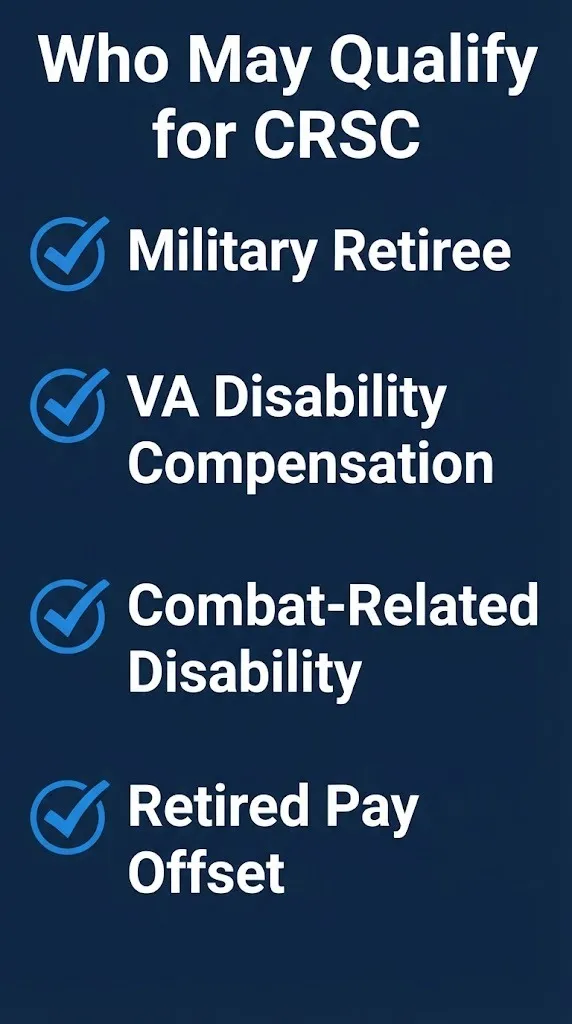
You may qualify for Combat-Related Special Compensation in 2026 if you meet four criteria. You must be a military retiree, you must receive VA disability compensation, your disability must be combat-related, and your retired pay must be offset by the VA amount.
The combat-related standard is stricter than the VA’s service-connected standard. Your disability must result from one of these:
- Armed conflict
- Hazardous service
- An instrumentality of war
- Simulated war conditions
A service-connected disability from a training accident on a stateside base may not qualify unless it involved an instrumentality of war. A combat injury from an IED blast clearly qualifies.
The 2026 changes expanded eligibility for veterans who were medically retired before completing 20 years. Previously, some of these veterans faced restrictions. The new policy allows certain medical retirees with combat-related disabilities to receive CRSC even if they did not serve 20 years.
How Do I Apply for Combat-Related Special Compensation?
You apply for Combat-Related Special Compensation through your military branch’s CRSC board, not through the VA.
The process works like this:
- Download the CRSC application form from your branch’s website.
- Complete DD Form 2860, the official CRSC application.
- Attach your DD Form 214 showing your retirement date and characterization of service.
- Attach your VA rating decision showing your service-connected disabilities.
- Attach combat documentation: award citations, combat action badge, medical records from deployment.
- Submit the package to your branch’s CRSC board address.
- Wait for the board’s decision, which typically takes 12 to 18 months.
Each branch has slightly different submission addresses. The Army, Navy, Air Force, Marine Corps, and Coast Guard all maintain separate boards.
Veterans service organizations can help you prepare the application for free. The Disabled American Veterans and the VFW have certified service officers trained on CRSC.
What is the CRSC Application Processing Time in 2026?
The CRSC application processing time in 2026 is 12 to 18 months for most branches. Some claims move faster, some slower.
The Army receives the highest volume of applications and historically has the longest wait times. The Air Force and Navy generally process claims faster.
The processing time reflects multiple steps. The board reviews your application, requests additional documentation if needed, determines combat-related status for each disability, calculates the CRSC amount, and coordinates with DFAS for payment.
You can check your application status through your branch’s CRSC board. Most boards do not provide online status tracking. You may need to call or email the board directly.
Key Takeaway: CRSC is a free, branch-administered benefit with a 12 to 18 month processing backlog. File early and keep copies of everything.
What Disabilities Qualify as Combat-Related?
Disabilities qualify as combat-related if they result from armed conflict, hazardous service, an instrumentality of war, or simulated war conditions. The standard comes directly from the CRSC statute.
Armed conflict includes direct engagement with enemy forces. It also includes injuries from enemy fire, IEDs, mortars, and other hostile actions.
Hazardous service includes duties like flight operations, parachute jumps, demolition work, and other inherently dangerous activities. A hearing injury from repeated artillery fire may qualify.
Instrumentality of war includes vehicles, weapons, and equipment designed for military use. A knee injury from jumping out of a military vehicle could qualify. The same injury from a civilian car would not.
Simulated war conditions includes training exercises that replicate combat. Live-fire exercises, combat maneuver training, and other realistic combat simulations fall under this category.
Does Combat-Related Special Compensation Affect VA Disability Pay?
Combat-Related Special Compensation does not reduce your VA disability pay. You receive both payments together.
CRSC specifically restores the portion of military retired pay that was offset by VA disability compensation. It is not deducted from your VA check.
The mechanics work like this. Federal law requires a dollar-for-dollar offset between military retired pay and VA disability compensation. If your retired pay is $2,000 per month and your VA disability is $800, your retired pay drops to $1,200.
CRSC restores that $800 offset if your disability is combat-related. You then receive $1,200 retired pay, $800 CRSC, and $800 VA disability. Your total is $2,800 instead of $2,000.
This is different from Concurrent Retirement and Disability Pay, or CRDP, which automatically restores the offset for retirees with 20 years and a 50 percent or higher VA rating. CRSC requires a separate application and a combat-related determination.
What Changed in Combat-Related Special Compensation for 2026?
Combat-Related Special Compensation changed in 2026 due to provisions in the National Defense Authorization Act for Fiscal Year 2026.
The main change expands eligibility for medical retirees. Previously, veterans who were medically retired before reaching 20 years of service faced restrictions on CRSC. The new law allows certain medical retirees with combat-related disabilities to receive CRSC without the 20-year requirement.
The change took effect on January 1, 2026. Veterans who were previously denied may reapply under the new standard.
A second change adjusts the calculation methodology for certain high-disability retirees. The details are still being implemented by DFAS and the military branches as of February 2026.
Key Takeaway: The 2026 NDAA expanded CRSC eligibility for medical retirees. Previously denied veterans should consider reapplying.
Is Combat-Related Special Compensation Taxable?
Combat-Related Special Compensation is not taxable as federal income. It is treated like VA disability compensation for tax purposes.
You will not receive a W-2 or 1099 for CRSC payments. The IRS does not count CRSC as taxable income in most cases.
State tax treatment varies. Most states follow the federal rule and exclude CRSC from taxable income. A few states have different rules for military retirement pay.
If you are receiving CRSP, check your state’s military retirement tax rules. Some states tax military retired pay but exempt disability compensation. CRSC falls on the disability compensation side in most states.
What Happens After My CRSC Application is Approved?
After your CRSC application is approved, the board notifies you by letter. The approval letter lists which disabilities were determined combat-related and the effective date.
DFAS then calculates your retroactive payment. CRSC is generally payable from the date you filed your application, not the date of your disability.
The first payment typically arrives within 60 to 90 days after approval. Retroactive amounts are paid as a lump sum. Ongoing monthly payments follow on your regular military pay schedule.
If your application is denied, you can appeal. Each branch has an appeal process that allows you to submit additional evidence or request reconsideration.
What Documents Do I Need for a CRSC Application?
You need four categories of documents for a CRSC application.
The required documents are:
- DD Form 214 showing your retirement date
- VA rating decision showing your service-connected disabilities
- Combat documentation linking your disabilities to combat
- DD Form 2860 completed and signed
Combat documentation can include award citations like the Combat Action Badge, Purple Heart, Bronze Star with V device, or Combat Infantryman Badge. Deployment orders, medical records from combat zones, and eyewitness statements also help.
The board will not search for your records. You must provide everything. Missing documentation is the most common reason for denial or delay.
Can I Get Retroactive Combat-Related Special Compensation?
You may receive retroactive Combat-Related Special Compensation dating back to your application filing date. In some cases, retroactive payments go back further.
The general rule is that CRSC starts on the first day of the month after your application is received. If you filed on June 15, 2025, your CRSC could start July 1, 2025.
Veterans who were medically retired before 2008 may qualify for retroactive payment back to January 1, 2008, under the law that expanded CRSC eligibility. This only applies if you meet all eligibility criteria for that period.
The retroactive lump sum can be substantial. Some veterans receive $50,000 or more in back payments, though amounts depend on your individual calculation.
How Do I Check My CRSC Application Status?
You check your CRSC application status by contacting your branch’s CRSC board directly. There is no unified online portal for all branches.
Each branch maintains its own contact method:
| Branch | Status Check Method |
|---|---|
| Army | Email or phone the Army CRSC Board |
| Navy | Email or phone the Navy CRSC Board |
| Air Force | Email or phone the Air Force CRSC Board |
| Marine Corps | Email or phone the Marine Corps CRSC Board |
| Coast Guard | Contact the Coast Guard Pay and Personnel Center |
Response times for status inquiries vary. Some boards respond within a week. Others take longer, especially during peak application periods.
Key Takeaway: The 2026 changes and the free application process make CRSC one of the most underutilized benefits available to combat-injured retirees.
What is the Difference Between CRSC and CRDP?
CRSC and CRDP are both programs that restore retired pay offset by VA disability compensation, but they differ in key ways.
CRDP, or Concurrent Retirement and Disability Pay, is automatic. You receive it if you have at least 20 years of service and a VA disability rating of 50 percent or higher. No application is required.
CRSC requires an application and a combat-related determination. However, CRSC is available to some veterans who do not qualify for CRDP, including some medical retirees with less than 20 years.
The two programs also differ on tax treatment. CRDP is taxed as military retired pay. CRSC is not taxable. For some veterans, CRSC provides better net income even if the gross amount is the same.
What Happens Next With Combat-Related Special Compensation?
Combat-Related Special Compensation is a mature program, but implementation of the 2026 changes is still ongoing.
The expected timeline:
Early 2026: DFAS issues updated CRSC calculation guidance to the military branches.
Spring 2026: Branch CRSC boards publish revised application instructions reflecting the medical retiree expansion.
Summer 2026: First wave of reapplications from previously denied medical retirees processed.
Late 2026: GAO or DoD Inspector General may review implementation of the expanded eligibility.
Ongoing: Application processing continues at 12 to 18 months per claim.
Veterans who believe they are newly eligible under the 2026 changes should start gathering documents now. The boards will likely see a surge in applications.
Frequently Asked Questions
Is Combat-Related Special Compensation a lawsuit settlement?
No. CRSC is a federal benefit program, not a lawsuit or settlement.
It has existed since 2003 and is administered by the Department of Defense.
How much does Combat-Related Special Compensation pay?
Most recipients receive between $300 and $3,500 per month depending on disability rating and service history.
The exact amount depends on your individual retired pay calculation and VA offset.
Who qualifies for Combat-Related Special Compensation?
Military retirees with combat-related disabilities who receive VA disability compensation may qualify.
The disability must result from armed conflict, hazardous service, an instrumentality of war, or simulated war conditions.
What is the application deadline for CRSC?
There is no application deadline. CRSC applications are accepted on a rolling basis.
However, payment generally starts from the filing date, so applying sooner means larger retroactive payments.
Is the CRSC application free?
Yes. The CRSC application is completely free.
Veterans service organizations provide free assistance with the application.
What changed for CRSC in 2026?
The 2026 National Defense Authorization Act expanded eligibility for certain medical retirees.
Some veterans who were previously denied may now qualify.
Does CRSC reduce my VA disability pay?
No. CRSC does not reduce VA disability compensation.
You receive both payments together without reduction.
How long does CRSC processing take?
Most CRSC applications are processed in 12 to 18 months.
Processing times vary by branch and application volume.
Combat-Related Special Compensation is not a lawsuit, not a settlement, and not something you should pay anyone to help you obtain. It is a federal benefit that belongs to you if your disabilities are combat-related.
The 2026 expansion opened the door for more medical retirees. If you were denied before, consider reapplying. Gather your DD Form 214, your VA rating decision, and your combat documentation this week.