Credit Card Debt Settlement Lawsuits 2026: FTC Crackdowns, CFPB Cases, and Warning Signs
Quick Answer
- Credit card debt settlement itself is legal, but the industry has real, active federal enforcement cases against specific companies for fraud and illegal fees.
- There is no single class-wide payout for consumers here; any compensation depends on which specific company defrauded you and whether that case results in monetary relief.
- The FTC’s case against “Accelerated Debt Settlement, Inc.” and related companies remains active following a July 2025 court order freezing assets and appointing a receiver.
If you’re searching “credit card debt settlement,” you might be shopping for a legitimate program or you might be trying to figure out if a company that contacted you is a scam. Both questions matter, and the answer depends on which company you’re dealing with.
Debt settlement itself, negotiating with creditors to pay less than you owe, is a legal and regulated process. But federal regulators have brought real cases against specific debt settlement companies for charging illegal upfront fees, impersonating banks and government agencies, and leaving consumers worse off. One active case, against a group of companies operating as “Accelerated Debt,” allegedly collected more than $100 million from seniors and veterans before a federal court froze the operation in July 2025.
This article breaks down the real enforcement actions against debt settlement companies, what makes a program legitimate versus a scam, and what to check before signing up. One detail most competing coverage misses: the regulator historically most active in these cases, the CFPB, had its funding and authority significantly curtailed by federal legislation in 2025.
The Facts
| Case | FTC v. Accelerated Debt Settlement, Inc., et al. (active); multiple prior CFPB cases against individual debt settlement companies (resolved) |
| Court | U.S. District Court for the District of Arizona (Accelerated Debt case) |
| Status | Active. Temporary restraining order, asset freeze, and receiver appointed July 2025; case ongoing |
| Fund Size | Alleged more than $100 million collected from consumers by the Accelerated Debt operation; final monetary relief not yet confirmed |
| Est. Per Person | Not yet determined; depends on final court judgment and any consumer redress fund created |
| Claim Deadline | Not yet confirmed; no claims process has been announced as of September 2026 |
| Administrator | A court-appointed receiver is currently overseeing the Accelerated Debt defendants’ operations; no consumer claims administrator has been named |
| Proof Needed | Not yet confirmed; watch for FTC announcements if a consumer refund program is established |
Is credit card debt settlement a scam?
No, debt settlement itself is a legal process, but the industry includes both legitimate companies and outright scams, and telling them apart matters.
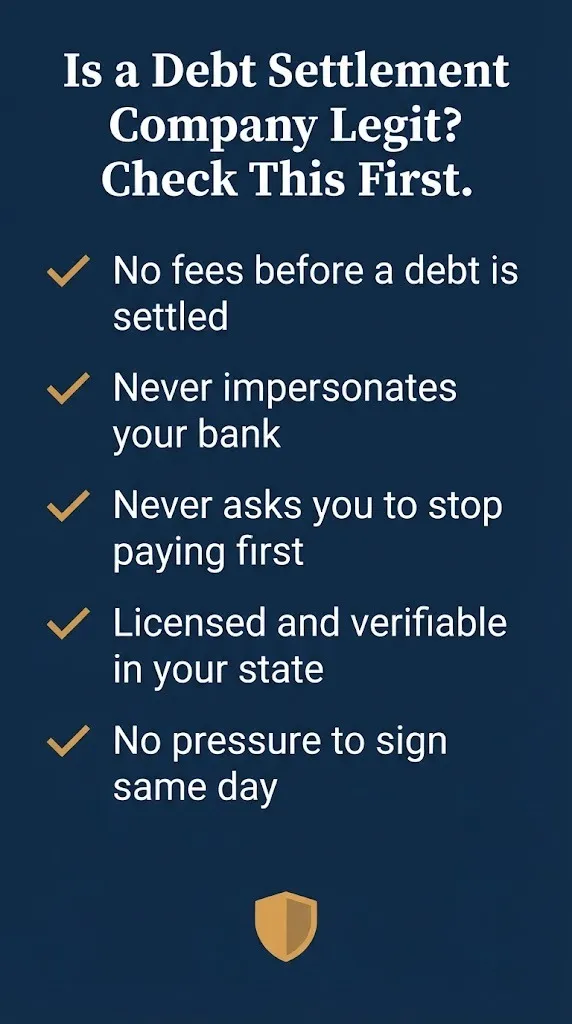
Legitimate debt settlement involves negotiating directly with your creditors, or through a company acting on your behalf, to pay a lump sum that’s less than your full balance owed. The Federal Trade Commission’s Telemarketing Sales Rule specifically regulates how these companies can operate, including a ban on charging fees before they actually settle a debt.
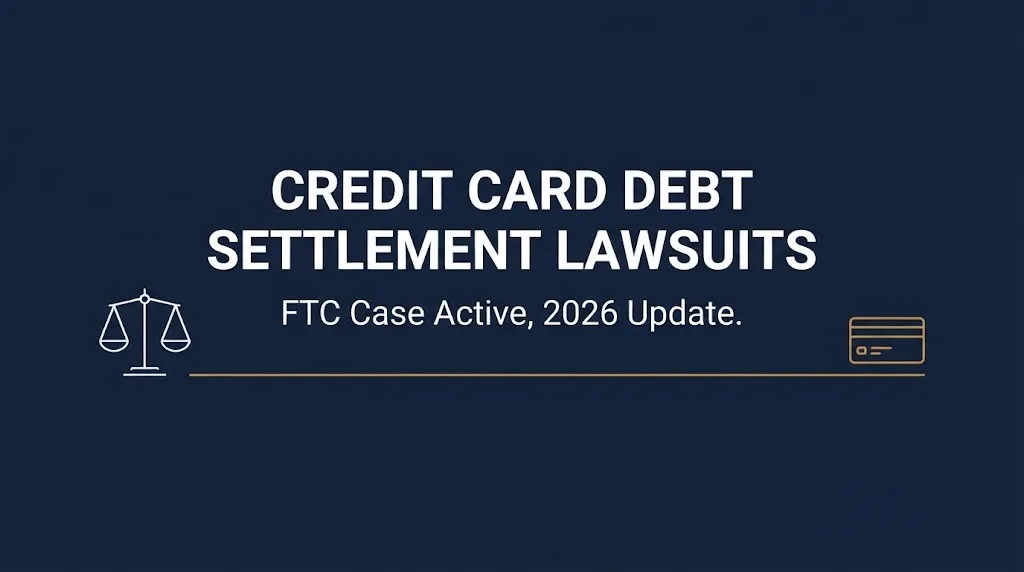
The scams that make headlines involve companies that never negotiate anything, or that charge illegal upfront fees, or that impersonate banks and government agencies to pressure people into signing up. The FTC’s case against “Accelerated Debt Settlement, Inc.” and related companies is a clear example: the complaint alleges the defendants impersonated banks, credit bureaus, and even the Social Security Administration and CFPB to convince consumers to pay thousands of dollars in advance fees.
Key Takeaway: Debt settlement as a category is legal, but specific companies have been shut down by federal courts for fraud, so checking a company’s track record before signing up matters more than the industry’s overall legality.
How much could you get back if a debt settlement company defrauded you?
Not yet determined, because no final judgment or consumer redress fund has been announced in the active Accelerated Debt case as of September 2026.
The FTC’s complaint against Accelerated Debt Settlement, Inc. and its related companies seeks monetary relief for defrauded consumers, and the court has already frozen the defendants’ assets and appointed a receiver to oversee operations. That does not mean a specific payout amount exists yet.
What’s confirmed versus what isn’t in this specific case:
| Item | Status |
|---|---|
| Amount allegedly collected from consumers | More than $100 million, per FTC complaint |
| Asset freeze | Confirmed, ordered July 2025 |
| Receiver appointed | Confirmed |
| Final judgment amount | Not yet confirmed |
| Consumer refund process | Not yet confirmed; no claims administrator named as of September 2026 |
If you were a customer of a specific debt settlement company that was later shut down by the FTC or CFPB, refund eligibility and amounts depend entirely on that specific enforcement action’s outcome, not on any industry-wide fund.
Reality Check: No legitimate debt settlement company or government refund program will ever call, text, or email you first demanding payment to “process” a refund you’re supposedly owed. If a company that previously took your money is now contacting you offering a refund for an upfront fee, that is very likely a second scam layered on top of the first.
How do you check if a debt settlement company is legitimate?
You can verify a debt settlement company’s standing by checking specific federal and state resources before you pay anyone anything.
Steps to check a company before you sign up or send money:
- Search the company’s name plus “FTC” or “CFPB lawsuit” to check for active enforcement actions.
- Confirm the company is not asking for payment before they’ve actually settled a specific debt, since that violates the FTC’s Telemarketing Sales Rule.
- Check your state attorney general’s consumer protection page for local complaints or licensing issues.
- Ask directly whether the company is a registered debt settlement company or an attorney offering “legal representation,” since some companies use a law firm structure specifically to get around fee rules.
- Verify the company will only take a fee after they’ve settled a specific debt and you’ve made at least one payment under that settlement, not before.
- Read any contract fully before signing, and never provide bank account access without understanding exactly how funds will be handled.
What is the “Accelerated Debt” lawsuit and who does it involve?
The FTC filed a complaint against seven companies and three individuals accused of running the “Accelerated Debt” program, which allegedly defrauded consumers out of more than $100 million.
The defendants named in the complaint include Accelerated Debt Settlement, Inc., ADS Resolve LLC, Financial Solutions Group LLC, Unified Capital Services LLC, Mediawerks, Resolution Specialists LLC, Futura Capital LLC, and individuals Jeffery A. Lakes, Robert Knechtel, and Elizabeth Reaney. The case was filed in the U.S. District Court for the District of Arizona.
The FTC alleges the defendants falsely promised to reduce consumer debt by up to 75%, while impersonating banks, credit bureaus, and government agencies including the Social Security Administration and the CFPB to gain consumers’ trust and financial information.
What the court has already ordered, as confirmed:
- A temporary restraining order halting the defendants’ operations.
- An asset freeze on the defendants’ accounts.
- Appointment of a temporary receiver to oversee business operations.
- A prohibition on releasing or using consumer data collected by the defendants.
Who did the Accelerated Debt scheme allegedly harm?
The FTC’s complaint specifically highlights harm to older Americans and veterans, describing a pattern of vulnerable consumers being pushed deeper into debt rather than out of it.
One case cited in FTC materials involved an Army veteran whose credit score dropped from the high 700s into the 500s after being advised to stop making credit card payments, which nearly cost him a job-related security clearance. Another veteran reportedly paid nearly $10,000 in unlawful fees and had to draw on retirement savings as a result.
Alleged tactics used against consumers, as described in the FTC complaint:
- Impersonating consumers’ own banks and credit card companies.
- Posing as federal agencies, including the Social Security Administration and CFPB.
- Falsely claiming debts had been compromised to create urgency.
- Instructing consumers to stop paying creditors, worsening their credit and debt position.
- Collecting illegal advance fees before any actual settlement occurred.
Key Takeaway: The Accelerated Debt case shows how debt settlement scams specifically target people already under financial stress, using fear and impersonation rather than transparent negotiation.
Are there other active lawsuits against debt settlement companies in 2026?
Yes, federal regulators have brought multiple cases against debt settlement companies over the years, though not every case remains active in 2026.
The CFPB has historically been the primary regulator pursuing these cases, including a prior action against DMB Financial, a Massachusetts-based debt settlement company, which resulted in a $5.4 million settlement over allegedly illegal upfront fees. The CFPB separately pursued Performance SLC LLC and related entities over illegal advance fee practices in California.
A comparison of confirmed federal debt settlement enforcement actions:
| Company | Regulator | Outcome |
|---|---|---|
| Accelerated Debt Settlement, Inc. and affiliates | FTC | Active; asset freeze and receiver appointed July 2025 |
| DMB Financial LLC | CFPB | Resolved; $5.4 million settlement over illegal fees |
| Performance SLC LLC and related entities | CFPB | Legal action filed over illegal advance fees, California |
| Clear Creek Legal Debt Resolution Program | Reported, not formally confirmed as an enforcement target | Company’s website went dark in January 2026 following consumer complaints |
Why is regulatory oversight of debt settlement companies changing in 2026?
Federal oversight capacity for consumer finance issues, including debt settlement enforcement, has been significantly reduced following legislative and budget changes in 2025.
The “One Big Beautiful Bill Act,” signed into law in July 2025, curtailed the CFPB’s borrowing authority. The Trump administration has also proposed budget cuts to the FTC, including an $18 million reduction specifically to its Bureau of Consumer Protection. Separately, CFPB employees have challenged the administration’s authority to effectively wind down the agency in ongoing litigation, NTEU v. Vought.
This matters directly for consumers because the CFPB has historically been one of the two main federal regulators bringing these debt settlement enforcement cases. A weakened CFPB means fewer resources devoted to catching new debt settlement scams before they cause widespread harm.
What is the “attorney model” loophole in debt settlement, and why does it matter?
The attorney model is a structure where a debt settlement company operates through a law firm in name, allowing it to charge upfront fees that would otherwise be illegal under standard FTC rules.
Under the Telemarketing Sales Rule, debt settlement companies generally cannot charge fees until they’ve settled a specific debt and the consumer has made at least one payment toward that settlement. Attorneys are exempt from this rule when providing actual legal representation, and some companies have exploited that exemption by nominally structuring themselves as law firms.
Consumer advocates describe this practice as a way to “skirt FTC rules and get to the fees as quickly as possible,” since the settlement company typically does all the actual work while the attorney association exists mostly on paper. If you’re ever unsure whether you’re speaking with a licensed attorney providing real representation or a settlement company using an attorney’s name as cover, ask directly whether you’ll be assigned a specific attorney and whether that person will personally handle your case.
What Happens Next
- July 2025 (already happened): Federal court issues temporary restraining order, freezes assets, and appoints a receiver in the FTC’s Accelerated Debt case.
- Ongoing: The court-appointed receiver continues overseeing the frozen Accelerated Debt operations while litigation proceeds.
- Not yet confirmed: A final judgment or settlement in the Accelerated Debt case, which would determine whether and how defrauded consumers receive compensation.
- Not yet confirmed: Whether the FTC will establish a consumer claims process similar to past cases where the agency has issued direct refunds to victims.
- Ongoing: Continued uncertainty around CFPB enforcement capacity following 2025 budget and authority changes, which may affect how quickly new debt settlement cases get brought.
Frequently Asked Questions
Is credit card debt settlement legal?
Yes, negotiating a lump-sum settlement with creditors for less than the full balance owed is a legal process.
Federal rules under the Telemarketing Sales Rule regulate how debt settlement companies can charge fees and communicate with consumers.
Is there a class action lawsuit for credit card debt settlement?
Not as a single nationwide case covering the whole industry.
Enforcement actions exist against specific companies, like the FTC’s active case against Accelerated Debt Settlement, Inc. and affiliated companies, but there’s no single settlement fund covering all debt settlement customers.
How do I know if a debt settlement company is scamming me?
Warning signs include upfront fees charged before any debt is actually settled, pressure to stop paying your creditors immediately, and callers claiming to be your bank, credit bureau, or a government agency.
The FTC’s case against Accelerated Debt specifically alleged all three of these tactics.
Can I get my money back if I was scammed by a debt settlement company?
Possibly, but it depends entirely on whether that specific company faces an active enforcement action with a confirmed consumer refund process.
Check FTC and CFPB press releases for the specific company name, since general “credit card debt settlement” searches won’t show individual case outcomes.
What happened to the CFPB’s ability to police debt settlement companies?
The CFPB’s borrowing authority was curtailed by the “One Big Beautiful Bill Act,” signed into law in July 2025.
The agency’s future enforcement capacity is also being contested in ongoing litigation, NTEU v. Vought, over whether the administration can effectively wind the agency down.
What is the “attorney model” in debt settlement?
It’s a structure where a debt settlement company operates nominally through a law firm to bypass rules limiting when fees can be charged.
Consumer advocates say the settlement company typically still does the actual work while the attorney association exists mainly to avoid the FTC’s advance-fee restrictions.
How much did the Accelerated Debt scheme allegedly collect from consumers?
The FTC alleges the operation collected more than $100 million from consumers, primarily seniors and veterans, before a federal court froze its assets in July 2025.
No final judgment amount or consumer refund total has been confirmed as of September 2026.
Should I stop paying my credit cards if I enter a debt settlement program?
This article can’t give you personal financial advice, but the FTC’s complaint against Accelerated Debt specifically flags that instructing consumers to stop paying creditors immediately was part of the alleged scheme’s harm, since it damaged credit scores and increased debt through fees and interest.
Any decision about your specific accounts should involve your own research or a conversation with a nonprofit credit counselor, not a decision made under pressure from a telemarketer.
Before working with any credit card debt settlement company, verify it hasn’t been named in an active FTC or CFPB enforcement action, and never pay a fee before a specific debt is actually settled. The Accelerated Debt case, still active as of September 2026, is the clearest current example of what can go wrong when that rule gets ignored.