AT&T Settlement Eligibility 2026: Who Qualifies, Claim Deadlines, and Payment Amounts
Quick Answer
- AT&T has several separate settlements, not one, covering data breaches, hidden fees, and privacy violations.
- Eligibility depends on which settlement applies to you and whether you were an AT&T customer during specific periods.
- Claim deadlines vary by case, with some passed and others still open into late 2026.
The AT&T settlement eligibility question in 2026 has no single answer. AT&T has faced multiple class action lawsuits over the past several years. Each one has its own eligibility rules, its own claim deadline, and its own payout amount.
You might qualify for one settlement and not another. You might have missed one deadline but still have time on a different case. The confusion is real, and scammers exploit it.
This article breaks down every verified AT&T settlement active or recently paid as of September 2026. It tells you who qualifies, how to check, and what to ignore.
The Facts
| Fact | Detail |
|---|---|
| Company | AT&T Inc. and subsidiaries |
| Active Settlements | Multiple, including data breach and hidden fee cases |
| Total Combined Fund | Varies by case, no single combined amount |
| Est. Per Person | Varies widely, some flat payments, some pro rata |
| Claim Deadlines | Multiple, some passed, some open |
| Administrator | Case-specific, not unified |
| Proof Needed | Varies by claim type and settlement |
Is the AT&T Settlement Eligibility Notice Real or a Scam?
The AT&T settlement notices are real for verified cases, but scammers also send fake ones.
Real settlement notices arrive by mail or email from a court-appointed settlement administrator. They include a case name, a court, a claim deadline, and instructions for filing through an official website. They never ask for payment.
Fake notices arrive by text or email claiming you are owed money from an AT&T settlement. They ask for your bank details or a processing fee. Real settlements never work that way.
If you received a notice, check the case name against public court records. If the case is real and the administrator matches, the notice is legitimate. If you cannot verify the case, it is a scam.
Key Takeaway: Multiple AT&T settlements are real and paying claims, but fake notices circulate widely, so verify any message before responding.
How Much Can You Get From AT&T Settlements in 2026?
The amount you might receive depends entirely on which settlement applies to you.
The AT&T data breach settlement has produced payments. Claimants who filed valid claims have received amounts that vary based on documented losses and the number of approved claims. Some received small flat payments. Others with documented identity theft losses received larger amounts.
The hidden administrative fee settlement produced different amounts. That case involved fees charged to wireless customers. Payouts were calculated based on how long you were a customer and how many fees you paid.
The privacy settlement, if approved, would produce yet another set of amounts. No final payout schedule exists for that case as of this date.
| Settlement | Typical Payment | Status |
|---|---|---|
| Data breach (older case) | Varies, some paid | Paying |
| Hidden fees | Small flat or pro rata | Paying or paid |
| Privacy (newer case) | Not yet determined | Pending approval |
| Throttling / data management | Varies | Closed or paying |
What Is the AT&T Data Breach Settlement?
The AT&T data breach settlement resolved claims that the company failed to protect customer data in a breach that exposed personal information.
The breach involved customer records that may have included names, addresses, and in some cases Social Security numbers. AT&T denied wrongdoing but agreed to settle to avoid continued litigation.
Eligibility for that settlement required being an AT&T customer during the breach period. Claimants had to submit a claim form by a specific deadline. That deadline has passed.
If you filed a claim in that case, you may have already received payment or you may still be waiting depending on your claim type. If you did not file, that settlement is closed to you.
What Is the AT&T Hidden Fee Settlement?
The hidden fee settlement involved claims that AT&T charged administrative fees that were not properly disclosed to wireless customers.
Plaintiffs alleged that AT&T added monthly fees that functioned as disguised price increases. The settlement covered current and former customers who paid those fees during the class period.
Eligibility required being an AT&T wireless customer during specific years. The claim deadline for that settlement has passed. Payments have been issued or are in the final distribution phase.
If you were an AT&T wireless customer between roughly 2015 and 2020, you may have been part of that class. If you filed a claim, check your status through the settlement administrator.
Key Takeaway: The data breach and hidden fee settlements have passed their claim deadlines. Only previously filed claimants can still receive money.
What Is the Newer AT&T Privacy Settlement?
A newer privacy settlement involves claims about how AT&T handled customer data or location information. The specifics are still being finalized, and no final approval hearing has occurred as of September 2026.
This settlement is not yet paying. Eligibility rules have been proposed but not finalized. Claim deadlines have not been set.
If you are an AT&T customer now or were one recently, you may eventually receive a notice about this settlement. Until a judge grants preliminary approval and a claim form is published, there is nothing to do.
Watch the official settlement website for updates. Do not trust third-party sites that claim to have claim forms before the court approves the settlement.
How Do You Check If You Qualify for an AT&T Settlement?
Checking your eligibility requires knowing which settlement you are asking about.
Step 1: Identify the settlement. Look at any notice you received. Note the case name and administrator.
Step 2: Visit the official settlement website. Use the case name to find the right site.
Step 3: Use the eligibility lookup tool if the site has one. Some settlements let you enter your phone number or account details to check.
Step 4: Review the class definition. It tells you exactly who qualifies based on dates and service type.
Step 5: Check the claim deadline. If it has passed, you cannot file unless the court allowed late claims.
Step 6: Gather proof of eligibility. This might include old bills, account numbers, or identity theft reports.
Step 7: Contact the settlement administrator if you are still unsure. They can confirm whether you are in the class.
What Is the Deadline to File an AT&T Settlement Claim in 2026?
There is no single deadline because there is no single settlement.
The data breach settlement claim deadline passed. The hidden fee settlement deadline passed. The privacy settlement deadline has not been set because the settlement has not received preliminary approval.
If you received a notice with a deadline, that deadline applies to that specific case. Missing it means you cannot file for that settlement unless the court allows exceptions.
If you have not received a notice but think you qualify for a pending settlement, monitor the official settlement website. Deadlines are always published there once they are set.
Reality Check: Real settlement administrators never charge you to file a claim. Filing is always free. Anyone asking for money to process your AT&T settlement claim is running a scam.
What Proof Do You Need for an AT&T Settlement Claim?
Proof requirements vary by settlement and claim type.
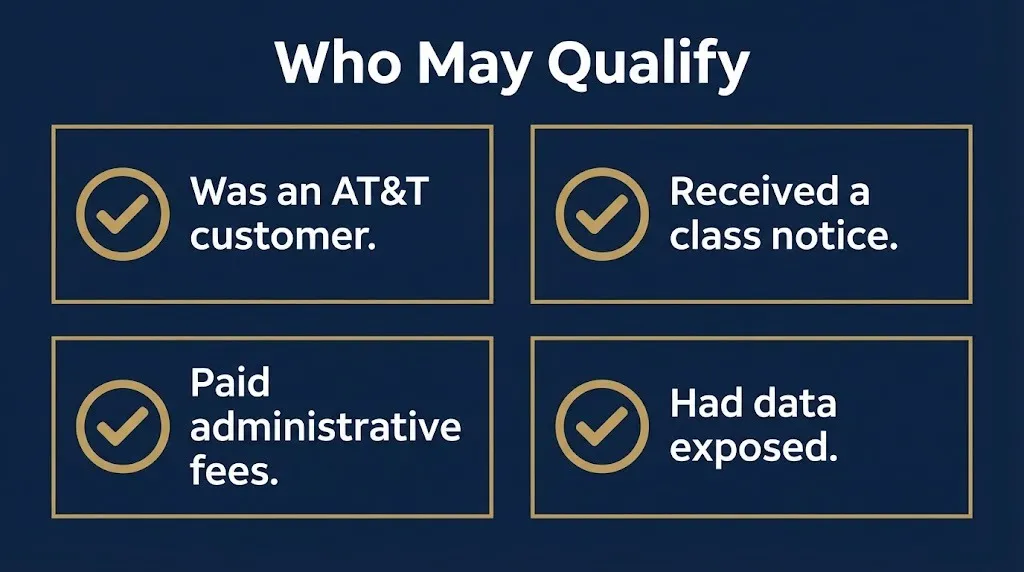
For a data breach claim involving identity theft, you may need:
- Police report or FTC identity theft affidavit
- Bank or credit card statements showing fraudulent charges
- Credit report showing unauthorized accounts
- Receipts for identity theft protection services
For a hidden fee claim, you may need:
- Your AT&T account number
- Dates of service
- Monthly bills showing the administrative fees
For simpler claims, your name, address, and phone number may be enough. The claim form tells you exactly what is required.
If you are missing documentation, file anyway if the deadline is still open. Some settlements allow a minimum payment without extensive proof.
What Is the Current Status of AT&T Settlements in 2026?
The status depends on the case.
The older data breach settlement is in the payment distribution phase. Some claimants have been paid. Others are still waiting due to verification issues or payment method.
The hidden fee settlement is also in payment distribution or already complete for most claimants. If you filed and have not been paid, check your status.
The privacy settlement is in the pre-approval stage. No class notice has been issued. No claim form exists. No payment timeline is set.
New lawsuits against AT&T continue to be filed. Some will settle. Some will be dismissed. The landscape shifts, which is why checking official sources matters.
Key Takeaway: Older AT&T settlements are paying claims, while newer ones remain in early legal stages with no claim forms yet.
What Happened in the AT&T Data Breach?
The data breach that led to the settlement involved unauthorized access to customer information.
AT&T disclosed that customer data may have been exposed. The breach affected a large number of current and former customers. Exposed information varied by individual.
The lawsuit alleged that AT&T failed to implement reasonable security measures to protect that data. The settlement resolved those claims without AT&T admitting fault.
The exact number of affected customers and the precise date of the breach are part of the public record. The settlement covered people who were customers during the relevant period.
Who Is Eligible for the AT&T Data Breach Settlement?
Eligibility for the data breach settlement required being an AT&T customer during the breach period and receiving notice that your data may have been compromised.
The class definition was specific. It included current and former customers whose information was potentially exposed. Not every AT&T customer qualified.
If you received a notice from the settlement administrator, you were part of the class. If you did not receive a notice, you likely were not included.
The deadline to file a claim in that case has passed. If you filed, your claim is either paid, pending, or denied based on your documentation.
Who Is Eligible for the AT&T Hidden Fee Settlement?
Eligibility for the hidden fee settlement required being an AT&T wireless customer during the class period.
The class period covered specific years when the administrative fees were charged. Customers on certain plans paid those fees. The settlement aimed to refund a portion of those charges.
If you were an AT&T wireless customer during those years and paid administrative fees, you may have been part of the class. The claim deadline has passed.
If you filed a timely claim, your payment was calculated based on your service duration and fee history. If you did not file, you cannot now claim that settlement.
What Is the AT&T Throttling Settlement?
AT&T faced a separate lawsuit over data throttling. The claim was that AT&T slowed data speeds for unlimited plan customers without proper disclosure.
That case settled years ago. Payments went out. The claim deadline passed long before 2026.
If you were an AT&T unlimited data customer during the relevant period and filed a claim, you may have received a payment. If you did not file, that settlement is closed.
This case is often confused with the newer privacy settlement. They are different cases with different eligibility rules. The throttling case is done. The privacy case is not.
What Should You Do If You Got an AT&T Settlement Email in 2026?
First, check whether the email references a real case. Search the case name in federal court records.
If the case is real and the email comes from the official settlement administrator, follow the instructions. File your claim if the deadline is still open.
If the email asks for money, your bank password, or your full Social Security number, it is a scam. Delete it.
If the email references a case you cannot verify, it is likely a phishing attempt. Do not click any links.
Legitimate settlement emails come from the administrator’s domain, not a Gmail or Yahoo address. They never ask for payment. They include a case name and court information.
Can You Still File a Claim for Any AT&T Settlement in 2026?
It depends on the settlement.
For the data breach and hidden fee settlements, the deadlines have passed. You cannot file a new claim unless the court allowed a late claim exception.
For the privacy settlement, no claim form exists yet. When the court grants preliminary approval, a claim deadline will be announced. You can file then if you qualify.
For any future AT&T settlement, watch for official notices. Do not rely on third-party blogs or social media posts. They are often wrong about deadlines and eligibility.
Key Takeaway: No currently open AT&T settlement has an active claim form as of September 2026. The next filing window will come from a future settlement.
What Are the Most Common AT&T Settlement Scams in 2026?
Scammers use AT&T’s name because millions of people are customers. They send fake messages about settlements that do not exist or that have already closed.
The most common scams include:
- Texts claiming you are owed money from an AT&T data breach settlement
- Emails with fake claim forms asking for your Social Security number
- Calls demanding a processing fee to release your settlement payment
- Websites that mimic official settlement sites but steal your information
All of these have one thing in common. They ask for something a real settlement never asks for: payment or sensitive information before you receive anything.
A real settlement pays you. It never charges you. A real notice gives you information. It never demands immediate action through a suspicious link.
What Should You Watch For in Future AT&T Settlements?
The privacy litigation is the main AT&T case to watch in late 2026 and 2027.
If a settlement is reached, you will see official notices. The court will hold a preliminary approval hearing. A claim deadline will be published. A final approval hearing will follow.
All of that happens in public court records. You can track it yourself through the U.S. District Court docket. You do not need a third-party service to tell you when a settlement is real.
When a settlement is approved, the official settlement website goes live. That is where you file. That is where you check your status. That is the only place that matters.
What Happens Next in AT&T Settlement Litigation?
The timeline for pending and future AT&T settlements looks like this.
Expected late 2026: Possible preliminary approval for the privacy settlement if the parties reach terms.
Expected early 2027: If approved, class notices would go out and a claim deadline would be set.
Ongoing: Remaining payments in older settlements continue as administrators process final claims.
Watch for: Any official notice from a court-appointed administrator. That is the only reliable signal that a new claim window is open.
Key Takeaway: No AT&T settlement has an open claim window right now. The next real opportunity depends on court approval of a pending case.
Frequently Asked Questions
Is there an AT&T settlement in 2026 I can file for?
No AT&T settlement has an open claim window as of September 2026.
Older settlements have closed, and newer ones are still in early legal stages.
How do I know if I qualify for an AT&T settlement?
Check the specific settlement’s class definition on the official settlement website.
Your eligibility depends on being a customer during the relevant period and meeting other criteria.
What was the AT&T data breach settlement amount?
The total settlement fund was set in the court-approved agreement.
Individual payments varied based on documented losses and the number of approved claims.
Can I still file for the AT&T hidden fee settlement?
No, the claim deadline for the hidden fee settlement has passed.
Only previously filed claims can still receive payment.
Are AT&T settlement text messages real?
Real settlement notices never arrive as unsolicited text messages.
Texts claiming you are owed money are almost certainly scams.
What proof do I need for an AT&T identity theft claim?
You typically need a police report, FTC affidavit, or bank statements showing fraud.
The claim form lists the exact documents required.
When will the next AT&T settlement claim window open?
No date is confirmed for the next AT&T settlement claim window.
Watch official court dockets and settlement websites for announcements.
How do I check my AT&T settlement claim status?
Visit the specific settlement administrator’s website and use the status tool.
You will need your claim number or the email you used to file.
What You Should Do Right Now
Check your records. If you filed a claim in any AT&T settlement, find your claim number and check your status through the official administrator.
If you have not filed anything, do not chase rumors. No open claim window exists as of September 2026. The next legitimate opportunity will come with a court-approved notice, not a text message.
The single most important fact: filing is always free, and no one from a real settlement will ever ask you to pay.