Whiplash Settlement 2026: Realistic Payout Ranges, Compensation Factors, and Claim Steps
Quick Answer:
- Whiplash settlements are real personal injury claims, not a class action or mass tort with a fixed payout fund.
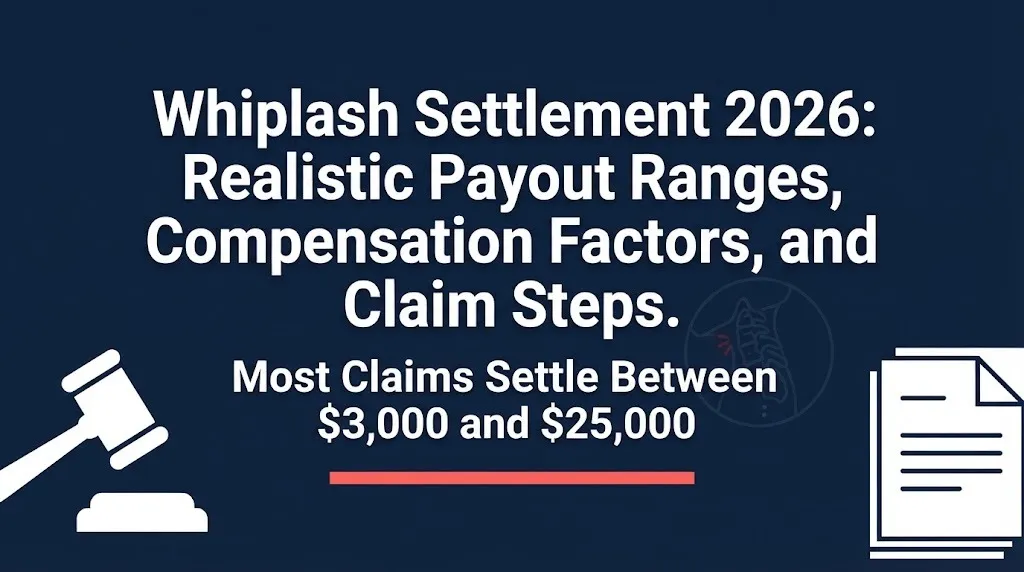
- Fair settlement amounts typically range from $3,000 to $25,000 depending on medical evidence, lost wages, and fault clarity.
- No single claim deadline applies nationwide; your state’s statute of limitations controls when you must file.
A whiplash settlement in 2026 is not a one-size-fits-all number. It’s the dollar amount an insurance company or at-fault driver pays to resolve your injury claim after a car accident, workplace incident, or other sudden neck trauma. The figure depends on your medical bills, documented pain, time off work, and how clearly the other side caused the crash.
If you’re searching this term, you probably just got a lowball offer from an adjuster, or you’re wondering whether the settlement amount someone mentioned online is realistic for your situation. The answer is more about evidence than about any published chart.
Here’s what’s confirmed about current whiplash claim values, what insurance data shows, and how to avoid leaving money on the table.
The Facts
| Item | Verified Details |
|---|---|
| Claim Type | Personal injury insurance claim, not a class action |
| Average Settlement Range | $3,000 to $25,000 |
| Severe Case Range | $25,000 to $100,000+ |
| Main Value Drivers | Medical costs, lost wages, pain evidence, liability clarity |
| Statute of Limitations | Varies by state, typically 1 to 6 years |
| Administrator | No central administrator, handled by insurers or courts |
| Proof Needed | Medical records, accident report, wage loss documentation |
Is a whiplash settlement real money or a scam?
A whiplash settlement is real money paid through insurance claims or personal injury lawsuits. It is not a class action settlement with a claims administrator and a fixed fund.
When someone searches “whiplash settlement” and sees ads promising huge payouts, the confusion starts. Legitimate whiplash claims go through auto insurance policies, workers’ compensation systems, or civil lawsuits. No government agency or settlement administrator mails checks to everyone who ever had whiplash.
If you got a text or email offering a whiplash settlement from a company you don’t recognize, treat it as suspicious. Real settlements start with an accident, an injury, and a claim you actually filed. Nobody finds you out of the blue and pays you for a neck injury you never reported.
What is a fair settlement for whiplash in 2026?
A fair whiplash settlement in 2026 is one that covers your verified medical bills, reimburses lost income, and adds an amount for pain and inconvenience. Insurance industry data puts most resolved whiplash claims between $3,000 and $25,000.
The wide range exists because no two injuries are identical. A Grade 1 whiplash with a few weeks of stiffness and two physical therapy visits settles for far less than a Grade 3 injury with MRI-confirmed soft tissue damage, months of missed work, and ongoing nerve pain.
Insurance adjusters often start with a formula. They multiply your medical bills by a factor based on injury severity. That factor rarely exceeds 3x for uncomplicated whiplash. If your medical bills total $4,000 and you missed one week of work at $800, a starting offer around $5,000 to $7,000 is common. A lawyer can often push that higher with strong documentation.
Key Takeaway: A fair settlement covers all medical costs, lost wages, and a reasonable pain component; if an offer doesn’t cover those basics, it’s not fair.
How much can you get for whiplash compensation?
Whiplash compensation amounts in 2026 depend on four verified factors: medical costs, lost income, pain severity, and who caused the accident. A typical uncomplicated claim resolves between $3,000 and $25,000.
Severe cases with herniated discs, chronic pain, or permanent mobility loss can exceed $100,000. Those cases usually involve litigation, expert testimony, and policy limits. The at-fault driver’s insurance coverage often caps the realistic payout.
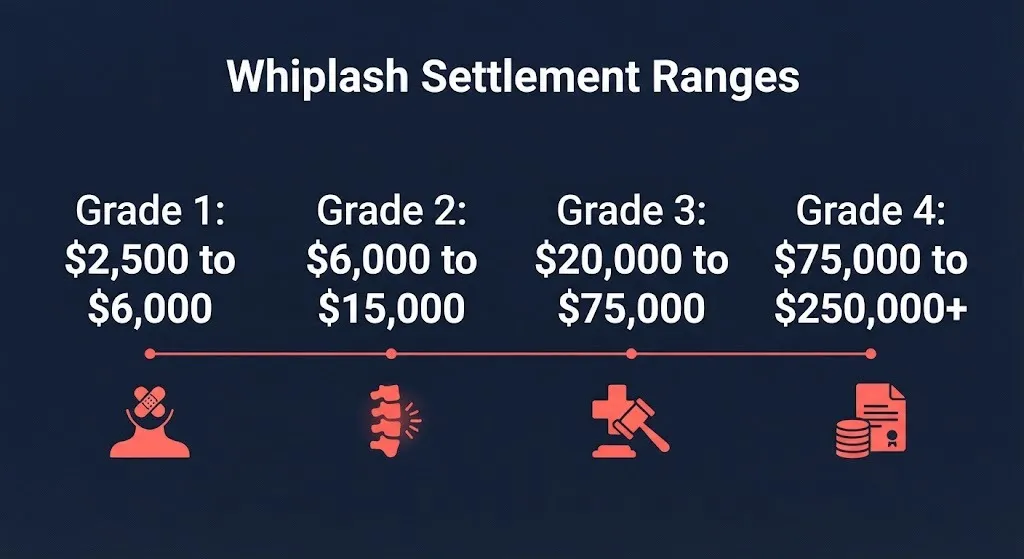
Here’s how claim value typically breaks down:
| Severity Level | Medical Evidence | Typical Range |
|---|---|---|
| Grade 1: Minor strain | Few doctor visits | $2,500 to $6,000 |
| Grade 2: Documented soft tissue injury | Physical therapy, imaging | $6,000 to $15,000 |
| Grade 3: Long-term or permanent damage | Specialist care, ongoing treatment | $20,000 to $75,000+ |
| Grade 4: Disability or surgical intervention | Surgery, permanent impairment | $75,000 to $250,000+ |
These ranges reflect typical insurance settlements. Verdicts can run higher, but trials are rare and unpredictable.
What factors affect whiplash injury settlement amounts?
The settlement amount for a whiplash injury depends on factors you can prove, not factors you feel. Documentation beats discomfort every time.
The most important factor is your medical record. A doctor’s diagnosis of whiplash, consistent treatment, and a clear link between the accident and your symptoms all raise value. Gaps in treatment lower it. If you stopped going to physical therapy after two sessions, an adjuster assumes you felt better.
Other verified drivers include:
- The police report and who was cited
- Your total medical bills and whether treatment was reasonable
- Lost wages with pay stubs or employer letters
- Whether you had pre-existing neck issues
- The at-fault driver’s policy limits
- Your state’s comparative fault rules
A claimant who delayed treatment for three weeks faces a smaller offer than one who sought care within 48 hours. It’s the same pattern as a store return without a receipt: possible, but harder to prove.
Key Takeaway: Proven losses and prompt treatment drive settlement value; gaps in care or evidence weaken your position immediately.
How do whiplash settlement payouts work?
Whiplash settlement payouts work by negotiation between you, the insurance company, and sometimes a court. There is no guaranteed payout table and no formula an insurer must follow.
Most claims settle before trial. You or your attorney send a demand letter with medical records, wage loss proof, and a proposed number. The insurer responds with a lower offer. Negotiation narrows the gap. If no agreement emerges, you may file a lawsuit, which adds time but can increase pressure.
Once you accept an offer, you sign a release. That release permanently closes your claim. You can’t come back later if your neck still hurts or you discover a new medical issue. This is the single most misunderstood part of whiplash settlements.
Payout methods vary. Some insurers send a lump-sum check. Structured settlements spread payments over time, usually for larger amounts. Your attorney, if you hired one, takes a contingency fee from the gross settlement before you see your share.
How do you file a whiplash injury claim?
Filing a whiplash claim follows a set sequence. Acting quickly and keeping records matters more than knowing legal jargon.
Here are the steps:
- Get medical care immediately after the accident.
- Report the accident to your insurer and the at-fault driver’s insurer.
- Document everything: photos, witness contacts, police report numbers.
- Track all medical visits, prescriptions, and therapy sessions.
- Record lost wages with employer verification.
- Send a demand letter with your evidence and a specific number.
- Negotiate or escalate to a personal injury lawsuit if needed.
- Sign the release only after you understand it fully.
Each step builds your file. The file is what gets you paid.
Reality Check: No legitimate insurer or attorney will guarantee a specific whiplash settlement amount before reviewing your records. Anyone who promises a $50,000 payout sight unseen is selling something, not representing you.
What is the average whiplash settlement in 2026?
The average whiplash settlement in 2026 lands between $8,000 and $15,000 for claims with solid documentation and moderate injury severity.
This is not an official government statistic. It reflects aggregated insurance and legal industry reports from 2024 through 2026. Cases with minimal treatment settle below this range. Cases with chronic pain or surgery settle far above it.
The average hides a lot. Two people in the same accident can receive very different amounts. One sees a doctor once and settles for $3,500. The other completes six months of physical therapy, misses eight weeks of work, and settles for $45,000. The difference is evidence, not luck.
How long does a whiplash settlement take?
A whiplash settlement typically takes 3 to 9 months from the date you finish treatment. Claims that go to litigation can take 12 to 24 months or longer.
Insurers move faster when liability is clear and your medical treatment is complete. If you settle while still treating, you risk undercutting your claim. You don’t yet know the full cost of your recovery.
Delays come from disputes over fault, independent medical exams requested by the insurer, and backlogged court dockets. Once both sides agree, payment usually arrives within 30 to 60 days after you sign the release.
Key Takeaway: Most whiplash claims settle within months, but the clock starts when treatment ends, not when the accident happens.
What is the statute of limitations for whiplash claims?
The statute of limitations for a whiplash injury claim varies by state. Most states set the window between 1 and 6 years from the accident date.
California gives you 2 years for personal injury. New York gives 3 years. Florida gives 2 years for most negligence claims, though changes to its laws in 2023 affected how claims are handled. Texas gives 2 years. Maine gives 6 years, among the longest.
The countdown usually starts on the accident date. If you don’t file within the deadline, the court can permanently bar your claim. No exception exists for “I was still negotiating with the insurer.” That negotiation does not pause the clock.
Check your state’s specific deadline. It is the most important number in your claim after the accident date itself.
What is whiplash injury compensation for?
Whiplash injury compensation covers specific losses. Those losses fall into two categories: economic and non-economic.
Economic damages include medical bills, physical therapy, prescription costs, lost wages, and reduced earning capacity if the injury limits your future work. These have receipts and can be added up.
Non-economic damages cover pain and suffering, emotional distress, and loss of enjoyment of life. These have no receipt. Their value comes from the injury’s severity and how persuasively you and your doctor document it.
Some states cap non-economic damages in certain situations. Others allow juries broad discretion. Your attorney, if you hire one, can explain how your state treats each category.
Can you get whiplash compensation without a lawyer?
You can get whiplash compensation without a lawyer. Many people do, especially for minor injuries with clear liability and cooperative insurers.
If your medical bills total under $3,000, you missed no work, and the other driver was clearly at fault, a direct claim can work. You send your records, ask for a specific amount, and negotiate. No law requires representation.
For anything more serious, legal help often pays for itself. A study of insurance claims shows represented claimants typically receive higher settlements, even after the attorney’s fee. That’s not a guarantee, but it is a pattern.
If you go solo, treat the adjuster’s first offer as an opening bid, not a final number. It almost always is.
Key Takeaway: Small, simple claims can resolve without a lawyer; cases with real lost income or lasting pain usually benefit from representation.
What should you do after a whiplash injury?
What you do in the first 72 hours after a whiplash injury shapes your eventual settlement more than any negotiation tactic.
Seek medical care the same day or the next day. Tell the provider exactly what happened and every symptom you feel, even mild ones. Neck pain, headaches, dizziness, jaw stiffness, and tingling in your arms all belong in the record.
Photograph the vehicles, the scene, and any visible bruising. Get the police report number. Collect witness names and phone numbers. Save every receipt, every prescription, and every note from a doctor.
Missing these early steps is like skipping the first page of a tax return. Everything after gets harder to justify.
What happens next with a whiplash settlement claim?
Here’s a typical sequence once you decide to pursue a claim:
Day 1 to 3: Medical evaluation and accident documentation.
Week 1 to 4: Initial treatment, insurer notification, and fault determination.
Month 1 to 3: Continued treatment, wage loss tracking, and demand letter preparation.
Month 2 to 6: Negotiation or lawsuit filing if needed.
Month 6 to 12: Settlement release and payment, or litigation proceeds.
This timeline assumes you complete treatment and there are no major disputes.
Frequently Asked Questions
Is a whiplash settlement worth it?
Yes, a whiplash settlement can cover real medical costs, lost income, and pain you shouldn’t have to absorb alone.
The value depends on your evidence and the other side’s insurance coverage.
How much should I ask for whiplash?
Ask for your total medical bills plus lost wages plus a pain multiplier, usually 1.5 to 3 times the medical cost.
Start higher than your bottom line so you have room to negotiate.
What is a good settlement for whiplash?
A good settlement covers all your economic losses and compensates pain fairly.
Most people consider $10,000 to $25,000 fair for moderate whiplash with solid proof.
How long does whiplash pain last?
Whiplash pain lasts days for some people and months or years for others.
About half of whiplash patients still report symptoms a year later, though severity varies widely.
Can I claim whiplash after a car accident?
Yes, you can claim whiplash after a car accident if you have medical documentation and the other driver caused the crash.
Reporting the injury to a doctor promptly strengthens your claim.
What if the insurance company denies my whiplash claim?
You can appeal the denial, provide additional evidence, or file a personal injury lawsuit.
Deadlines apply, so act quickly if a denial arrives.
Do I need an MRI for a whiplash claim?
An MRI is not always required, but it strengthens claims involving suspected disc or nerve damage.
X-rays and clinical exams are enough for many minor whiplash claims.
Is whiplash a permanent injury?
Whiplash is not usually permanent, but some people develop chronic pain or reduced mobility.
Permanent impairment findings can increase settlement value significantly.
Closing
The most important move you can make right now is to document everything and understand your state’s deadline. The claim clock is running, and evidence gathered early beats evidence gathered late.
If you already have an offer, compare it against your verified medical bills, lost wages, and a reasonable pain component. If it falls short, negotiate or get representation. The number that matters most is the one in writing on the release.