Sale of Structured Settlement in 2026: How It Works, What You Lose, and the Court Step Nobody Skips
Quick Answer
- Is it legit? Yes, but only through a court-approved factoring company, not a cold caller offering instant cash.
- How much will you get? Usually 30% to 80% of the face value of the payments you sell, depending on the discount rate .
- What deadline matters? There is no universal filing deadline, but most states require 20 to 30 days’ notice before the court hearing, so plan on at least a month of waiting .
A sale of structured settlement is a legal process where you trade future annuity payments for a lump sum today, at a discount. That discount is not small. It is the price you pay for immediate cash, and it is the single most important number in the entire deal.
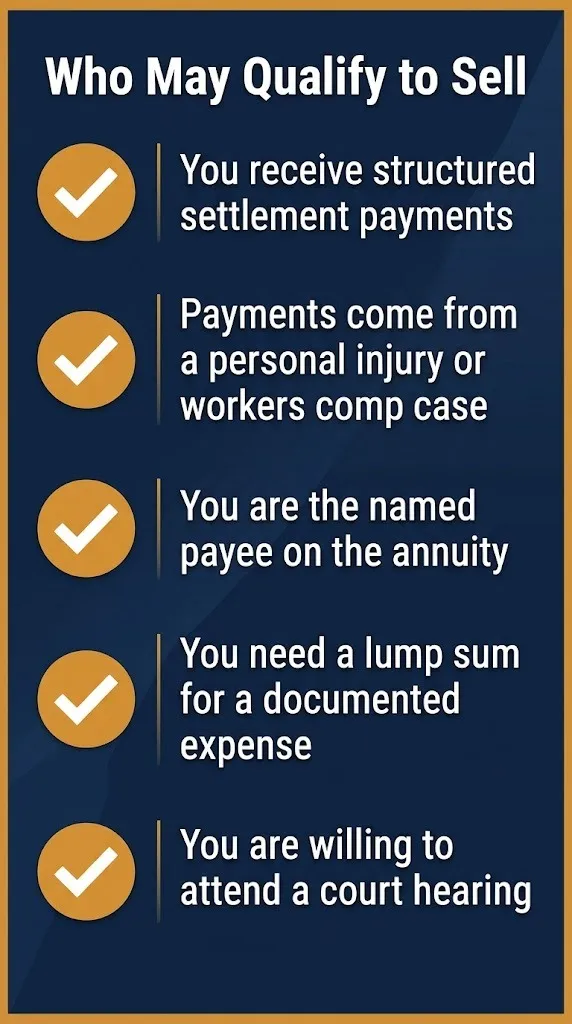
If you are reading this, you probably have a structured settlement from a personal injury case and a financial emergency that will not wait for the next scheduled check. Or someone contacted you promising “cash now” and you want to know if the offer is fair.
This guide walks through the verified mechanics: how much you actually receive, why a judge has to sign off, what the federal tax rule does, and the specific questions you should ask before signing anything.
The Facts
| Item | Status |
|---|---|
| Transaction Type | Structured settlement factoring |
| Federal Statute | 26 U.S.C. § 5891 |
| State Oversight | Structured Settlement Protection Acts (SSPAs) in 49 states plus D.C. |
| Court Approval Required | Yes, in nearly every state |
| Typical Timeline | 30 to 60 days, up to 90 days |
| What You Receive | 30% to 80% of face value, depending on discount rate |
| Key Federal Rule | 40% excise tax on buyer unless transfer is court-approved |
| Proof Needed | Settlement agreement, annuity documents, court petition, disclosure statement |
Is selling a structured settlement real or a scam?
Selling a structured settlement is real and legal, but the industry has a scam problem on the edges. The legitimate version involves a licensed factoring company, a written disclosure statement, and a judge who reviews whether the sale is in your best interest .
The scam version looks different. Someone calls you unsolicited and offers “instant cash” with no court approval mentioned. They ask for upfront fees. They pressure you to sign before you talk to a lawyer.
MetLife, one of the major annuity issuers, lists specific red flags for sellers: no verifiable business address, no membership in a trade association like the National Association of Settlement Purchasers, and pressure to skip independent advice .
Real factoring companies file a petition in your local court. They provide a disclosure statement that shows the discounted present value of the payments you are selling, the gross amount you will receive, and every fee deducted .
If a buyer tells you court approval is unnecessary, that is your signal to walk away. Federal law imposes a 40% excise tax on the buyer for any factoring transaction that is not approved by a qualified court order . No legitimate company risks that.
Key Takeaway: The court hearing is not red tape. It is the one step that separates a regulated sale from a predatory one.
How much money do you actually get from selling structured settlement payments?
You typically receive 30% to 80% of the total face value of the payments you sell. The exact percentage depends on the discount rate applied, when the payments are due, and whether the payments are guaranteed or life-contingent .
The discount rate is the buyer’s profit and risk margin. Industry ranges run from 9% to 18%, according to published guidance from factoring companies and consumer resources . A lower rate means more cash in your pocket.
Here is how the same payment stream changes with the rate:
| Discount Rate | Lump Sum on a $200,000 Payment Stream |
|---|---|
| 10% | Roughly $130,000 |
| 14% | Roughly $105,000 |
| 18% | Roughly $85,000 |
That is a $45,000 difference on identical future money, based solely on the rate the buyer applies .
Real court filings show how steep the gap can get. In one New York case, a seller transferred payments with an aggregate value of $42,058 and received $13,500, which the disclosure stated represented 37.63% of the discounted present value . In another, the seller received 28.43% of the estimated current value .
Payments due sooner get better offers. Guaranteed payments get better offers than life-contingent ones, because the buyer is not taking the risk that you die before the payments finish .
Reality Check: No legitimate factoring company promises a specific lump sum before reviewing your annuity documents. If someone quotes you a number over the phone without seeing the payment schedule, that number is meaningless. Also, no one charges you an upfront “processing fee” to start the sale. Fees come out of the proceeds, not your pocket.
Why does a judge have to approve the sale?
A judge must approve the sale because federal law and state Structured Settlement Protection Acts require a court to find that the transfer is in your best interest and does not violate any statute .
The federal rule sits in 26 U.S.C. § 5891. It imposes a 40% excise tax on the buyer of structured settlement payment rights unless the transfer is approved in advance by a “qualified order.” A qualified order is a final court order finding that the transfer is in your best interest, taking into account your dependents’ welfare .
Every state except one has enacted an SSPA that sets the procedure. These laws require the buyer to give you a disclosure statement, give you a cooling-off period (often three days) to cancel, and present the deal to a judge .
The judge looks at whether you understand what you are giving up. Some states require you to appear in person at the hearing. Others require a sworn statement about prior transfers you have attempted .
Not every petition gets approved. Judges have rejected sales where the discount was too steep or the seller’s need was not documented. The hearing is your protection, but it is also a hurdle that adds weeks to the timeline.
How long does the sale of a structured settlement take?
The sale of a structured settlement usually takes 30 to 60 days from the day you accept an offer to the day you receive your lump sum. Some transactions stretch to 90 days if the court calendar is crowded or your paperwork is incomplete .
The timeline breaks into four stages:
| Stage | Typical Duration |
|---|---|
| Quote and contract signing | 1 to 7 days |
| Court notice period | 20 to 30 days |
| Court hearing and judge’s order | 1 to 3 weeks |
| Funding after signed order | 1 to 10 business days |
The court notice period is the fixed delay you cannot negotiate away. State law requires the buyer to notify interested parties, including the annuity issuer, a set number of days before the hearing. Most states set that at 20 days, some at 30 .
After the judge signs the order, funding can move fast. One factoring company says funding can happen as quickly as one business day once the signed order is received and all underwriting items are in place .
The most common delay at the end is not the company. It is the court clerk being slow to issue a file-stamped copy of the order, or the seller still needing to submit annuity paperwork .
Key Takeaway: If you need cash for a closing date or a medical bill, start the process at least 60 days before your deadline. The court notice period alone eats a month.
What are the steps to sell a structured settlement?
The process to sell a structured settlement has six steps, and you cannot skip the court hearing in any state that has an SSPA. The buyer handles most of the paperwork, but you must review it and show up.
- Gather your settlement and annuity documents. The buyer needs the payment schedule, the annuity contract, and the court order or settlement agreement that created the stream.
- Request quotes from at least three factoring companies. Compare the discount rate, not just the lump sum. A two-point difference in rate can mean thousands of dollars .
- Review the disclosure statement and sign the purchase agreement. The disclosure must show the payments sold, the gross amount, every fee, and the discounted present value .
- Wait through the court notice period. The buyer files the petition and notifies the annuity issuer and any other interested parties. This takes 20 to 30 days in most states .
- Attend the court hearing. Some states require your presence. The judge asks whether you understand the transaction and whether it serves your best interest.
- Receive your lump sum after the judge signs. Funding usually arrives within days to two weeks after the signed order is delivered.
If you are selling only part of your payments, the steps are the same. A partial sale lets you keep some future income while cashing out a portion. It still requires full court approval.
What is the 40% federal excise tax on structured settlement sales?
The 40% federal excise tax is a penalty on the buyer, not on you. It applies to the factoring discount when a transfer is not approved by a qualified court order. If the sale goes through court and the judge approves it, the tax does not apply .
This rule exists to force factoring companies into court. Before Congress passed § 5891 in 2002, the market had less oversight. The excise tax made court approval the only economically viable path for buyers.
For you as the seller, the tax consequence is different. Structured settlement payments from personal injury cases are generally tax-free under § 104(a)(2). Selling those payments does not create a new tax liability for you, according to consumer guidance from the industry .
That does not mean you should skip a tax professional. The interaction between the sale, the annuity, and your overall income can be complicated. The IRS does not treat every factoring transaction identically on the seller’s side.
The practical takeaway is simple: if a buyer offers to skip court to “save time,” they are either misunderstanding the law or planning to absorb a 40% tax that will come out of your proceeds.
What happens next after you accept an offer?
After you accept an offer, the next stages are fixed by state law and court scheduling. You cannot speed them up by pushing the company, but you can avoid delays by having your documents ready.
Within 1 to 3 days: The buyer sends the purchase agreement and disclosure statement. Read every page.
Within 1 to 2 weeks: The buyer files the court petition and sends notice to the annuity issuer. The 20 to 30 day notice clock starts.
Expected 3 to 6 weeks out: The court hearing. You may need to appear. The judge approves or denies.
Within 1 to 2 weeks after approval: The signed order goes to the annuity issuer. Funding is released.
Within 1 to 10 business days after funding: Your lump sum arrives by check or wire.
Frequently Asked Questions
Can I sell my structured settlement without going to court?
No, not in any state that has a Structured Settlement Protection Act. Court approval is required, and federal tax law penalizes buyers who skip it.
How much of my structured settlement will I actually receive?
Most sellers receive 30% to 80% of the face value of the payments they sell, depending on the discount rate and payment timing.
Is selling a structured settlement a good idea?
It depends on why you need the cash. If you are avoiding foreclosure or paying a medical bill that cannot wait, the discount may be worth it. If you are funding a discretionary purchase, the long-term loss is harder to justify.
Can I sell only part of my structured settlement?
Yes. Partial sales are common. You sell specific payments or a portion of each payment and keep the rest of the stream intact.
Do I have to pay taxes on the lump sum from selling my structured settlement?
Generally no, if the underlying settlement was tax-free personal injury compensation. Confirm with a tax professional before filing.
What happens if the judge denies my transfer petition?
The sale does not go through. You keep your future payments. The buyer may refile with more documentation or a better price, or you can walk away.
How do I know if a factoring company is legitimate?
Check for a physical business address, membership in a trade association, and a willingness to provide a written disclosure before you sign anything. Call your state attorney general’s consumer hotline if you are unsure.
Can I cancel the sale after I sign the contract?
Most states require a cooling-off period, often three days, during which you can cancel without penalty. Check your state’s SSPA for the exact rule.
The one number that matters most
Get three quotes before you sign anything. The difference between a 10% and an 18% discount rate on the same payment stream is $45,000 on a $200,000 sale. That is not a rounding error. It is the cost of not shopping around.
Write down the rate each company quotes you. Compare them side by side. Then decide whether the cash today is worth what you are giving up tomorrow.