Trump White House Ballroom Lawsuit 2026: Case Status Explained
Quick Answer
- The Trump White House ballroom lawsuit is a real, active federal case: National Trust for Historic Preservation v. National Park Service, filed December 12, 2025.
- This is not a consumer compensation case. There is no settlement fund and no payout available to the public.
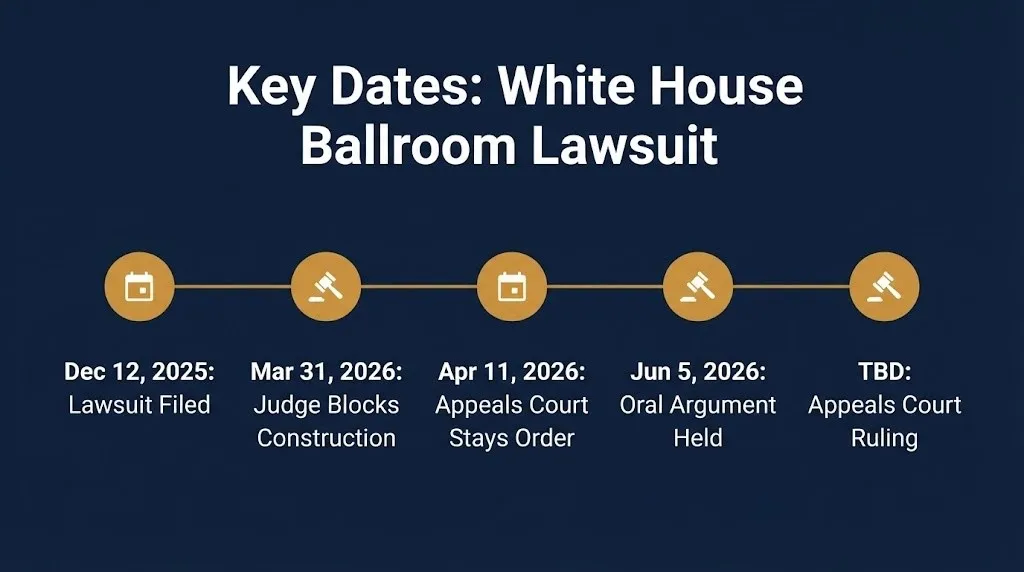
- The D.C. Circuit Court of Appeals heard arguments June 5, 2026, and hasn’t ruled as of this writing.
If you’ve seen headlines about a lawsuit over the White House ballroom, the case is real, and it’s still unresolved. The National Trust for Historic Preservation sued President Trump and several federal agencies in December 2025 to stop construction of a 90,000 square foot ballroom on the site of the demolished East Wing.
This case doesn’t involve consumer payouts or class action money. It’s a dispute over presidential authority, historic preservation law, and who gets to approve major changes to federal property. The most important fact right now: a federal appeals panel heard the case June 5, 2026, and hasn’t ruled.
This article walks through who sued whom, what the legal arguments are, and where the case stands today. One detail that surprises people: the same appeals panel already ruled once before, in April, without deciding the actual legal question.
The Facts
| Case | National Trust for Historic Preservation in the United States v. National Park Service, et al. |
| Court | U.S. District Court for the District of Columbia (trial); U.S. Court of Appeals for the D.C. Circuit (appeal) |
| Status | Awaiting D.C. Circuit ruling following June 5, 2026 oral argument |
| Project Cost | Approximately $400 million, per President Trump’s public statements |
| Funding Source | Described as privately funded by the administration; confirmed public funds tied to underground security construction |
| Filed | December 12, 2025 |
| Compensation Available to the Public | None. This is not a consumer claims or settlement case |
| Next Step | Pending appellate ruling, no confirmed date |
Is the Trump White House Ballroom Lawsuit Real?
Yes, this is a real, active federal lawsuit, not a rumor or social media exaggeration.
The case is formally titled National Trust for Historic Preservation in the United States v. National Park Service, filed in the U.S. District Court for the District of Columbia on December 12, 2025. It names President Trump, the National Park Service, and other federal officials as defendants.
The National Trust, a nonprofit chartered by Congress to protect historic sites, brought the suit after the White House demolished the East Wing in October 2025 to make way for the new structure.
You can verify the case through public court dockets, the National Trust’s own press releases, and reporting from outlets including Reuters, AP, NPR, and ABC News.
Is the National Trust Actually Suing to Stop Construction?
Yes, the National Trust is seeking a court order halting ballroom construction until Congress authorizes the project and required federal reviews take place.
The complaint argues Trump acted without required environmental review, without consultation from the National Capital Planning Commission, and without congressional approval for work on federal property. The Trust calls the project “ultra vires,” meaning outside the president’s legal authority.
The White House has consistently defended the project. A spokesperson said Trump has “full legal authority to modernize, renovate, and beautify the White House,” a position the administration has repeated throughout the litigation.
Key Takeaway: This is a genuine, ongoing federal lawsuit over presidential authority and historic preservation law, not a hoax or a consumer scam.
How Much Does the White House Ballroom Cost, and Who Is Paying?
Trump has publicly stated the ballroom will cost around $400 million, though the estimate has changed several times since the project was announced.
Early estimates in mid-2025 put the cost near $200 million for a smaller 650-person venue. That figure rose to $300 million, then $400 million, as the design expanded to roughly 90,000 square feet and a capacity near 999 people.
| Timeframe | Reported Cost Estimate | Reported Capacity |
|---|---|---|
| Mid-2025 announcement | ~$200 million | ~650 people |
| December 2025 lawsuit filing | ~$300 million | 90,000 sq. ft. |
| Early 2026 statements | ~$400 million | Up to 999 people |
Trump has said the project is funded “100% by me and some friends of mine,” and the White House maintains no taxpayer dollars pay for the ballroom itself.
Is Any Taxpayer Money Funding the Ballroom Project?
Public reporting confirms taxpayer funds are tied to security and underground construction connected to the ballroom site, even as the above-ground structure is described as privately funded.
Court filings and reporting reference an underground bunker complex being built beneath the ballroom, work the administration has defended as a “safety-and-security exception” tied to protecting the president and staff. That underground work has continued even during periods when above-ground construction was contested in court.
A separate document, made public through a Freedom of Information Act lawsuit filed by the watchdog group Public Citizen, showed an agreement letting a nonprofit called the Trust for the National Mall retain a percentage of private donations collected for the project. Fact-checkers found no evidence Trump personally profited from that arrangement.
Reality Check: No part of this lawsuit involves a claims process, a settlement fund, or payments to members of the public. If you see anything online suggesting you can file a claim or receive money tied to this case, that claim is false, and you should not submit personal information anywhere in response to it.
Can the Public Get Compensation From This Lawsuit?
No, there is no compensation available to the public through this case, and none is being sought.
This lawsuit is a request for injunctive relief, meaning the National Trust wants a court order stopping or reversing construction, not monetary damages paid to individuals. Unlike class action settlements over data breaches or defective products, no fund exists here and none is contemplated in the complaint.
If your search brought you here expecting a payout, that expectation doesn’t match this case. This is a government accountability lawsuit, not a consumer claim.
Who Filed the Lawsuit and Who Is Being Sued?
The National Trust for Historic Preservation, a privately funded nonprofit designated by Congress to protect historic American sites, filed the lawsuit as the sole plaintiff.
The defendants include President Trump, the National Park Service, and other federal officials and agencies involved in approving or carrying out the ballroom project. The Trust retained the law firm Foley Hoag as outside counsel, with attorney Tad Heuer arguing the case before the D.C. Circuit.
Who’s Involved:
- National Trust for Historic Preservation (plaintiff)
- President Donald Trump (defendant)
- National Park Service (defendant)
- U.S. Department of Justice (representing the government)
- Judge Richard Leon (district court)
- D.C. Circuit panel: Judges Patricia Millett, Neomi Rao, Brad Garcia
Can You Join the Lawsuit or File Public Comment?
You cannot join this lawsuit as a plaintiff, but you may have had a chance to submit public comment through a related federal review process.
The Commission of Fine Arts held a public meeting on the ballroom’s design in February 2026 and reportedly received around 2,000 public comments, a record for the commission, with the large majority critical of the project. That comment period was separate from the lawsuit itself.
There’s no ongoing public claims process tied to the litigation. If you want to follow or support either side, the National Trust and the White House both publish public statements on their own websites.
How Can You Track the Case as It Moves Forward?
You can track the case through the D.C. Circuit’s public docket and through statements published by the National Trust for Historic Preservation.
The appeals court case carries docket numbers 26-5123 and 26-5134, reflecting cross-appeals from both sides. Major legal filings, including briefs and amicus filings from outside groups, are part of the public record.
Key Takeaway: There’s no way for members of the public to join this lawsuit or receive money from it, but the case record is fully public and trackable through court dockets and the National Trust’s own updates.
What Is the Status of the Ballroom Lawsuit as of July 2026?
As of July 19, 2026, the case is awaiting a ruling from the D.C. Circuit following oral argument held June 5, 2026.
That hearing focused on whether the district court properly weighed national security concerns when it blocked above-ground construction. Reporting from the hearing described the three-judge panel as skeptical of the government’s argument that only Congress lacks authority to stop the project, though no formal decision has followed.
This is the second time this same panel has reviewed the case without resolving the underlying legal question, after an earlier April 2026 ruling sent the matter back to the district court for clarification.
Did the D.C. Circuit Rule on the Ballroom Case?
Not yet. As of this writing, the D.C. Circuit has not issued a decision following the June 5, 2026 oral argument.
The panel’s earlier April 11, 2026 order was procedural, not a ruling on the merits. It stayed the district court’s injunction temporarily and asked Judge Leon to clarify how national security concerns factored into his decision.
Watch for a written opinion from the D.C. Circuit panel of Judges Millett, Rao, and Garcia. No confirmed timeline for that ruling exists in public reporting.
Is Ballroom Construction Still Happening Right Now?
Yes, based on reporting through early June 2026, construction has continued at the site while the legal fight plays out on appeal.
Judge Leon initially ordered a halt to above-ground work in a March 31, 2026 ruling, finding the National Trust was likely to win its case. The D.C. Circuit stayed that order days later, allowing work to resume while the appeal proceeded, and Leon subsequently clarified his order to permit underground bunker work regardless of the outcome above ground.
Trump described the project as “ahead of schedule and under budget” in a late March 2026 statement to reporters, a claim that predates the June hearing and hasn’t been independently verified against a construction timeline.
Why Did the National Trust Sue Trump Over the Ballroom?
The National Trust sued because it says federal law requires independent review and congressional approval before major construction changes federal property like the White House.
The complaint cites the National Environmental Policy Act, requirements for review by the National Capital Planning Commission, and the Constitution’s Property Clause, which gives Congress authority over federal property. The Trust argues no statute authorized demolishing the East Wing or building a structure nearly twice its size in its place.
“No president is legally allowed to tear down portions of the White House without any review whatsoever,” the complaint states, naming Trump specifically while noting the same rule would apply to any president.
What Happened to the White House East Wing?
The White House demolished the historic East Wing in October 2025 to clear space for the planned ballroom, a move that caught many observers off guard.
The East Wing had stood for over a century and housed the offices of the first lady and other White House staff. Its removal, along with the adjacent Jacqueline Kennedy Garden, drew criticism from architectural and preservation groups and from former first ladies including Michelle Obama and Hillary Clinton.
The National Historic Preservation Act, which normally requires review for projects affecting historic buildings, specifically exempts the White House itself, a gap the National Trust argues other federal statutes still close.
What Are the Arguments on Both Sides?
The National Trust argues Trump exceeded his legal authority, while the administration argues the president has broad discretion over White House construction and that security concerns justify moving forward.
The Trust’s position rests on the idea that Congress, not the president alone, controls changes to federal property, and that skipping legally required reviews sets a dangerous precedent regardless of who occupies the office. The administration counters that past presidents made White House changes without congressional approval, and that heightened security needs following recent incidents near the White House make delay risky.
| Argument | National Trust’s Position | Administration’s Position |
|---|---|---|
| Legal authority | Congress must approve major changes to federal property | President has discretion over White House construction |
| Process | Required environmental and planning reviews were skipped | Past presidents also skipped similar reviews without challenge |
| Security | Legal issues are unchanged by security concerns | Project is urgent for security given recent incidents |
| Funding | Public accountability required regardless of funding source | Project is privately funded, limiting public interest |
What Happens if the National Trust Wins the Case?
If the National Trust ultimately wins, a court could order construction paused or reversed until Congress and required review bodies approve the project.
That outcome wouldn’t create any payout or claims process for the public. It would primarily affect the pace and legal footing of the construction project itself, and could set precedent for how future presidents handle changes to federal property.
If the administration prevails instead, the ballroom project would likely continue without needing congressional sign-off, a result the Trust warns could weaken oversight of federal property decisions going forward.
What Happens Next
June 5, 2026: D.C. Circuit heard oral argument on the government’s appeal.
Expected summer 2026: A written ruling from the D.C. Circuit panel is anticipated, though no date is confirmed.
Following that ruling: Either side may seek further review, including a possible request to the full D.C. Circuit or the Supreme Court.
Ongoing: Construction activity, including underground work, is expected to continue pending further court action, based on reporting through June 2026.
Frequently Asked Questions
Is the Trump White House ballroom lawsuit real?
Yes, it’s an active federal case filed December 12, 2025, by the National Trust for Historic Preservation.
The case is currently before the U.S. Court of Appeals for the D.C. Circuit.
It challenges the legality of the ballroom project and the East Wing’s demolition.
Can I get money from the White House ballroom lawsuit?
No, this case involves no settlement fund or payout available to the public.
It’s a request for a court order, not monetary compensation.
Anyone claiming you can file a claim for money is not describing this case accurately.
Who is suing Trump over the White House ballroom?
The National Trust for Historic Preservation, a congressionally chartered nonprofit, filed the lawsuit.
It’s the sole plaintiff, represented by the law firm Foley Hoag.
The defendants include Trump, the National Park Service, and other federal officials.
Has a court ruled on the ballroom lawsuit yet?
No final ruling on the merits has been issued as of July 19, 2026.
The D.C. Circuit heard oral argument June 5, 2026, and hasn’t yet decided.
An earlier April 2026 ruling was procedural, not a decision on the underlying legal question.
Is the ballroom being built with taxpayer money?
The above-ground structure is described by the administration as privately funded.
Public funds have been tied to underground security and bunker construction connected to the site.
A separate FOIA lawsuit revealed details about private donation handling for the project.
Is construction still happening at the White House?
Yes, based on reporting through early June 2026, construction has continued during the appeal.
An earlier court order halting work was stayed by the D.C. Circuit pending review.
Underground work has proceeded even during periods when above-ground work was contested.
What law does the National Trust say Trump violated?
The Trust cites federal environmental review requirements and the Constitution’s Property Clause.
It argues Congress, not the president alone, controls major changes to federal property.
The complaint also cites a lack of required review by federal planning commissions.
What is the National Trust for Historic Preservation?
It’s a privately funded nonprofit chartered by Congress in 1949 to protect historic American sites.
It is not a government agency, despite its congressional charter.
The group is the sole plaintiff in this case against the ballroom project.
Watch the D.C. Circuit’s public docket for the panel’s written ruling following the June 5, 2026 oral argument. That decision, whenever it comes, is the single most important next step in this case.