When Will the Tylenol Autism Lawsuit Be Settled in 2026? Status, Science, and Realistic Timelines
Quick Answer
- The Tylenol autism lawsuit has no settlement date, and no settlement fund exists as of September 2026.
- The litigation is still in pretrial proceedings, with bellwether trials expected in 2027 or later.
- The most important deadline is the statute of limitations for filing a claim, which varies by state.
If you searched for “when will the Tylenol autism lawsuit be settled,” you’re likely a parent who used acetaminophen during pregnancy and has a child with autism. You want a timeline, a payout amount, and a deadline.
This article gives you the honest answer as of September 9, 2026: no one knows when or if this case will settle. The litigation is active, the science is contested, and the timeline is measured in years, not months.
Here’s the part most articles skip: the Tylenol autism litigation faces significant scientific hurdles that make a global settlement far from certain. This isn’t a typical product liability case with clear causation.
The Facts
| Item | Detail |
|---|---|
| Official Case Name | In re: Acetaminophen ASD/ADHD Products Liability Litigation |
| Court / Jurisdiction | U.S. District Court, Southern District of New York |
| Current Status | Active multidistrict litigation, no settlement |
| Total Settlement Fund | Not yet confirmed, none exists |
| Est. Per Person | Not yet determined |
| Claim Deadline | No deadline, no settlement exists |
| Administrator | Not yet appointed |
| Proof Needed | Medical records, pregnancy acetaminophen use documentation |
Is the Tylenol Autism Lawsuit Legitimate?
Yes, the litigation is real and active in federal court. It’s not a hoax.
The cases were consolidated into multidistrict litigation in the Southern District of New York. That means thousands of individual lawsuits filed across the country were transferred to one judge for coordinated pretrial proceedings.
The claims allege that prenatal exposure to acetaminophen, the active ingredient in Tylenol, increases the risk of autism spectrum disorder and ADHD in children. Plaintiffs argue that manufacturers failed to warn pregnant women about this risk.
The litigation is legitimate in the sense that real cases are pending before a real judge. But “legitimate litigation” is not the same as “likely to succeed.”
Key Takeaway: The cases are real, but the scientific foundation is heavily contested, which makes the outcome uncertain.
What Is the Science Behind the Tylenol Autism Claims?
The science is contested, and that’s the central problem for plaintiffs.
Several observational studies have found an association between acetaminophen use during pregnancy and increased autism or ADHD risk in children. These studies are the foundation of the litigation.
But association is not causation. Acetaminophen is the most widely used pain reliever during pregnancy. Women take it for fevers and pain, and the underlying conditions being treated could themselves affect fetal development.
Major medical organizations, including the American College of Obstetricians and Gynecologists, have stated that acetaminophen remains safe when used as directed during pregnancy. The FDA has declined to change its guidance.
The scientific consensus, if there is one, is that the evidence is insufficient to prove causation. That’s a significant hurdle for the litigation.
What Has the Judge Ruled So Far?
The judge has made several key rulings, most of them favorable to the defense.
The most important ruling involved the admissibility of expert testimony. In federal court, expert testimony must meet the Daubert standard, which requires that the testimony be scientifically reliable.
The judge has excluded or limited some plaintiffs’ expert testimony, finding that the proposed experts couldn’t reliably establish causation. This is a major setback for the plaintiffs.
Without expert testimony establishing that acetaminophen causes autism, the individual cases cannot proceed to trial. The judge’s rulings have significantly weakened the plaintiffs’ position.
The plaintiffs are appealing some of these rulings, but the appeals process adds more time to an already lengthy litigation.
Key Takeaway: The judge’s expert rulings have been mostly favorable to the defense, which delays settlement and weakens the plaintiffs’ leverage.
When Could the Tylenol Autism Lawsuit Settle?
No settlement timeline exists, and any prediction is speculative.
The litigation is still in pretrial proceedings. Expert challenges are ongoing. Bellwether trials have not been scheduled with firm dates as of September 9, 2026.
In complex product liability litigation, settlements typically happen after bellwether trials produce verdicts. Those trials test the strength of the evidence and establish a value range for future settlements.
Realistic timeline projections:
| Stage | Estimated Timing |
|---|---|
| Expert challenges | Ongoing through 2026 |
| Bellwether trial scheduling | 2027 or later |
| First bellwether trials | 2027 to 2028 |
| Possible settlement talks | After first trials |
| Global settlement (if any) | 2028 or later |
These are projections based on how similar litigation has progressed, not verified dates.
Reality Check: No one texts, calls, or emails about a Tylenol autism settlement. No legitimate attorney charges a fee to “register” you for a lawsuit. If someone asks for money to secure your claim, it’s a scam. Filing a lawsuit costs nothing upfront with contingency fee lawyers.
How Much Could a Tylenol Autism Settlement Pay?
Not yet determined. No settlement exists, so no payout range is verified.
If a settlement eventually emerges, the amounts would depend on the strength of individual cases. In product liability litigation involving birth injuries, settlements can range from tens of thousands to millions of dollars.
But those figures assume causation is proven. In the Tylenol litigation, causation is the central dispute, and the judge’s expert rulings suggest plaintiffs face an uphill battle.
A more realistic scenario, based on the current state of the litigation, is that many cases are dismissed, some settle for modest amounts, and a few proceed to trial. The outcome depends heavily on how the appeals on expert testimony resolve.
Who Qualifies for the Tylenol Autism Lawsuit?
No qualification criteria exist yet because no settlement has been approved.
If the litigation eventually produces a settlement, eligibility would likely require:
- Pregnancy use of acetaminophen (Tylenol or generic)
- A child diagnosed with autism spectrum disorder or ADHD
- Documentation of acetaminophen use during pregnancy
- Filing within the applicable statute of limitations
The documentation requirement is significant. Many women don’t remember exactly when or how often they took acetaminophen during pregnancy years ago. That evidentiary gap weakens individual claims.
What Should Parents Do Now?
If you believe your child’s autism is related to prenatal acetaminophen exposure, here’s what to do:
- Gather medical records from your pregnancy.
- Document any acetaminophen use, including dates and amounts if possible.
- Obtain your child’s autism or ADHD diagnosis records.
- Contact a product liability attorney for an evaluation.
- Check your state’s statute of limitations immediately.
- Don’t wait for a settlement that may never come.
- Be skeptical of law firm advertising that promises specific outcomes.
The statute of limitations is your most urgent concern. In most states, you have two to three years from the date you discovered the potential connection. That clock may have already started.
What Is the Statute of Limitations for Filing a Tylenol Autism Claim?
The deadline varies by state and depends on when the injury was discovered.
Most states apply a discovery rule, meaning the clock starts when you knew or should have known about the potential connection between acetaminophen and autism. For many parents, that clock started when the litigation received widespread media attention in 2022 and 2023.
The standard personal injury statute of limitations is two to three years in most states. Some states allow longer. A few allow shorter.
If you’re considering filing, the time to talk to an attorney is now. The window may be closing or already closed in your state.
Key Takeaway: Your filing deadline is personal to your state and your facts, and it’s running whether or not a settlement ever happens.
What Are the Weaknesses in the Tylenol Autism Litigation?
The litigation faces significant challenges that make a global settlement uncertain.
| Weakness | Impact |
|---|---|
| Causation science | The judge has limited expert testimony |
| Observational studies only | No clinical trial proves causation |
| Medical consensus | Major organizations still say acetaminophen is safe |
| Alternative explanations | Underlying conditions may explain the association |
| Documentation gaps | Many plaintiffs can’t prove prenatal use |
These weaknesses don’t mean the litigation is over. Appeals are pending, and the plaintiffs’ attorneys are fighting. But they do mean the path to settlement is longer and less certain than in cases with stronger science.
What Is the Difference Between This Litigation and Successful Drug Lawsuits?
Successful drug litigations share characteristics that the Tylenol cases lack.
Successful cases, like those involving Vioxx or talcum powder, typically had:
- Clinical trial data showing causation
- Internal company documents showing knowledge of the risk
- Regulatory findings against the manufacturer
- Consistent expert testimony on causation
The Tylenol litigation has none of these. The studies are observational, not clinical. No internal documents have emerged showing manufacturers knew of a causal link. The FDA has not changed its position. And the judge has already limited expert testimony.
These differences explain why the Tylenol litigation is moving slowly and why settlement isn’t imminent.
What Happens Next in the Tylenol Autism Litigation?
The litigation will proceed through the standard pretrial process.
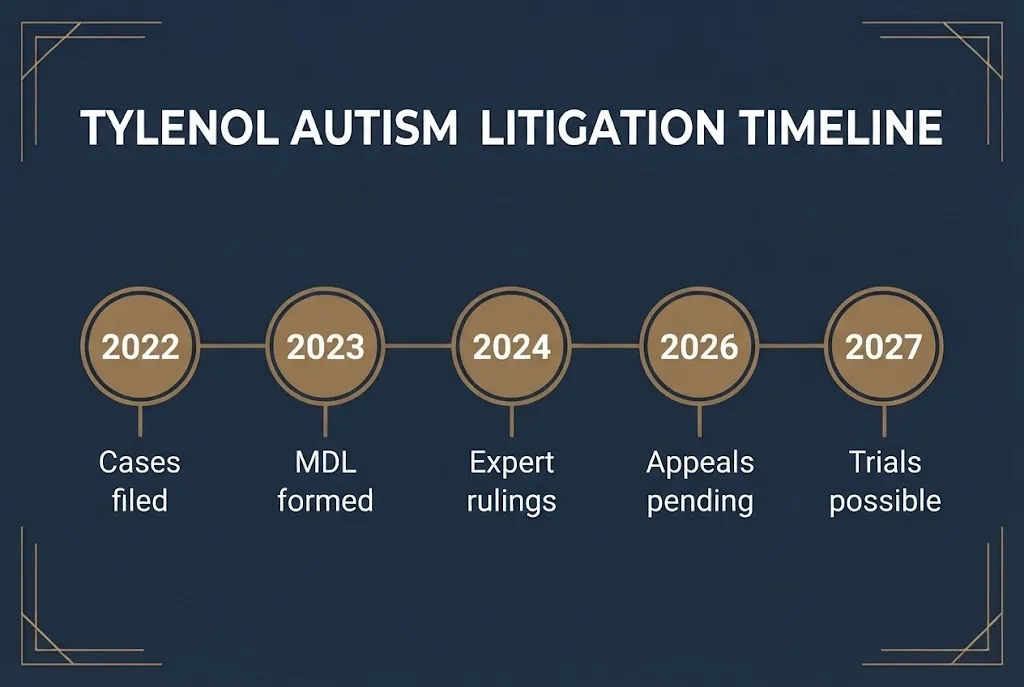
- Late 2026: Expert appeals continue, with rulings expected.
- 2027: Bellwether trial scheduling likely.
- 2028: Possible first trials or settlement talks.
- No guarantee: The litigation could end in dismissal of most cases.
The outcome depends heavily on the appellate rulings on expert testimony. If the judge’s rulings are upheld, many cases will be dismissed and settlement leverage will collapse.
If the rulings are reversed, the litigation gains new life and settlement becomes more likely.
For parents watching and waiting, the honest answer is: don’t wait. The resolution is years away, and the outcome is uncertain.
Frequently Asked Questions
Is there a Tylenol autism settlement?
No settlement exists as of September 2026.
The litigation is active but pretrial.
No settlement fund or claim process has been established.
When will the Tylenol autism lawsuit settle?
No one knows, and no date is set.
Bellwether trials are expected in 2027 or later.
Settlement could follow trials, or never happen.
How much will the Tylenol autism lawsuit pay?
No payout amount exists because no settlement exists.
Any future amount depends on case strength and trial outcomes.
Projections are speculative.
Can I still file a Tylenol autism lawsuit?
Possibly, depending on your state’s statute of limitations.
Contact an attorney immediately.
The filing window may be closing.
What proof do I need for a Tylenol autism claim?
Medical records from pregnancy and your child.
Documentation of acetaminophen use.
Autism or ADHD diagnosis records.
Is acetaminophen safe during pregnancy?
Major medical organizations say yes when used as directed.
The FDA has not changed its guidance.
The litigation alleges otherwise but has not proven causation.
What is the status of the Tylenol autism MDL?
Active multidistrict litigation in New York.
Expert testimony has been limited by the judge.
Appeals are pending.
Should I wait for a settlement before filing?
No, waiting risks missing the statute of limitations.
File or consult an attorney now.
The litigation may take years to resolve.
If you’re a parent waiting for a Tylenol autism settlement, the honest answer is that no settlement exists and none is imminent. The litigation is active but facing significant hurdles. The best action is consulting an attorney now, while your filing deadline is still open.
The most important fact: your statute of limitations is running, and it won’t wait for a settlement that may never come.