Maine Cabin Masters Lawsuit 2026: What Homeowners Need to Know Before Filing
Quick Answer
- The Maine Cabin Masters lawsuit involves EPA violations for lead paint safety rules during five 2020 renovations.
- Kennebec Property Services paid a $16,500 penalty in October 2022. No consumer payout fund exists.
- There is no claim deadline or settlement administrator. This case is closed.
If you searched for “Maine Cabin Masters lawsuit” expecting a claims form or payout, you’re looking at the wrong type of case. This was a federal environmental enforcement action, not a consumer class action.
The company behind the hit renovation show settled with the U.S. Environmental Protection Agency in October 2022. They paid a fine. They agreed to follow the rules going forward. That’s it.
Here’s what actually happened, why it matters if you own an older home, and what you should know about lead paint safety when hiring contractors. The surprising part: the settlement required the show to teach viewers about lead safety on air.
The Facts
| Case | EPA v. Kennebec Property Services, LLC |
|---|---|
| Status | Settled October 2022 |
| Fund Size | No consumer fund, $16,500 EPA penalty |
| Est. Per Person | Not applicable |
| Claim Deadline | None, case closed |
| Administrator | U.S. Environmental Protection Agency |
| Proof Needed | Not applicable |
Is the Maine Cabin Masters lawsuit real or fake?
The Maine Cabin Masters lawsuit is real, but it’s not a consumer settlement you can claim money from. It was a federal enforcement action brought by the EPA against Kennebec Property Services, LLC.
The EPA alleged the company violated the Lead Renovation, Repair and Painting Rule during five renovations in 2020 . These renovations happened at properties built before 1978, when lead paint was still legal.
If you saw a social media post or text message promising money from a “Maine Cabin Masters settlement,” that’s a scam. No consumer payout exists. The case ended with a fine paid to the government, not compensation for homeowners.
The show itself wasn’t sued. The production company and its contractors were the target of the EPA action.
How much was the Maine Cabin Masters settlement?
The Maine Cabin Masters settlement was a $16,500 penalty paid by Kennebec Property Services to the EPA. That’s the entire financial penalty.
There is no consumer payout fund. No money was set aside for homeowners or viewers.
Here’s the breakdown:
| Party | Amount | Type |
|---|---|---|
| Kennebec Property Services | $16,500 | EPA penalty |
| Homeowners | $0 | No compensation ordered |
| Consumer fund | $0 | Does not exist |
The EPA doesn’t typically award damages to individuals in these enforcement actions. The goal is compliance and deterrence, not compensation.
If you owned one of the five renovated properties, you weren’t awarded money through this settlement. Any claims you might have would be separate civil matters.
Reality Check
No one will text you settlement money from the Maine Cabin Masters case. This wasn’t a class action, and there’s no claims process. Filing for a payout is impossible because no payout fund exists. If someone contacts you promising money from this lawsuit, they’re running a scam.
Who qualifies for money from the Maine Cabin Masters lawsuit?
No one qualifies for money from this lawsuit. It’s not a class action and no compensation fund was established.
The EPA settlement was about regulatory compliance, not victim compensation. The agency fined the company and required it to change its practices.
If you’re a homeowner who hired Kennebec Property Services and believe you were harmed, you’d need to pursue a separate civil claim. That would be independent of this EPA action.
For the five specific homeowners whose properties were involved in the 2020 renovations, the EPA action didn’t result in direct payments to them.
Key Takeaway: This was an environmental enforcement case with a $16,500 fine, not a consumer settlement. No claims process exists.
What did Maine Cabin Masters actually do wrong?
Maine Cabin Masters’ production company violated federal lead paint safety rules during five renovations in 2020. The EPA found multiple specific failures.
According to the EPA’s consent agreement, Kennebec Property Services failed to :
- Obtain recertification before beginning renovations
- Assign a certified renovator to each renovation
- Provide property owners with the EPA-approved lead hazard information pamphlet
- Maintain records showing compliance with RRP measures
These aren’t minor paperwork issues. Lead paint exposure can cause serious health problems, especially in children. The rules exist to prevent poisoning during renovation work.
The properties involved were all built before 1978. That’s the year lead paint was banned for residential use in the United States.
What is the Lead Renovation, Repair and Painting Rule?
The Lead Renovation, Repair and Painting Rule is a federal regulation that requires contractors to follow specific safety practices when working on pre-1978 homes. It’s designed to prevent lead exposure during renovations.
The rule applies to anyone who is paid to perform renovation work that disturbs painted surfaces in older homes. This includes:
- General contractors
- Painters
- Window installers
- Electricians
- Plumbers
- Handymen
What the rule requires:
- Firms must be certified by the EPA
- Renovators must complete EPA-accredited training
- Lead-safe work practices must be used
- Property owners must receive lead hazard information
- Records must be maintained for three years
Lead-based paint and lead-contaminated dust pose special risks to children. Lead can harm brain development and cause other permanent health problems .
Did Maine Cabin Masters lose their show because of the lawsuit?
No, Maine Cabin Masters did not lose their show. The series continued airing new episodes throughout the legal proceedings and after the settlement.
The lawsuit didn’t result in a suspension of production. The show moved from the DIY Network to the Magnolia Network in 2022 .
As part of the settlement, the company agreed to help raise awareness about lead safety. They committed to:
- Providing lead safety information in at least three episodes of their upcoming season
- Posting RRP Rule information on the program’s website
- Producing a podcast episode focused on EPA lead safety measures
The show turned the violation into an educational opportunity. Whether that was genuine reform or reputation management, the EPA accepted it as part of the resolution.
What penalties did Kennebec Property Services face?
Kennebec Property Services faced a $16,500 penalty and ongoing compliance requirements. The company also had to commit to public education about lead safety.
The full penalty package:
| Penalty Type | Details |
|---|---|
| Monetary fine | $16,500 |
| Certification | Obtained RRP firm certification |
| Compliance | Agreed to follow RRP Rule in all future work |
| Public education | Lead safety info in 3+ episodes and podcast |
| Website | RRP Rule information posted |
The company has since obtained its Lead Renovation, Repair and Painting Rule certification . They’ve agreed to follow the guidelines in all future renovation activities.
This isn’t the first time a home renovation show has faced EPA scrutiny. The agency has targeted other shows for similar violations. The message is clear: if you demonstrate renovation work on TV, you’d better follow the rules.
How do I check if a contractor is EPA certified?
You can check if a contractor is EPA certified by searching the EPA’s database or asking for their certification number. Never hire a renovator for pre-1978 work without verifying this.
Step-by-step verification:
- Ask the contractor for their EPA firm certification number
- Search the EPA’s online database for that number
- Confirm the certification is current, not expired
- Ask if they have a certified renovator assigned to your job
- Request the EPA lead hazard pamphlet before work begins
- Verify they’ll maintain records of compliance
If a contractor can’t provide this information, don’t hire them for work on an older home. The risks are too high.
It’s like checking if a restaurant has a health inspection grade. You wouldn’t eat somewhere that can’t prove basic safety standards. Same logic applies here.
What should homeowners with pre-1978 properties know?
Homeowners with pre-1978 properties need to understand lead safety rules before any renovation. These requirements protect you and your family.
If your home was built before 1978:
- Any paid renovation that disturbs paint requires RRP compliance
- You must receive the EPA lead hazard pamphlet
- The contractor must be EPA certified
- A certified renovator must be assigned to your job
- Work practices must minimize lead dust
You can’t waive these requirements. They’re federal law, not optional recommendations.
If a contractor tells you the rules don’t apply or offers to skip the paperwork, that’s a red flag. They’re either uninformed or willing to break the law.
What happens if you’re exposed to lead during renovation?
Lead exposure during renovation can cause serious health problems, especially for children and pregnant women. If you suspect exposure, see a doctor immediately.
Health effects of lead exposure:
- Decreased IQ in children
- Learning and behavior problems
- Reduced focus and academic achievement
- Brain development damage
- Other irreversible health complications
The EPA noted that lead exposure for children is “extremely dangerous and is entirely preventable” . That’s why the rules exist.
If you believe you were exposed due to a contractor’s negligence, you may have legal options. Consult with an attorney who handles environmental or personal injury cases.
What happens next with the Maine Cabin Masters lawsuit?
Nothing happens next. The Maine Cabin Masters lawsuit is closed. The settlement was finalized in October 2022, and the company has completed its obligations.
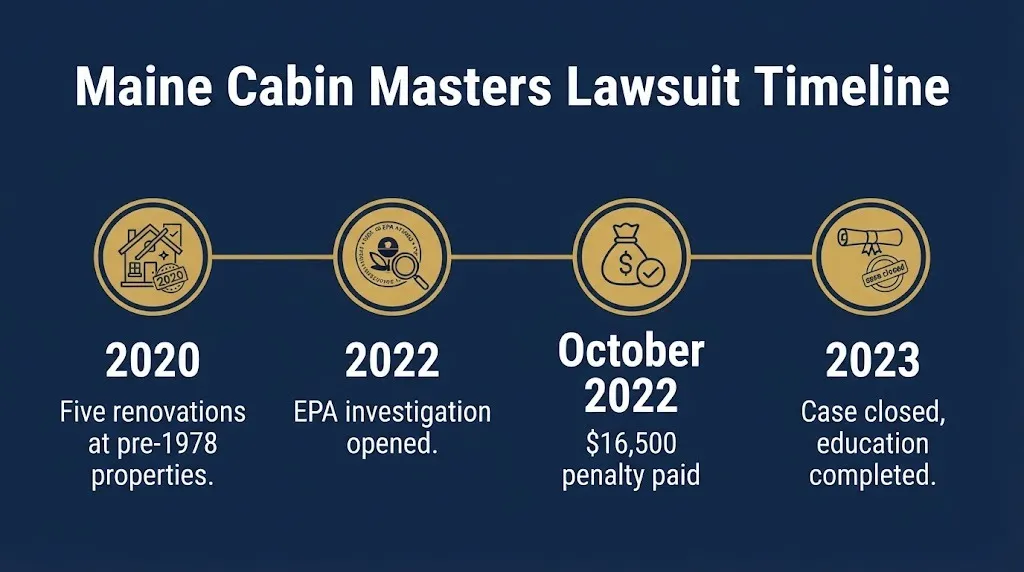
Timeline of the case:
2020: Five renovations conducted at pre-1978 properties
2022: EPA investigation and consent agreement reached
October 2022: Settlement announced, $16,500 penalty paid
2022-2023: Company completes public education requirements
Present: Case closed, no further action expected
There is no appeal pending. No additional penalties are expected. No consumer claims process will be opened.
If you’re searching for this case in 2026, you’re looking at a resolved matter. The only ongoing relevance is the precedent it set for renovation shows and the education it provided about lead safety.
Key Takeaway: The Maine Cabin Masters case is closed. The company paid its fine, got certified, and completed its education obligations. No further developments are expected.
Frequently Asked Questions
Is there a Maine Cabin Masters class action settlement?
No. The Maine Cabin Masters case was an EPA enforcement action, not a class action.
There is no settlement fund and no claims process.
No consumer payouts were made or will be made.
Can I still file a claim for the Maine Cabin Masters lawsuit?
No. You cannot file a claim because no claims process exists.
The case ended in October 2022 with a fine paid to the EPA.
There is no administrator accepting claims.
How much did Maine Cabin Masters pay in the settlement?
Kennebec Property Services paid a $16,500 penalty to the EPA.
The company also agreed to provide lead safety education on the show.
No compensation was paid to homeowners or viewers.
Is Maine Cabin Masters still on TV?
Yes. The show continued airing new episodes after the settlement.
It moved from DIY Network to Magnolia Network in 2022.
No production suspension resulted from the lawsuit.
What was the Maine Cabin Masters lawsuit about?
The EPA alleged violations of lead paint safety rules during five 2020 renovations.
The properties were built before 1978, when lead paint was legal.
The company failed to follow required RRP Rule procedures.
What is the Lead Renovation, Repair and Painting Rule?
It’s a federal regulation requiring lead-safe practices during renovations of pre-1978 homes.
Contractors must be EPA certified and follow specific work practices.
The rule protects against lead exposure, especially for children.
How do I check if my contractor is EPA certified?
Ask for their EPA firm certification number.
Search the EPA’s online database to verify it’s current.
Never hire an uncertified contractor for pre-1978 renovation work.
Are there other lawsuits against Maine Cabin Masters?
No other major lawsuits have been reported against the show or its production company.
The EPA action is the primary legal matter connected to the series.
Check court records if you need to verify current litigation status.
What should you do if you own a pre-1978 home?
If you own a pre-1978 home, verify your contractor’s EPA certification before any renovation. This protects your family from lead exposure.
Ask for the certification number. Look it up. Don’t take anyone’s word for it.
You can also request the EPA lead hazard pamphlet, which contractors are required to provide. If they don’t have it, that’s a problem.
The Maine Cabin Masters case shows what happens when contractors skip these steps. The fines are real. The health risks are real. The rules exist for a reason.
Lead paint safety isn’t optional. It’s federal law, and it’s there to protect you.