DuPont Lawsuit 2026: Settlement Status, Claim Deadlines, and Who May Qualify
Quick Answer
- The $455 million DuPont settlement with North Carolina is legitimate and recent, announced September 9, 2026, resolving state and local government PFAS claims.
- Individual payouts to residents are not part of this specific deal, but separate personal injury and water utility settlements may still apply depending on your location.
- The most critical deadlines have largely passed, with the DuPont water system claim window closing June 30, 2026, though some personal injury litigation remains active.
The DuPont lawsuit landscape in 2026 is a patchwork of settlements, closed claim windows, and ongoing litigation. The newest development is a $455 million agreement between DuPont, Chemours, Corteva, and the State of North Carolina, resolving claims tied to PFAS contamination from the Fayetteville Works facility. This settlement, announced September 9, 2026, represents the largest environmental damages recovery in North Carolina history.
For individuals who lived near DuPont facilities or drank contaminated water, the question of compensation depends entirely on where you lived and which settlement program covers your area. The national DuPont water system settlement, valued at $1.185 billion, has already closed its claim window as of June 30, 2026. Personal injury claims, however, follow a different track with ongoing litigation in the AFFF MDL.
This article breaks down what’s verified about the 2026 DuPont settlements, which deadlines have passed, which remain open, and how to check if you may still qualify for compensation.
The Facts
| Case | State of North Carolina v. DuPont, Chemours, and Corteva (PFAS claims) |
|---|---|
| Status | Settlement announced September 9, 2026; subject to dismissal orders |
| Fund Size | $455 million total, paid over 15 years |
| Est. Per Person | Not applicable; funds go to state and local governments |
| Claim Deadline | Not applicable for this settlement; separate water system claims closed June 30, 2026 |
| Administrator | Not yet appointed for this settlement |
| Proof Needed | Not applicable for individual claims |
Is the DuPont lawsuit real or a scam?
The DuPont lawsuit settlements are real and documented in court records and SEC filings. The most recent is a $455 million agreement filed September 9, 2026, between DuPont, Chemours, Corteva, and the State of North Carolina. This is not a viral rumor. It was announced by North Carolina Attorney General Jeff Jackson and disclosed in DuPont’s Form 8-K filing with the U.S. Securities and Exchange Commission.
However, “real” doesn’t mean “everyone gets a check.” This particular settlement resolves claims brought by the state and 11 local governments, not individual residents. The money goes to public entities, not to your mailbox.
If you receive a text, email, or social media message promising DuPont settlement money in exchange for personal information, treat it as a scam. Legitimate settlements never contact you first demanding payment or bank details. The official water system settlement had a claims process managed through a court-approved administrator, and that window has closed.
How much is the DuPont lawsuit settlement worth?
The September 2026 DuPont settlement is valued at $455 million in total payments over 15 years. The net present value of the deal is approximately $355 million to be shared by DuPont, Chemours, and Corteva according to their 2021 cost-sharing agreement. DuPont’s specific share has a pre-tax present value of about $126 million, with 44% of that reimbursed by Qnity Electronics.
This figure is separate from the earlier and larger DuPont PFAS water system settlement, valued at $1.185 billion, which covered public water providers nationwide. That settlement’s claim deadline for treatment costs passed on June 30, 2026.
For individuals with personal injury claims from PFAS exposure, there is no single settlement amount. These cases are handled individually or through the AFFF MDL, with payouts determined by factors like specific disease diagnosis, documented exposure levels, and state statutes of limitations. No fixed per-person amount exists for those claims as of September 2026.
Key Takeaway: The $455 million DuPont settlement is government compensation, not a class action payout for individuals.
Who may qualify for DuPont settlement money?
Eligibility depends entirely on which DuPont settlement program applies to your situation. There is no single “DuPont lawsuit” that covers everyone. The company faces multiple separate legal tracks, each with its own eligibility rules.
The September 2026 settlement covers the State of North Carolina and 11 specific local entities, including Bladen, Brunswick, Columbus, Cumberland, New Hanover, Robeson, and Sampson counties, along with the Town of Wrightsville Beach, City of Lumberton, Village of Bald Head Island, and Lower Cape Fear Water and Sewer Authority. If you are an individual resident of those areas, this settlement does not provide direct compensation to you.
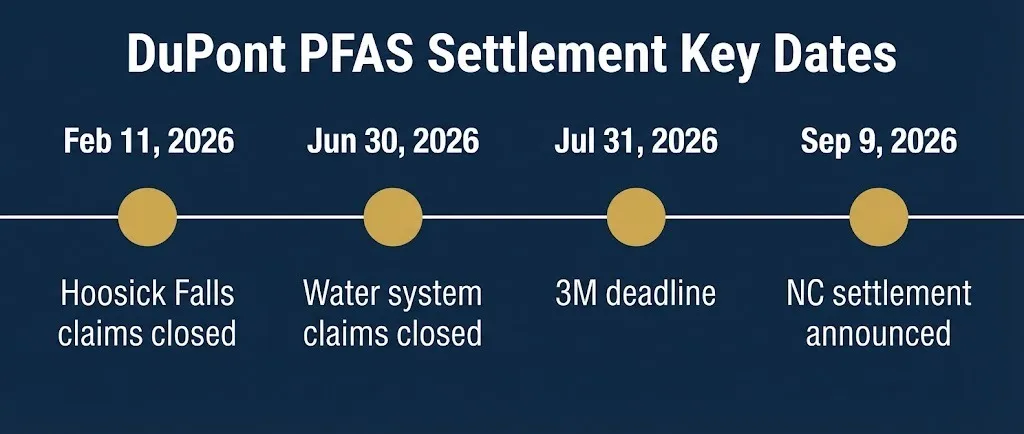
For individuals, the relevant programs are different. The Hoosick Falls settlement in New York, valued at $27 million, covers residents who drank contaminated water and have a blood test showing PFOA levels above 1.86 parts per billion. That claim deadline was February 11, 2026, and has passed.
Personal injury claims tied to PFAS exposure remain active in the AFFF MDL for people with diagnosed conditions like certain cancers, thyroid disease, or liver damage. These are handled case by case.
How do I file a DuPont settlement claim?
Most DuPont settlement claim windows for water systems and communities have closed as of September 2026. The primary deadlines were:
- March 31, 2026: Deadline for PFAS testing cost claims under the DuPont water system settlement.
- June 30, 2026: Deadline for DuPont treatment and cost claims for Phase 2 water systems.
- July 31, 2026: Corresponding 3M settlement treatment claim deadline.
- August 1, 2026: Special Needs Fund claims deadline for both settlements.
- February 11, 2026: Hoosick Falls individual claim deadline.
For personal injury claims, there is no single filing deadline. Instead, each case is subject to state-specific statutes of limitations, which typically range from one to three years from the date of diagnosis or discovery of injury. If you believe you have a PFAS-related injury, the action step is to consult a qualified attorney about your state’s filing window, not to search for a claims form.
What is the DuPont lawsuit about?
The DuPont lawsuits center on PFAS contamination from the company’s chemical manufacturing operations. PFAS, short for per- and polyfluoroalkyl substances, are synthetic chemicals used in products like firefighting foam, nonstick coatings, and stain-resistant fabrics. They are called “forever chemicals” because they do not break down in the environment or the human body.
The Fayetteville Works facility in North Carolina has been a focal point of litigation. The state alleged that DuPont and its spinoff companies Chemours and Corteva discharged PFAS into the Cape Fear River and surrounding groundwater for decades. The September 2026 settlement resolves those claims.
Separate litigation has addressed contamination in West Virginia’s Ohio Valley, New Jersey’s Salem County, Michigan’s Parchment and Rockford areas, and New York’s Hoosick Falls and Newburgh communities. Each has its own settlement structure, payout ranges, and timelines.
The common thread is that DuPont and its corporate successors manufactured or used PFAS chemicals that migrated into drinking water sources, and residents and municipalities sought compensation for treatment costs, property damage, and health effects.
Reality Check: No one texts you settlement money. If someone contacts you claiming to be from a DuPont settlement administrator and asks for payment or bank information, it is a scam. Legitimate settlements never charge you to file a claim.
DuPont settlement amounts by state
Payouts under DuPont settlements vary dramatically by state, because each state’s contamination history and legal claims are different. There is no uniform national payout schedule.
| State | Settlement Program | Payout Range | Status 2026 |
|---|---|---|---|
| West Virginia | Ohio Valley | $5,000 to $1,000,000+ | Ongoing payouts |
| Ohio | Ohio Valley | $5,000 to $1,000,000+ | Ongoing payouts |
| New Jersey | Salem County Chemours | $1,000 to $85,000 | Filing closed March 2026 |
| Michigan | Rockford/Parchment | $5,000 to $120,000 | Active claims |
| New York | Hoosick Falls/Newburgh | $2,500 to $150,000 | Limited availability |
| North Carolina | State/local government | Not applicable to individuals | Settled Sept 2026 |
The West Virginia Ohio Valley programs have the longest history, dating back to a 2005 class action covering six water districts. The New Jersey Salem County settlement specifically covers areas near the Chambers Works and Chemours plants, with payouts based on proximity zones.
North Carolina residents near Fayetteville Works may still have options through personal injury litigation, but the community water claims are not part of the September 2026 government settlement.
Key dates and what happens next
The next major milestone for the September 2026 settlement is the entry of dismissal orders for the covered litigations. The agreement remains subject to court approval and formal dismissal of the claims it resolves.
- Expected Q4 2026: Dismissal orders entered for North Carolina state and local claims.
- Within 30 days of execution: First settlement payment begins, followed by annual installments over 15 years.
- Ongoing: Personal injury cases in the AFFF MDL continue; no global settlement deadline announced.
- TBD: Cape Fear Public Utility Authority’s separate lawsuit remains active and unresolved.
For individuals with potential personal injury claims, the timeline is different and depends on your diagnosis date and state law. Consult an attorney promptly if you believe you have a PFAS-related condition.
Frequently Asked Questions
What is the DuPont lawsuit about in simple terms?
It’s about PFAS chemicals from DuPont’s manufacturing sites contaminating drinking water and the environment. DuPont and its spinoffs Chemours and Corteva have faced lawsuits from states, water utilities, and individuals seeking compensation for contamination cleanup and health effects.
Is the DuPont lawsuit a class action?
There are multiple DuPont-related lawsuits, and not all are class actions. The $1.185 billion water system settlement was structured as a class settlement. The September 2026 North Carolina settlement is a government enforcement action, not a class action. Personal injury claims are typically individual lawsuits.
How much will I get from the DuPont settlement?
There is no fixed per-person payout from any DuPont settlement as of September 2026. Government settlements like the North Carolina deal go to public entities. Personal injury payouts vary widely based on diagnosis, exposure evidence, and state law. Water system settlements paid utilities based on contamination levels and system size.
Can I still file a DuPont PFAS claim?
Most water system and community claim windows have closed. The DuPont water settlement deadline passed June 30, 2026. The Hoosick Falls deadline was February 11, 2026. Personal injury claims may still be viable if you’re within your state’s statute of limitations. Consult an attorney to check.
What are the PFAS health effects linked to DuPont?
PFAS exposure has been linked to thyroid problems, high cholesterol, liver damage, pregnancy complications, and increased cancer risk. These effects often appear years or decades after exposure, which is why medical monitoring programs exist for affected communities.
Do I need a lawyer to get DuPont settlement money?
If a settlement program covers you, filing a claim does not require a lawyer. For personal injury claims, however, having an attorney is standard practice because these cases involve medical evidence and litigation. Third-party “claim helpers” charging fees for basic filing are unnecessary for established settlement programs.
Key Takeaway: If you lived near a DuPont PFAS site and have health concerns, the most important step is checking your state’s filing deadline with an attorney, not searching for a claims form online.