Non-Domiciled CDL Lawsuit 2026: The 19-Driver Florida Case and the Federal Rule Fight
Quick Answer
- The non-domiciled CDL lawsuit is a constitutional challenge to federal and Florida rules that stripped thousands of immigrant drivers of their commercial licenses.
- There is no settlement fund and no claims process for the public, because this is a civil rights action seeking declaratory and injunctive relief, not a class action settlement .
- The plaintiffs are seeking to overturn the rule and force Florida to resume issuing non-domiciled CDLs, but no deadline for public claims exists .
The non-domiciled CDL lawsuit is not a settlement case. It is a constitutional fight over whether the federal government can categorically exclude legally authorized immigrants from commercial driving. There is no money waiting for you, and no claim form to file.
The case was filed in the U.S. District Court for the Southern District of Florida on behalf of 19 commercial vehicle operators who lost their livelihoods when the Federal Motor Carrier Safety Administration issued its Interim Final Rule in September 2025 . That rule, later finalized in February 2026, restricted non-domiciled CDLs to only three visa categories.
Florida then placed an indefinite pause on issuing or renewing those licenses, even after a federal appeals court stayed the IFR . The drivers say the combined effect has been “catastrophic.”
This guide breaks down what the lawsuit claims, who the plaintiffs are, what the government argues, and what it means for immigrant truck drivers in 2026. The most important verified fact: no settlement fund exists, so anyone promising you a payout is lying.
The Facts
| Case | Rivera Lujan, et al. v. FMCSA, et al. |
| Court | U.S. District Court, Southern District of Florida |
| Case Number | 1:26-cv-22615-JB |
| Status | Active, filed 2026 |
| Relief Sought | Declaratory and injunctive relief, not damages |
| Fund Size | None |
| Est. Per Person | Not applicable |
| Claim Deadline | None (not a settlement) |
| Administrator | Not applicable |
Is the non-domiciled CDL lawsuit a class action settlement?
No. The non-domiciled CDL lawsuit is a civil rights action filed by 19 individual plaintiffs, not a class action settlement . There is no fund, no administrator, and no deadline for public claims.
The case challenges two government actions. First, the FMCSA’s Interim Final Rule from September 2025, which restricted non-domiciled CDL eligibility. Second, FMCSA’s Final Rule from February 2026, which reaffirmed those restrictions . Florida’s indefinite pause on issuing those licenses is also challenged .
The plaintiffs seek declaratory and injunctive relief, meaning they want the court to declare the rules unconstitutional and order the government to stop enforcing them . They are not asking for money damages.
If the court rules in their favor, the remedy would be a change in policy, not a payout to drivers. If it rules against them, the rules stand.
How much could the non-domiciled CDL lawsuit payout be?
There is no payout. The non-domiciled CDL lawsuit seeks declaratory and injunctive relief, not monetary damages . The plaintiffs want their licenses back and the rules overturned, not a settlement check.
Separate from this case, a lawfold.com guide suggests individual lawsuits could theoretically seek damages ranging from $10,000 to $150,000 for lost wages and discrimination . But that is a general estimate for hypothetical claims, not a verified outcome in this case.
If you lost your CDL and income due to the rule, your path to compensation would be a separate legal action, not this lawsuit. No fund exists for that either.
Who are the plaintiffs in the non-domiciled CDL lawsuit?
The plaintiffs are 19 commercial vehicle operators who held valid non-domiciled CDLs and lost their ability to work . They include drivers with various immigration statuses that the new rule excludes.
One named plaintiff, Jorge Rivera Lujan, is a DACA recipient who has lived in the U.S. since age two and worked as a truck driver for over a decade . He is also the named plaintiff in a separate D.C. Circuit challenge to the Final Rule .
The plaintiffs are represented by attorneys including the Public Citizen Litigation Group, which has been fighting the rule since the IFR was issued .
What does the non-domiciled CDL lawsuit claim?
The lawsuit claims the FMCSA rules and Florida’s pause violate the Constitution’s due process and equal protection guarantees . The plaintiffs argue they were deprived of their licenses without individualized hearings or any finding of fault.
The complaint describes the impact as “catastrophic.” The plaintiffs say they “cannot work, they cannot earn a living, they face financial ruin, and they have been deprived of vested property and liberty interests without due process of law” .
They also allege the rule was arbitrary and capricious because FMCSA failed to show that non-domiciled CDL holders pose a safety risk. The D.C. Circuit previously found the agency likely failed on that argument when it stayed the IFR .
The lawsuit seeks to declare the Final Rule and Florida’s pause unconstitutional and order Florida to resume issuing non-domiciled CDLs under the prior rules .
What is the FMCSA Final Rule on non-domiciled CDLs?
The FMCSA Final Rule restricts non-domiciled CDLs to holders of H-2A, H-2B, and E-2 visas only . It took effect March 16, 2026, and it eliminated eligibility for most other immigrant categories.
Under the rule, Employment Authorization Documents (EADs) alone are no longer accepted as proof of eligibility . This excludes DACA recipients, asylum seekers, asylees, refugees, and others with valid work authorization .
States must verify immigration status through the SAVE system before issuing, renewing, or upgrading a non-domiciled CDL . Licenses are capped at one year of validity, regardless of the I-94 expiration date .
If a driver’s status changes or eligibility lapses, the state must downgrade or revoke the license within 30 days .
Key Takeaway: The FMCSA Final Rule limits non-domiciled CDLs to H-2A, H-2B, and E-2 visa holders, excludes DACA recipients and other work-authorized immigrants, and caps license validity at one year .
What is Florida’s role in the non-domiciled CDL lawsuit?
Florida is a defendant because its Department of Highway Safety and Motor Vehicles placed an ongoing and indefinite pause on issuing, renewing, and extending non-domiciled CDLs and CLPs . That pause continued even after the D.C. Circuit stayed the IFR in November 2025 .
The lawsuit argues Florida’s pause is tied to the federal rule and FMCSA’s enforcement threats, and is therefore unlawful for the same reasons . The state has not resumed issuing those licenses despite the stay.
This combination, the federal rule plus Florida’s pause, is what the plaintiffs call “catastrophic” .
What is the D.C. Circuit challenge to the Final Rule?
A separate legal challenge to the Final Rule is pending in the U.S. Court of Appeals for the D.C. Circuit . The same plaintiffs who challenged the IFR filed a new petition on February 12, 2026, challenging the Final Rule .
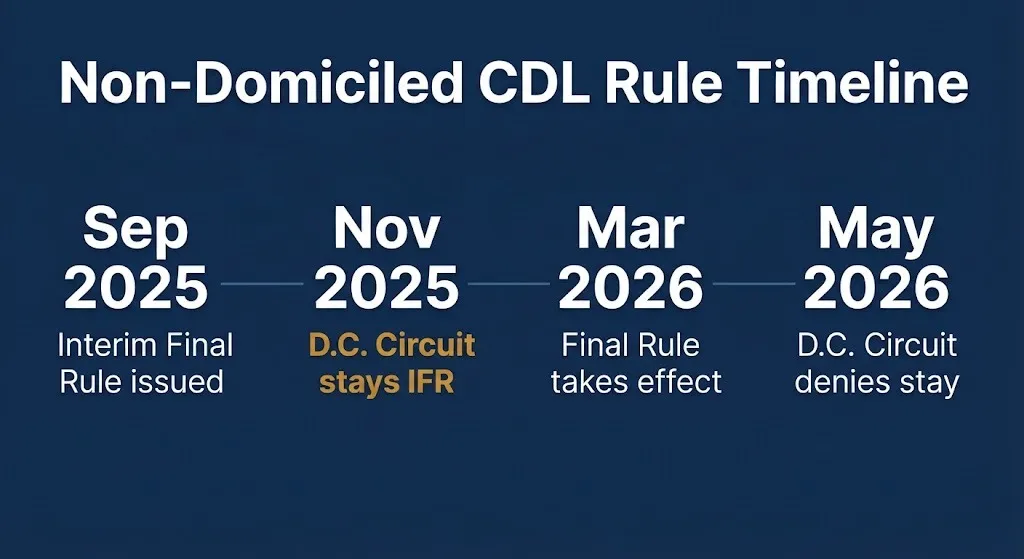
On May 6, 2026, the D.C. Circuit denied emergency motions to stay the Final Rule while it expedites merits review . Judges Katsas and Rao indicated the petitioners were unlikely to succeed on several core arguments, including that FMCSA lacked statutory authority .
The court emphasized that the Final Rule ensures vetting of foreign drivers is “no less rigorous” than for U.S.-domiciled drivers .
What happens next in the non-domiciled CDL lawsuit?
The Florida case is in its early stages. The D.C. Circuit challenge is on an expedited track.
Expected 2026: Florida case proceeds through motions and discovery.
Expected 2026-2027: D.C. Circuit issues merits decision on the Final Rule.
TBD: Florida case ruling on the constitutional claims.
TBD: Any policy changes or resumption of non-domiciled CDL issuance.
There is no timeline for a resolution that would restore licenses to affected drivers. The harm is ongoing and, as the plaintiffs argue, “irreparable” .
Frequently Asked Questions
Is the non-domiciled CDL lawsuit a settlement?
No. It is a constitutional challenge seeking injunctive relief, not a settlement fund .
Can I get money from the non-domiciled CDL lawsuit?
No. The plaintiffs seek declaratory and injunctive relief, not damages .
Who filed the non-domiciled CDL lawsuit?
19 commercial drivers filed the Florida case. The Public Citizen Litigation Group represents them .
What visas are eligible for non-domiciled CDLs?
Only H-2A, H-2B, and E-2 visa holders are eligible under the Final Rule .
Are DACA recipients eligible for non-domiciled CDLs?
No. The Final Rule explicitly rescinds guidance that allowed DACA recipients to obtain non-domiciled CDLs .
What happens if I lose my non-domiciled CDL?
You must stop driving commercially. Your state may downgrade or revoke your license within 30 days of status change notification .
Is the non-domiciled CDL rule still in effect?
Yes. The Final Rule took effect March 16, 2026, and the D.C. Circuit denied an emergency stay on May 6, 2026 .
Can I sue for lost income from the CDL rule?
You would need to consult an attorney about a separate legal claim. This lawsuit does not provide damages .
Your next step
If you hold a non-domiciled CDL and your livelihood is at risk, document everything now. Save your license records, employment history, and any denial or revocation notices.
The D.C. Circuit is reviewing the Final Rule on an expedited basis. The Florida case is moving forward. Neither has a confirmed timeline. The most important fact to remember: no settlement fund exists, and the remedy sought is policy change, not payment.