Medical Lawsuit 2026: Payouts, Deadlines and the Rules That Kill Claims
Quick Answer
- A medical lawsuit is real litigation, but most states gate it behind an expert certificate of merit.
- Average paid malpractice claims ran about $463,000 in 2025, according to federal reporting data.
- Deadlines start as short as one year. Kentucky and Louisiana are the tightest.
A medical lawsuit is a civil claim against a healthcare provider, hospital, or drug and device maker for harm caused by negligence or a defective product. The federal National Practitioner Data Bank recorded 9,859 malpractice payment reports in 2025, totaling roughly $4.56 billion.
This matters to anyone weighing whether to sue after a bad medical outcome. The deadline is the first thing that kills claims, and in California the clock can run out just one year after you discover the injury.
Below you’ll find the three separate tracks a medical lawsuit can take, the real payout data, the pre-suit gates, and the reasons most claims never reach a jury. One number frames everything: physicians win between 80 and 90 percent of malpractice cases that go to trial.
The Facts
| What it covers | Medical malpractice, drug and device product liability, and healthcare-related consumer claims |
| Status | Active nationwide. Roughly 198,000 MDL claims were pending across about 158 dockets at the start of 2026 |
| Total paid (malpractice) | About $4.56 billion across 9,859 payment reports in 2025 |
| Average per paid claim | About $463,000 in 2025, up from about $439,000 in 2024 |
| Filing deadline | Varies by state. One year in Kentucky and Louisiana, up to four years in Minnesota |
| Pre-suit requirement | A certificate or affidavit of merit in more than half of states |
| Proof needed | Medical records, expert opinion on standard of care, documented damages |
What counts as a medical lawsuit?
A medical lawsuit is any civil claim seeking money for harm connected to medical care or a medical product.
The term covers three distinct legal animals, and people searching it mean different things. Malpractice cases target a provider’s negligence. Product cases target a drug or device manufacturer. A third group covers billing, privacy, and consumer claims against health systems.
The procedural rules differ sharply between them:
| Type | Defendant | Typical structure |
|---|---|---|
| Medical malpractice | Doctor, nurse, hospital | Individual state court case |
| Drug or device injury | Manufacturer | Federal MDL or state mass tort |
| Healthcare consumer claim | Health system, insurer | Class action |
Medical malpractice accounts for less than 5% of all personal injury cases pending nationwide, according to National Center for State Courts data.
That statistic cuts against the common assumption that courts are drowning in malpractice suits. They are not.
Is your medical lawsuit real, or is that text a scam?
Real medical litigation exists in volume, but the text message on your phone may not connect to it.
Legitimate mass torts are documented on the Judicial Panel on Multidistrict Litigation docket. As of the January 5, 2026 JPML report, the Hair Relaxer MDL had 10,948 pending actions and the Paraquat MDL had 6,476.
Marketing firms scrape those dockets and blast ads. That is legal, but the ad is not a court notice.
Signals that a message is marketing, not a claim:
- It promises a specific dollar amount before reviewing your records
- It asks for payment or a “case filing fee” up front
- It gives no case name, MDL number, or court
- It pressures you to sign within hours
Treat it like a warranty extension call. The underlying product may be real, but the caller is selling, not notifying.
Verified litigation carries an MDL number and a named judge. Depo-Provera litigation sits at MDL 3140, for example.
Which of the three medical lawsuit tracks are you actually in?
Your track depends on who caused the harm, and it determines every deadline you face.
If a provider deviated from the standard of care, you’re in malpractice territory. Medical malpractice cases require expert testimony, because a qualified medical professional must confirm the provider departed from accepted practice.
If a drug or implanted device injured you, you’re likely in a mass tort. Federal courts had roughly 198,000 MDL claims pending across about 158 dockets entering 2026.
Ask yourself these in order:
- Did a person providing care make the error?
- Or did a manufactured product cause the injury?
- Is the same product injuring thousands of others?
- Did the harm involve billing, records, or data instead?
- Did the injury happen at a federal facility such as a VA hospital?
The last one matters. Claims against federal employees run under the Federal Tort Claims Act, with its own procedure.
Key Takeaway: Identify whether your claim is malpractice, product liability, or a consumer claim first, because each one runs on a different clock and different proof rules.
How much is a medical lawsuit worth in 2026?
Not determined by the claim type alone. Value depends on injury severity, economic losses, your state’s caps, and the strength of the expert evidence.
Federal reporting gives the clearest national benchmark available. The NPDB analysis tool recorded 9,859 malpractice payment reports in 2025, totaling approximately $4.56 billion.
| Year | Payment reports | Total paid | Average per report |
|---|---|---|---|
| 2023 | 11,440 | About $4.8 billion | About $420,000 |
| 2024 | 11,451 | About $5.02 billion | About $439,000 |
| 2025 | 9,859 | About $4.56 billion | About $463,000 |
Fewer payments, higher average. That trend is visible across all three years.
No one can quote your number from a phone call. Anyone promising a figure before reading your records is guessing.
What does the average medical malpractice payout actually mean?
Less than you think, because the average is dragged upward by a small group of catastrophic cases.
Analysis of 2023 NPDB data found roughly 3,200 claims, about 28%, paid under $100,000. Only about 1,300, roughly 11%, exceeded $1 million.
Here’s the distribution problem in plain terms:
- More than a quarter of paid claims landed below six figures
- Around one in nine crossed the million-dollar mark
- The rest clustered in between
An industry report cited in July 2026 found the average payout among the top 50 malpractice verdicts rose from $32.6 million in 2022 to $50 million in 2025. Those outliers are what inflate the national average.
The same report described malpractice claim frequency falling from roughly 17% in the 1991 to 2005 period to about 4.6% in 2025. Fewer claims, bigger ones.
Treat the average the way you’d treat an average home price in a city with a few mansions. It describes the dataset, not your house.
Do damage caps limit what you can recover?
Yes, in many states, and the cap usually hits pain and suffering rather than your actual costs.
California runs the best-documented example. Under Assembly Bill 35, which amended Civil Code section 3333.2, the 2026 non-economic damages cap is $470,000 for non-fatal cases and $650,000 for wrongful death.
| California MICRA cap | 2026 amount |
|---|---|
| Non-fatal malpractice injury | $470,000 |
| Wrongful death | $650,000 |
Those figures rise by $40,000 and $50,000 each January 1 until they reach $750,000 and $1,000,000 in 2033, then adjust for inflation from 2034.
Economic damages are not capped in California. Medical care costs, future care, and lost income fall outside the limit entirely.
Caps differ sharply elsewhere. Some states cap non-economic damages, a few cap total damages, and several state supreme courts have struck caps down as unconstitutional.
Reality Check: No court, hospital, or settlement administrator will text you offering money before your case exists. Legitimate malpractice attorneys work on contingency, meaning no upfront fee. Anyone charging you to “register” a medical claim or promising a guaranteed payout is selling something, not representing you.
Key Takeaway: The national average payout near $463,000 hides a distribution where most paid claims settle well below it and a handful of catastrophic verdicts pull the number up.
Who may qualify to file a medical lawsuit?
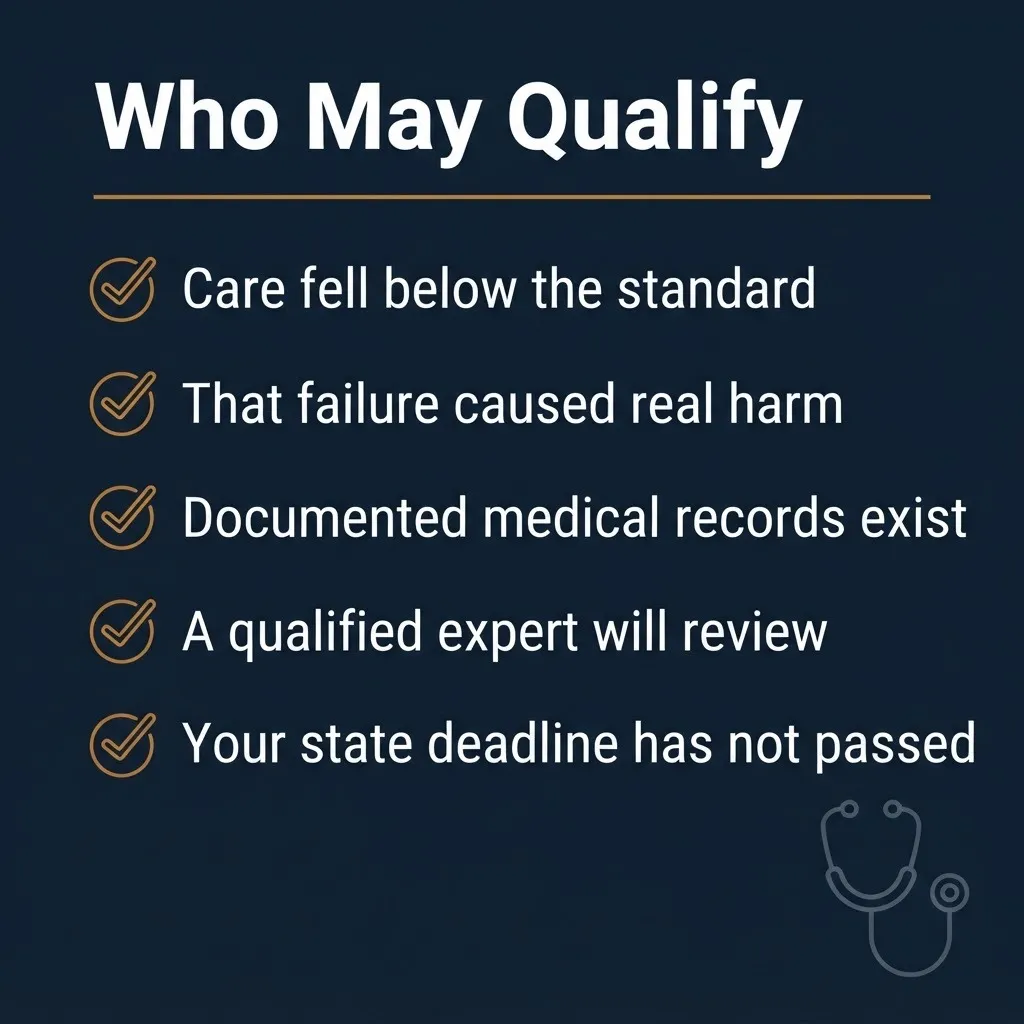
You may qualify if a provider’s care fell below the professional standard and that failure caused you measurable harm.
A bad outcome alone is not malpractice. The care itself must have been negligent.
Three elements generally have to line up:
- A provider owed you a duty of care.
- The care departed from the accepted standard.
- That departure caused your injury and real damages.
For product cases, the test is different. You generally need documented use of or exposure to the product, a diagnosis of the specific injury the litigation covers, and a timely claim under your state’s deadline.
Certain claims carry extra rules. Kaiser Permanente members and patients of some medical groups sign arbitration agreements at enrollment, which route malpractice claims out of civil court.
Nobody can tell you that you qualify from this page. Eligibility turns on your records and your state’s law.
How do you file a medical lawsuit step by step?
Filing starts long before a complaint reaches the courthouse, because most states require pre-suit steps first.
The typical sequence:
- Request your complete medical records in writing.
- Consult a licensed attorney in the state where care occurred.
- Have a qualified medical expert review the records.
- Obtain the certificate or affidavit of merit your state requires.
- Serve any required pre-suit notice on the provider.
- File the complaint before the statute of limitations expires.
- Serve the defendants and begin discovery.
California requires 90 days of written notice before filing, under Code of Civil Procedure section 364. Michigan requires a notice of intent served at least 182 days before suit, with the limitations period tolled during that window.
Obtaining a qualified expert willing to review your case typically takes weeks or months. That practical delay is why the nominal deadline is misleading.
Start earlier than the statute suggests. The expert review, not the filing itself, is the bottleneck.
What is a certificate of merit and do you need one?
A certificate of merit is a sworn statement that a qualified medical professional reviewed your case and found a legitimate basis for the claim.
More than half of U.S. states require an affidavit of merit in medical malpractice cases, and others impose similar pre-suit requirements under different names.
The rules vary by state:
- Some require an expert-signed affidavit attached to the complaint
- Others accept an attorney certification based on expert consultation
- Some tie the requirement to pre-suit notice or a screening panel
- Connecticut requires a certificate of good faith plus a written opinion letter from a similar health care provider
Missing the deadline, using the wrong type of expert, or filing a conclusory certificate can create dismissal risk before discovery starts.
Dismissal can come with prejudice, meaning the case cannot be refiled. That single procedural failure ends more meritorious claims than any jury ever does.
Limited exceptions exist. Some states carve out res ipsa loquitur claims, where negligence is self-evident, such as a surgical instrument left inside a patient.
Key Takeaway: In most states, an expert must sign off on your case before a court will even look at it, and a defective certificate can end the claim permanently.
What is the deadline to file a medical lawsuit?
Deadlines run from one to four years depending on your state, and most states layer a second outer limit on top.
Reported ranges put the shortest limitations periods at one year in Kentucky and Louisiana, and the longest at four years in Minnesota.
| Deadline layer | What it does |
|---|---|
| Statute of limitations | Runs from injury or from discovery of the injury |
| Discovery rule | Starts the clock when you knew or should have known |
| Statute of repose | Absolute outer cutoff regardless of discovery |
| Minority tolling | Extends deadlines for injured children in many states |
California illustrates the trap. Under Code of Civil Procedure section 340.5, the deadline is one year from discovery or three years from the injury, whichever comes first.
Most states use that two-part structure: a shorter window from discovery combined with an absolute outer limit from the date of the act.
Confirm your state’s rule with a licensed attorney. Deadlines listed in general guides are not a substitute for checking the current statute.
How long does a medical lawsuit take?
Expect years, not months, once the case is filed.
Reporting on 2026 malpractice practice puts typical resolution at two to four years from filing. That figure is commonly cited rather than drawn from a court statistics release, so treat it as an estimate.
What consumes the time:
- Records retrieval across multiple providers
- Expert review and report preparation
- Written discovery and depositions
- Daubert challenges to expert testimony
- Mediation, then trial scheduling
Mass torts move on their own calendar. The NEC baby formula MDL had bellwether trials scheduled for August 2026, November 2026, and February 2027.
Compare it to a disputed insurance claim that escalates to appraisal. Every added layer of review buys accuracy and costs months.
Settlement usually arrives before trial. A settlement guarantees a payout, while trial carries the risk reflected in the 80 to 90 percent defense win rate.
Which medical mass torts are active in 2026?
Dozens are accepting new claims, and the JPML publishes pending counts monthly.
From the January 5, 2026 JPML report:
| MDL | Pending actions |
|---|---|
| Hair Relaxer (MDL 3060) | 10,948 |
| Bair Hugger warming devices (MDL 2666) | 8,666 |
| Cook Medical IVC Filters (MDL 2570) | 6,896 |
| Paraquat (MDL 3004) | 6,476 |
| Paragard IUD (MDL 2974) | 3,800 |
The February 2, 2026 report listed Bard Implanted Port Catheter at 2,674 pending, Covidien Hernia Mesh at 2,260, Depo-Provera at 2,098, and Suboxone at 1,853.
The largest active mass tort overall is the J&J talcum powder litigation, reported at more than 67,000 pending cases.
GLP-1 drug litigation, covering Ozempic and similar medications, reached over 3,191 pending actions in MDL 3094, a 130% year-over-year increase.
Case counts shift monthly. Check the current JPML report rather than relying on a figure from a marketing page.
Key Takeaway: Filing deadlines in medical cases are short, layered, and state-specific, and the expert review that must precede filing takes weeks or months of its own.
What is happening with the Depo-Provera litigation?
A final settlement has not been confirmed. Reporting indicates the parties told the court in June 2026 they had reached an agreement in principle on a settlement framework.
An agreement in principle is not an approved settlement. No fund size, per-person amount, claim deadline, or administrator has been publicly confirmed as of this writing.
What is verified:
- The litigation sits in MDL 3140, consolidated before a federal judge
- It reached 2,098 pending actions by the February 2, 2026 JPML report
- Plaintiffs allege the contraceptive injection caused meningioma brain tumors
Anyone quoting you a Depo-Provera payout figure right now is working from speculation, not a court-approved schedule.
Watch the MDL docket for a motion for preliminary approval. That filing is the first moment real numbers become public.
Why do most medical lawsuits fail?
Most fail on proof and procedure, not on sympathy.
Physicians win between 80 and 90 percent of medical malpractice cases that reach trial, according to research published in Clinical Orthopaedics and Related Research.
The recurring failure points:
- No qualified expert. Without one, the standard of care cannot be established.
- Defective certificate of merit. Dismissal can come before discovery.
- Blown deadline. The statute of repose bars claims even when discovery was late.
- Causation gap. A bad outcome that the treatment did not cause.
- Thin damages. Real harm must be documented in records and wages.
Fewer than 1% of medical errors ever lead to a malpractice claim, and fewer still result in a payout.
That gap is not evidence the system works. It reflects how expensive and evidence-heavy these cases are to bring.
What is the difference between malpractice and a bad outcome?
Malpractice means the care itself was negligent. A bad outcome means the result was poor, which happens even with competent care.
Courts measure providers against the professional standard of care, not against a perfect result. Surgery carries known risks, and a known complication is generally not negligence.
Examples that commonly form malpractice claims:
- Surgical errors, including wrong-site procedures
- Misdiagnosis or significantly delayed diagnosis
- Medication and dosage errors
- Birth injuries
- Anesthesia mistakes
Specialty risk varies. According to 2026 American Medical Association data, roughly 6 in 10 OB-GYNs report at least one malpractice claim over a career, with general surgeons just over half.
Around 29% of physicians have been sued at some point, rising to 45% for physicians over age 55.
What evidence do you need to bring a medical claim?
You need records first, expert opinion second, and documented damages third.
Start collecting immediately, because records requests routinely take weeks:
- Complete medical records from every treating provider
- Imaging, lab results, and operative reports
- Prescription and pharmacy records
- Proof of product use for drug or device claims
- Wage records showing income lost
- Bills for past and projected future care
Medical records are the essential evidence, and obtaining and reviewing them takes months. That delay counts against your filing window.
For mass torts, proof of use is non-negotiable. A diagnosis without documented exposure generally fails.
Keep a written timeline of symptoms and appointments. Memory fades faster than a case moves.
What happens next
Expected within weeks of consulting counsel: Records requests go out, and expert review begins.
Expected 90 to 182 days before filing in some states: Pre-suit notice is served, as California and Michigan require.
August 2026, November 2026 and February 2027: NEC baby formula bellwether trials were scheduled on those dates.
Expected mid to late 2026: Bellwether selection in the GLP-1 drug MDL.
Expected 2027 or later: Any Depo-Provera settlement framework would need court approval before payments. No dates confirmed.
Frequently Asked Questions
What is a medical lawsuit?
It’s a civil claim for harm caused by medical care or a medical product.
The main categories are malpractice, drug and device product liability, and healthcare consumer claims.
Each runs on different rules.
How much is the average medical malpractice payout?
About $463,000 per paid claim in 2025, based on federal reporting data.
Roughly 28% of 2023 paid claims came in under $100,000.
Your case value depends on your own facts.
How long do I have to file?
It varies by state, from about one year to four.
Kentucky and Louisiana sit at the short end, Minnesota at the long end.
Many states add an absolute outer deadline called a statute of repose.
Do I need an expert before I can sue?
In most states, yes.
More than half require a certificate or affidavit of merit signed by a qualified professional.
Filing without one risks dismissal.
Can I sue for a bad outcome?
Not by itself.
The care must have fallen below the professional standard and caused your injury.
Known complications of competent treatment generally don’t qualify.
Do damage caps apply to my case?
It depends entirely on your state.
California caps non-economic damages at $470,000 for non-fatal malpractice in 2026, and $650,000 for wrongful death.
Economic damages are uncapped there.
How do I know if a mass tort is real?
Check whether it has an MDL number on the JPML docket.
Hair Relaxer is MDL 3060 and Depo-Provera is MDL 3140, for example.
Advertising alone proves nothing.
Does filing cost money upfront?
Malpractice and mass tort attorneys typically work on contingency.
That means fees come from any recovery, not from you upfront.
Anyone demanding an upfront filing fee from you deserves scrutiny.
Request your complete medical records this week and note the date you first suspected something went wrong. That date drives every deadline in your case.
Confirm your state’s limitations period and certificate of merit rule before doing anything else. In California, the clock can expire just one year after you discover the injury.