Intellectual Property Litigation in 2026: What You Need to Know Before You File
Quick Answer
- Is it legit? Yes, IP litigation is real and active. Patent, trademark, and copyright disputes are reshaping forums and strategies in 2026.
- How much? Costs vary widely. UPC infringement actions now start at 14,600 euros plus value-based fees.
- Key deadline? No single deadline applies. Each case has its own statute of limitations, often three years for copyright claims.
If you own a patent, trademark, or copyright, the rules for enforcing it shifted in 2026. The forums are changing, the costs are rising, and the Supreme Court is weighing in on issues that could affect every creator and business. Intellectual property litigation is no longer just about filing a complaint and waiting for a judge. It is about choosing the right venue, understanding the new fee structures, and knowing when a dispute is worth pursuing.
The stakes run from a few thousand dollars for a small trademark dispute to over a billion dollars in cases like the Cox Communications copyright fight. For inventors and small business owners, the most important question is practical: where do I go, what does it cost, and how long will it take? This article answers those questions using verified 2026 data and court records.
This article covers the major IP litigation forums, the new fee schedules taking effect, the Supreme Court cases that matter, and the practical steps to protect your rights in 2026. One surprising detail: the Unified Patent Court can now grant injunctions that extend to the United Kingdom, even though the UK is not part of the EU.
The Facts
| Case | No single case. This covers the 2026 IP litigation landscape. |
|---|---|
| Status | Multiple active developments across U.S., EU, UK, and China |
| Fund Size | Not applicable. Costs vary by forum and case value. |
| Est. Per Person | UPC infringement: 14,600 euros fixed plus value-based fees |
| Claim Deadline | Statutes of limitations vary. Copyright is typically three years. |
| Administrator | Not applicable. Each court runs its own procedures. |
| Proof Needed | Registration certificates, infringement evidence, damages documentation |
How Much Does Intellectual Property Litigation Cost in 2026?
Intellectual property litigation costs in 2026 depend heavily on the forum you choose and the value of your case. The Unified Patent Court raised its fees on January 1, 2026, and the increases are significant.
An infringement action before the UPC now carries a fixed fee of 14,600 euros. If the case value exceeds 500,000 euros, value-based fees apply on top of that. For a case valued up to 5 million euros, the value-based fee is 44,600 euros, bringing the total court fees to roughly 59,200 euros before you pay your own lawyers .
Compare that to the old UPC rate. Before January 1, 2026, the same infringement action cost 11,000 euros fixed plus a 32,000-euro value-based fee for cases up to 5 million euros. The total was 43,000 euros. That is a 16,200-euro increase in court fees alone for a mid-range patent case .
The fee increases affect more than just infringement actions. Applications for preservation of evidence jumped from 350 euros to 5,000 euros. Protective letters went from 200 euros to 300 euros. Isolated revocation actions now cost 26,500 euros .
In the United States, costs are less transparent. District court filing fees remain relatively low, but attorney fees for patent litigation routinely run into the millions. The ITC has become a more attractive venue for some patent owners because of its speed and the availability of exclusion orders, which can block infringing imports .
Key Takeaway: The UPC’s new fee schedule makes European patent enforcement significantly more expensive in 2026, but it also streamlines the process for smaller cases with caps on recoverable costs.
Who Can Qualify to File an Intellectual Property Lawsuit?
You can qualify to file an intellectual property lawsuit if you own a valid patent, trademark, copyright, or trade secret and someone else is using it without permission. Ownership is the threshold requirement, and it must be documented.
For patents, you need either an issued patent or a pending application that has been published. For trademarks, federal registration is not technically required to sue, but it gives you significant advantages, including nationwide priority and the ability to seek statutory damages.
For copyrights, you must have a registration before you can file suit in U.S. federal court for infringement of a U.S. work. The Copyright Claims Board, a smaller forum for lower-value disputes, also requires registration and has a three-year statute of limitations .
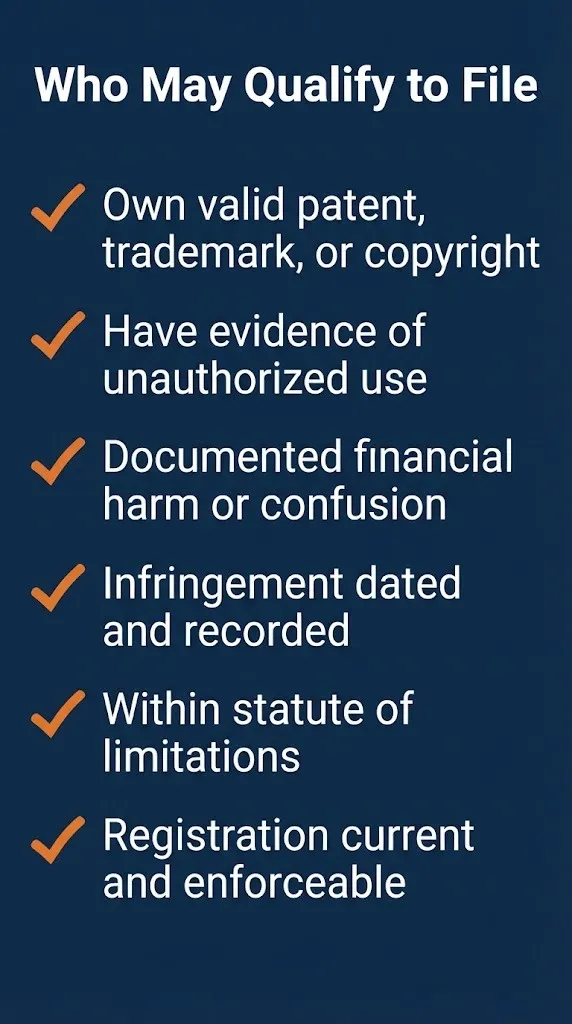
Here is a quick checklist to assess whether you may have a claim:
- You own a registered patent, trademark, or copyright
- You have evidence that someone else is using your protected work without authorization
- The unauthorized use is causing you financial harm or market confusion
- You have documented the infringement with dates, screenshots, or physical evidence
- You are within the statute of limitations for your claim type
If you are a defendant rather than a plaintiff, the eligibility question flips. You need to assess whether the plaintiff has a valid claim, whether the patent is vulnerable to invalidity arguments, and whether the forum they chose is the right one for your defense.
How to File an Intellectual Property Lawsuit: Step by Step
Filing an intellectual property lawsuit requires preparing your evidence, choosing your forum, and following that forum’s procedural rules. The steps below apply broadly to U.S. federal court, but the specifics vary by jurisdiction.
- Confirm your ownership and registration. Gather your patent, trademark, or copyright certificates. Verify that your rights are current and enforceable.
- Document the infringement. Collect evidence showing the unauthorized use. This includes dates, product samples, screenshots, and any communications with the infringer.
- Assess the damages. Calculate your losses or the infringer’s profits. For patent cases, this may require an expert analysis of reasonable royalties or lost sales.
- Choose your forum. Consider federal district court, the ITC, or the Copyright Claims Board. Each has different costs, timelines, and remedies.
- Check the statute of limitations. Copyright claims generally must be filed within three years of accrual. Patent and trademark claims have their own timelines.
- Send a cease-and-desist letter. This is not always required, but it puts the infringer on notice and can strengthen a willfulness claim under the new Chinese punitive damages rules .
- File your complaint. Include your claims, the relief you seek, and the basis for jurisdiction. In the UPC, the statement of claim must include the estimated value of the case .
- Prepare for early motions. Expect the defendant to challenge jurisdiction, validity, or the sufficiency of your pleadings.
What Changed in U.S. Patent Litigation in 2026?
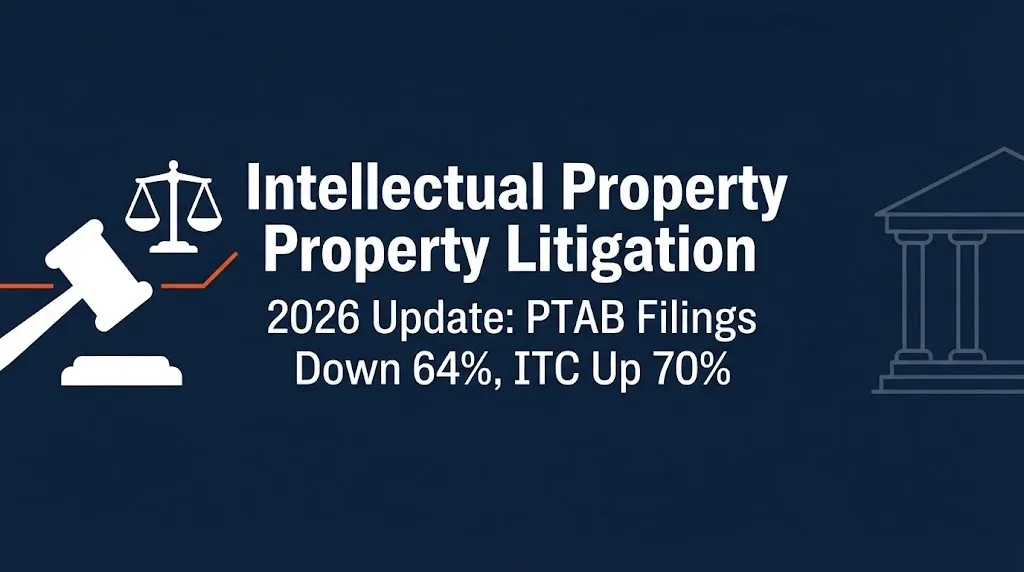
U.S. patent litigation shifted dramatically in 2026, with PTAB filings down 64% year over year and ITC complaints up 70%. The Patent Trial and Appeal Board has become harder to access, pushing defendants and challengers toward different strategies.
The changes at the PTAB came quickly after the 2024 election. Interim leadership withdrew practice memos, changed institution procedures, and introduced a “settled expectations” concept for patents older than six years. This approach has no clear basis in the America Invents Act, but it has sharply reduced the number of inter partes reviews that get instituted .
For patent owners, the ITC has become a more attractive enforcement venue. The Lashify decision broadened the domestic industry requirement, opening the ITC’s doors to small companies, foreign manufacturers, and non-practicing entities. The ITC can issue exclusion orders that block infringing products from entering the United States, which is a powerful remedy .
District court filings also dropped 19% year over year in Q1 2026. Some of that decline reflects the broader uncertainty in patent law, including pending legislation like the Patent Eligibility Restoration Act and the PREVAIL Act. These bills aim to overhaul Section 101 eligibility and streamline PTAB proceedings, but they have not passed yet .
What Is the Unified Patent Court and Why Does It Matter in 2026?
The Unified Patent Court is a new international court that handles patent disputes across participating EU member states. It began operations in 2023 and has quickly become a major forum for European patent litigation.
The UPC’s jurisdiction extends beyond the EU in one important way. Recent case law confirms that the UPC can hear infringement actions involving UK-validated European patents if it has jurisdiction over the defendant. The court cannot revoke UK patents outright, but it can assess validity between the parties and grant injunctions that extend to the UK .
This development changes cross-border litigation strategy. If you are enforcing a European patent portfolio and the defendant operates in both the EU and the UK, the UPC may offer a single forum for relief that covers multiple markets. That is a significant efficiency gain, but it also increases the stakes.
The UPC’s new fee schedule, effective January 1, 2026, raised fixed fees by roughly 33% to account for inflation since 2016. Value-based fees also increased. The court now charges higher fees for appeals because five judges hear those cases instead of three at the first instance .
What Are the Biggest IP Cases Before the Supreme Court in 2026?
The Supreme Court is weighing two intellectual property cases in 2026 that could have widespread effects. One involves copyright liability for internet service providers. The other concerns induced infringement and generic drug labels.
In Cox Communications v. Sony Music, the Supreme Court heard oral arguments on December 1, 2025. The case examines whether Cox is liable for failing to terminate repeat copyright infringers despite receiving millions of notices. The Fourth Circuit had upheld a judgment of more than $1 billion against Cox. The Justices signaled skepticism toward both sides during arguments, questioning Sony’s broad theory of ISP liability and Cox’s arguments that would effectively eliminate it .
In Hikma Pharmaceuticals v. Amarin, the Supreme Court granted certiorari in January 2026 to review induced infringement claims involving “skinny labels” on generic drugs. Hikma carved out Amarin’s patented cardiovascular-risk-reduction indication from its generic label. Amarin alleges that Hikma’s marketing statements induced physicians to prescribe the drug for the patented use. The Federal Circuit found those allegations plausible. The Supreme Court’s review could reshape how generic manufacturers communicate about their products .
Both cases are expected to be decided by June 2026, and both could affect how businesses assess their IP litigation risk.
How Do I Choose an Intellectual Property Litigation Lawyer?
Choosing an intellectual property litigation lawyer means finding someone with specific experience in your type of IP and your preferred forum. IP law is not monolithic. A lawyer who handles trademark oppositions may not be the right choice for a patent infringement trial.
Look for these qualifications when evaluating counsel:
- Technical background: For patent cases, the lawyer should understand the technology at issue. Many patent litigators have engineering or science degrees.
- Forum experience: If you are filing in the UPC, ITC, or a specialized court, find someone who has appeared there before.
- Trial experience: Most IP cases settle, but you want a lawyer who can try the case if settlement talks fail.
- Industry knowledge: A lawyer who understands your industry will grasp the commercial context faster.
- Rankings and peer reviews: Directories like Chambers and Partners rank IP litigators by jurisdiction and specialty .
You can also consider the size of the firm. Boutique IP firms often offer deeper specialization. Larger firms may have broader resources for complex, multi-jurisdictional cases. The right choice depends on your budget, the value of your case, and whether you expect the dispute to go to trial.
What Is the Statute of Limitations for Intellectual Property Claims?
The statute of limitations for intellectual property claims varies by type of IP and jurisdiction. In the United States, copyright claims generally must be filed within three years of when the claim accrues. That means three years from the date you knew or should have known about the infringement .
Patent infringement claims are also subject to a limitations period, though the analysis is more complex because infringement can be ongoing. Damages are typically limited to the three years before you file suit, but injunctive relief may still be available for ongoing infringement.
Trademark infringement claims often follow state statutes of limitations, which can range from two to six years depending on the state. The Lanham Act does not contain a specific limitations period, so courts apply the most analogous state law.
In the UPC, there is no separate statute of limitations in the same sense as U.S. law. The court applies the substantive law of the member states and EU regulations. For most infringement actions, the relevant limitation periods are determined by national law .
The practical takeaway is this: if you believe your IP rights are being infringed, do not wait. Evidence gets harder to collect over time, witnesses become unavailable, and the statute may bar your claim entirely.
What Are the Risks of Third-Party Litigation Funding in IP Cases?
Third-party litigation funding is a growing concern in intellectual property disputes. In these arrangements, an outside investor pays the legal costs in exchange for a share of any recovery. Norton Rose Fulbright’s 2026 Litigation Trends Survey found that corporate counsel see third-party funding as a rising risk in patent disputes .
The concern is that funded litigation can encourage weaker cases to proceed because the plaintiff has no financial downside. It also raises questions about control over settlement decisions. If the funder wants a trial and the patent owner wants to settle, whose interests prevail?
For defendants, third-party funding can mean facing a better-resourced opponent. For plaintiffs, it can provide access to justice that would otherwise be unaffordable. The ethical and practical implications are still being worked out in courts and legislatures.
If you are considering litigation funding for your own case, read the agreement carefully. Understand how much control you are giving up and what happens if the case settles early. If you are defending against a funded plaintiff, investigate whether the funder has a history of aggressive litigation tactics.
What Happens Next in IP Litigation in 2026?
Expected Q4 2026: Supreme Court decisions in Cox Communications v. Sony Music and Hikma v. Amarin. Both could reshape copyright and patent litigation strategies.
Expected Q4 2026 or Q1 2027: Continued shifts in PTAB and ITC filings as the “settled expectations” doctrine and Lashify decision work through the system.
Expected 2027: Congress may act on patent eligibility reform. The PERA, PREVAIL, and RESTORE Acts remain pending, and their passage could fundamentally change how patents are litigated .
Ongoing: The UPC continues to expand its influence, with more cases involving UK patents and cross-border enforcement. The new fee schedule may affect filing volumes in 2026 and 2027.
Ongoing: AI-related copyright and inventorship questions remain unresolved. More cases are expected as generative AI tools proliferate.
Frequently Asked Questions
Is intellectual property litigation worth it?
It depends on the value of your IP and the cost of enforcement. For small disputes, the Copyright Claims Board or mediation may be more cost-effective. For high-value patents or trademarks, litigation can be worth the investment if the infringement is causing significant harm.
How long does an intellectual property lawsuit take?
In U.S. federal court, IP cases typically take two to three years from filing to trial. In the UPC, main proceedings take about two to two and a half years. The ITC aims to complete investigations within 12 to 18 months.
Can I sue for intellectual property infringement without a lawyer?
Technically yes, but it is not advisable. IP litigation is complex, and procedural mistakes can end your case. The Copyright Claims Board allows parties to proceed without attorneys, but the stakes are lower in that forum.
What is the difference between a patent and a trade secret?
A patent gives you exclusive rights in exchange for publicly disclosing your invention. A trade secret protects confidential information that gives you a business advantage. You choose one or the other. You cannot patent something and also claim it as a trade secret.
How much does it cost to hire an IP litigation lawyer?
Costs vary widely. Hourly rates for experienced IP litigators range from $400 to over $1,000 per hour. Some firms offer alternative fee arrangements or contingency fees for certain cases. The total cost depends on the complexity of the case and how long it takes to resolve.
What can I recover in an IP lawsuit?
You can recover lost profits, reasonable royalties, the infringer’s profits, and in some cases statutory damages and attorney fees. Willful infringement can lead to enhanced damages. In China, punitive damages can now reach five times the base amount .
Do I need to register my copyright before suing?
Yes, for U.S. copyright infringement suits in federal court, you must have a registration. You can file for registration and sue once the application is pending if the Copyright Office refuses registration, but the process is faster if you register before infringement occurs.
What is the UPC and should I use it?
The Unified Patent Court is a European court for patent disputes across participating EU states. It can be faster and cheaper than litigating in multiple national courts. However, the new fee schedule makes it more expensive for high-value cases. Whether to use it depends on your portfolio and enforcement strategy.