Chase Lawsuit 2026: Settlements, Payouts, and Deadlines You Need to Know
Quick Answer
- Multiple Chase class actions are active in 2026, covering credit card membership fees, data breaches, and Zelle fraud claims.
- The credit card membership settlement expects payouts of $25 to $400 per claimant, with first checks arriving October 2026.
- The Zelle fraud case has no settlement fund yet; the credit card settlement claim deadline passed June 30, 2026.
If you bank with Chase and saw a headline about a lawsuit settlement, the first question is probably simple: is this real, and can I get money? The answer depends on which Chase lawsuit you mean. JPMorgan Chase faces several active class actions in 2026, and each one has different deadlines, eligibility rules, and payout structures. Some are paying soon. Others are still in early litigation.
You might be one of millions of Chase customers who paid annual credit card fees, lost money to Zelle scams, or received a data breach notification. Each situation ties to a different case. The most urgent deadline already passed: claims for the credit card membership settlement closed June 30, 2026. If you missed it, other cases may still apply.
This article breaks down every major Chase lawsuit active in 2026, what each one covers, who may qualify, and what the court record actually shows. You’ll also find the scam warnings and realistic payout expectations that most headlines skip.
The Facts
| Case | JPMorgan Chase credit card membership lawsuit (Sacchi) |
| Status | Settlement pending final approval (August 2026 hearing) |
| Fund Size | Not yet confirmed in public court records |
| Est. Per Person | $25 to $400 depending on documentation |
| Claim Deadline | June 30, 2026 (closed) |
| Administrator | Not yet named in available records |
| Proof Needed | Billing statements for enhanced payouts; basic claims accepted |
Key Takeaway: The Chase credit card settlement offers modest payouts, and the claims deadline has passed. Focus on other active cases if you missed it.
Is the Chase Bank Lawsuit Settlement Real or a Scam?
The Chase Bank class action settlements are real, but not every “Chase lawsuit” headline you see is legitimate. JPMorgan Chase faces multiple verified class actions in federal courts across the country. These cases have public dockets, assigned judges, and identifiable plaintiffs.
The credit card membership lawsuit challenges Chase’s marketing of automatic credits for specific purchases, which customers say never materialized. The Zelle fraud case alleges the bank failed to reimburse customers who were scammed on the payment platform. A data breach case stems from a package containing sensitive customer information that went missing in Massachusetts.
Red flags to ignore: Anyone who texts or calls claiming you’re owed Chase settlement money and asks for a fee. Settlement administrators never charge you to file a claim. If you have to pay first, it’s a scam. The official settlement website and court records are your only reliable sources.
How Much Will Chase Class Action Members Get?
Payouts vary widely by case. The credit card membership settlement is the most clearly defined. Most claimants can expect $25 to $400, depending on how many annual fees they paid and whether they provide documentation. Those who submit complete billing statements typically receive three to four times more than basic self-attestation claims.
For the Zelle fraud case, no settlement fund exists yet. The CFPB’s lawsuit against Chase was dismissed in March 2025 without a compensation framework. New York Attorney General Letitia James filed a separate case seeking $1 billion in restitution, but that only covers New York residents and remains unresolved.
| Case | Payout Status |
|---|---|
| Credit card membership | $25 to $400 expected |
| Zelle fraud | Not yet determined, no fund established |
| Data breach (2026) | Not yet confirmed, case in early stages |
Key Takeaway: Only the credit card membership case has confirmed payout ranges. The Zelle case has no money to distribute yet.
Reality Check: No One Is Texting You Free Chase Settlement Money
Settlement administrators do not text you first. They don’t ask for your Social Security number upfront, and they never charge a fee to file a claim. If someone contacts you claiming to be from a Chase settlement and asks for payment or sensitive information, hang up and report it. The real settlement process works through official websites and court-approved notices, not cold calls or text messages. Third-party “claim helpers” charging fees are unnecessary; filing is always free.
Who Qualifies for the Chase Credit Card Lawsuit Settlement?
You may qualify if you held an eligible Chase credit card and paid annual membership fees between 2019 and 2024. The lawsuit specifically targets cardholders who were promised automatic credits for certain purchases but never received them. Chase denies wrongdoing but agreed to settle to avoid further litigation costs.
The class includes both current and former Chase cardholders. You don’t need to still have the card to be included. If your account is closed, you can request records from Chase, though they may charge a fee. Allow four to six weeks for a response if you need statements for an enhanced claim.
For the Zelle fraud case, eligibility would require you to show you sent money through Zelle from a Chase account, were deceived into sending it, reported the fraud promptly, and were denied reimbursement. But no claims process exists yet.
How to File a Claim in the Chase Settlement (Step by Step)
The claims period for the credit card settlement closed June 30, 2026. If a future Chase settlement opens, here’s the typical process:
- Confirm the official settlement website through court records or the notice you receive.
- Gather your Chase account statements showing the fees or charges in question.
- Complete the claim form with your personal information and Chase account details.
- Attach documentation if you want an enhanced payout.
- Submit before the deadline via the official portal or mail.
- Save your confirmation number for tracking.
- Check the administrator’s portal for claim status updates.
- Report non-delivery if your check doesn’t arrive within 30 days of payment notification.
Never pay anyone to file for you. The process is free.
When Will Chase Settlement Checks Arrive?
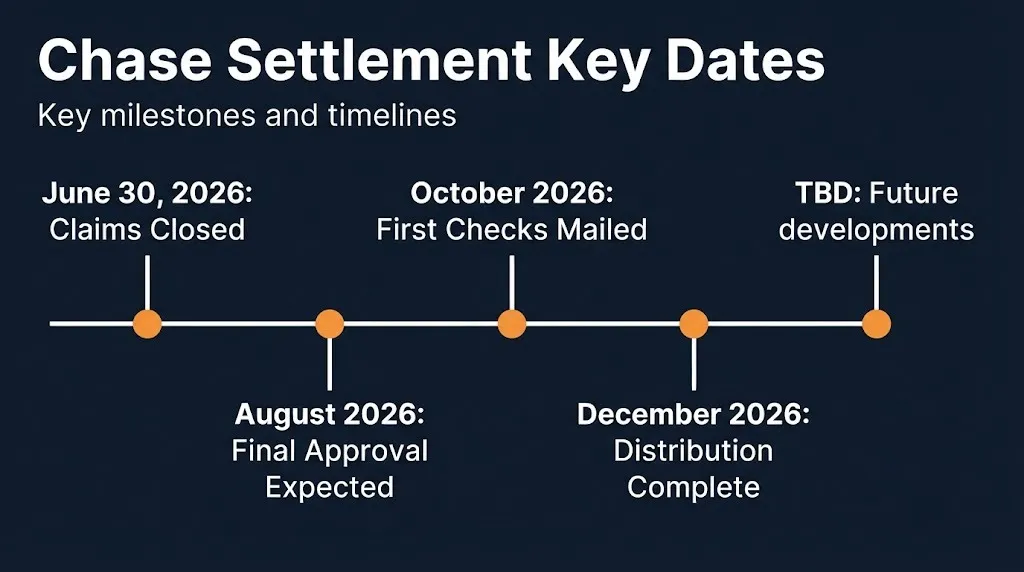
First checks for the credit card membership settlement are expected in October 2026, with full distribution completing by December 2026. This timeline assumes final court approval in August 2026. If objections delay approval, payments shift by two to three months.
The payment schedule from the settlement guide shows initial distribution covering 80% of claims in October and November, with secondary distributions in November and December. Electronic payments arrive three to five days faster than mailed checks.
For the Zelle fraud case, no payment timeline exists because no settlement has been reached. The New York Attorney General’s case remains active, but even a successful judgment would require a court-established claims process that could take additional months or years.
Chase Zelle Fraud Lawsuit: What Happened and Where It Stands
The Chase Zelle fraud lawsuit is not settled as of September 2026. The CFPB filed a case in December 2024 alleging Chase and other banks failed to protect customers from fraud on Zelle. The agency claimed Chase customers lost over $360 million across 420,000 accounts, with average losses around $857 per fraudulent transaction.
The CFPB voluntarily dismissed its case in March 2025 without explanation or compensation terms. New York Attorney General Letitia James filed a separate lawsuit in August 2025 seeking $1 billion in restitution, but that case only covers New York consumers and remains unresolved.
If you were scammed on Zelle through Chase, you currently have no class action settlement to join. You can still pursue individual reimbursement claims or contact your state attorney general.
Key Takeaway
The Zelle fraud case has no settlement fund, and the CFPB’s dismissal in 2025 left victims without a coordinated path to compensation.
Is Chase Bank Still Suing Customers Over the TikTok Glitch?
Yes, Chase continues pursuing customers who exploited the 2024 TikTok ATM glitch, and those customers are not class members in any settlement. The viral “money hack” encouraged people to write bad checks and withdraw funds before the checks cleared. Chase treated these transactions as fraud, not bank errors.
By 2026, Chase has filed civil lawsuits in state courts, obtained default judgments when defendants failed to appear, and pursued wage garnishment and bank account levies. Federal prosecutors have also charged individuals who withdrew large amounts, with some guilty pleas resulting in probation and restitution, and others facing prison time.
There is no settlement fund for glitch participants. The legal activity flows in the opposite direction: Chase suing customers, not customers suing Chase. Scammers offering “Chase debt forgiveness programs” for upfront fees are running a con. Chase does not use third-party companies for that purpose.
What Happens Next in the Chase Lawsuits
August 2026: Final approval hearing for the credit card membership settlement (expected). October 2026: First settlement checks mailed or electronically deposited. December 2026: Full distribution completed for approved claims. 2027: Continued litigation in the New York Zelle case and private class actions. TBD: Any future settlement in the data breach case.
Frequently Asked Questions
Is the Chase lawsuit settlement real?
Yes, multiple Chase class actions are real and documented in federal court records. The credit card membership settlement is the furthest along, with payouts expected in late 2026.
How much will I get from the Chase settlement?
Most claimants in the credit card settlement can expect $25 to $400. Payouts depend on how many annual fees you paid and what documentation you provide.
What is the deadline to file a Chase settlement claim?
The credit card membership settlement claim deadline was June 30, 2026, and it has passed. No extensions were granted.
Can I still join the Chase class action lawsuit in 2026?
You can no longer file a claim in the credit card settlement. Other cases, including the Zelle fraud litigation, do not have open claims processes at this time.
How do I prove I paid Chase membership fees?
Billing statements showing annual fee charges are the best proof. Account closure confirmations, Chase email notifications, or bank statements showing payments to Chase also work.
Will joining a Chase settlement affect my bank account?
No, participating in a settlement does not affect your Chase accounts or credit standing. Chase cannot close your accounts or change your terms because you filed a claim.
When will Chase settlement checks arrive?
First checks are expected in October 2026, with full distribution by December 2026, assuming final court approval in August 2026.
What happens if I miss the Chase settlement deadline?
You lose the right to any payout from that specific settlement. Watch for future Chase class actions with new claim periods.
Your Next Move
If you filed a claim in the Chase credit card settlement, watch for emails from the settlement administrator and verify your mailing address is current. Payments start going out in October 2026, and a wrong address means a delayed or lost check. If you missed the deadline, bookmark the official settlement administrator’s site and court records for future cases. The Zelle fraud litigation and data breach case could eventually produce new claim windows. The single most important date to remember: October 2026, when the first Chase settlement checks arrive.