Flores Settlement Agreement in 2026: Status, Legal Challenges, and What It Means
Quick Answer
- The Flores Settlement Agreement is a 1997 consent decree setting nationwide standards for the detention, treatment, and release of immigrant minors in U.S. custody.
- It is not a payout program. No money, claim forms, or settlement funds go to individuals.
- The Trump administration’s motion to terminate the agreement was denied, but the appeal is pending before the Ninth Circuit as of 2026.
Introduction to the Flores Settlement Agreement
The Flores Settlement Agreement is a landmark 1997 consent decree that established nationwide standards for how the U.S. government must detain, treat, and release immigrant children in federal custody. It is not a financial settlement, and no individual receives compensation from it.
The agreement came from a class-action lawsuit filed in 1985 on behalf of Jenny Lisette Flores, a 15-year-old who fled El Salvador and was detained in harsh conditions. After more than a decade of litigation, the government agreed to binding standards in 1997.
This article explains what the agreement requires, how the Trump administration has tried to terminate it, what the courts have ruled, and what the appointment of a Special Master in August 2026 means. One critical detail: the agreement applies to all minors in immigration custody, including children apprehended with their parents, not just unaccompanied children.
The Facts
| Item | Detail |
|---|---|
| Case Name | Jenny L. Flores v. Edwin Meese (originally Flores v. Reno) |
| Court | U.S. District Court for the Central District of California |
| Case Number | 2:85-cv-04544 (DMG) |
| Status | Active and enforceable. Government motion to terminate denied. Appeal pending in Ninth Circuit. |
| Settlement Fund | Not applicable. This is a consent decree, not a monetary settlement. |
| Est. Per Person | Not applicable. No individual payments. |
| Claim Deadline | Not applicable. No claims process. |
| Administrator | Flores counsel (Center for Human Rights and Constitutional Law, National Center for Youth Law) and court-appointed monitors |
| Proof Needed | Not applicable. The agreement is enforced through court oversight, not individual claims. |
Is the Flores Settlement Agreement Still in Effect in 2026?
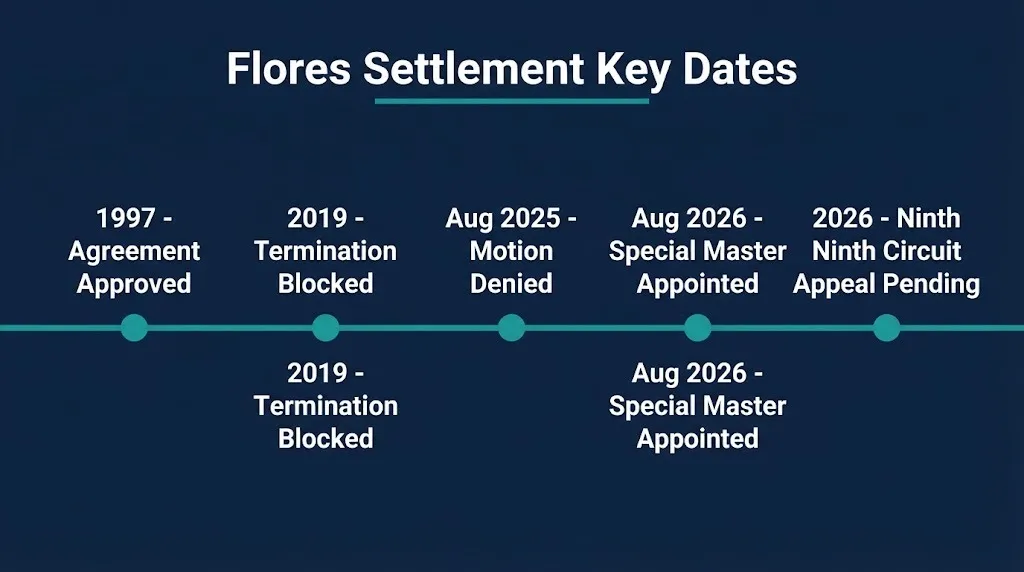
Yes, the Flores Settlement Agreement remains in effect in 2026. A federal judge denied the Trump administration’s motion to terminate it in August 2025, finding the government was not in substantial compliance.
The government filed a notice of appeal to the Ninth Circuit in July 2026. That appeal is pending. The agreement remains binding while the appeal proceeds.
In August 2026, the federal court took the extraordinary step of appointing a Special Master and Independent Monitor to oversee government compliance. This came after more than a year of documented violations, including children held for weeks or months beyond the 20-day limit.
The court noted that despite fewer children crossing the border, CBP has detained hundreds of children in conditions described as “cement prisons” with no access to the outdoors, no privacy, and inadequate medical care.
Key Takeaway: The Flores Settlement Agreement is still the law of the land, but the government is fighting to end it in the Ninth Circuit, and a court-appointed monitor is now watching for violations.
What Does the Flores Settlement Agreement Require?
The Flores Settlement Agreement requires the government to follow specific rules when detaining immigrant minors. These rules have the force of law and bind the government’s agents, employees, and contractors.
Here are the core requirements:
- Release without unnecessary delay: Children must be released to a parent, legal guardian, adult relative, or licensed program as quickly as possible.
- Least restrictive setting: If release is not possible, children must be placed in the least restrictive setting appropriate to their age and needs.
- Licensed facilities: Children must be held in state-licensed facilities designed for their care, not in unlicensed detention centers or hotels.
- 20-day limit: Children in family detention cannot be held for more than 20 days.
- Basic standards of care: The agreement sets standards for food, water, medical care, toilets, temperature control, and supervision.
The agreement also requires that children be treated “with dignity, respect, and a special concern for their particular vulnerability”.
How Has the Trump Administration Tried to Terminate the Agreement?
The Trump administration has made multiple attempts to terminate the Flores Settlement Agreement, both in 2019 and again starting in May 2025. All attempts have failed so far.
The first attempt came in 2019 when the government published regulations aimed at superseding the agreement. A federal court blocked those regulations, and the Ninth Circuit affirmed that decision.
The second attempt began on May 22, 2025, when the DOJ filed a motion to terminate the agreement in the Central District of California. The government argued that new regulations and the Supreme Court’s decision in Garland v. Aleman-Gonzalez justified termination.
On August 15, 2025, Judge Dolly Gee denied the motion. She found the government was not in substantial compliance and that there had been no meaningful change in factual conditions or law. She wrote that improvements in detention conditions were “direct evidence that the FSA is serving its intended purpose, but to suggest that the agreement should be abandoned because some progress has been made is nonsensical”.
The government appealed to the Ninth Circuit in July 2026. That appeal is pending.
What Did the Courts Rule on the Motion to Terminate?
The federal district court denied the government’s motion to terminate the Flores Settlement Agreement on August 15, 2025. The court found the government had not met the legal standard for termination.
Judge Gee’s order addressed several arguments. The government claimed that its 2024 regulations for unaccompanied children complied with the agreement’s goals. The court found the government had not yet achieved substantial compliance.
The government also argued that the One Big Beautiful Bill Act (OBBBA) overrode the agreement by funding family detention. A coalition of 20 state attorneys general and 25 senators filed amicus briefs rejecting that argument. They argued that an appropriation cannot implicitly repeal substantive law and that Congress would have legislated expressly if it intended to override Flores.
The court’s denial is now on appeal before the Ninth Circuit. The agreement remains in effect while that appeal is pending.
What Is the Government Doing That Violates the Agreement?
The government has been documented violating the Flores Settlement Agreement in multiple ways. Court filings describe a pattern of systemic non-compliance.
Prolonged detention beyond 20 days: As of January 2026, DHS had confined more than 900 children in family detention centers for longer than 20 days. About 270 were confined for more than 40 days. Some families were detained for more than nine months.
Unlicensed hotels: The government has imprisoned children and families in unlicensed hotel rooms for extended periods. Families report being watched at all times, including while sleeping, and not allowed outside or permitted outgoing phone calls.
Unsafe conditions: Children report freezing temperatures, paper-thin blankets, lights left on all night, exposed toilets, and no soap. One mother detained with her husband and 6-year-old daughter for 104 days said there were no showers for the first four days.
Lack of medical care: Families at the Dilley facility in Texas describe delayed medical attention, contaminated food, and mental health deterioration.
What Happens Next with the Flores Settlement Agreement?
The future of the agreement depends on the Ninth Circuit appeal and continued enforcement efforts. Here is the expected timeline:
Pending 2026: Ninth Circuit reviews the government’s appeal of the denial to terminate the agreement.
Ongoing 2026-2027: Court-appointed Special Master and Independent Monitor oversee compliance, including detention times, conditions, and data reporting.
Ongoing: Flores counsel continue filing motions to enforce the agreement based on violations documented through facility inspections and declarations.
Expected 2027: If the Ninth Circuit affirms the denial, the government may seek Supreme Court review.
Frequently Asked Questions
Is the Flores Settlement Agreement a payout program?
No. The Flores Settlement Agreement is a consent decree setting standards for immigrant child detention. It does not provide money or compensation to individuals.
Can I file a claim under the Flores Settlement Agreement?
No. There is no claims process or fund. The agreement is enforced through court oversight and motions filed by Flores counsel.
Is the Flores Settlement Agreement still in effect?
Yes. The government’s motion to terminate was denied, and the agreement remains binding while the appeal is pending before the Ninth Circuit.
What does the 20-day limit mean?
The agreement requires that children in family detention not be held longer than 20 days. Court filings show the government has routinely violated this limit.
Who oversees compliance with the Flores Settlement Agreement?
Flores counsel (Center for Human Rights and Constitutional Law and National Center for Youth Law) monitor compliance. In August 2026, the court appointed a Special Master and Independent Monitor to oversee the government’s compliance.
What happens if the Ninth Circuit terminates the agreement?
If the Ninth Circuit rules for the government, the agreement could end, and the 20-day limit and other protections could be eliminated. The case could then go to the Supreme Court.
Who was Jenny Flores?
Jenny Lisette Flores was a 15-year-old who fled El Salvador in 1985 and was detained by immigration authorities. She was handcuffed and strip-searched, and the government refused to release her to her aunt. Her case led to the settlement that bears her name.
Does the agreement apply to children detained with their parents?
Yes. In 2015, a federal court ruled that the Flores requirements apply to both unaccompanied minors and children apprehended with their parents.