Homeowner Wins Lawsuit Against HOA: 2026 Cases, Legal Grounds, and How to Win Yours
Quick Answer
- Yes, homeowners regularly win real lawsuits against HOAs when the association violates its own governing documents or state law.
- Verified 2026 judgments range from a few hundred dollars in refunded fees to over $33,000 in damages and attorney’s fees.
- There’s no universal filing deadline, since it depends on your state’s statute of limitations, typically two to four years from the violation.
If you’re searching “homeowner wins lawsuit against HOA,” you’re likely mid-dispute with your own association and want proof this actually happens. It does, and it happened again just this month.
Unlike a class action with one settlement fund, this is a pattern playing out in courtrooms across the country, case by case. In May 2026, a Bexar County, Texas judge ordered an HOA and its board president to pay a combined $33,243.39 to a homeowner after a three-year fight over rental restrictions. That’s not an outlier, it’s one of several documented 2026 wins covered below.
This guide walks through what actually won in court this year, the legal grounds that give homeowners real leverage, and the concrete steps that separate a winning case from a wasted one. One detail most guides skip: even when homeowners win, the money to pay that judgment often comes out of the same community’s dues.
The Facts
| Category | Verified Status |
|---|---|
| Case | Elizabeth Luna v. Oaks Northwest Homeowners Association and board president Terri Thomure |
| Court | Bexar County, Texas |
| Status | Resolved. Judgment entered in Luna’s favor in May 2026 |
| Judgment Amount | $33,243.39 total: $20,743.39 from the HOA, $12,500 from Thomure personally |
| Legal Basis | Improper notice under Texas Property Code Section 209.0051 for a special meeting that adopted a rental restriction |
| Claim Deadline | Not applicable, this case is closed. General HOA lawsuit deadlines depend on your state’s statute of limitations |
| Administrator | Not applicable, this was an individual lawsuit, not a class settlement |
| Proof Needed | Not applicable to this specific case; general evidence requirements are covered below |
Can a Homeowner Really Win a Lawsuit Against an HOA?
Yes. Homeowners win lawsuits against HOAs when the association violates its own governing documents, ignores state notice requirements, or oversteps its legal authority.
Courts don’t automatically side with HOA boards just because they hold power over a community. Judges look at whether the association followed its own bylaws, complied with state statutes, and acted within the authority its governing documents actually grant.
Recent confirmed 2026 examples where homeowners won:
- Elizabeth Luna won $33,243.39 against Oaks Northwest HOA and its board president in Bexar County, Texas.
- A Missouri family kept their swingset after a judge ruled the HOA couldn’t force them to repaint it.
- An Arizona homeowner won an injunction stopping further fines from Talus Homeowners’ Association in Maricopa County Superior Court.
Key Takeaway: Winning against an HOA isn’t rare or theoretical, it happened in multiple documented 2026 cases across different states.
Is Winning Against an HOA Common, or Rare?
It’s more common than most homeowners assume, though most disputes never reach a courtroom at all. Many resolve through demand letters, mediation, or the HOA backing down once a homeowner pushes back with documentation.
That said, formal lawsuits that go all the way to judgment are less common simply because litigation is expensive and slow. Elizabeth Luna’s case took three years from the disputed meeting to a final judgment, which reflects the real timeline for a contested HOA lawsuit, not a quick win.
More than 77.1 million Americans now live in a community association, according to the Community Associations Institute’s January 2026 advocacy report, which counted roughly 369,000 associations nationwide. That scale means disputes are inevitable, but most get resolved before a judge ever rules.
How Much Can a Homeowner Win in a Lawsuit Against an HOA?
Amounts vary widely depending on the violation, the state, and whether attorney’s fees get awarded on top of damages. There’s no standard payout, because these are individual lawsuits, not a shared settlement fund.
| Case | Verified Outcome |
|---|---|
| Luna v. Oaks Northwest HOA (Texas, 2026) | $33,243.39 total: $20,743.39 from HOA, $12,500 from board president personally |
| Pope v. La Vida Homeowners Association (Arizona, 2022) | HOA ordered to comply with maintenance obligations, $500 filing fee refunded; the administrative judge lacked authority to award the roughly $28,486 in damages requested |
| Duncan v. LaBlonde Development / Talus HOA (Arizona, 2023) | Court granted a preliminary injunction stopping further HOA fines, but denied attorney’s fees to both sides |
| Florida case reported by ABA Journal (via Harper Law commentary) | Homeowners spent $220,000 in legal fees over an original $2,212 HOA bill, with fee reimbursement still pending court determination |
That range matters. Some wins put real money in a homeowner’s pocket, while others only stop the HOA’s bad behavior going forward without any damages at all.
What Did the San Antonio Homeowner Win Against Her HOA in 2026?
Elizabeth Luna won $33,243.39 in combined damages and legal fees against Oaks Northwest HOA and its board president after a three-year dispute over rental restrictions.
A Bexar County judge ordered the HOA to pay $20,743.39 and board member Terri Thomure to personally pay an additional $12,500 for interfering with Luna’s rental contract. Luna had secured a 12-month tenant lease, but the arrangement fell apart after Thomure allegedly approached the tenant’s assistant in a parking lot demanding identification and personal information.
The core legal argument: Luna’s HOA adopted a rental restriction through a March 2023 special meeting that didn’t comply with Texas Property Code Section 209.0051, which requires at least 72 hours notice for special meetings and 144 hours for regular ones. Luna argued the improper notice made the entire amendment void.
Luna has publicly said the HOA and Thomure have both paid what they owe, and she’s urging other homeowners to scrutinize whether their boards actually follow their own rules.
How Do I Sue My HOA and Actually Win?
Winning starts with documentation, not emotion, since courts decide cases on evidence, not frustration. Build your case methodically before you ever file.
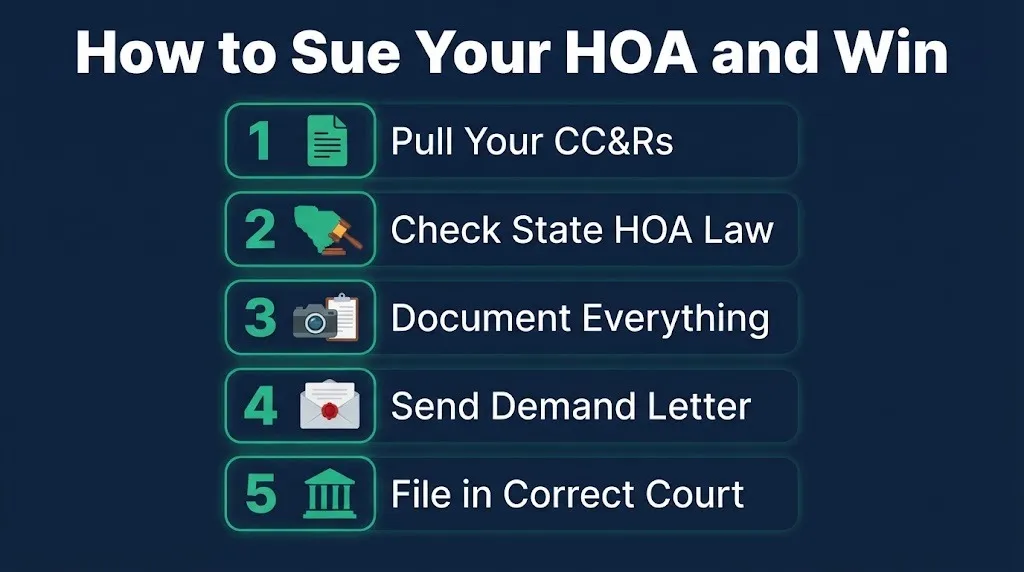
- Pull your CC&Rs, bylaws, and any amendment history related to the dispute.
- Compare exactly what the HOA did against what those documents actually authorize.
- Check your state’s specific HOA statute for notice, voting, and fine procedures.
- Document every interaction in writing, including dates, names, and outcomes.
- Send a formal demand letter citing the specific violation before filing suit.
- Consult an attorney who handles HOA litigation, many take strong cases on contingency.
- File in the correct court, small claims for smaller amounts, district court for larger ones.
- Keep every receipt, email, and photo tied to your damages throughout the process.
Key Takeaway: The strongest HOA lawsuits point to a specific rule the association broke, not a general complaint about being treated unfairly.
How Much Does It Cost to Sue an HOA?
Costs vary by case size and complexity, but many states have fee-shifting laws that can require the losing HOA to cover the homeowner’s attorney fees. That structure changes the financial calculus significantly.
Small claims court, available in most states for disputes under roughly $10,000 to $25,000 depending on the jurisdiction, is designed to be filed without an attorney and keeps costs low. Larger or more complex cases, like discrimination claims or fiduciary duty violations, typically need an attorney with HOA litigation experience.
Reality Check: No legitimate attorney or court process requires you to pay a stranger who contacts you out of nowhere claiming to help you “settle” with your HOA. Filing a real lawsuit goes through your local courthouse, and any legitimate contingency fee arrangement is explained in a signed agreement, not a cold call or text.
The Florida case reported by the ABA Journal is a cautionary example here: homeowners spent $220,000 fighting a $2,212 bill, and even after winning, court-awarded fee reimbursement wasn’t guaranteed to cover what they’d spent. Costs can spiral fast when a dispute turns into prolonged litigation.
How Long Do I Have to Sue My HOA?
There’s no single deadline, since the statute of limitations for HOA disputes depends entirely on your state and the type of claim. This is not a class action with one filing window for everyone.
Breach of contract claims, which cover most CC&R and governing document disputes, commonly run two to six years depending on the state. Claims involving fraud or specific statutory violations may have different, sometimes shorter, windows.
What to do regardless of your state’s deadline:
- Note the exact date of the violation or HOA action in writing.
- Check your state’s specific statute of limitations for breach of contract and any relevant HOA statute.
- Don’t wait to consult an attorney, since evidence and witness memory both degrade with time.
- File sooner rather than later, since a technically valid claim filed too late gets dismissed regardless of merit.
What’s the Latest Homeowner Win Against an HOA in 2026?
The most recent confirmed win is Elizabeth Luna’s $33,243.39 judgment against Oaks Northwest HOA, reported this week and finalized in May 2026. It’s currently the most detailed, court-documented HOA win of the year that we could verify.
Luna’s case is notable because it combined two separate legal theories: an improperly noticed governing document amendment, and personal interference by a specific board member with her rental contract. That combination let the court hold both the HOA and an individual board member financially accountable.
Key Takeaway: The Luna case shows courts will hold individual board members personally liable, not just the HOA entity, when they personally interfere with a homeowner’s rights.
What Other Homeowners Have Won Lawsuits Against Their HOA?
Beyond the 2026 Texas case, several other documented rulings show homeowners winning on different legal grounds. Each case turned on a distinct type of HOA overreach.
In Duncan v. LaBlonde Development Corporation and Talus Homeowners’ Association, a Maricopa County, Arizona court granted homeowners a preliminary injunction stopping the HOA from imposing further fines related to a construction defect dispute, though it denied attorney’s fees to both sides.
In Pope v. La Vida Homeowners Association, an Arizona administrative law judge found the HOA violated its own community documents by failing to maintain a common area tree that damaged the homeowner’s patio, ordering the HOA into compliance and refunding the homeowner’s $500 filing fee.
In an earlier Indiana appellate case, Feather Trace Homeowners Association v. Luster, the Indiana Court of Appeals affirmed a trial court ruling that a homeowner didn’t have to pay his assessment because the HOA itself had stopped maintaining the community’s public areas.
What Are the Most Common Reasons Homeowners Win Against HOAs?
Homeowners most often win when an HOA fails to follow its own procedural rules, oversteps the authority granted in its governing documents, or fails to maintain what it’s contractually obligated to maintain.
Common winning grounds across verified cases:
- Improper meeting notice, as in Luna’s Texas case involving state-mandated notice periods.
- Failure to maintain common areas the HOA is contractually responsible for, as in the Pope and Feather Trace cases.
- Overreach beyond what CC&Rs actually authorize, as in disputes over architectural restrictions.
- Individual board members personally interfering with a homeowner’s contracts or rights.
- Fines or enforcement actions that don’t follow the association’s own stated procedures.
Key Takeaway: Courts consistently rule for homeowners when the HOA’s own paperwork contradicts what the board actually did.
What Happens to the HOA After It Loses a Lawsuit?
When an HOA loses, it typically must pay the judgment, and that money usually comes from the association’s insurance, its reserve funds, or additional assessments on every homeowner in the community. It’s a bit like an unexpected repair bill in an apartment building: the cost eventually gets spread across everyone, even the residents who had nothing to do with the dispute.
If the HOA doesn’t carry adequate liability insurance for the type of claim involved, the board may need to levy a special assessment or raise regular dues to cover the judgment. That means even homeowners who weren’t part of the lawsuit can end up indirectly paying for the board’s mistake.
Individual board members, as seen in Luna’s case, can also be held personally liable separate from the HOA itself when their individual conduct crosses a legal line, which is a real financial risk board volunteers should understand.
Can I Sue My HOA in Small Claims Court?
Yes, for smaller disputes, small claims court is often available and doesn’t require hiring an attorney. Texas, for example, allows claims under $10,000 to be filed through a local justice of the peace court.
Small claims limits vary significantly by state, generally ranging from around $5,000 to $25,000 depending on where you live. This route is faster and cheaper than district court, making it the right fit for disputes over specific fines, smaller maintenance failures, or contract violations that don’t involve large sums.
Steps to file in small claims:
- Confirm your state and county’s small claims dollar limit.
- Gather your documentation, contracts, and any correspondence with the HOA.
- File your claim at the appropriate local court, often a justice of the peace or municipal court.
- Serve the HOA with notice according to your local court’s rules.
- Present your evidence at the hearing; most small claims courts don’t require formal legal briefs.
What’s the Difference Between Suing an HOA and Filing a State Administrative Complaint?
Some states offer an administrative complaint process as an alternative to a full lawsuit, though the remedies available are often more limited. Arizona’s Department of Real Estate, for example, handles certain HOA disputes through its Office of Administrative Hearings.
In the Pope case, the administrative law judge could order the HOA to comply with its governing documents and refund a filing fee, but explicitly stated she lacked the statutory authority to award the roughly $28,486 in monetary damages the homeowner had requested. That’s a meaningful limitation compared to a civil lawsuit.
When an administrative complaint may fit better:
- The core issue is getting the HOA to follow its own documents, not collecting damages.
- The state offers a lower-cost, faster administrative path for your type of claim.
- You want a formal ruling without the cost of full civil litigation.
A civil lawsuit remains the only path for recovering significant monetary damages in most cases.
Do Homeowners Always Win When They Sue Their HOA?
No. Homeowners lose HOA lawsuits regularly, particularly when they can’t point to a specific documented violation or when the cost of litigation outweighs any realistic recovery.
The Florida case reported by the ABA Journal illustrates this risk clearly: homeowners spent $220,000 in legal fees over an original $2,212 dispute, and even after prevailing, court-determined fee reimbursement wasn’t guaranteed to make them whole. Litigation against a well-funded HOA board can become a war of attrition regardless of who’s technically right.
Courts also don’t automatically favor homeowners just because HOAs can seem heavy-handed. Judges rule based on the governing documents, applicable state statutes, and the evidence presented, not sympathy for either side.
What Happens Next
May 2026: A Bexar County judge entered judgment in Luna’s favor, ordering payment from both the HOA and its board president.
September 2026: Luna publicly confirmed both parties have paid the judgment in full.
Ongoing: State legislatures, including several currently in 2026 legislative sessions per the Community Associations Institute, continue considering HOA reform bills that could affect notice requirements and homeowner protections nationwide.
Expected, ongoing: More individual HOA lawsuits will continue moving through courts nationwide, each decided on its own specific facts and state law.
Frequently Asked Questions
Can a homeowner really win a lawsuit against their HOA?
Yes, homeowners win HOA lawsuits regularly when the association violates its governing documents or state law.
A Texas homeowner won $33,243.39 against her HOA and its board president in a case resolved in May 2026.
Winning typically requires documented proof of a specific rule violation, not just general dissatisfaction.
How much money can you get from suing your HOA?
Amounts vary widely, from a few hundred dollars in refunded fees to over $33,000 in damages and legal costs in verified 2026 cases.
There’s no standard payout because these are individual lawsuits, not a shared settlement fund.
The amount depends on your specific damages, your state’s laws, and whether attorney’s fees get awarded.
What is the most common reason homeowners win against HOAs?
The most common reason is the HOA failing to follow its own governing documents or state-mandated procedures.
This includes improper meeting notice, failure to maintain common areas, or enforcement actions that exceed the board’s actual authority.
Courts consistently rule for homeowners when an association’s own paperwork contradicts its actions.
How long do I have to sue my HOA?
There’s no single deadline, since the statute of limitations depends on your state and the type of claim involved.
Breach of contract claims commonly run two to six years depending on the state.
Consult an attorney promptly, since waiting too long can bar an otherwise valid claim.
Can I sue my HOA without a lawyer?
Yes, for smaller disputes, small claims court allows homeowners to file without an attorney.
Texas permits claims under $10,000 through local justice of the peace courts, and other states have similar thresholds.
Larger or more complex cases generally benefit from an attorney experienced in HOA litigation.
Who pays when an HOA loses a lawsuit?
The HOA typically pays through its insurance, reserve funds, or a special assessment on all homeowners in the community.
This means even homeowners uninvolved in the original dispute can end up indirectly covering the cost.
Individual board members can also be held personally liable in some cases, separate from the HOA itself.
Is it worth suing my HOA over a small dispute?
Not always, since litigation costs can exceed the amount in dispute even when you win.
One Florida case involved $220,000 in legal fees over an original $2,212 bill.
Small claims court is often the more cost-effective path for smaller, well-documented disputes.
Bottom Line
Homeowners do win real, verified lawsuits against HOAs, and the most recent example closed out this month with a $33,243.39 judgment in Texas. Whether you’d win depends entirely on documented proof that your HOA broke its own rules or state law.
Pull your governing documents, check your state’s specific HOA statute, and document every interaction before you file anything. That preparation is what separated Elizabeth Luna’s successful three-year fight from a case that never gets off the ground.