West Capital Lending Lawsuit 2026: LO Comp Rule, Regulatory Fines, and Active Court Cases
Quick Answer
- West Capital Lending is both a plaintiff suing loanDepot over alleged illegal loan officer compensation practices and a defendant in TCPA class actions.
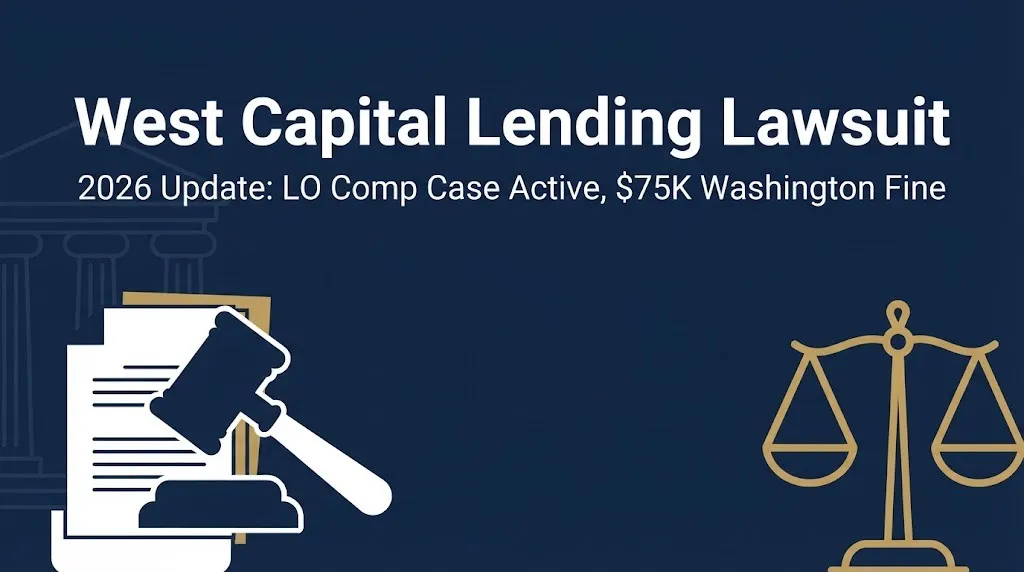
- The Washington State Department of Financial Institutions fined the company $75,000 in July 2026 for multiple Consumer Loan Act violations.
- The LO Comp lawsuit against loanDepot involves forward-looking injunctive relief only, after West Capital withdrew its monetary restitution claim.
The Facts
| Primary Active Case | West Capital Lending, Inc. v. loanDepot.com, LLC (8:26-cv-00522) |
|---|---|
| Court | U.S. District Court, Central District of California |
| Status | Motion to Dismiss argued August 27, 2026 |
| Allegation | loanDepot violated California’s Unfair Competition Law through illegal loan officer compensation |
| Relief Sought | Injunctive relief only (monetary restitution withdrawn June 2026) |
| Washington State Fine | $75,000 plus $3,000 investigation fee |
| TCPA Class Actions | Perry v. West Capital Lending (Arkansas), Cohen v. West Capital Lending (California) |
| Settlement Fund | Not yet confirmed |
What Is the West Capital Lending Lawsuit Against loanDepot About?
The West Capital Lending lawsuit against loanDepot is a rare competitor-versus-competitor fight over the Loan Officer Compensation Rule. West Capital Lending (often called WestCap) filed suit in early 2026, accusing loanDepot of violating California’s Unfair Competition Law by tying originators’ compensation to loan terms and targeting rivals with pricing exceptions .
WestCap claims that loanDepot’s production managers granted pricing exceptions, even when losing money on a loan, for customers who were weighing offers from competitors like WestCap . The smaller shop says this behavior limited its market share because it cannot compete on pricing when it plays by the rules.
loanDepot fired back in its July 16 filing. The company denied the allegations and accused WestCap of “smuggling” business grievances under the guise of a regulatory complaint . loanDepot also pointed out that WestCap withdrew its earlier claim for monetary restitution in June 2026, leaving only forward-looking injunctive relief on the table .
The hearing on loanDepot’s motion to dismiss took place on August 27, 2026, before Magistrate Judge John D. Early in the Central District of California .
Is the West Capital Lending Lawsuit Legitimate?
Yes, the West Capital Lending lawsuit is a legitimate federal court case. The docket is active, the attorneys are named, and the hearing was scheduled before a federal magistrate judge .
The case was filed under the Truth in Lending Act (TILA) cause of action, specifically 15 U.S.C. § 1601 . That’s the same statute that governs the Loan Officer Compensation Rule, which restricts how mortgage lenders can pay their originators.
The National Mortgage News reported on the case in July 2026, noting that these are “rare complaints of a lender violating the LO Comp Rule” . The Consumer Financial Protection Bureau’s stance on private rights of action under the rule is central to loanDepot’s defense.
loanDepot argues that the LO Comp Rule’s private right of action is reserved for consumers impacted by non-compliance, not competitors . The company also suggests its production managers are not “originators” under the CFPB’s statute, and that nothing in the law prevents it from charging any initial rate it wants or lowering it to match a rival’s offer .
If the judge agrees with loanDepot, the case could be dismissed. If the judge sides with WestCap, the case proceeds to discovery and potentially a trial.
Key Takeaway
Key Takeaway: The West Capital Lending lawsuit against loanDepot is a live federal case that hinges on whether a competitor can sue under the LO Comp Rule, with a motion to dismiss argued in August 2026.
How Much Is the West Capital Lending Lawsuit Worth?
Not yet determined. The lawsuit against loanDepot seeks only forward-looking injunctive relief, not monetary damages. WestCap withdrew its restitution claim in June 2026 .
That means there is no settlement fund, no payout pool, and no money set aside for consumers from this specific case. If WestCap wins, the court could order loanDepot to change its compensation practices, but it would not write a check to WestCap for lost business.
For the TCPA class actions against West Capital Lending, no settlement amounts have been announced. TCPA cases can result in statutory damages of $500 to $1,500 per illegal call or text, but that depends on whether the class is certified and whether a settlement is reached.
Here’s what is confirmed versus pending:
| Item | Status |
|---|---|
| Settlement Fund (loanDepot case) | None. Injunctive relief only. |
| Settlement Fund (TCPA cases) | Not yet confirmed |
| Regulatory Fine (Washington) | $75,000 paid or agreed |
| Attorney Fees | Not applicable to consumer claims |
Who May Qualify for the TCPA Class Actions?
You may qualify for a TCPA class action against West Capital Lending if you received unwanted telemarketing calls or texts from the company without consent. Two class actions are currently active.
The first is Perry v. West Capital Lending, Inc., filed in the Eastern District of Arkansas (Case No. 4:26-cv-00094) on February 3, 2026 . The complaint alleges violations of the Telephone Consumer Protection Act, which restricts the use of telephone equipment for unsolicited calls .
The second is Cohen v. West Capital Lending, Inc., filed in the Central District of California (Case No. 8:26-cv-00496) on March 3, 2026 . This is also a TCPA case.
A third TCPA case, Perez v. West Capital Lending, was voluntarily dismissed with prejudice on March 16, 2026 .
To potentially qualify for a TCPA class action, you would need to have received calls or texts from West Capital Lending that you did not consent to. The class period and specific criteria are not yet confirmed for either case.
Reality Check: You do not need to hire a lawyer or pay anyone to join a class action. If a class is certified and a settlement is reached, you will be notified through official channels. Third parties charging fees to “register” you for a class action are unnecessary.
What Happened with the Washington State Fine?
Washington state regulators fined West Capital Lending $75,000 after alleging multiple violations of the state’s Consumer Loan Act. The consent order was entered on July 8, 2026 .
The Washington State Department of Financial Institutions cited a long list of violations, including:
- Unlicensed activity: The company took at least one residential mortgage loan application for a Washington property before obtaining a state license
- Unlicensed managers: At least six managers supervising Washington-licensed mortgage loan originators were not licensed by the state
- Failed supervisory plans: The company failed to prepare and maintain at least 34 supervisory plans for its managers
- Surety bond lapse: West Capital failed to maintain required surety bond coverage for 2023 and 2024
- Reporting failures: The company did not submit timely annual reports for 2022 and 2023, and failed to submit accurate reports for those years
- Rate lock delays: At least four borrowers did not receive rate lock agreements within three business days
- Prohibited advertising: The company used phrases like “lowest interest rates and closing costs possible”
- Compensation violations: At least one loan originator was compensated based on profit the company received from that originator’s loans
The company did not admit to the allegations or any wrongdoing as part of the settlement . West Capital waived its right to a hearing and withdrew its appeal to the state’s Office of Administrative Hearings .
This is not West Capital’s first regulatory action. In a 2023 settlement, the company was accused of nearly identical allegations in Hawaii, Oregon, and Idaho. Those states imposed administrative penalties totaling more than $464,000 .
Key Takeaway
Key Takeaway: Washington state fined West Capital Lending $75,000 in July 2026 for a pattern of licensing, reporting, and compensation violations that mirrors earlier penalties from other states.
What Is the Loan Officer Compensation Rule?
The Loan Officer Compensation Rule is a federal regulation that restricts how mortgage lenders can pay their loan originators. It prohibits compensation that varies based on the loan’s terms or conditions, like the interest rate or the presence of prepayment penalties.
The rule exists to prevent loan officers from steering borrowers into higher-cost loans just to earn bigger commissions. When a loan officer’s pay goes up because the rate is higher, the borrower pays for that incentive.
West Capital Lending claims loanDepot violated this rule by tying originators’ compensation to loan terms . loanDepot counters that its production managers are not “originators” under the statute, and that the law does not prohibit it from charging high rates and then discounting them to match competitors .
The case raises a novel legal question: can a competitor sue another lender for LO Comp Rule violations? loanDepot says no, arguing the private right of action belongs only to consumers . WestCap says yes, framing loanDepot’s conduct as unfair competition that harmed its business.
How to Check the Status of a West Capital Lending Case
You can check the status of any federal case against or involving West Capital Lending through the Public Access to Court Electronic Records (PACER) system. The case numbers are:
- West Capital Lending v. loanDepot: 8:26-cv-00522 (Central District of California)
- Perry v. West Capital Lending: 4:26-cv-00094 (Eastern District of Arkansas)
- Cohen v. West Capital Lending: 8:26-cv-00496 (Central District of California)
Here are the steps to check a case:
- Go to the PACER website and create an account.
- Search by case number or party name.
- Pay the per-page fee (currently $0.10 per page, capped at $3.00 per document).
- Download the docket to see all filings and hearing dates.
- Check for notices of settlement or class certification.
For the Washington state regulatory action, the consent order is available through the Washington State Department of Financial Institutions website.
What Happens Next in the West Capital Lending Cases?
Here is the expected timeline for the active cases:
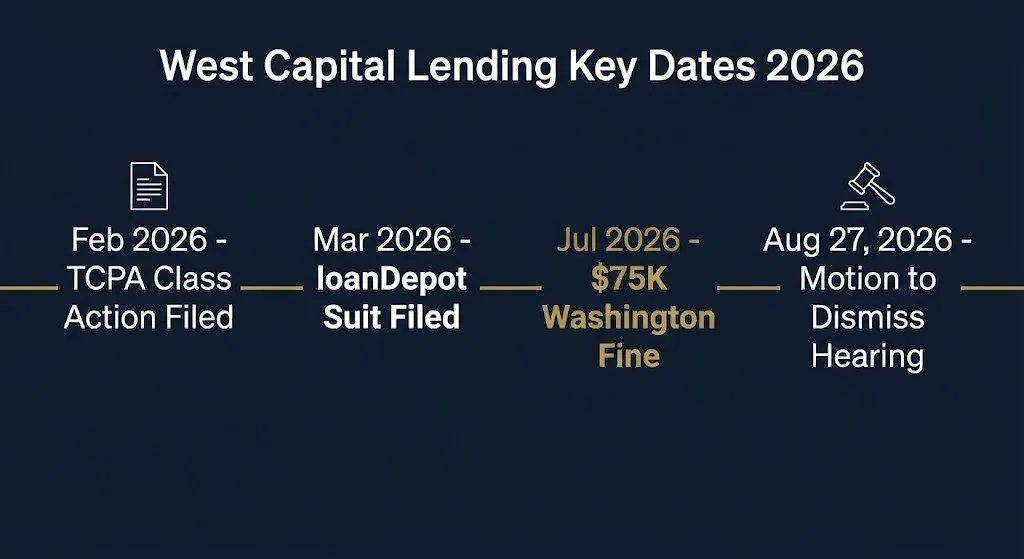
August 27, 2026: Motion to dismiss hearing in West Capital Lending v. loanDepot . The judge will decide whether the case proceeds or is dismissed.
Expected late 2026: Ruling on the motion to dismiss. If denied, the case moves to discovery.
Expected 2027: Class certification decisions in the TCPA cases (Perry and Cohen), if they proceed.
Ongoing: Washington state investigation. The Department’s investigation into alleged violations was continuing at the time of the September 2025 statement of charges .
TBD: Any settlement announcements in the TCPA cases. No settlement funds have been confirmed.
Frequently Asked Questions
Is West Capital Lending being sued?
Yes. West Capital Lending is the defendant in two active TCPA class actions: Perry v. West Capital Lending in Arkansas and Cohen v. West Capital Lending in California.
What is the West Capital Lending lawsuit against loanDepot about?
West Capital Lending accuses loanDepot of violating California’s Unfair Competition Law by tying loan officer compensation to loan terms and targeting rivals with pricing exceptions.
How much is the West Capital Lending lawsuit worth?
Not yet determined. The lawsuit against loanDepot seeks only injunctive relief, not monetary damages. No settlement fund has been established.
Did West Capital Lending settle with Washington state?
Yes. West Capital Lending agreed to pay a $75,000 fine plus a $3,000 investigation fee in a consent order entered July 8, 2026, without admitting wrongdoing.
What is the Loan Officer Compensation Rule?
It is a federal regulation that prohibits mortgage lenders from paying loan originators based on loan terms like interest rate or prepayment penalties.
Can I join a class action against West Capital Lending?
If you received unwanted calls or texts from West Capital Lending, you may potentially qualify for the TCPA class actions. No claim deadline has been announced.
How do I check if I’m part of the TCPA class?
You would need to have received calls or texts from West Capital Lending without consent. Class certification has not yet been decided in either case, so no official class list exists yet.
What happened to the Perez v. West Capital Lending case?
The case was voluntarily dismissed with prejudice on March 16, 2026. That means the plaintiff chose to end the case and cannot refile the same claim.
Your Next Step
If you received unwanted calls or texts from West Capital Lending, document the dates, times, and phone numbers. Keep any voicemails or text messages.
Check the PACER docket for the TCPA cases to see if class certification is granted. If a class is certified, you will receive notice through official channels. You do not need to pay anyone to monitor the case for you. The docket is public, and the official notices are free.