Fidelity Data Breach Settlement 2026: $5,000 Claims Close July 27
Quick Answer
- The Fidelity data breach settlement is real and court-approved, resolving a 2024 hack that exposed data on roughly 77,099 people.
- Most filers can expect a $100 no-proof cash payment, with up to $5,000 available for documented losses.
- The claim deadline is July 27, 2026. Miss it and you get nothing.
If you got a notice about Fidelity’s 2024 data breach, you’re likely wondering whether this settlement is legitimate and whether it’s worth your time. It is legitimate. A federal judge in Massachusetts granted final approval on July 9, 2026, clearing the way for payments.
This affects anyone whose Fidelity account number, routing number, Social Security number, or driver’s license data was exposed between August 17 and August 19, 2024. The claim deadline, July 27, 2026, is the single date that matters most right now.
This article covers eligibility, exact payment amounts, how to file, and what happens after the deadline passes. One detail surprised us: Massachusetts regulators separately fined Fidelity $1.25 million, a penalty that has nothing to do with your settlement check.
The Facts
| Case | In re: Fidelity Investments Data Breach Litigation, No. 1:24-CV-12601-LTS |
| Court | U.S. District Court, District of Massachusetts |
| Status | Final approval granted July 9, 2026 |
| Fund Size | $2.5 million |
| Est. Per Person | ~$100 cash (no proof), up to $5,000 with documentation |
| Claim Deadline | July 27, 2026 |
| Administrator | Settlement Administrator, P.O. Box 25226, Santa Ana, CA 92799-9958 |
| Proof Needed | Receipts, statements, or written documentation for loss claims over $100 |
Is the Fidelity data breach settlement legit?
Yes, this settlement is a real, court-supervised class action, not a scam text or phishing scheme. It stems from a lawsuit filed after Fidelity disclosed a 2024 cybersecurity incident.
U.S. District Judge Leo T. Sorokin oversees the case in Massachusetts federal court. He granted preliminary approval earlier this year and signed off on final approval at a hearing on July 9, 2026.
Fidelity denies any wrongdoing. The company agreed to settle to avoid the cost and uncertainty of continued litigation, which is standard language in most corporate settlements, not an admission of fault.
Key Takeaway: The Fidelity settlement is a court-approved legal process, verified through official case filings, not a random payout offer.
What happened in the Fidelity data breach?
Fidelity detected suspicious activity on its network and later confirmed that a third party accessed customer data files without authorization. The intrusion happened over three days.
Here’s what was exposed:
- Full names
- Social Security numbers
- Financial account numbers and routing numbers
- Driver’s license numbers
Court documents put the number of affected people at 77,099. A separate media report cited a figure closer to 155,000, so treat the higher number as not yet confirmed against the official court record.
Massachusetts Secretary of the Commonwealth William Galvin fined Fidelity Brokerage Services $1.25 million separately, finding weak enforcement of its own cybersecurity rules let the breach happen. That fine is a state regulatory action. It does not add money to your settlement check.
Who qualifies for the Fidelity settlement?
You may qualify if Fidelity sent you a notice letter or email saying your account number and routing number were compromised in the August 2024 incident.
Two groups are covered:
- People who received direct notice from Fidelity about the breach.
- People whose account and routing numbers were exposed but who never got a direct notice.
If you fall into the second group, use the ID lookup tool on the official settlement website, or call the administrator, to confirm your status before the deadline.
Reality Check: No one from a real settlement will text you first asking for a fee to release your money. Filing a claim is always free. Third-party “claim recovery” services charging you to file are unnecessary and add no benefit you can’t get directly.
How much money can you get from the Fidelity settlement?
You can expect a roughly $100 cash payment with no proof required, plus up to $5,000 if you document actual losses tied to the breach.
Here’s the tier breakdown, based on the official settlement terms:
| Benefit | Amount | Proof Required |
|---|---|---|
| Pro rata cash payment | ~$100 (may adjust up or down based on claim volume) | No |
| California CCPA payment | +$50 additional | Residency confirmation only |
| Documented loss reimbursement | Up to $5,000 | Yes, receipts/statements |
| Identity theft protection | 2 years, includes $1 million fraud insurance | No |
The $100 figure is an estimate, not a guarantee. Because the total fund is fixed at $2.5 million, your actual pro rata payment depends on how many people file valid claims. More claimants means a smaller per-person slice.
California residents get an extra $50 on top of the base payment, with no documentation needed beyond confirming you lived in California when the breach happened.
How do you claim documented losses up to $5,000?
You can claim up to $5,000 by submitting receipts, account statements, or other written proof of out-of-pocket losses tied to the breach.
Covered losses include:
- Money lost to fraud or identity theft
- Fees paid to freeze, unfreeze, or monitor your credit
- Costs of a new credit report
- Time spent resolving identity theft, within the plan’s documented limits
Losses must have occurred between August 17, 2024, and July 27, 2026. Save every document you can before you file, since the administrator reviews each claim individually.
How do you file a claim before the July 27 deadline?
You file a claim by logging into the official settlement website with your Login ID and PIN, or by mailing a paper form postmarked by July 27, 2026.
Follow these steps:
- Locate the settlement notice you received by mail or email for your Login ID and PIN.
- Go to the official website, FidelityDataSettlement.com, and log in.
- Confirm your contact information is current, since this is how you’ll get paid.
- Choose your benefit: cash payment, documented loss reimbursement, identity theft protection, or a combination.
- Upload supporting documents if you’re claiming losses over the base amount.
- Submit online, or print, sign, and mail the form to the Santa Ana P.O. Box address.
- Keep a copy or confirmation number for your records.
If you lost your notice, email the administrator at [email protected] or call (833) 386-6470 with your name and mailing address to request your ID and PIN.
Key Takeaway: The claim form takes about five to ten minutes online, and the July 27, 2026 postmark deadline applies to both online and mailed submissions.
What if you want to opt out or object?
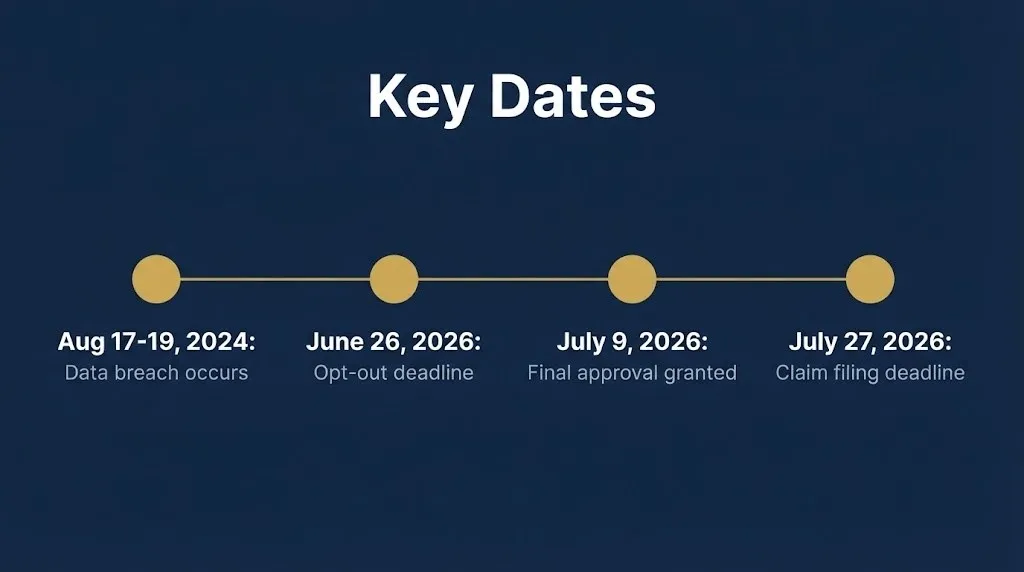
The window to exclude yourself or object to the settlement has already closed. That deadline was June 26, 2026.
If you did nothing by that date, you’re automatically part of the class and bound by the settlement terms. That means you can still file a claim for payment, but you can’t separately sue Fidelity over this same data incident.
Think of it like a warranty return window: once it closes, your options narrow to what the program itself offers, not a separate path around it.
When will settlement checks actually go out?
There is no fixed payment date yet. Checks are expected to go out after the final approval and after any appeal period passes.
Because final approval was granted July 9, 2026, the settlement now moves into the post-approval phase. If no one appeals the ruling, distribution typically follows within a few months, though the administrator has not published a locked mailing date.
Keep checking the official settlement website for updates rather than relying on a specific timeline promised anywhere else.
Is the identity theft protection worth signing up for?
Yes, the two years of credit monitoring is worth claiming even if you skip the cash payment, given the sensitivity of the exposed data.
The coverage includes CyEx Financial Shield Complete, plus $1 million in fraud and identity theft insurance. Given that Social Security numbers, driver’s license numbers, and full financial account details were exposed, monitoring adds a real layer of protection, not just a nice-to-have extra.
You can claim the monitoring in addition to the cash payment and any documented loss reimbursement. Filing all three together is the practical baseline for most affected people.
What should you do if you’re still getting fraud alerts?
You should freeze your credit files with the three major bureaus if you haven’t already, separate from anything tied to this settlement.
The Federal Trade Commission recommends:
- Freezing your credit report with Equifax, Experian, and TransUnion (free to do).
- Setting up fraud alerts, which require lenders to verify your identity before opening new accounts.
- Reviewing your credit report at least once a year through AnnualCreditReport.com.
These steps work whether or not you file a settlement claim, and they cost nothing.
What happens if you do nothing?
If you don’t file a claim by July 27, 2026, you get no payment and lose the right to sue Fidelity separately over this same breach.
You’ll still technically remain a class member since you didn’t opt out by June 26, 2026. You just won’t receive any of the settlement’s financial benefits. That’s the version of this settlement’s fine print worth repeating: silence here doesn’t protect you, it just costs you the payout.
What happens next in this case?
Here’s the expected sequence from this point forward:
July 9, 2026: Final approval granted by Judge Sorokin.
July 27, 2026: Claim filing deadline for all class members.
Expected late 2026: Appeal period closes if no objections were filed at the fairness hearing.
Expected following months: Administrator begins verifying claims and processing payments, exact date not yet confirmed.
TBD: Checks and reimbursements mailed once the fund is finalized and claims are counted.
Frequently Asked Questions
Is the Fidelity data breach settlement real?
Yes, it’s a court-supervised class action settlement, not a scam.
A federal judge in Massachusetts granted final approval on July 9, 2026.
Check the case number, 1:24-CV-12601-LTS, against the official court docket if you want to verify it yourself.
How much money will I get from the Fidelity settlement?
Most people can expect around $100 with no proof required.
You can get up to $5,000 if you document actual financial losses from the breach.
The exact base payment depends on how many people file claims.
What is the deadline to file a Fidelity settlement claim?
The deadline is July 27, 2026.
Claims must be submitted online or postmarked by mail on that date.
There is no indication this deadline will be extended.
Do I need a lawyer to file a Fidelity settlement claim?
No, filing the standard claim form takes about five to ten minutes and needs no attorney.
You’d only need a lawyer if your documented losses far exceeded $5,000 and you wanted to pursue an individual case instead, which required opting out by June 26, 2026.
That window has already closed.
How do I check if I’m eligible for the Fidelity settlement?
Check your mail or email for a settlement notice with a Login ID and PIN.
If you didn’t get one but believe your account and routing numbers were exposed, use the ID lookup tool on the official site or call the administrator.
The phone number is (833) 386-6470.
When will Fidelity settlement checks be mailed?
There is no confirmed payment date yet.
Checks go out after final approval and after any appeal period, which is still pending as of this writing.
Watch the official settlement website for updates rather than guessing at a date.
Can California residents get extra money from this settlement?
Yes, California residents can receive an additional $50 payment under the CCPA.
No extra documentation is needed beyond confirming California residency at the time of the breach.
This is on top of the standard $100 cash payment.
What if I missed the opt-out deadline?
If you missed the June 26, 2026 exclusion deadline, you’re automatically included in the settlement class.
You can still file a claim for payment by July 27, 2026.
You gave up the right to sue Fidelity separately over this same incident.
If you received a Fidelity data breach notice, don’t wait on this one. File your claim before July 27, 2026, and hold onto any receipts tied to fraud or credit costs from the breach. The official settlement website is your only reliable source for updates once the claim window closes.