Compensation for Easement on Property 2026: How to Determine What Your Land Is Worth
Quick Answer
- What it is: Compensation for an easement is the money paid to a property owner for granting another party the right to use their land.
- How much: Usually 1% of fair market value for frontage easements, but higher for disruptive or subsurface takings.
- Key formula: The “before and after” method compares your property’s value before the easement to its value after.
Someone wants an easement across your land. Maybe it is a utility company for power lines, a pipeline for natural gas, or a city for drainage. They have made an offer, and you are staring at a number that feels too low. Or maybe no number has been offered yet, and you are trying to figure out what your land is actually worth to them.
Easement compensation is not a single fixed amount. It depends on what rights you are giving up, how disruptive the easement will be, and the specific rules in your state. A standard utility easement might be worth 1% of your property’s value. A subsurface easement with significant disruption factors can be worth 20% or more .
This article explains the formulas appraisers and courts use, the difference between easement types, and how to challenge an offer that undervalues your land.
The Facts
| Standard Frontage Easement | ~1% of fair market value |
|---|---|
| Subsurface Easement | ~20% of surface value (example from Fort Smith, AR) |
| Valuation Method | “Before and after” or comparable sales |
| Key Case | Tucker v. The Honey Pot (not relevant, but shows courts scrutinize claims) |
| State Variation | Rules differ by state; Texas requires certified appraisals |
| Proof Needed | Appraisal, easement terms, impact analysis |
What Is Compensation for an Easement on Property?
Compensation for an easement is the payment a property owner receives for granting a limited right to use their land. The easement holder does not own the land. They get specific rights, such as the right to install a pipeline, run power lines, or access a road.
The payment reflects the value of the rights being transferred. When you grant an easement, you lose some of the “sticks” in your bundle of property rights. You might lose the right to build a structure in the easement area. You might lose the right to grow crops there. You might lose the right to prevent the easement holder from entering your land to make repairs.
The compensation should reflect the value of what you gave up. It should not be based on what the easement holder thinks they can get away with paying .
How Is Easement Compensation Calculated?
Easement compensation is calculated using two main methods: the “before and after” approach and comparable sales. The method depends on whether the easement is a partial taking or a full acquisition of specific rights.
The “Before and After” Method values the entire property before the easement is imposed and then values it again after. The difference between the two numbers is your compensation. This method captures both the value of the land taken and any damage to the remainder of your property .
Comparable Sales look at what other landowners in the area received for similar easements. If a neighbor got $5,000 for a 50-foot utility easement, that sale becomes a benchmark for your case .
For standard frontage easements, such as roads or underground water pipes, a common rule of thumb is 1% of the fair market value of the affected area . But that percentage rises when the easement causes significant disruption.
Here is how a real appraisal broke down a sewer easement in Fort Smith, Arkansas :
| Component | Value |
|---|---|
| Value Before Taking | $47,600 |
| Value After Taking | $47,216 |
| Just Compensation | $384 (rounded to $400) |
The property lost only a small fraction of its value because the easement was subsurface and did not prevent surface use.
Reality Check: The First Offer Is Almost Never the Final Number
Reality Check: Easement offers from utilities, pipeline companies, and municipalities are often based on what the entity has paid elsewhere, not on a full appraisal of your specific property. If you accept the first number without getting your own valuation, you may leave thousands of dollars on the table. You have the right to negotiate.
What Is the Difference Between a Temporary and Permanent Easement?
A temporary easement lasts for a set period, often during construction. A permanent easement lasts forever and is recorded against your property title. Permanent easements almost always require higher compensation because they permanently reduce your property’s value.
A temporary construction easement might be needed for a few months while crews install a pipeline. You still own the land and can use it after construction ends. Compensation is usually based on the rental value for that period .
A permanent easement runs with the land. It binds future owners. If you sell, the buyer takes the property subject to the easement. Because the burden never goes away, the compensation is higher.
A conservation easement is a special type of permanent easement that prohibits development. It is often donated for tax benefits, but when required by a government entity as a condition of a permit, it may constitute a taking requiring compensation .
Key Takeaway: Permanent easements require higher compensation because they permanently reduce your property’s value and bind future owners.
How Does an Easement Affect Your Property Value?
An easement affects your property value by restricting what you can do with the land and potentially deterring some buyers. The impact depends on the type of easement, its location, and how visible it is.
A subsurface pipeline easement that does not affect the surface might have minimal impact. You can still farm, build, or develop the land. The value difference might be just a few hundred dollars .
A transmission line easement with tall towers, cleared vegetation, and restrictions on structures has a larger impact. Buyers may pay less for a property with high-voltage lines running across it. The appraisal should account for that market reality .
A conservation easement that prevents development can significantly reduce value. The appraiser must consider what the property could have been worth without the restriction. If the government required the easement as a permit condition, the landowner may be entitled to compensation for the loss .
How Do You Challenge a Low Easement Offer?
You challenge a low easement offer by getting your own appraisal, understanding the easement terms, and negotiating from evidence. The entity making the offer has a process. You can use that process to your advantage.
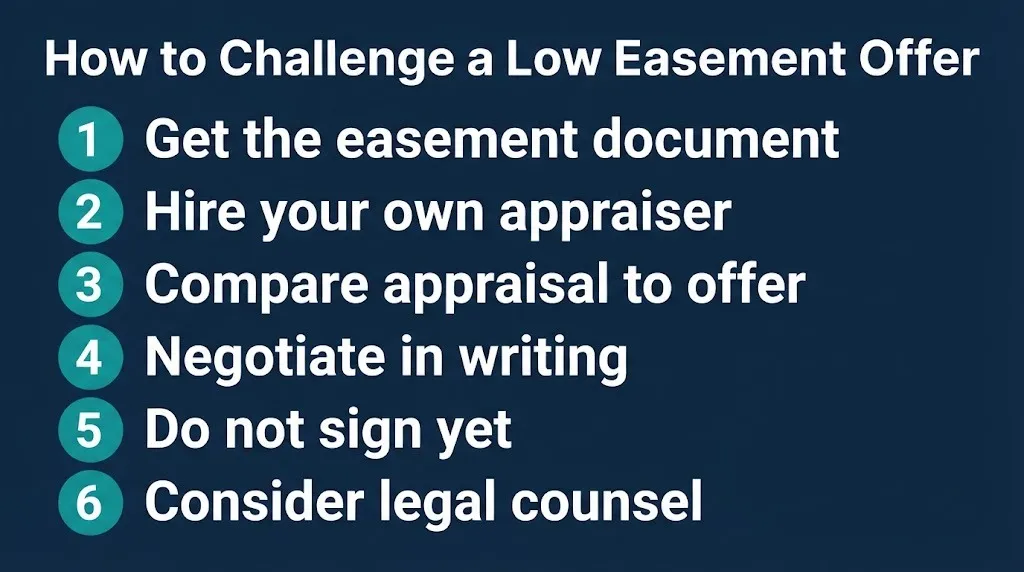
Here are the steps:
- Get a copy of the proposed easement document. Understand exactly what rights you are granting.
- Hire your own appraiser. Choose someone with experience valuing easements in your area.
- Compare the appraisal to the offer. Identify where the entity’s number falls short.
- Negotiate in writing. State your counteroffer and the evidence supporting it.
- Do not sign anything until you understand the terms. An easement is a permanent encumbrance.
- Consider legal counsel for large or complex easements. An attorney can review the document and advise on your rights.
- If litigation becomes necessary, understand the process. Texas and other states have specific procedures for condemnation and objection to awards .
What Happens Next in an Easement Negotiation?
Initial Offer: The entity makes a written offer with an appraisal. In Texas, the offer must include a copy of the landowner’s bill of rights and a certified appraisal .
Negotiation: You and the entity exchange counteroffers. Most easements are resolved through negotiation.
Objection to Award: If the entity files a condemnation action, a special commissioners’ award is issued. You have until the first Monday after the 20th day after notice to object .
Trial: If you object, the case goes to trial. A judge or jury determines just compensation.
Appeal: Either party can appeal the verdict.
Frequently Asked Questions
How is compensation for an easement calculated?
Most easements are valued using the “before and after” method, comparing your property’s value with and without the easement.
What percentage of property value is an easement worth?
Standard frontage easements are often valued at about 1% of fair market value. Subsurface easements can be worth 20% or more depending on disruption .
Do I have to accept an easement offer?
You can negotiate. If you cannot agree, the entity may file a condemnation action to take the easement by eminent domain.
What is the difference between an easement and a right of way?
A right of way is a type of easement that grants passage across your property. The terms are often used interchangeably.
Can I refuse an easement on my property?
You can refuse a negotiated easement. If the entity has eminent domain authority and the easement is for a public purpose, they can take it through condemnation.
How long does an easement last?
A permanent easement lasts forever. A temporary easement lasts for a defined period, often during construction.
What happens if I disagree with the easement appraisal?
You can get your own appraisal and challenge the offer. If the case goes to condemnation, a judge or jury decides the final amount.
Do I need a lawyer for an easement negotiation?
For simple easements, you may not need a lawyer. For large or complex easements, an attorney can review the document and protect your interests.
What You Should Do Next
Get a copy of the proposed easement document. Understand exactly what rights you are giving up. Then hire an appraiser with easement valuation experience.
The single most important fact: the first offer is rarely the final number. You have the right to negotiate, and an independent appraisal is your strongest tool.