Will I Get a Settlement From L&I in 2026: Eligibility, Process, and What You Can Expect
Quick Answer
- Not everyone gets a settlement from L&I; you must be 50 or older with an accepted claim at least 180 days old.
- Settlement amounts are not published and vary widely; there is no fixed schedule or guarantee.
- The most important step is applying online or by phone, and understanding that settlements are voluntary and close most future benefits.
If you are receiving time-loss benefits from Washington’s Department of Labor & Industries and wondering whether you can get a lump sum to move on with your life, the answer depends on two hard eligibility rules. You must be at least 50 years old, and your accepted claim must be at least 180 days old. If you meet those thresholds, a Claim Resolution Settlement Agreement may be available to you.
This is not a lawsuit against your employer. It is a negotiated agreement between you, L&I, and sometimes your employer, to close your claim in exchange for a structured payout. The money replaces future time-loss and pension benefits, but medical coverage for your accepted conditions continues. The decision is entirely yours, and no one can force you to settle.
The Facts
Program | Washington State Department of Labor & Industries (L&I)
Settlement Type | Claim Resolution Settlement Agreement (CRSA)
Eligibility Age | 50 or older
Claim Age Requirement | Accepted claim at least 180 days old
Payment Structure | Structured payments or lump sum, beginning within 14 days after finalization
Approval Body | Board of Industrial Insurance Appeals (BIIA)
Revocation Period | 30 days after BIIA approval
Medical Benefits | Continue for accepted conditions after settlement
Average Settlement | Not published by L&I; varies by injury severity and wage history
Will I get a settlement from L&I?
You will get a settlement from L&I only if you meet the eligibility rules and both you and L&I agree to the terms. Settlement is not an entitlement. It is a voluntary option that you or L&I can initiate, but either side can decline. The program is designed for workers who want to resolve their claim rather than continue receiving ongoing benefits.
The two hard eligibility requirements are clear:
- You must be age 50 or older. The law sets this threshold. A 2025-26 bill proposed removing the age limit, but it has not been enacted as of October 2026.
- Your accepted claim must be at least 180 days old. This gives time for the claim to stabilize and for treatment to progress.
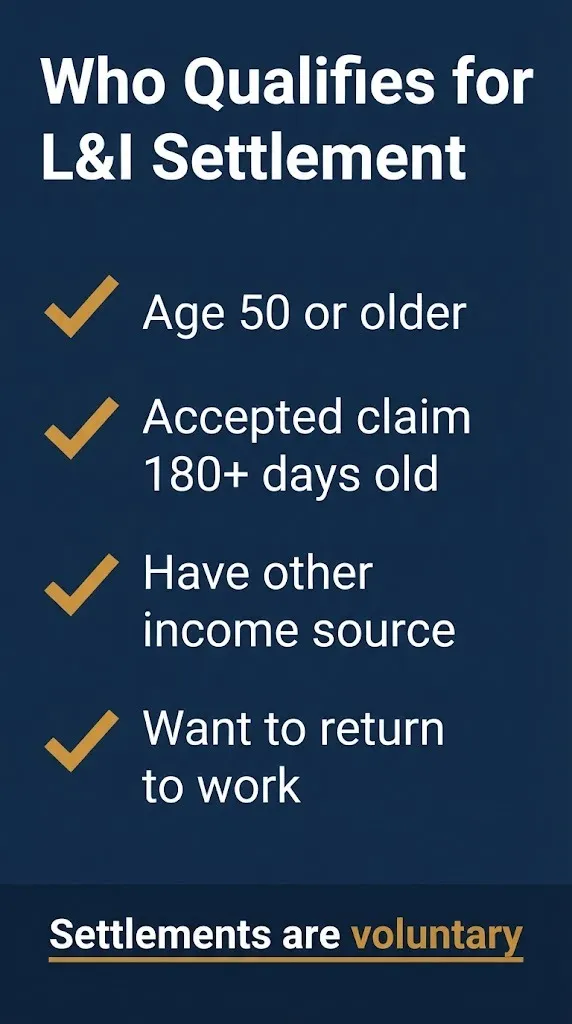
Beyond those rules, L&I looks at whether settlement makes sense for your situation. The agency’s own guidance says you might be a good candidate if you have another source of income, want to return to work part-time, or are not interested in retraining. If you are still actively treating and hoping to return to your old job, settlement may not be the right fit.
How much can you get from an L&I settlement?
The amount you can get from an L&I settlement is not published by the agency and varies widely based on your injury, wage history, and remaining benefit exposure. There is no settlement calculator or payout schedule. L&I negotiates each agreement individually.
Third-party estimates suggest a broad range. One workers’ comp calculator site lists typical settlements for minor sprains at $10,000 to $30,000, and for herniated discs or surgical injuries at $50,000 to $200,000 or more. Those figures are not official and should be treated as rough context, not promises.
The settlement amount is meant to replace future time-loss or pension benefits you would otherwise receive. If you are on a pension for permanent total disability, the value of that lifetime benefit is a major factor. If you are on time-loss and near the end of your treatment, the calculation is smaller.
L&I pays settlements either as a lump sum or as structured payments over a relatively short period. The structured option spreads the money out, which can help with financial planning. Payments begin within 14 days after the agreement becomes final.
Key Takeaway: L&I does not publish settlement amounts. The number depends on your injury, wages, and remaining benefits. Any figure you see online is an estimate, not a guarantee.
Who qualifies for an L&I claim resolution settlement?
You qualify for an L&I claim resolution settlement if you are at least 50 years old and have an accepted claim that is at least 180 days old. Both conditions must be met. There is no exception for younger workers or newer claims under current law.
The claim age is measured from the date L&I or your self-insured employer received your claim. If your claim was initially denied and later allowed on appeal, the 180-day clock may run from the original filing date, but you should confirm with L&I.
L&I’s guidance identifies several situations where settlement might appeal to you:
- You have an open claim paying time-loss benefits.
- You have other income, such as retirement, Social Security, or a pension.
- You want to return to work, full-time or part-time.
- You are not interested in retraining for a different occupation.
- You prefer to resolve the claim and stop receiving L&I paperwork.
If you are self-insured, meaning your employer handles its own workers’ comp instead of going through L&I, the process is different. You negotiate directly with your employer, and the parties are you and the employer, not L&I.
How do you apply for an L&I settlement?
You apply for an L&I settlement by submitting an application online or by mail, explaining why settlement is more appropriate than continuing your current benefits. If you have an attorney, they can handle the process for you.
Here are the steps:
- Confirm your eligibility. Check that you are 50 or older and your accepted claim is at least 180 days old.
- Decide if settlement is right for you. Consider your income sources, work plans, and whether you want to keep receiving L&I benefits.
- Complete the application. Use the online portal or fill out the Application for Claim Resolution Settlement (F240-002-000).
- Complete the Income and Expense Worksheet. This form (F240-007-000) helps L&I evaluate your situation.
- Submit your application. Send it online, by email, mail, or fax.
- Negotiate terms if L&I agrees to proceed. L&I will contact all parties and discuss settlement amounts and structure.
- Sign the agreement if terms are acceptable. L&I drafts the contract and circulates it for signatures.
- Wait for BIIA approval and the 30-day revocation period. The agreement is not final until this period ends.
What happens after you apply for an L&I settlement?
After you apply for an L&I settlement, L&I reviews your claim and decides whether to negotiate. If both sides agree on terms, the contract goes to the Board of Industrial Insurance Appeals for approval. The agreement becomes final after a 30-day revocation period, during which any party can back out.
The revocation period is a safeguard. If you change your mind, you can revoke for any reason within those 30 days. L&I continues paying your benefits during this time.
Once the 30 days pass, the agreement is final. Settlement payments begin within 14 days after that date. If the agreement includes closing your claim, it is closed at the same point.
If L&I declines to negotiate, or if negotiations fail, your claim continues as before. You keep receiving benefits and medical treatment. You can apply again later if circumstances change.
What benefits does an L&I settlement close?
An L&I settlement closes all future benefits except medical treatment for your accepted conditions. You give up future time-loss payments and any pension you might have received. You keep the right to medical care for the conditions L&I already allowed on your claim.
The medical carve-out is important. Even after settlement, you can still see doctors, get surgery, and receive treatment for your work injury. L&I pays for that care under the same rules as before.
What you give up is the ongoing cash. If you settle and later your condition worsens, you cannot reopen the claim for more time-loss or a pension. The only exception is if the agreement itself allows reopening for specific future treatment, which is rare.
You also retain the right to file a new claim if you suffer a new injury or develop a new occupational disease. The settlement only resolves the existing claim.
Reality Check: An L&I settlement is not free money. It replaces future benefits you would otherwise receive. If you settle for $50,000 and later realize you could have received $100,000 in pension benefits over your lifetime, you cannot undo the deal. Consider consulting an attorney or financial advisor before signing.
Does a settlement affect your Social Security or Medicare?
A settlement can affect your Social Security disability benefits because Washington is a “reverse offset” state. Under RCW 51.32.220, L&I can reduce your workers’ comp benefits when you also receive Social Security disability benefits. The combined amount is capped at 80% of your average current earnings.
The offset works like this. If your combined L&I and Social Security benefits exceed 80% of your pre-disability income, L&I reduces your workers’ comp payment. You should not be offset by both agencies at the same time.
A settlement may change how the offset is calculated. If you settle and receive a lump sum instead of monthly benefits, L&I and Social Security may treat that lump sum differently for offset purposes. The rules are technical, and you should discuss the impact with a benefits attorney or financial advisor before agreeing to a settlement.
Medicare is generally not affected by a workers’ comp settlement. Medicare is an entitlement program, not means-tested, so settlement money does not disqualify you. But if you have a Medicare Set-Aside arrangement, part of the settlement may need to be allocated to future medical costs.
What happens next in your L&I settlement case?
The timeline depends on where you are in the process.
If you are considering settlement: Review your eligibility. Gather information on your income, expenses, and future work plans. Consult an attorney if you are unsure.
If you have applied: L&I will review your claim and contact you about next steps. The agency may decline to negotiate.
If you are negotiating: Work with L&I to agree on an amount and payment structure. The contract is drafted and circulated.
If you have signed: The agreement goes to BIIA for approval. The 30-day revocation period begins after approval.
If the revocation period ends: The settlement becomes final. Payment begins within 14 days. Your claim closes except for medical benefits.
Frequently Asked Questions
Who qualifies for an L&I settlement in Washington?
You must be 50 or older and have an accepted L&I claim at least 180 days old.
How much is an L&I settlement?
L&I does not publish settlement amounts. They vary based on injury, wages, and remaining benefits. Third-party estimates range widely.
Can L&I force me to settle my claim?
No. Settlements are strictly voluntary. You cannot be required to settle, and neither can your employer.
What happens to my medical benefits after settlement?
You keep medical benefits for your accepted conditions. L&I continues to pay for treatment related to your work injury.
How long does an L&I settlement take?
The timeline varies. After BIIA approval, there is a 30-day revocation period. Payments begin within 14 days after finalization.
Does an L&I settlement affect Social Security?
Yes. Washington is a reverse offset state, and L&I can reduce your workers’ comp benefits if you receive Social Security disability benefits.
Can I reopen my claim after settlement?
Generally, no. Settlement closes the claim for future time-loss and pension benefits. You may only reopen for medical treatment in limited circumstances.
Do I need a lawyer for an L&I settlement?
You are not required to have one, but L&I recommends considering legal or financial advice before signing.
The Bottom Line
Will you get a settlement from L&I? Only if you are 50 or older, your claim is at least 180 days old, and both you and L&I agree to terms. The amount is negotiated, not published, and it replaces future benefits except medical care. If you are considering settlement, talk to an attorney or financial advisor first. The 30-day revocation period is your last chance to change your mind.