Serious Injury Compensation in 2026: What the Guidelines Actually Say
Quick Answer
- Serious injury compensation is a legal claim for life-changing harm caused by someone else’s negligence. These are individual cases, not a class action settlement.
- Amounts are not fixed. The 2026 Judicial College Guidelines set general damages ranges, with very severe brain injury awards between £372,570 and £533,720.
- The most important deadline is typically three years from the accident or date of knowledge. Missing it usually bars your claim entirely.
Serious injury compensation is money recovered through a legal claim when you suffer a life-changing injury because another party failed to meet their duty of care. It is not a government payout or a class action fund. The Judicial College Guidelines, updated on April 9, 2026, set the ranges judges use to value general damages for pain, suffering, and loss of amenity . The most catastrophic injuries now command awards exceeding £500,000 for the injury alone before any financial losses are added .
If you are living with a traumatic brain injury, spinal cord damage, an amputation, or another condition that has permanently altered your daily life, you may have grounds to claim. The single most important number is the three-year deadline, which runs from the accident date or the date you first knew the injury was linked to negligence . Missing it usually ends the claim.
This article breaks down what the 2026 Guidelines actually say, how compensation is calculated, what documents you need, and the real reasons most injured people never file. It also flags where the system is failing claimants, because the gap between what the rules promise and what actually happens matters.
Is serious injury compensation legit or a scam?
Serious injury compensation is a legitimate legal remedy when pursued through a qualified solicitor, and a scam when anyone promises a fixed payout before assessing your case. No one can tell you what your claim is worth from a text message or a cold call. The amounts depend on medical evidence, your prognosis, and documented financial losses .
The bigger problem in 2026 is not scams. It is silence. New research from the Association of Personal Injury Lawyers found that nearly a third of UK adults say they have suffered an injury caused by someone else’s negligence. Only one in five approached a personal injury lawyer. Forty-four percent made no claim at all . Fears about legal costs, mistrust of solicitors, and worry about employer reactions are the main reasons people stay away.
Most serious injury claims run on a No Win, No Fee basis. You pay nothing upfront. If the claim fails, you owe nothing. The fees that may apply at the end are capped and explained in writing before you sign anything .
Key Takeaway: Serious injury compensation is a legitimate legal process, and the real risk in 2026 is not scams but eligible people failing to claim because they fear costs that most solicitors waive upfront.
How much compensation can you get for a serious injury in 2026?
The 2026 Judicial College Guidelines set general damages for very severe brain injury at £372,570 to £533,720, and tetraplegia at £396,140 to £493,000 in the previous edition, with this year’s 8.26% increase pushing the top end higher . Those figures cover pain, suffering, and loss of amenity only. They do not include lost earnings, care costs, or home adaptations.
The Guidelines are not binding law. They are a reference tool that judges, insurers, and solicitors use to keep valuations consistent. Actual awards depend on your medical evidence and how the injury affects your specific life .
Here is what the ranges look like for the most catastrophic categories:
| Injury Type | General Damages Range (2026 Guidelines) |
|---|---|
| Very severe brain injury | £372,570 to £533,720 |
| Tetraplegia (spinal cord) | £396,140 to £493,000 (17th ed. baseline, increased by 8.26% in 2026) |
| Paraplegia (spinal cord) | £267,340 to £346,890 (17th ed. baseline) |
| Severe back injuries | Upwards of £200,000 in top cases |
| Amputation | Varies by limb and level |
The 2026 update introduced a new bracket for miscarriage damages and revised the sections on epilepsy and abuse . The most serious injuries now have top-end brackets exceeding £500,000.
Not yet determined: Your specific award. No table can tell you what your case is worth without reviewing your medical records and financial losses. The ranges are starting points, not promises.
What is the discount rate and why does it matter for serious injury claims?
The discount rate is the interest rate used to calculate the present-day value of your future losses, and it directly controls how much you receive for long-term care and lost earnings. A lower discount rate means a higher lump sum, because it assumes you will earn less interest on the money over time. The Lord Chancellor sets this rate, and it applies to all personal injury settlements in England and Wales .
Your future losses are the biggest part of most serious injury claims. If you need care for the rest of your life, or if you can no longer work, those costs are projected decades into the future and converted to a single capital sum. The Ogden Tables are the actuarial tool used for that calculation .
Think of it like a delayed tax refund. The government owes you money, but by the time you get it, inflation has eaten some of its value. The discount rate is supposed to account for that, except in reverse. It adjusts a future stream of money into a lump sum you receive today.
Special damages also include interim payments, which fund treatment and cover income gaps while the claim is still being argued. If liability is admitted or clear, you can request interim payments before the final settlement .
What can serious injury compensation actually cover?
Serious injury compensation covers two categories: general damages for the injury itself, and special damages for every financial loss that flows from it. General damages compensate pain, suffering, and loss of amenity. Special damages reimburse specific, documented costs and future projections .
The list of what special damages can cover is longer than most people expect:
- Lost earnings, both past and future, including reduced earning capacity if you cannot return to your previous work.
- Medical treatment and rehabilitation, including private therapy, specialist consultations, and prescription costs.
- Care and assistance, whether paid professionals or family members who provide unpaid care. Family care is valued even without an invoice.
- Home adaptations, such as ramps, widened doorways, or adapted bathrooms.
- Mobility equipment, including wheelchairs, prosthetics not available on the NHS, and adapted vehicles.
- Travel costs related to medical appointments and treatment.
- Vehicle losses after a road accident, including repair costs or pre-accident market value for a write-off.
Past losses are proven with payslips, receipts, and medical records. Future losses are projected using the Ogden Tables and expert evidence about your long-term needs .
What documents and evidence do you need to prove a serious injury claim?
You need medical records, accident evidence, financial documentation, and expert reports to prove a serious injury claim. The strength of your evidence determines the value of your settlement more than any other factor. Solicitors build the case by gathering witness accounts, accident reports, photographs, and CCTV footage where available .
Here is a checklist of what to gather:
- Medical records from your GP, hospital, and any specialists who have treated you.
- Accident reports or incident logs, especially for workplace accidents.
- Witness statements from anyone who saw what happened.
- Photographs of the accident scene, your injuries, and any damage.
- Financial records showing lost income, including payslips and bank statements.
- Receipts for medical treatment, travel, equipment, and home adaptations.
- A symptom journal documenting how the injury affects your daily life.
Medical documentation and expert opinions are vital. Without a clear medical prognosis, you cannot prove the long-term impact that justifies a serious injury award .
How long do you have to file a serious injury claim?
You generally have three years from the accident date or the date you first knew the injury was linked to negligence, whichever is later. This is called the “date of knowledge” rule, and it matters most in cases where symptoms appeared slowly or a diagnosis came years after the incident .
For children under 18, the three-year clock usually starts on their 18th birthday. For fatal accidents, the period typically begins from the date of death or from an inquest or post-mortem that confirms negligence .
Certain exceptions apply for people who lack mental capacity. In those cases, the time limit may not run at all, or it may be suspended. If you think you might be near the deadline, get legal advice immediately. Solicitors can sometimes apply for an extension, but the discretion is narrow and never guaranteed.
Key Takeaway: The three-year deadline is the single most important number in any serious injury claim, and the “date of knowledge” rule means it may start later than the accident itself.
How does the claims process work from start to finish?
The claims process starts with medical treatment, then moves through evidence gathering, legal assessment, negotiation, and settlement. Most serious injury claims settle outside court, but the process still takes months or years depending on complexity .
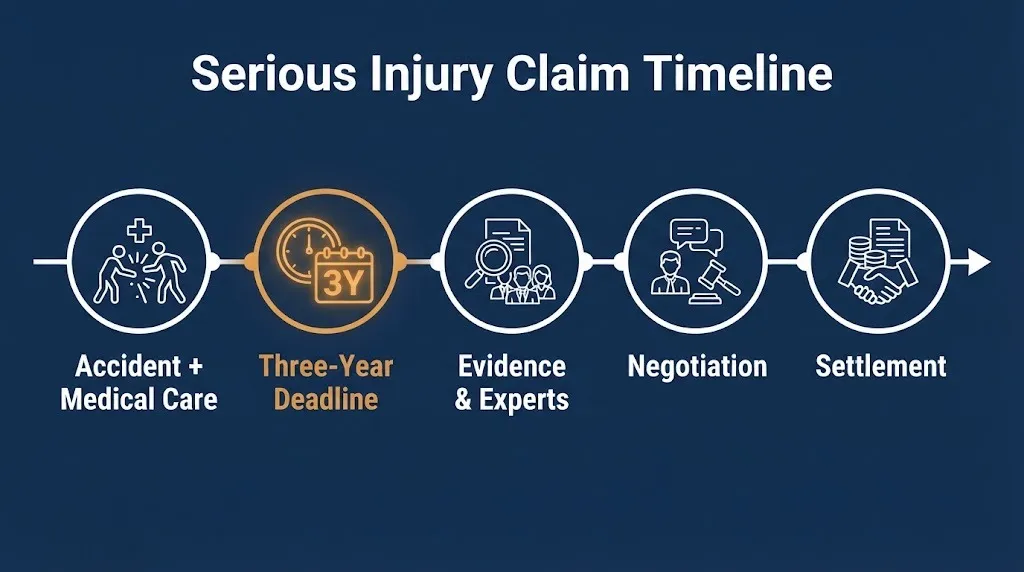
Here is the step-by-step sequence:
- Seek medical attention immediately. Your health comes first, and the medical records become evidence.
- Contact a specialist solicitor. Most offer a free initial consultation and assess whether you have a valid claim.
- Gather evidence. Your solicitor collects medical records, witness statements, accident reports, and financial documents.
- Obtain expert medical evidence. Independent specialists assess your injury, prognosis, and long-term needs.
- Submit a formal claim. Your solicitor prepares and files the legal documents setting out the allegations and losses.
- Negotiate with the insurer. Many claims settle at this stage, though serious injury cases often require more time to establish long-term prognosis.
- Issue court proceedings if needed. If negotiation fails, the claim goes to court, though the vast majority settle before trial.
- Settlement and payment. Once agreed, the compensation is paid, sometimes in a lump sum plus periodic payments.
Specialist representation matters more in serious injury cases because insurers defend high-value claims more aggressively. The market for low-value claims has shrunk, and insurers are focusing resources on complex cases .
What is the reality check on serious injury compensation?
Reality Check: No one sends you a text offering you settlement money for a serious injury. Legitimate claims go through a solicitor, and the compensation comes from the negligent party’s insurer or, in some cases, through the Motor Insurers’ Bureau or the Criminal Injuries Compensation Authority. Those last two routes are slower and more adversarial than most people expect. APIL data shows CICA rejection rates jumped from 38% to 59% in a year, and only 4% of those turned down appeal. The Motor Insurers’ Bureau has seen a 47% increase over five years in claim settlement times . If you are claiming through either body, expect delays and prepare to push back.
What happens next: the serious injury claim timeline
- Immediately after the accident: Seek medical attention and report the incident. Keep every document.
- Within days to weeks: Contact a specialist solicitor for a free assessment. Do not accept a direct settlement offer from an insurer without legal advice.
- Within three years: File your claim. This deadline is strict, and extensions are rare.
- Months 1 to 6: Evidence gathering, medical expert assessments, and financial loss documentation.
- Months 6 to 18: Negotiation with the insurer. Serious injury claims often take longer because prognosis needs to be established.
- Beyond 18 months: If negotiation fails, court proceedings may be issued. Most cases still settle before trial.
Frequently Asked Questions
Can I claim serious injury compensation if the accident was partly my fault?
Yes, you may still claim, but your compensation will be reduced by your share of responsibility. This is called contributory negligence. For example, not wearing a seatbelt typically reduces the award by up to 25% .
How long does a serious injury claim take to settle?
Serious injury claims often take one to three years or longer because they require detailed medical evidence and long-term prognosis assessments. The complexity of your injuries drives the timeline more than anything else .
Do I need a solicitor to make a serious injury claim?
You can file a claim without a solicitor, but serious injury cases involve complex medical evidence, Ogden Table calculations, and insurers who defend high-value claims aggressively. Specialist representation significantly improves the outcome .
What is the maximum serious injury compensation in 2026?
The 2026 Judicial College Guidelines top out above £500,000 for general damages in the most catastrophic cases, and total settlements including special damages can exceed £1 million where lifetime care and lost earnings are substantial .
Can I get interim payments while my claim is being settled?
Yes, if liability is admitted or clear, you can request interim payments to fund treatment, rehabilitation, and cover income gaps before the final settlement is agreed .
What is the three-year rule for personal injury claims?
You have three years from the accident date, or from the date you first knew the injury was connected to someone else’s negligence, to file your claim. Missing this deadline usually means you cannot claim at all .
What is the difference between general and special damages?
General damages compensate pain, suffering, and loss of amenity. Special damages reimburse specific financial losses like lost earnings, medical costs, care, and home adaptations .
Can I claim if my injury happened at work?
Yes, if your employer failed to provide a safe working environment, proper training, or maintained equipment, you may have a claim. The three-year deadline applies the same way .