T-Mobile Lawsuit for Overcharging: 2026 Settlement Payouts, Eligibility, and Claim Deadlines
Quick Answer
- Is it legit? Yes. A real $89 million class action settlement covers unauthorized third-party charges on T-Mobile bills from 2017 to 2023.
- How much can you get? Payments range from $25 to $150 depending on your situation, but you must file a claim with proof.
- Key deadline: The claim deadline is tied to final approval, expected in late 2026. Watch the official settlement website for the exact date.
The T-Mobile Overcharging Lawsuit Explained
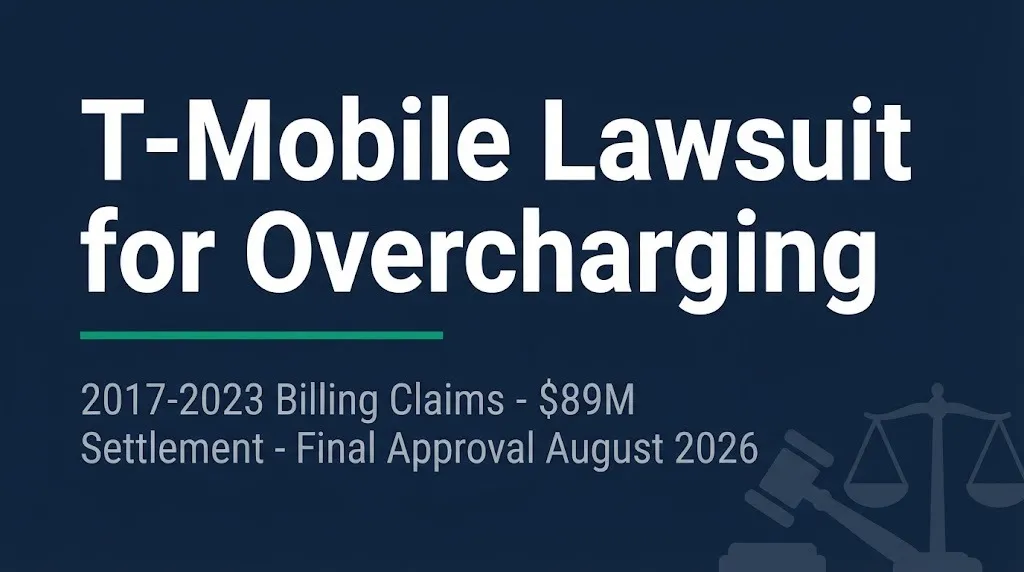
The T-Mobile lawsuit for overcharging is a real, active class action that accuses the carrier of billing customers for unauthorized third-party charges, a practice known as cramming. The case covers charges that appeared on T-Mobile bills between January 1, 2017, and December 31, 2023. Unlike the separate data breach settlements you may have heard about, this case focuses specifically on money taken from your monthly bill without your consent.
Who does this affect? If you were a T-Mobile postpaid customer during that six-year window and saw mysterious charges from third-party vendors on your statement, you may be part of the class. The lawsuit claims T-Mobile allowed these vendors to add charges through premium SMS short codes, often just $5 to $10 per month, buried among normal service fees. Most customers never noticed until the charges added up.
This article breaks down exactly who qualifies, how much the settlement tiers pay, what proof you need, and the deadlines you cannot afford to miss. One detail worth knowing upfront: T-Mobile already paid $90 million in a 2014 FTC cramming settlement, and this new case alleges the company kept the practice going anyway.
The Facts
| Case Detail | Information |
|---|---|
| Case Name | Proposed class action against T-Mobile USA, Inc. (billing/overcharging) |
| Status | $89 million settlement agreed; final approval scheduled August 2026 |
| Fund Size | $89 million |
| Est. Per Person | $25 to $150 depending on tier |
| Claim Deadline | Expected late 2026, tied to final approval (not yet confirmed) |
| Administrator | Not yet appointed |
| Proof Needed | Bills showing unauthorized third-party charges, complaint records |
Is the T-Mobile Lawsuit for Overcharging Legitimate or a Scam?
The T-Mobile overcharging lawsuit is legitimate. It is a certified class action filed in the U.S. District Court for the Western District of Washington in August 2021, with case number 2:21-cv-01067. The FTC investigated similar cramming allegations against T-Mobile and reached a $90 million settlement in 2014 covering charges through 2013. The current case picks up where that FTC action ended.
Scammers often exploit real settlements by sending fake texts or emails claiming you are owed money. Here is how to tell the difference:
- Legitimate settlements never ask you to pay a fee to receive money. If anyone requests payment upfront, it is fraud.
- Official notices come from a court-appointed administrator, not random phone numbers or email addresses.
- You can verify the case through the court docket or the official settlement website once it launches.
- No one will text you a settlement check. Payments arrive by check or digital transfer after a valid claim is processed.
If you receive suspicious communications about T-Mobile settlement money, do not click links or share personal information. Report it to the FTC.
How Much Is the T-Mobile Overcharging Settlement Payout?
The T-Mobile overcharging settlement uses a tiered payout structure based on how long you paid unauthorized charges and whether you complained. The total fund is $89 million. Here are the confirmed tiers:
| Your Situation | Estimated Payment |
|---|---|
| You complained and T-Mobile refunded the charges | $25 |
| You complained but T-Mobile did not refund | $75 |
| You paid unauthorized charges for 1 to 6 months | $45 |
| You paid unauthorized charges for 7 to 12 months | $95 |
| You paid unauthorized charges for over 12 months | $150 |
These amounts are estimates based on the settlement agreement. Final payments depend on how many valid claims are filed and whether the court approves the full fund. If fewer people file than expected, payments could be higher. If more file, they could be lower.
Key Takeaway: The T-Mobile overcharging settlement is real and active, but you must file a claim with proof of unauthorized charges to receive anything. Doing nothing means getting nothing.
Who Qualifies for the T-Mobile Overcharging Settlement?
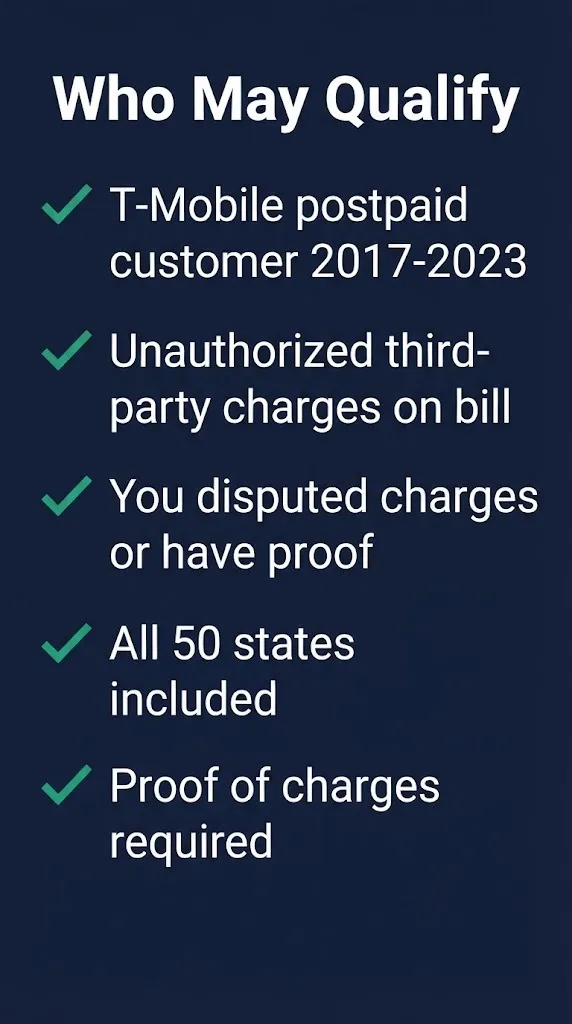
You may qualify for the T-Mobile billing settlement if you meet all three of these criteria:
- You were a T-Mobile postpaid customer between January 1, 2017, and December 31, 2023.
- You had third-party charges appear on your bill that you did not authorize.
- You either disputed the charges or can prove you did not sign up for the service.
The settlement class includes customers in all 50 states. T-Mobile postpaid accounts include monthly plans, not prepaid or Metro by T-Mobile lines. If you had a family plan, charges on any line could make you eligible.
What does NOT qualify: Prepaid customers, business accounts, and anyone whose only issue was a data breach (that is a separate case). The overcharging case is specifically about unauthorized billing, not security failures.
Reality Check: Filing a claim is always free. No legitimate settlement administrator will ever ask you to pay a processing fee, buy a gift card, or share your bank password to receive a payout. If anyone contacts you with those demands, it is a scam targeting this real settlement.
How to File a Claim in the T-Mobile Overcharging Settlement
Filing a claim requires proof, so start gathering documents now. Here are the steps:
- Locate your old T-Mobile bills from 2017 through 2023. Check for charges from unfamiliar third-party vendors.
- Request billing history from T-Mobile if you no longer have old statements. The settlement agreement requires T-Mobile to provide this at no charge.
- Document any complaints you filed about the charges, including dates and reference numbers.
- Wait for the official claim form to become available after final approval, expected in late 2026.
- Submit your claim online or by mail with copies of your bills and complaint records.
- Keep confirmation of your submission and note the claim deadline.
- Update your address with the settlement administrator if you move before payments go out.
The claim deadline has not been confirmed yet. It will be set roughly 90 days after final approval, which is scheduled for August 2026. Payments are expected in late 2026.
What Proof Do You Need to File a T-Mobile Overcharging Claim?
This settlement is different from no-proof cases. You must show evidence that unauthorized charges actually appeared on your bill. Acceptable proof includes:
- Copies of bills showing the third-party charges and the dates they appeared.
- Descriptions of the charges, including vendor names and amounts.
- Documentation of complaints you filed with T-Mobile about the charges.
- Any refund records if T-Mobile credited you back.
If you do not have old bills, T-Mobile customer service can provide billing history at no cost. The settlement agreement requires this. Request your records now, because waiting until the claim deadline approaches could cause delays.
No proof means no payment in this case. The tier structure rewards people who can document longer periods of unauthorized charges.
When Will T-Mobile Overcharging Settlement Checks Arrive?
T-Mobile overcharging settlement checks are expected in late 2026 or early 2027. The exact timing depends on when final approval occurs and how long claims processing takes.
Here is the expected timeline:
- August 2026: Final approval hearing scheduled.
- Late 2026: Claim period opens, expected to last about 90 days.
- Late 2026 to early 2027: Claims reviewed and validated.
- Late 2026 to early 2027: Payments distributed by check or digital transfer.
Appeals could delay this timeline. If any class member objects to the settlement or appeals the final approval, payments could be pushed into 2027.
Key Takeaway: The T-Mobile overcharging settlement is not paying out yet, but it is moving forward with final approval scheduled for August 2026. If you have old bills showing unauthorized charges, start gathering them now.
T-Mobile Data Breach Settlement vs. Overcharging Lawsuit: What’s the Difference?
These are two completely separate cases, and mixing them up could cost you. The T-Mobile overcharging lawsuit is about unauthorized charges on your monthly bill. The data breach settlement is about the August 2021 security failure that exposed personal information for roughly 76 million people.
Here is how they compare:
| Overcharging Lawsuit | Data Breach Settlement | |
|---|---|---|
| Issue | Unauthorized third-party charges on bills | Security breach exposing personal data |
| Coverage Period | 2017 to 2023 | August 2021 breach |
| Fund Size | $89 million | $350 million |
| Status | Settled, final approval Aug 2026 | Closed, paid out 2023-2025 |
| Can You File? | Yes, once claims open | No, deadline passed Jan 2023 |
The data breach settlement paid $25 base payments, $100 for California residents, and up to $25,000 for documented losses. That claim deadline passed on January 23, 2023, and cannot be reopened. If you filed a valid claim and never received payment, the window to request a reissue closed on March 31, 2026.
The overcharging case is your only path to a new payment right now.
T-Mobile Price Lock Lawsuit: What Happened to That Case?
T-Mobile also faced a class action over alleged broken price-lock promises, but that case hit a wall in September 2026. A Washington federal judge ruled that customers must arbitrate their claims individually, agreeing with T-Mobile that customers consented to an arbitration agreement by continuing to use service after receiving updated terms.
That means the price-lock case will not produce a class-wide settlement. Individual arbitration is possible, but it requires pursuing your own claim, which most customers will not do. The overcharging settlement remains the primary active case for T-Mobile customers seeking compensation.
What Happens Next in the T-Mobile Overcharging Case
August 2026: Final approval hearing scheduled for the $89 million settlement.
Late 2026: Claim period expected to open, lasting about 90 days.
Late 2026: Claims reviewed, validated, and prepared for payment.
Late 2026 to early 2027: Payments distributed to approved claimants.
Ongoing: Watch for the official settlement website and claim form, which will be announced through court-authorized notices.
Frequently Asked Questions
Is the T-Mobile lawsuit for overcharging real?
Yes. It is a certified class action in the U.S. District Court for the Western District of Washington with an $89 million settlement agreed.
How much will I get from the T-Mobile overcharging settlement?
Payments range from $25 to $150 based on your tier. You must file a claim with proof of unauthorized charges to receive anything.
What is the deadline to file a T-Mobile overcharging claim?
The claim deadline has not been confirmed yet. It will be set roughly 90 days after final approval, expected in late 2026.
Do I need proof to file a T-Mobile overcharging claim?
Yes. You need bills showing unauthorized third-party charges, complaint records, or both. Without proof, you cannot receive payment.
Can I still file a claim in the T-Mobile data breach settlement?
No. The data breach claim deadline passed on January 23, 2023. You cannot file a new claim for that settlement.
How do I know if I qualify for the T-Mobile overcharging settlement?
You may qualify if you were a T-Mobile postpaid customer between 2017 and 2023 and had unauthorized third-party charges on your bill.
When will T-Mobile overcharging settlement payments go out?
Payments are expected in late 2026 or early 2027, after final approval and claims processing are complete.
Is T-Mobile still charging unauthorized fees in 2026?
The settlement covers charges through December 31, 2023. The lawsuit does not address billing practices after that date.